Estate Planning for Young Families
in New York, NY
New York Estate Planning Law Firm
Estate Planning
While estate planning is not something that most people look forward to, many of our clients find the process to be intensely meaningful. None of us is going to be around forever, and making sure our loved ones are taken care of when we’re gone is one of the most important and selfless actions we can take. Protecting those we love and designing a legacy that reflects our values can be incredibly rewarding.
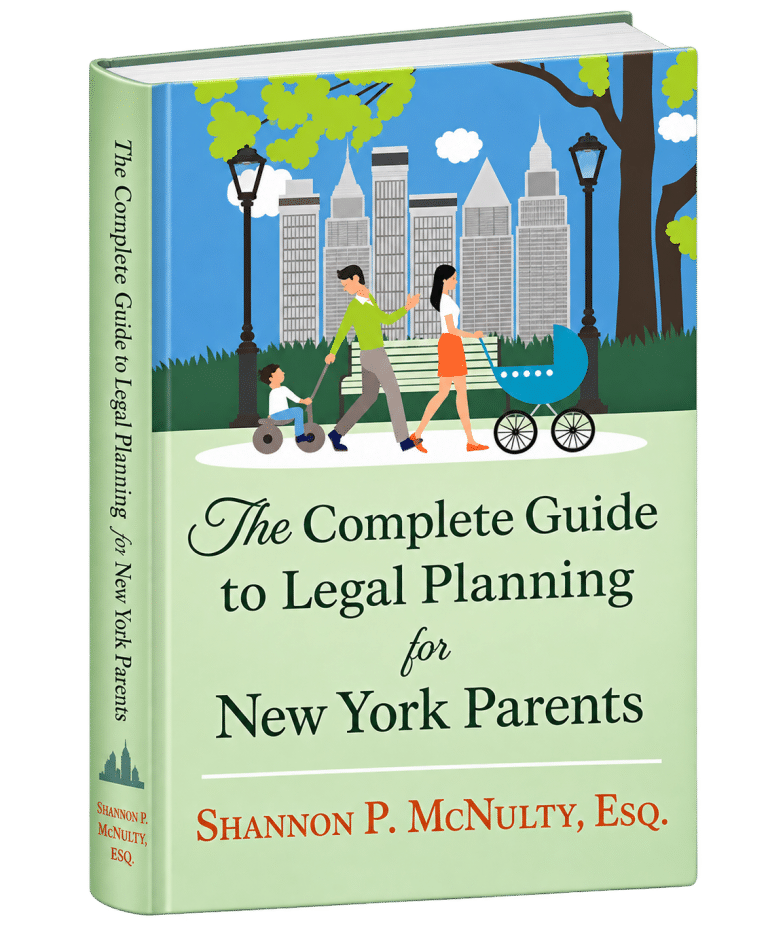
The Complete Guide to Legal Planning for New York Parents A step-by-step, practical guide of everything you need to know and everything you need to do to make sure your family is taken care of if tragedy strikes.

Estate Planning for Parents: Preserve Assets for Your Growing Family
We help busy parents implement a comprehensive legal plan to protect their children, preserve their assets, shield their privacy, and minimize their taxes. We pride ourselves not just on our technical expertise, but on the strong, trusting relationships we develop with our clients. Legal planning can involve a host of emotions and sensitive topics. Talking about money and family relationships isn’t always easy, but a failure to consider these factors can doom the most sophisticated estate plan.
We make it easy to get your plan done with a modern approach to servicing clients. Few people are busier than parents raising young kids in New York City. We make it simple to protect your family with online scheduling, video conferences, and constant connectivity.
Why Parents Need to Plan
Planning to protect young children in the event that both parents pass away is a weighty responsibility. Effective planning requires not only specific legal documents, but also making sure that a designated adult would have the financial and practical information they would need to provide the child with the best support possible.
Planning for the care of young children is made more challenging – and more important – by the suboptimal rules that apply when a minor child receives an inheritance. Children under the age of 18 are not legally capable of managing the assets themselves, so assets left to a child are supervised by a court until the child turns 18.
The court appoints someone to administer the assets on behalf of the children, and that person must file annual reports with the court that document the value of the assets being held for each child, how those assets are invested, and how the money is being spent, for example, the amount spent on childcare, clothing, field trips, etc. This requirement exposes detailed information about your child’s expenses to public view, making your children vulnerable to identity thieves and other predators.
When your child turns 18, he or she must petition the court to lift the guardianship, and all the remaining assets are then transferred to your child’s name. The child would then have unfettered access to the funds, potentially leading to bad spending habits and a poor work ethic and making your child attractive to malingerers or others who may seek to take advantage of them.
An additional problem can arise if you have more than one child. Assets allocated to one child under a guardianship cannot be used for the benefit of your other children. This could result in an unfair allocation of assets if one child was injured or developed a serious illness, incurring large medical expenses.
Fortunately, these problems can all be avoided by putting in place a comprehensive legal plan.
Protect Your Family with a Comprehensive Plan
Designate a Guardian
The best way to make sure your children are well-cared for if you’re not there to take care of them yourself is to name a responsible, trustworthy friend or family member to serve as the children’s guardian. A guardianship designation not only ensures that your children would be in good hands, but can also prevent messy, public family disputes that can add to the difficulty your children would experience during an extremely tragic time.
Prevent Unwise Spending
Is it a good idea for an 18 year old to be handed a large sum of money with no supervision or restrictions? We don’t think so either, but that’s exactly what can happen without proper estate planning. Sure, your nine-month-old is a perfect angel now, but no one really knows if their child will have great judgment decades into the future.
Even the most mature children go through phases where they make questionable decisions. Having access to money at a young age can result in a slew of problems. Squandering an inheritance, developing a poor work ethic, and becoming the target of predators and con artists are all more likely when a young person is given access to a substantial amount of money at a young age.
If handing over a large sum of money to your child when he or she turns 18 doesn’t sound like a good idea, you can delay your children’s access to their inheritance by leaving your assets to a trust. You would designate a trustee of the trust, who would administer the assets for the benefit of the children until they reach an age you specify. (We find most parents choose age 30; we have yet to have a parent tell us they would choose any age younger than 25.)
Your guardianship designation should be included both in your will and in a separate standby-guardianship document. Because a will takes effect only upon death, the guardianship designation in that document is not sufficient if a guardian is needed as a result of your incapacity, for example, if you were unconscious from a car accident. A standby guardianship document allows the person designated therein to serve as guardian under certain circumstances. A standby-guardianship document also allows the named guardian to serve immediately, while the guardian named in your will can only legally serve after your will is probated and the court appoints the guardian named in the will. A standby guardianship document can fill the gap between the time of a parent’s death and the date the will is probated.
What happens if no guardian has been named by a child’s parents? If more than one person requests to be the child’s guardian, a lengthy, public court battle could ensue. In the worst case scenario, the court could assign your children to state custody while the dispute is being resolved; courts have been known to do precisely that where guardianship is unclear. Because we aim to make sure your children have the best case possible, all of our plans include comprehensive guardianship planning.
Solution for protecting your Children execute a Will in which you designate a guardian and alternate guardian for your children. Also execute a Standby Guardianship Designation, which designates who would take care of your children if you became incapacitated. A Standby Guardianship Designation also ensure your child is not without a guardian during the period between your death and the time a court formally appoints a legal guardian.
Protect Your Child's Privacy
Would it bother you if detailed information about your child's inheritance and how it was being spent was open to the public? That's a rhetorical question, of course, because any sane person would have a big problem with that scenario.
The Hidden Consequences
What most parents don't realize is that this is precisely what happens when you leave assets to your child outright. Because children under the age of 18 (legally known as minors) are not legally permitted to own assets, a court appoints an individual to administer the inheritance of anyone under the age of 18.
Unveiled Finances
Each year, the appointed person is required to complete and file an “accounting” of the assets held for the child, which must include information about distributions, investments, and financial institutions where the funds are held. This “accounting” is then filed in with the court in the public record, available for any stranger off the street to come in and see.
Protecting Your Information
There are two ways you can keep your kids’ inheritance out of the public record. You can leave your assets to a trust for the benefit of your children, or your will can direct that assets left to your children be administered by a custodian (a friend of relative).
Protecting Your Information
Just by reading the news, you know how dangerous it can be for sensitive financial information to get in the wrong hands. Having financial details of your children’s assets available as part of the public record can leave your kids vulnerable to identity thieves and other predators.
Ensure Fair Division of Assets
If assets are left to your children directly, the assets will be held in separate accounts for each child until they turn either 18. In many situations, this method of dividing the assets isn’t a problem. If the children are close in age and have similar financial needs, then allocating the assets equally may result in a fair outcome.
If the children are not similar in age, however, or if one of them incurs large medical expenses as a result of injury or illness, then dividing assets equally among them could pose a very big problem. Suppose one child is 16 and the other is 21 upon the death of the parent and the 21 year old had his entire college education paid for. The child who is 16 will have to use most of his inheritance to pay for college, while the 21 year old will essentially receive a windfall. In another scenario, one child might develop a disability or other medical issues. The child’s medical or therapeutic expenses could deplete that child’s account without affecting the other children’s finances.
As parents, you provide financial support to your children based on each child’s needs, which often doesn’t result in an equal allocation. Leaving your assets directly to your children doesn’t allow for this type of adjustment; however, you can provide for flexibility in your will by leaving your assets to your children in a trust. The trustee who you designate would be able allocate the assets to your children according to each child’s need.
This flexibility allows the trustee to save money for the younger child’s education or allocate money to a special fund if one of the children develops a disability. When the youngest child reaches a specified age (usually 30), the assets remaining in the trust are generally divided equally among the children.
Minimize Taxes
You’ve worked hard to make sure your family would be financially taken care of if something happened to you. By failing to plan appropriately, a large chunk of that money could end up going to the government – not to provide for your loved ones.
The federal estate tax (and soon the New York estate tax) exemption is currently $5.49 million per individual. This means that your family will only have to pay estate taxes if your estate exceeds this amount.
To determine whether you would be subject to the estate tax, add your net worth to your life insurance proceeds. This will give you the value of your estate for estate tax purposes. If this number exceeds or comes close to $5.49 million, your family may have to pay estate taxes. Make sure to include the value of your life insurance proceeds, since this pushes many families with young children above the estate tax threshold.
If your estate exceeds or comes close to the estate tax threshold, you should talk to an estate planning attorney about ways to minimize or even eliminate the tax for your family. Even if your estate would not currently exceed $5.49 million, your family may be affected by the estate tax in the future if you have several million dollars and are continuing to accumulate wealth. By planning early, you can take advantage of strategies for minimizing your family’s estate tax burden in the long run. Those strategies may not be available to you if you wait until your net worth increases.
Provide Guidance
Making sure your family is protected in your absence requires more than executing legal documents. It is just as important to provide practical guidance to those you’re entrusting to support and care for your children. Leaving instructions for your guardian on how you want your children to be raised, information about their special medical or emotional needs, and religious or other traditions that are important to your family are all essential to ensuring that your children would have the best care and support possible.
In addition to your legal documents, we provide you with the tools to address these concerns. All our clients have access to an online library of forms and templates for everything from organizing assets to writing a letter to your guardian.
While a will leaving everything to one’s spouse may be sufficient for a traditional family, other families often require more creative and flexible solutions to provide for the various family members. We work with families of all types to ensure your wishes are carried out and your loved ones protected.
Estate Planning for Blended Families, Second Marriages, and Unmarried Couples
Most of the estate laws in place today were written at a time when the typical family looked more like Leave It to Beaver than Modern Family. Families these days come in all shapes and sizes, and estate planning must adapt to the variety of relationships that we see today.
The default rules of the state – while often appropriate for the traditional family – can spell disaster for other families. So being proactive about putting a plan in place is particularly important if your family does not fit the conventional mold.
There are several strategies and tools we use to help families create a flexible plan that works for their unique situation.
Planning for Blended Families & Second Marriages
While a will leaving everything to one’s spouse may be sufficient for a traditional family, in families where there are children from a prior marriage, more creative planning is often necessary. Leaving everything to your spouse without ensuring that your children are provided for in your spouse’s estate could have unintended consequences.
To illustrate, suppose a man has three children from a prior marriage and dies leaving everything to his current wife, with the expectation that she will leave remaining assets to his children.
There are many scenarios that might result in the children’s inheritance being lost:
-
His Wife Dies Without a Will
So everything is goes to her next-of-kin.
-
His Wife Remarries and Doesn't Sign a Pre-nuptial Agreement
Even if she executes a will leaving everything to the children, if she dies before her new husband, the husband will have a right to one-third of her estate.
-
The Wife May Simply Decide to Leave All Her Assets
To her own children or another party, leaving your children with nothing.
So everything is goes to her next-of-kin.
Even if she executes a will leaving everything to the children, if she dies before her new husband, the husband will have a right to one-third of her estate.
To her own children or another party, leaving your children with nothing.
Fortunately, there are strategies that you can implement to ensure that both your spouse and your children are taken care of when you’re no longer around.
Estate Planning for the LGBTQ Community
No matter what your sexual orientation or identity is, The Village Law Firm is here to help. (Our name is The Village Law Firm, for heck’s sake!) As a NYC-based firm, we welcome people of every stripe (well, except for maybe Trump supporters).
Estate Planning for LGBTQ Couples
Since the United State Supreme Court recognized the equal rights of same-sex couples to marry in 2015, estate planning for same-sex couples has been nearly identical to estate planning for hetero-sex couples. Still, if you are in a nontraditional marriage of any kind, there may be a greater chance that your wishes would be contested, so it’s particularly important to put your legal documents in place. Additionally, if you die or become incapacitated in a state that is hostile to LGBTQ couples, the laws protecting your relationship may not be immediately enforced or may require a legal fight. These are just some of the reasons why it’s so important for LGBTQ couples to have a well-thought out estate plan in place, leaving no doubt about who you want to make life and death decisions for you, manage your finances if you were in the hospital, and receive your assets when you pass.
Ensuring Custody of Your Children
Another common issue that LGBTQ couples deal with is the right to raise their own children. If you are not the biological parent of your child, it’s important to establish your parental rights, so there would be no question about the custody of the child if one parent dies. The best way of securing your parental rights if one parent passes is through a second-parent adoption when both parents are still alive.
Estate Planning Issues for Transgender Individuals
If you are transgender, there are a few things to be particularly aware of in planning your estate. If you have changed your name, make sure that your legal documents use your legal name. We also recommend that your documents include any previous names in case there is a question about identity or ownership of assets. If your child is transgender, be sure that estate planning documents are clear about the child’s identity. Terms like son and daughter or niece and nephew can result in a transgender child or adult being left out of a will or trust. As a member of the LGBTQ community, you have just as much right as anyone else to have your wishes respected. But it’s important to work with an attorney experienced in dealing with these issues to ensure that your rights will be enforced. If you would like to ensure that your wishes are respected, we’d love to help you. Simply contact our firm to schedule a consultation.
Estate Planning for Global Families
We’ve helped hundreds of expats who have moved to the United States navigate the complex rules that individuals face when relatives and assets span more than one country.
Tax and estate planning can be a challenging topic for anyone, but the rules are far more complicated – and the stakes often higher – for those with cross-border ties.
Despite increasing mobility across countries, laws facilitating the inheritance of assets between residents of different countries have not kept pace with modern times. While we can now transfer money with the click of a button, inheritance laws – particularly those governing inter-country transfers – seem stuck in the 19th century. Likewise, laws providing for the care of minor children when family members live overseas are shockingly inhospitable.
As a result of these anachronistic laws, it can be incredibly difficult to coordinate the inheritance of assets located in different countries and to ensure the care of young children if something happens to their parents. A failure to properly plan can easily leave your loved ones with tens of thousands of dollars in legal bills, millions in unnecessary taxes, and countless hours navigating the rules of an unfamiliar jurisdiction. Worst of all, your child could end up in the care of a stranger.
The Three Main Areas of Cross-Border Estate Planning
The three main topics that planning for cross-border families should address are:
- Protecting minor children when your close family members live overseas;
- Arranging assets in a way that allows for the easy transition to your heirs if something happens to you; and
- Minimizing taxes.
Protecting Minor Children: Appointing a Foreign Guardian
If you weren’t around to take care of your kids, you might think a family member could just hop on a plane and take your children back to your home country. Unfortunately, that’s not how things work – even if that person had a valid visa to enter the U.S. Specific legal processes must be followed, and these processes can take time – potentially more than a year.
All children under the age of 18 must have a
legal guardian
who is responsible for their care. While the parents are alive, they serve as the natural guardians of their children. If the parents pass away, another guardian must be appointed by a court, and a judge usually relies on a guardianship designation in the parents’ Wills when making the appointment. If that person is not a U.S. resident, their appointment as guardian can present legal and logistical challenges. A U.S. court may be reluctant to send your child to live in a foreign country, especially if the child is not a citizen of that country or if the country has different human rights standards than the U.S.
Even if the court does appoint a foreign guardian, the process can be lengthy. For these reasons, it’s important to appoint a back-up guardian who lives in the U.S. The guardians should be named in your will and in a temporary guardianship document.
At The Village Law Firm, we handle foreign guardianship planning on a regular basis. We’d be happy to help you create a plan to ensure that your children’s care will be secure, even in the worst of circumstances.
Facilitating the Transfer of Assets to Heirs
The difficulties in arranging for the transfer of assets after someone passes and international issues are involved can be summed up in one word: Bureaucracy. Despite increasing mobility across countries, laws facilitating the inheritance of assets between residents of different countries have not kept pace with modern times. While we can now transfer money with the click of a button, inheritance laws – particularly those governing inter-country transfers – are stuck in the 19th century. Specialized planning is required to prevent your loved ones having to deal with a bureaucratic nightmare.
Avoiding Probate
In the United States, transferring assets upon your passing generally requires a court process called probate. When someone passes away, no one can access the assets left behind until such access is authorized by the probate court. Probate can be a burdensome process even in the simplest of circumstances. Add in foreign relatives or assets to the mix, and you have a recipe for years of red tape. In the meantime, your family may be without badly-needed funds to pay your mortgage or rent, healthcare expenses, and childcare costs.
Due to the bureaucratic challenges involved in transferring assets when international issues come into play, we advise clients with cross-border issues to avoid the court system entirely to the extent possible. Avoiding probate usually requires creating a Revocable Living Trust. A Revocable Living Trust dramatically reduces the paperwork and delays that result from probate.
Coordinating Planning for Assets Oversees
Other issues arise when you own assets in a country outside of the U.S. In this case, your U.S. estate planning attorney should coordinate with an attorney in the country where the assets are located. While most people should have only one will, if you own assets in more than one country, you may want to have a will for each of those countries. As a technical matter, a will executed in the country where you permanently reside can apply to certain assets in other countries; however, applying a U.S. will to non-U.S. assets — and vice versa — can prove challenging as a practical matter, resulting in substantial delays and expenses.
It is also important to have a power of attorney in each country where you own assets. A power of attorney can be extremely important if those assets are necessary to care for yourself or your family in the event you become incapacitated. Like a Will, a Power of Attorney executed in the U.S. may technically be enforceable in another country, the time and legal hassle required make relying on one power of attorney an unattractive option.
Minimizing Taxes
The U.S. tax rules applicable to cross-border families and individuals are often counter-intuitive and, in some cases, downright draconian. Getting good tax advice is critical for foreign nationals living in the U.S. or planning to live here. Too often, our firm sees clients who unwittingly engaged in simple transactions that have had devastating tax consequences for themselves or their families. Those consequences could have been easily avoided if they had consulted with a tax professional beforehand.
As a general rule, any time money or assets cross borders, you should consult with a tax professional prior to taking any action. Some common transactions or events that can trigger taxes are:
- A non-U.S. resident opening a brokerage account in the U.S.;
- A non-U.S. resident purchasing property in the U.S.;
- A U.S. resident receiving money from their parent who lives in another country;
- A U.S. resident receiving a foreign inheritance;
- A U.S. resident receiving money from a foreign trust; and
- A U.S. resident investing in a foreign mutual fund.
At The Village Law Firm, we advise foreign nationals on avoiding trouble with the I.R.S. and structuring transactions so that you and your family get to keep as much of your own money as possible under the law.
Protecting Minor Children: Appointing a Foreign Guardian
If you weren’t around to take care of your kids, you might think a family member could just hop on a plane and take your children back to your home country. Unfortunately, that’s not how things work – even if that person had a valid visa to enter the U.S. Specific legal processes must be followed, and these processes can take time – potentially more than a year.
All children under the age of 18 must have a legal guardian who is responsible for their care. While the parents are alive, they serve as the natural guardians of their children. If the parents pass away, another guardian must be appointed by a court, and a judge usually relies on a guardianship designation in the parents’ Wills when making the appointment. If that person is not a U.S. resident, their appointment as guardian can present legal and logistical challenges. A U.S. court may be reluctant to send your child to live in a foreign country, especially if the child is not a citizen of that country or if the country has different human rights standards than the U.S.
Even if the court does appoint a foreign guardian, the process can be lengthy. For these reasons, it’s important to appoint a back-up guardian who lives in the U.S. The guardians should be named in your will and in a temporary guardianship document.
At The Village Law Firm, we handle foreign guardianship planning on a regular basis. We’d be happy to help you create a plan to ensure that your children’s care will be secure, even in the worst of circumstances.
Facilitating the Transfer of Assets to Heirs
The difficulties in arranging for the transfer of assets after someone passes and international issues are involved can be summed up in one word: Bureaucracy. Despite increasing mobility across countries, laws facilitating the inheritance of assets between residents of different countries have not kept pace with modern times. While we can now transfer money with the click of a button, inheritance laws – particularly those governing inter-country transfers – are stuck in the 19th century. Specialized planning is required to prevent your loved ones having to deal with a bureaucratic nightmare.
Avoiding Probate
In the United States, transferring assets upon your passing generally requires a court process called probate. When someone passes away, no one can access the assets left behind until such access is authorized by the probate court. Probate can be a burdensome process even in the simplest of circumstances. Add in foreign relatives or assets to the mix, and you have a recipe for years of red tape. In the meantime, your family may be without badly-needed funds to pay your mortgage or rent, healthcare expenses, and childcare costs.
Due to the bureaucratic challenges involved in transferring assets when international issues come into play, we advise clients with cross-border issues to avoid the court system entirely to the extent possible. Avoiding probate usually requires creating a Revocable Living Trust. A Revocable Living Trust dramatically reduces the paperwork and delays that result from probate.
Coordinating Planning for Assets Oversees
Other issues arise when you own assets in a country outside of the U.S. In this case, your U.S. estate planning attorney should coordinate with an attorney in the country where the assets are located. While most people should have only one will, if you own assets in more than one country, you may want to have a will for each of those countries. As a technical matter, a will executed in the country where you permanently reside can apply to certain assets in other countries; however, applying a U.S. will to non-U.S. assets — and vice versa — can prove challenging as a practical matter, resulting in substantial delays and expenses.
It is also important to have a power of attorney in each country where you own assets. A power of attorney can be extremely important if those assets are necessary to care for yourself or your family in the event you become incapacitated. Like a Will, a Power of Attorney executed in the U.S. may technically be enforceable in another country, the time and legal hassle required make relying on one power of attorney an unattractive option.
Minimizing Taxes
The U.S. tax rules applicable to cross-border families and individuals are often counter-intuitive and, in some cases, downright draconian. Getting good tax advice is critical for foreign nationals living in the U.S. or planning to live here. Too often, our firm sees clients who unwittingly engaged in simple transactions that have had devastating tax consequences for themselves or their families. Those consequences could have been easily avoided if they had consulted with a tax professional beforehand.
As a general rule, any time money or assets cross borders, you should consult with a tax professional prior to taking any action. Some common transactions or events that can trigger taxes are:
- A non-U.S. resident opening a brokerage account in the U.S.;
- A non-U.S. resident purchasing property in the U.S.;
- A U.S. resident receiving money from their parent who lives in another country;
- A U.S. resident receiving a foreign inheritance;
- A U.S. resident receiving money from a foreign trust; and
- A U.S. resident investing in a foreign mutual fund.
At The Village Law Firm, we advise foreign nationals on avoiding trouble with the I.R.S. and structuring transactions so that you and your family get to keep as much of your own money as possible under the law.
Estate Planning for Children with Special Needs
While the thought of not being there to raise your children is difficult enough for most parents, parents of children with special needs may have even greater concerns. Special planning is required to ensure that your child will receive the best care, support, and resources available to allow them to thrive in spite of their limitations.
Leaving assets to a child or loved one with special needs may affect their eligibility for government benefits that are vital to their well-being. Without proper planning, any inheritance would simply provide replacement funding for lost government services, with little to no net benefit to the beneficiary. With a special needs trust, you can provide for a person with special needs without affecting his or her eligibility for government benefits. They can continue to receive benefits and the trust can provide resources to enhance their quality of life.
Planning for children with special needs does not begin and end with a special needs trust, however. In order to ensure your child receives the best possible care, it is necessary to put in place a comprehensive plan that includes a choice of guardian and documentation of drug regimens, therapeutic exercises, and dietary restrictions. No one knows your child as well as you do, but you want to make it as easy as possible for a guardian to continue your child’s care with as little disruption as possible.
Estate Tax Planning Can Allow You to Reduce or Even Eliminate the Estate Tax
If you have accumulated significant assets during your lifetime, advanced tax planning can help transfer your assets to younger generations while minimizing your income and estate taxes. The federal estate tax imposes a tax of 40% on all assets in an estate in excess of $11 million if you die before 2026, and in excess of approximately $6 million thereafter. Therefore, if everything you own is worth more than $6 million – or is likely to be worth more than $6 million in the future – you may benefit from estate tax planning.
The federal estate tax is coordinated with the federal gift tax, such that the amount subject to tax is based on the combined value of assets that (1) you give away during your life and (2) are transferred to your heirs as part of your estate. The tax is levied only on amounts exceeding a certain threshold level, which for 2018 is around $11 million. This means that you have can give away $11 million dollars either during your lifetime or at death without incurring any estate taxes. The tax only kicks in for amounts in excess of the $11 million.
There are a number of strategies that can help you to reduce – or in some cases eliminate – the estate tax. Below are some estate planning strategies that we use to minimize estate tax liability.
Life Insurance Trusts
Irrevocable Life Insurance Trusts are one of the most common strategies for minimizing estate taxes. Life insurance can be an excellent way to provide for your family if something happens to you, but few people realize that life insurance is included in the value of your estate for estate tax purposes. So, even if your net worth is $4 million, your family could end up paying estate taxes if you have a $2 million life insurance policy. By purchasing the insurance policy through a trust or transferring an existing policy to a trust, you can remove the policy from your estate for estate tax purposes.
Grantor Retained Annuity Trusts (GRATs)
A Grantor Retained Annuity Trust (GRAT) is a planning technique that allows you to transfer property to your heirs in exchange for income paid to you over a certain term based on 120% of the Applicable Federal Rate (AFR) then in effect. While this technique does not entirely “freeze” your estate, it reduces any increase in the value of your estate to the applicable interest rate. The recent historically low interest rates have made GRATs a popular tool for transferring appreciation of an asset free of estate and gift tax because of the likelihood that, over a long period of time, the value of most assets will grow faster than the applicable interest rate.
GRATs were famously used by Mark Zuckerberg, the founder of Facebook, who transferred about 3.5 million shares of Facebook into a trust in 2008, in exchange for an annuity based on the then fair market value of the shares – about 83 cents per share at that time. In 2012, Facebook shares were valued at over $30 per share in an initial public offering. By using the GRAT, it is estimated that Zuckerberg was able to transfer over $37 million to his heirs free of any gift or estate tax. His cofounder, Dustin Moskovitz, transferred almost $150 million!
Of course, few people are in the position of Mark Zuckerberg. But in today’s low interest rate environment, anyone who is concerned about estate taxes may want to consider using a GRAT. The long-term AFR (9+ years) has recently been well under 3%, while the historic long-term performance of equities is 8-12%. By using a GRAT, any appreciation over 3% can be transferred to your heirs clear of any estate or gift tax, and there is no depletion of the gift and estate tax exemption.
Qualified Personal Residence Trusts (QPRTs)
A person’s most valuable asset is often their principal residence or vacation home. A common technique for transferring your home to your heirs while avoiding estate tax is the qualified personal residence trust (QPRT). To make use of the benefits of a QPRT, a person transfers their home to a trust while retaining the right to live in it for a specific term of years. The amount of the taxable gift to the beneficiaries is the value of the remainder interest in the home when the retained residence rights expire – a significant discount from its current value. When the term of the QPRT expires, the taxpayer can continue living in the home, but must pay rent to the beneficiaries of the trust.
Estate Planning
While estate planning is not something that most people look forward to, many of our clients find the process to be intensely meaningful. None of us is going to be around forever, and making sure our loved ones are taken care of when we’re gone is one of the most important and selfless actions we can take. Protecting those we love and designing a legacy that reflects our values can be incredibly rewarding.
Our Services
Explore our related services to build a comprehensive plan
that protects you, your family, and your assets.
Estate Planning
Wills, trusts, and personalized
plans for your family’s
future.
Medicaid Planning
Strategies to help you (or a loved one) qualify for Medicaid and protect your assets.
Asset Protection Planning
Legal strategies to safeguard your assets from potential risks and
future liabilities.
Estate Administration
Guidance through the probate process and the responsible management of an estate.