
Expect months, not days. Many New York estates are ready for distribution nine to eighteen months after the executor is appointed, while a straightforward estate is often settled within about a year. There is no hard state deadline, and the timing of distributing estate assets to beneficiaries in New York depends on the estate’s obligations and administration.
It is understandable to want a clear date, especially when an inheritance is important to your plans. Beneficiaries generally receive their share only after estate debts, expenses, and taxes are addressed, so a delay does not necessarily mean something is wrong.
This article explains what can affect the timeline, when an executor may make distributions, and what beneficiaries can expect from the process. You’ll also learn when professional estate administration can help bring clarity and care to a complex settlement.
Key Takeaways
- An executor’s role is to carry out the will or, when there is no will, distribute assets under New York intestacy law while safeguarding estate property.
- Identify which assets are part of probate: trusts, jointly titled property, and accounts with named beneficiaries typically pass outside the probate process.
- Beneficiaries can seek an accounting or challenge an executor’s conduct when they have concerns about how the estate is being handled.
- Understand what can affect the distribution timeline, including creditor notices, unresolved obligations, disputes, and court steps.
Can an executor distribute assets before all debts are paid?
In New York, an executor generally distributes the remainder of the estate under the will after valid debts and taxes are paid. An early payment may be possible, but it can put the estate and executor at risk if funds prove insufficient.
Estate Inventory and Distribution Duties
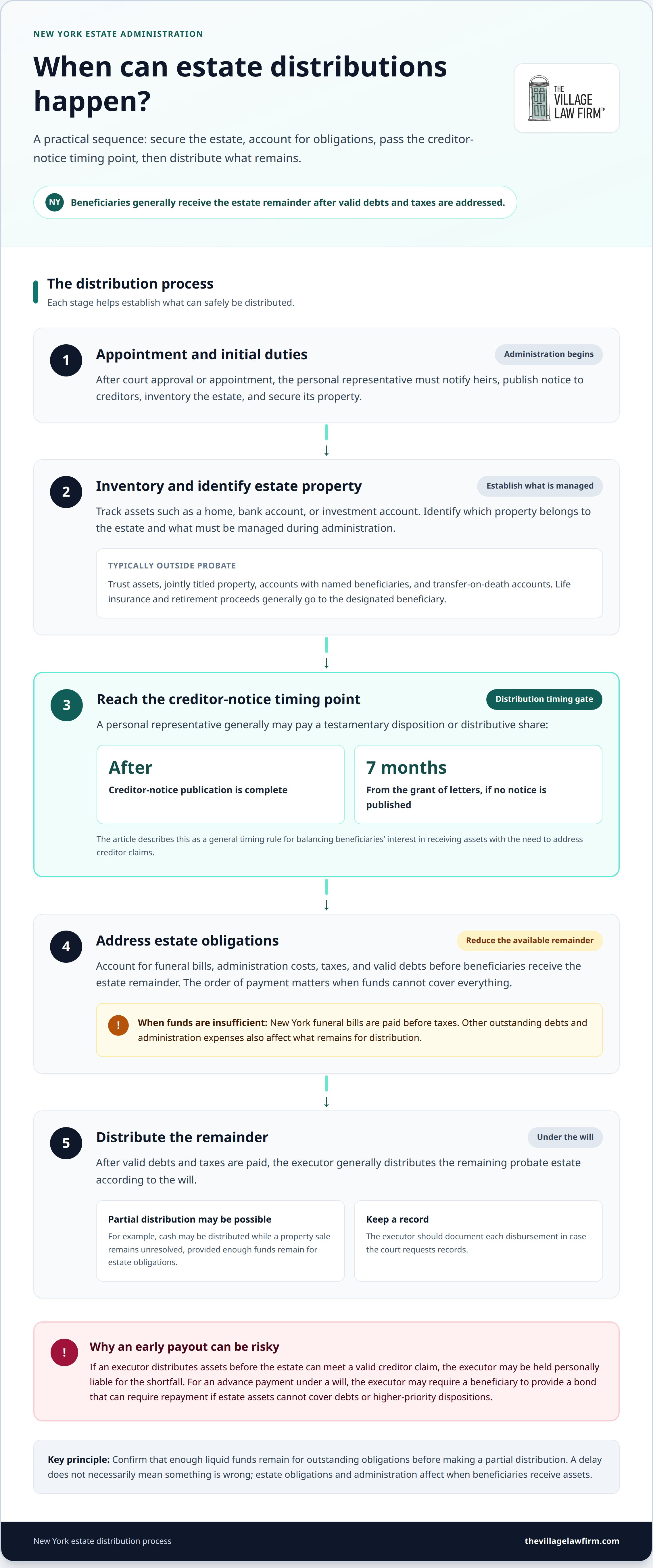
An estate inventory helps the executor track and manage the decedent’s assets during administration. After court approval or appointment, the personal representative must notify heirs, publish notice to creditors, inventory the estate, and secure its property.
An estate administration attorney can prepare probate filings and guide the court appointment process. The attorney can also organize records about assets such as a home, bank account, or investment account, helping the executor account for them before calculating distributions. This establishes what belongs to the estate and what must be managed during administration.
Creditor Claims and Executor Liability
Creditor claims are demands for payment from the estate, and they must be considered before beneficiaries receive the remainder. The executor should preserve enough liquid funds for valid debts and higher-priority obligations. Paying beneficiaries first can leave the estate unable to meet a later claim.
If an executor distributes assets prematurely and the estate cannot satisfy a valid creditor claim, the executor may be held personally liable for the shortfall. For an advance payment under a will, the executor may require a beneficiary to provide a bond. The bond can require repayment if estate assets cannot cover debts or higher-priority dispositions.
Timing of Estate Distributions
In New York, a personal representative generally may pay a testamentary disposition or distributive share after creditor-notice publication is complete, or after seven months from the grant of letters if no notice is published. This timing balances beneficiaries’ interest in receiving assets with the need to address creditor claims.
Before making a partial distribution, the executor should confirm that the estate has enough liquid funds to cover outstanding obligations. For example, cash may be distributed while a property sale remains unresolved, provided sufficient funds remain for estate obligations. The executor should document each disbursement in case the court requests records.
What rights do beneficiaries have in New York?
An estate administration attorney can help open probate, seek appointment of the executor, and guide asset distribution under the will. Beneficiaries may challenge an executor’s actions in Surrogate’s Court if they believe the will or the executor’s duties are not being followed.
Beneficiary Rights in Probate
A beneficiary’s rights depend on the will, the estate’s assets, and whether probate is required. For probate assets, formal distribution proceeds through Surrogate’s Court, which oversees estate administration.
An interested person can petition under SCPA 2205 to require an executor to account. A beneficiary may also seek removal under SCPA 711 for misconduct, including self-dealing, wasting assets, dishonesty, or serious neglect. A probate attorney can explain which concern fits the facts and how a consultation can clarify the available process.
Challenges to an Executor’s Distribution
A challenge asks the court to address an executor’s conduct or a distribution that appears inconsistent with the will. An interested person may contest a will or challenge actions they believe do not comply with its terms. A will contest may allege undue influence, fraud, or misrepresentation, or rely on another will.
Surrogate’s Court resolves disputes involving interested persons and estate administrators. The court may hear from people named in the will and those who would have inherited without it. An attorney can assess the accounting, relevant will provisions, and distribution records to help determine an appropriate legal course.
Probate With a Will
Probate with a will is the court process for establishing the will’s validity and authorizing its administration. If the court finds the will valid, the executor distributes probate assets according to its terms after estate obligations are addressed.
Not every asset passes through probate. Trust assets, jointly titled property, accounts with named beneficiaries, and transfer-on-death accounts typically pass outside it. Life insurance and retirement proceeds generally go to the designated beneficiary, rather than under the will. For guidance on the administration process, explore estate administration support.
Debts, administration expenses, funeral expenses, and taxes
Before beneficiaries receive the estate remainder, the executor must account for obligations that may reduce the available assets. The order of payment matters, particularly when estate funds cannot cover every bill.
Debts and Estate Expenses
Estate expenses include funeral bills, administration costs, taxes, and valid debts charged against estate assets. Beneficiaries receive only what remains after these obligations are addressed.
If funds are insufficient to cover everything provided for in the will, New York funeral bills are paid before taxes. Other outstanding debts and administration expenses also affect what remains for distribution. For example, an estate with limited cash may need to reserve funds for bills rather than distribute the full apparent value of its property.
Priority for Estate Administrators
Priority for estate administrators determines who may be appointed to manage an estate when no administrator is named. In New York, a spouse may have priority over a child for that appointment.
Appointment makes the personal representative responsible for administering estate assets and addressing obligations before distributing shares. If there is no will, New York intestacy laws determine which heirs inherit. The administrator’s appointment and the estate’s available assets therefore shape who manages the process and what may eventually pass to beneficiaries.
New York does not require a person to leave an inheritance to a child, whether the child is an adult or a minor. A surviving spouse is the only person who must receive a portion of the deceased person’s assets. When there is no will, intestacy law governs distribution to heirs instead.
Beneficiaries should distinguish estate obligations from taxes on particular assets. Retirement account funds are taxed according to the account’s terms, and the personal representative may make tax elections under New York Estates, Powers and Trusts Law § 11-1.2. The account type and applicable elections can affect the net amount ultimately available.
Estate distribution timelines in New York
Many New York estates are ready for distribution nine to eighteen months after the executor is appointed. A straightforward estate is often settled within about a year, but New York law sets no hard distribution deadline. These timeframes offer a general guide to how long distributing estate assets to beneficiaries in New York may take, not a promised payment date. The estate’s circumstances determine when each beneficiary receives their share.
Creditor-notice timing affects when a personal representative may pay a testamentary disposition or distributive share. If creditor notice is published, payment may generally follow completion of that publication. If no notice is published, payment may generally occur after seven months from the grant of letters. The grant of letters formally authorizes the representative to act for the estate, affecting when distributing estate assets to beneficiaries in New York can proceed.
Other steps can extend the timeline. A will contest may require court proceedings before the executor can settle distributions. Assets that need valuation or sale can also delay determining the estate’s remaining value. If a beneficiary is a minor, distributions typically require court approval, and funds may be held in a custodial account or trust until adulthood.
Closing the estate adds a stage after beneficiaries receive assets. The executor submits receipts and records to the court, then asks to close the estate and be released from the role. For real property, transferring the deed documents the change in ownership. Clear records help show how the executor handled each share and completed administration.
If a distribution is delayed, the estate’s current stage, unresolved court matters, and remaining assets can help explain what comes next. For tailored guidance on a New York estate’s timeline, speak with The Village Law Firm.
The Village Law Firm
The Village Law Firm helps families bring structure to estate matters through Estate Administration and related planning. When probate involves disputed distributions, assets across jurisdictions, or questions about managing the estate, legal guidance can clarify the process and the executor’s responsibilities.
Support can also be useful before a future loss. Estate Planning, Medicaid Planning, and Planning for Families with Children help families consider how to protect their assets and loved ones. The right next step depends on whether you are administering an estate now or planning for your family’s future.
Contact The Village Law Firm to discuss your estate administration or planning needs.
Take the next step with clarity
Planning for the decisions that follow an inheritance can help bring greater order to a family’s financial future. For anyone managing the distribution of estate assets to beneficiaries in New York, experienced legal guidance can connect immediate administration with broader family priorities. The Village Law Firm provides Estate Administration, Estate Planning, and Medicaid Planning for families’ changing needs.
Consider what would be most useful now: support with an estate already in administration, guidance on future planning, or a clearer understanding of how these matters fit together. A conversation can help identify the questions that need attention and an appropriate path forward, without assuming every family needs the same approach.
Contact The Village Law Firm to discuss your estate administration or planning needs. You can take the next step with care and a clearer sense of direction.
Frequently Asked Questions
How Long Should Distribution Take?
Many New York estates are ready for distribution nine to eighteen months after the executor’s appointment; straightforward estates are often settled within about a year. The timeline can extend if a will is contested, assets must be sold, or a beneficiary is a minor. Ask the executor for an update on outstanding administration steps, such as unresolved claims, court matters, or property transfers, to understand what is affecting progress.
Can I force the executor to give me an accounting?
An interested party can petition the New York Surrogate’s Court to order an executor to account under SCPA 2205. An accounting documents estate activity, including asset transfers and distributions. If you’re concerned about a specific transaction, identify it clearly when seeking legal guidance. The court process can require the executor to present an accounting for review and settlement.
Do all estates have to go through formal probate before distributing assets?
No. Probate is generally required for assets that need court administration, but some property passes outside probate. For example, assets held in trust, jointly titled property, accounts with named beneficiaries, and transfer-on-death accounts typically transfer outside probate. Life insurance and retirement proceeds generally pass to the named beneficiary rather than under the will. The applicable process depends on how each asset is titled.
What Constitutes Probate in New York?
Probate is the Surrogate’s Court process for handling a will and estate assets that require court administration. The court considers the will and the authority of the named executor; interested parties may contest the will. A will directs how probate assets should be distributed, but does not itself avoid probate. Assets with beneficiary designations or held in trust may follow a separate transfer process.
What happens if a beneficiary refuses to sign a receipt and release?
A beneficiary is not legally required to sign a receipt and release. If a beneficiary declines, the executor may seek judicial settlement of the accounting, allowing the court to review and settle the estate’s administration. A beneficiary with questions about a proposed release can seek advice before signing and raise concerns about particular transactions or distributions through the appropriate process.
What if a beneficiary is a minor or has special needs?
A distribution to a minor typically requires court approval, and the funds may be placed in a custodial account or trust until the child reaches adulthood. For a beneficiary receiving Medicaid or SSI, a direct inheritance can jeopardize benefits. A properly structured special needs trust may provide an alternative way to hold the inheritance while addressing the beneficiary’s needs.