
The estate, not the family, generally pays a deceased person’s valid debts. Knowing how to pay debts of an estate in New York starts with the legal payment order: estate administration expenses and reasonable funeral expenses come before preferred debts and taxes, followed by other valid claims. If the estate lacks enough assets, heirs generally do not have to pay the shortfall from their own funds.
It’s understandable to worry that unpaid bills could become a family member’s responsibility or delay an inheritance. In most cases, debts are handled through estate administration, and beneficiaries receive what remains after valid claims are paid in the proper order. A co-signer or joint account holder may have separate responsibility, so the details of each debt matter.
This article explains which claims are paid first, how an executor or administrator reviews creditor demands, and what happens when estate assets are insufficient. It also covers when a surviving relative may be responsible for a debt and how estate administration can organize a complicated process.
Key Takeaways
- New York creditors must file estate claims within 7 months from the date the Surrogate’s Court issues letters to the executor, according to the New York State Legislature.
- Estate administration and reasonable funeral expenses take priority, while lower-priority creditors may receive less if funds run short.
- Family members generally don’t inherit a deceased person’s debts, but co-signing or jointly holding an account can create separate responsibility.
- An executor or administrator reviews claims and manages estate obligations before distributing remaining assets to beneficiaries.
What debts are paid first from an estate?
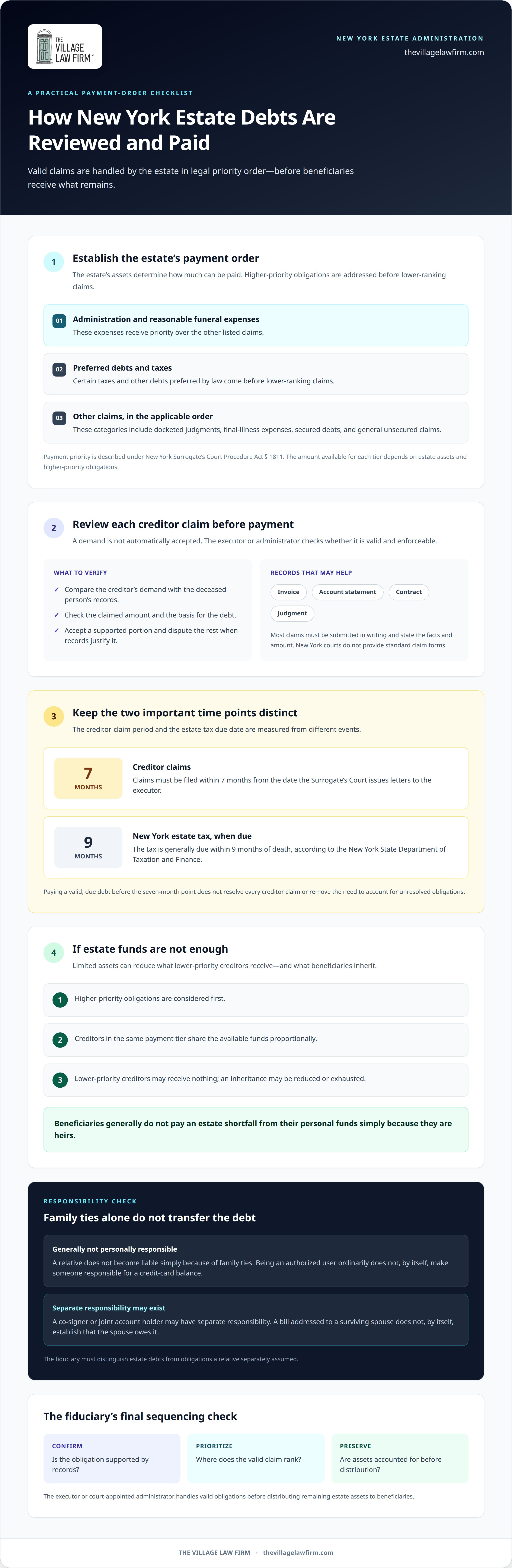
New York law ranks valid estate claims by priority. Estate administration expenses and reasonable funeral expenses come before preferred debts and taxes. Other categories include final-illness expenses, secured debts, and general unsecured claims. The amount available for each tier depends on the estate’s assets and higher-priority obligations.
A creditor must file a claim against an estate within 7 months from the date the Surrogate’s Court issues letters to the executor, according to the New York State Legislature. Most claims must be submitted in writing and state the facts and amount. New York courts don’t provide standard claim forms, so a creditor’s written submission should clearly identify the debt and explain its basis.
Claims should be reviewed before payment. The executor or administrator compares each demand with the deceased person’s records to determine whether it is valid and enforceable. An invoice, account statement, contract, or judgment, for example, may help establish the claimed balance. If records support only part of a demand, the estate representative may accept that portion and dispute the rest.
- Administration and funeral: Estate administration expenses and reasonable funeral expenses receive priority.
- Preferred obligations: Certain taxes and other debts preferred by law are paid before lower-ranking claims.
- Later tiers: Final-illness expenses, secured obligations, and general unsecured debts follow in the applicable order.
Under New York Surrogate’s Court Procedure Act § 1811, administration and funeral expenses precede preferred debts and taxes, docketed judgments, and other claims. New York estate tax, when due, is generally due within nine months of death, according to the New York State Department of Taxation and Finance.
If estate assets cannot cover every valid claim, creditors in the same payment tier share available funds proportionally. Lower-priority creditors may receive nothing, and an inheritance may be reduced or exhausted. Heirs generally do not have to cover an insolvent estate’s shortfall from personal funds simply because they are beneficiaries.
What Happens to Debts After Someone Dies in New York?
The executor named in a will or a court-appointed administrator handles the deceased person’s estate obligations. This fiduciary reviews claims, pays valid debts in priority order, and addresses liabilities before distributing estate assets.
Executor and Administrator Responsibilities
An executor or administrator is the fiduciary responsible for managing the deceased person’s financial affairs during estate administration. The work includes comparing creditor demands with records, determining whether obligations are legitimate, and arranging payment from estate assets. If there is no valid will, the Surrogate’s Court appoints an administrator. The distinction matters because an authorized representative is needed to manage claims and distributions.
Paying Legitimate Debts Before Distribution
A fiduciary must address legitimate debts before distributing assets to beneficiaries. This means reviewing bills, judgments, tax obligations, and other claims, then paying valid amounts in order of legal priority. A creditor’s demand is not automatically accepted: records may show that the balance is incorrect or only partly supported. Distributing property before resolving estate obligations can expose the fiduciary to personal liability to creditors.
Estate Debt Responsibility in New York
In New York, debts are generally handled by the estate, not transferred automatically to relatives. The estate’s available assets determine how much can be paid; if funds cannot cover every obligation, some creditors may go unpaid. The fiduciary must distinguish estate debts from separate responsibilities a relative assumed, such as by co-signing or jointly holding an account. This helps beneficiaries avoid confusing an estate claim with personal liability.
Debt Payments Before Probate or Claim Deadlines
Before appointment, a person generally cannot act as the estate’s executor or administrator. Once letters are issued, the fiduciary can address established obligations during administration, while accounting for claim deadlines and payment priority before making distributions. New York State law identifies a seven-month timing point relevant to fiduciary payments and distributions after the first letters issue. Paying a valid, due debt before that point does not resolve every creditor claim.
The key is careful sequencing: confirm the obligation, consider its priority, and preserve estate assets for other valid claims. An early payment does not give the fiduciary permission to distribute the remaining property without accounting for unresolved debts.
Does Your Family Inherit Your Debts?
In New York, beneficiaries generally receive estate assets only after valid debts are addressed. A relative’s personal responsibility depends on whether they separately agreed to pay or another legal rule applies.
Family Liability for a Deceased Person’s Debts
A surviving relative does not become personally liable for a debt simply because of family ties. A spouse or other relative may remain responsible after co-signing a loan or jointly holding an account. An authorized user ordinarily is not responsible for a credit card balance based on that role alone. A bill addressed to a surviving spouse also does not, by itself, establish that the spouse owes the debt.
New York’s doctrine of necessaries may raise a separate issue when necessary care was provided to a deceased spouse. A provider generally must show that the care was given with an expectation that the surviving spouse would be financially responsible, that the spouse can pay, and that the deceased spouse could not pay from their own income or property.
Executor Liability for Premature Distributions
An executor or administrator may face personal liability to creditors if estate assets are distributed prematurely. The risk arises when property goes to beneficiaries before valid claims and estate obligations are addressed. For example, a distribution could leave too little in the estate to pay a legitimate creditor. Serving as executor does not automatically make someone personally responsible for every debt, but mishandling distributions can create liability.
New York Estates, Powers and Trusts Law § 12-1.1 addresses distributee and testamentary beneficiary liability for estate debts. That framework matters when estate funds have already been distributed and a creditor’s claim remains unpaid.
Personal Liability for a Decedent’s Debts
Personal responsibility usually depends on a separate legal connection to the debt, not simply inheritance or marriage. A co-signer may be pursued because they independently agreed to repay the loan. Someone who guaranteed a debt in writing or jointly owns property securing it may also have responsibility connected to that agreement or property.
Debt collectors may contact the personal representative about payment or ask relatives how to reach that representative. They may not falsely claim that a relative is personally liable for a debt they do not legally owe. A surviving spouse facing a care-related bill should distinguish the estate’s obligation from any claim under the doctrine of necessaries.
How New York estate debts are handled
Managing estate debts in New York depends on which assets belong to the estate, whether property secures a debt, and who receives the assets. These distinctions shape what creditors can pursue and what beneficiaries may receive. For families asking how to pay debts of an estate in New York, a key first question is whether an asset passes through probate or directly to a beneficiary.
SCPA Article 18 governs a fiduciary’s payment of a decedent’s debts. Life insurance, retirement accounts, and payable-on-death accounts with named beneficiaries usually bypass the estate and are shielded from most creditor claims. Individually owned bank accounts, solely owned real estate, and personal property may instead be probate assets available to address estate obligations. Ownership and beneficiary designations therefore affect which assets enter the payment process.
Secured debts remain tied to their collateral. If the estate sells a mortgaged home, the mortgage is paid from the sale proceeds. If an heir keeps the home, the mortgage must remain current. An auto lender’s security interest likewise applies to the vehicle; any shortfall after the collateral is applied becomes a general claim. Real estate taxes may also need to be considered when estate property is distributed.
- Identify the asset: Establish whether it passes through probate or directly to a beneficiary.
- Match debt to property: Account for mortgages, vehicle loans, and property taxes tied to specific assets.
- Apply governing rules: Consider creditor rights and the will’s directions before distributing property.
New York SCPA § 1310 addresses payment of certain debts without administration. Article 18 also sets out a 60-day statute of limitations creditors must consider. If no administrator has been appointed, a deadline may be tolled, but that period cannot exceed 18 months. New York Estates, Powers and Trusts Law § 12-1.2 establishes the order in which distributees and testamentary beneficiaries may be liable for estate debts. A testator’s expressed or implied intent to prefer beneficiaries can affect that order. Understanding how to pay debts of an estate in New York means considering these rules alongside asset ownership and secured claims.
Because those factors can interact, get help with estate debt administration to have the obligations addressed in context.
The Village Law Firm
The Village Law Firm helps New York families organize estate administration and plan thoughtfully around their assets and legacy. When creditor claims, secured property, or beneficiary distributions raise questions, legal guidance can clarify how those issues fit together and what the estate must address.
For an estate being settled now, estate administration can help manage obligations and distributions. For future planning, estate planning can help you organize your wishes and assets. The right focus depends on whether you are administering an estate or preparing for one.
If you need guidance on estate debts or planning for your family, contact The Village Law Firm to discuss your situation.
Choose a Clear Next Step
Estate matters often arise at a difficult time, but deciding who will manage the legal and financial details can help restore direction. If you are settling an estate, professional guidance can help keep the administration aligned with your responsibilities. If you are planning ahead, you can make decisions with your family’s future in mind.
A conversation about how to pay debts of an estate in New York can help clarify whether Estate Administration, Estate Planning, or Medicaid Planning suits your circumstances. The Village Law Firm provides these services to individuals and families managing an estate or planning for future needs. The right focus depends on whether you are administering an estate now or organizing your own plans. Bring questions about asset ownership, family responsibilities, or decisions ahead.
Take the next step at a pace that feels manageable. Contact The Village Law Firm to discuss your circumstances and move forward with greater clarity.
Frequently Asked Questions
Do heirs inherit debt in New York?
Heirs generally do not become personally responsible for a deceased person’s debts simply by inheriting or being related to them. An adult child, for example, does not owe a parent’s credit card balance solely because of the family relationship. A relative may have separate responsibility if they co-signed, jointly incurred the debt, guaranteed it in writing, or are liable under another applicable rule.
Are funeral expenses paid before credit cards?
Yes. Reasonable funeral expenses are paid before general unsecured debts, such as credit card balances, though estate administration expenses also have priority. This matters if the estate cannot cover every bill: payments follow legal priority, and lower-ranking creditors may receive only part of their claims or nothing. A credit card balance does not move ahead just because a creditor requests payment.
Can creditors go after life insurance or retirement accounts?
Life insurance and retirement accounts that pass directly to named beneficiaries usually bypass the estate and are shielded from most creditor claims. For example, a policy naming a spouse may transfer its proceeds directly to that spouse rather than into probate assets. The result depends on how the account is titled and whether a beneficiary is designated, so an asset’s name alone does not establish how it passes.
How Does Your Representative Address Your Debts?
An executor or administrator reviews the deceased person’s records, manages estate property, and addresses valid obligations before distributing what remains. Administration may involve identifying assets, handling bills and taxes, keeping records, and preparing a final accounting. If there is no valid will, the Surrogate’s Court appoints an administrator. The representative manages estate matters but does not automatically assume every debt personally.
Questions About a Loved One’s Debts?
A debt collector may contact the deceased person’s personal representative about payment or ask a relative how to reach that representative. A collector cannot harass relatives, misrepresent a debt, or falsely claim that they are personally liable. If a call concerns you, distinguish between a request for contact information and an assertion that you owe the balance. Being an authorized user on a credit card generally does not make you responsible for it.
What About the House and Its Mortgage?
A mortgage remains secured by the home after the borrower dies. If the estate sells the property, the mortgage is paid from the sale proceeds. If an heir keeps the home, the mortgage must stay current. Inheriting a house does not erase the lender’s claim against the property. Any unsecured shortfall after the collateral is applied becomes a general estate claim.