

A taxpayer’s death doesn’t erase the filing deadline. For filing a final tax return for a deceased New York taxpayer, the federal return is generally due by April 15 of the year after death, according to the Internal Revenue Service. The final federal return is filed on Form 1040, and New York’s final personal income tax return generally follows similar filing rules.
Filing a final tax return for a deceased New York taxpayer can be difficult while you are also managing an estate. First distinguish the deceased person’s final individual return from any separate estate filing, then determine who must sign and submit each return.
This article explains when a final return is required, who handles filing, how Form 1310 may apply when a refund is due, and what to know about the New York deadline. With the filing timeline and roles set out clearly, you can approach the next steps with greater confidence.
Key Takeaways
- Determine whether the deceased person’s income and filing circumstances require a final individual return.
- Clarify whether you’re responsible for filing as the executor, administrator, or surviving spouse.
- Learn when Form 1310 may be needed to claim a refund owed to the deceased taxpayer.
- Separate an individual income tax filing from estate administration needs so each obligation can be addressed appropriately.
Do you need to file a return for a deceased taxpayer?
A deceased taxpayer may still need to file an individual federal income tax return and a New York State return. Whether a return is required depends on income, filing status, and the date of death.
Final Income Tax Returns
A final income tax return reports the deceased person’s individual income and tax obligations for the year of death. File the federal return on Form 1040, reporting income from January 1 through the date of death. According to the Internal Revenue Service, the personal representative or survivor generally has until April 15 of the following year to file. A surviving spouse may use married filing jointly or married filing separately when eligible.
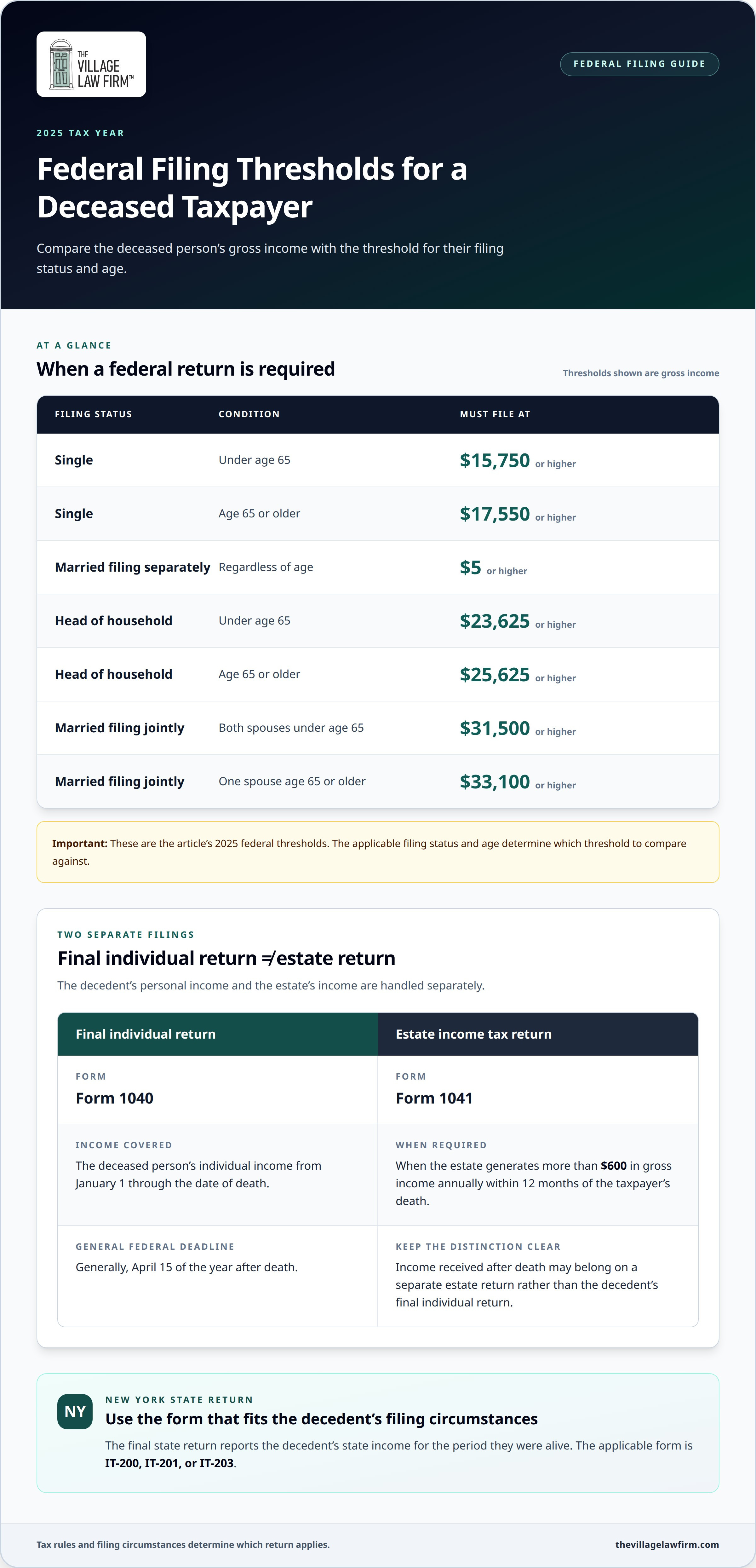
Deductions and credits depend on the deceased person’s eligibility and supporting records. An estate income tax return is separate: an estate generating more than $600 in gross income annually within 12 months of the taxpayer’s death must file Form 1041, according to the Internal Revenue Service.
Federal Filing Thresholds
Federal filing thresholds are gross-income levels that determine whether an individual return is required for a tax year. For the 2025 tax year, a single taxpayer under 65 must file at $15,750 or higher; at age 65 or older, the threshold is $17,550. A married taxpayer filing separately must file at $5 or higher, regardless of age.
For head-of-household filers, the 2025 thresholds are $23,625 under age 65 and $25,625 at age 65 or older. A married couple filing jointly must file at $31,500 when both spouses are under 65, or $33,100 when one spouse is 65 or older. Compare the deceased person’s gross income with the applicable status and age threshold.
New York State Returns
A New York State final income tax return reports the decedent’s state income tax for the period they were alive. Use the form that would have applied if the person had lived: IT-200, IT-201, or IT-203. The applicable form depends on the decedent’s filing circumstances.
An executor, administrator, or another person responsible for the decedent’s property handles the New York return. A joint state return after a spouse’s death is permitted only if a joint federal return was filed for that tax year. The spouses’ taxable years must have started on the same day and ended on different days only because of the death.
Income Before and After Death
Income before and after death is divided according to when it was earned or received and who is entitled to it. The final individual federal return covers income earned from January 1 through the date of death. Income received after death may belong on a separate estate return rather than the decedent’s final individual return.
Keep records such as Forms W-2 and 1099, prior returns, and receipts supporting deductions or credits. Incorrect or late filing can result in penalties when tax is owed: the failure-to-file penalty is 5 percent of unpaid tax per month, up to 25 percent. The late-payment penalty is 0.5 percent per month, up to 25 percent, plus interest.
Executor and surviving spouse responsibilities
An executor or administrator appointed to manage the estate handles the deceased person’s tax return. A court-appointed representative signs the final return and attaches the appointment document. If no representative or surviving spouse has been appointed, the person responsible for the property signs as “personal representative.”
A surviving spouse is the deceased person’s husband or wife who may have filing responsibilities for the year of death. If no representative was appointed, a spouse filing jointly signs and writes “filing as surviving spouse” in the signature area. For a joint return, the spouse and the appointed representative generally both sign.
Filing status determines which tax rules apply to a surviving spouse’s return. The spouse may file jointly or separately on the final return. The IRS considers the couple married for the entire year of death if the survivor doesn’t remarry that year. A surviving spouse with a dependent child may qualify for qualifying surviving spouse status for the next two tax years, provided they don’t remarry.
A joint New York State return after a spouse’s death is allowed only under specific conditions. The couple must have filed a joint federal return for that tax year, and their taxable years must have started on the same day and ended on different days only because of the death. Generally, the executor or administrator and surviving spouse join in filing the New York return.
A survivor’s home sale exclusion is a separate tax consideration from signing the deceased person’s final return. Keep records of the home’s ownership and use so those details can be considered separately from the decedent’s income and filing status. They don’t replace the executor’s responsibility to file the deceased person’s return.
Careful estate administration can help coordinate the return, representative authority, and estate records. For support with the estate’s legal administration, consider Estate Administration guidance.
Form 1310 and refunds owed to a deceased taxpayer
A refund claim and a final income tax return serve different purposes. The return reports the deceased taxpayer’s taxable income; the refund claim identifies who is seeking payment.
Form 1310 for Refund Claims
Form 1310 is the IRS statement used by a person claiming a refund due to a deceased taxpayer. According to the Internal Revenue Service, a person claiming that refund may use IRS Form 1310, Statement of Person Claiming Refund Due a Deceased Taxpayer.
The deceased taxpayer’s final federal return is filed on Form 1040. Form 1310 addresses the refund claim, not the income reported on that return. An executor or administrator should coordinate the refund claim with the return and the estate’s records, so the claimed amount matches the taxable year being filed.
Claiming a Deceased Taxpayer’s Refund
Claiming a deceased taxpayer’s refund means requesting tax overpayment owed to that person. The executor or administrator handling the estate can prepare the final return and establish who is making the claim. Form 1310 may be used for that purpose; it does not replace the final federal return.
For a deceased person who died during the tax year, the final federal income tax return uses Form 1040 and reports income through the date of death. The person responsible for the estate should keep the return, refund claim, and supporting income records together. That makes it easier to trace the refund to the relevant taxable year and representative.
An executor or administrator seeking a refund files the final return and uses Form 1310 when claiming the refund. An extension request concerns more time to file; it does not itself claim or document the refund. Keep the filing and refund steps distinct, and ensure the person signing has authority to act for the deceased taxpayer.
Final return filing deadline
The final return filing deadline is the date by which the decedent’s individual income tax return must be submitted. For a calendar-year taxpayer, the filing year follows the year of death, so identify the tax year before marking the due date.
According to the Internal Revenue Service, a personal representative or survivor generally has until April 15 of the following year to file the decedent’s final federal income tax return. New York’s individual return follows similar filing rules. The date of death determines which year’s return is final, while the income tax return for the prior year remains a separate filing.
For example, if a person dies in March 2026, the 2025 federal return was due April 15, 2026. The final return reports income earned from January 1, 2026, through the date of death, and was due April 15, 2027. The decedent’s assets or the time needed to administer them don’t change these individual return dates.
An estate return has a separate timetable from the decedent’s final Form 1040. According to the Internal Revenue Service, calendar-year estates and trusts must file Form 1041 by April 15, 2026, for their 2025 return. Don’t treat that estate deadline as the due date for the deceased person’s individual return.
A joint return may be available when a surviving spouse meets the applicable filing conditions, but the death-year return still follows the relevant tax-year deadline. Form 1310, the Statement of Person Claiming Refund Due a Deceased Taxpayer, concerns a refund claim; it doesn’t replace the income tax return or change its filing date. Keep the return deadline and refund paperwork as separate tasks.
To set the filing schedule, identify the date of death, the tax year being reported, and whether the filing concerns the individual or the estate. That sequence helps an executor or administrator distinguish a prior-year return from the decedent’s final return and the estate’s Form 1041.
The Village Law Firm
The Village Law Firm helps individuals and families address estate matters that can arise alongside a deceased person’s tax filings. Its Estate Administration and Estate Planning services support the broader legal work of managing an estate and protecting a legacy.
Consider legal guidance when an executor is coordinating estate responsibilities, a surviving spouse is handling a joint return, or assets and family needs make administration more complex. The Village Law Firm can help bring estate-related decisions into clearer order. Preparing and filing a tax return is a separate task from estate administration.
If you need help understanding the estate matters connected to a death, contact The Village Law Firm to discuss your situation.
Bring the estate’s next decisions into focus
Once immediate tax matters are underway, consider what the estate and family may need next. Tax paperwork is one part of a broader transition, and decisions about assets, planning, and care can be considered together. Filing a final tax return for a deceased New York taxpayer can be part of that wider view, rather than a stand-alone task.
The Village Law Firm offers Estate Planning, Estate Administration, and Medicaid Planning for people addressing these connected concerns. These services help you consider estate responsibilities alongside longer-term plans for your family and assets. Discuss the questions that matter most in your circumstances with the firm.
Contact The Village Law Firm to discuss your estate-related needs. A thoughtful conversation can help you identify a practical path forward.
Frequently Asked Questions
What supporting documents do you need to provide?
Keep income statements, prior returns, and records supporting deductions or credits together with the return. If a court appointed the representative, attach a copy of the appointment document. The Internal Revenue Service doesn’t require a death certificate or other proof of death with the final federal return. Clear records help the representative support reported amounts if questions arise later.
When is a final tax return due?
The decedent’s final federal income tax return is generally due April 15 of the year following death, according to the Internal Revenue Service. For example, a person who died during 2025 generally has a final federal return due April 15, 2026. A return for the tax year before death is separate, so identify the year each return covers before organizing filings.
Who pays if taxes are owed?
The personal representative or surviving spouse handling the filing arranges payment of tax due with the return or through an IRS payment option. Filing responsibility doesn’t by itself determine who ultimately bears the tax cost. The executor should account for any amount owed while administering the deceased person’s property and keep payment records with the corresponding return.
Who receives a refund for a deceased taxpayer?
The refund is claimed by the person authorized to act for the deceased taxpayer, such as an eligible personal representative or survivor. The Internal Revenue Service identifies Form 1310 as a statement for a person claiming a refund due to a deceased taxpayer. The representative should keep the refund claim connected to the final return and records showing the overpayment.
Who is responsible for filing a final tax return for a deceased person in New York?
An executor or administrator appointed to handle the estate files the deceased person’s New York State personal income tax return. If no representative has been appointed, another person responsible for the decedent’s property may have that responsibility. The person acting in that role must sign the return, so keep appointment papers available if a court appointed a representative.
What New York State and New York City tax returns are required after a death?
The decedent’s New York State personal income tax return uses the form that would have applied if the person had lived: IT-200, IT-201, or IT-203. New York City tax treatment depends on the person’s filing circumstances and residence. Don’t confuse an individual income tax return with Form ET-706, New York’s estate tax return, which serves a different purpose.