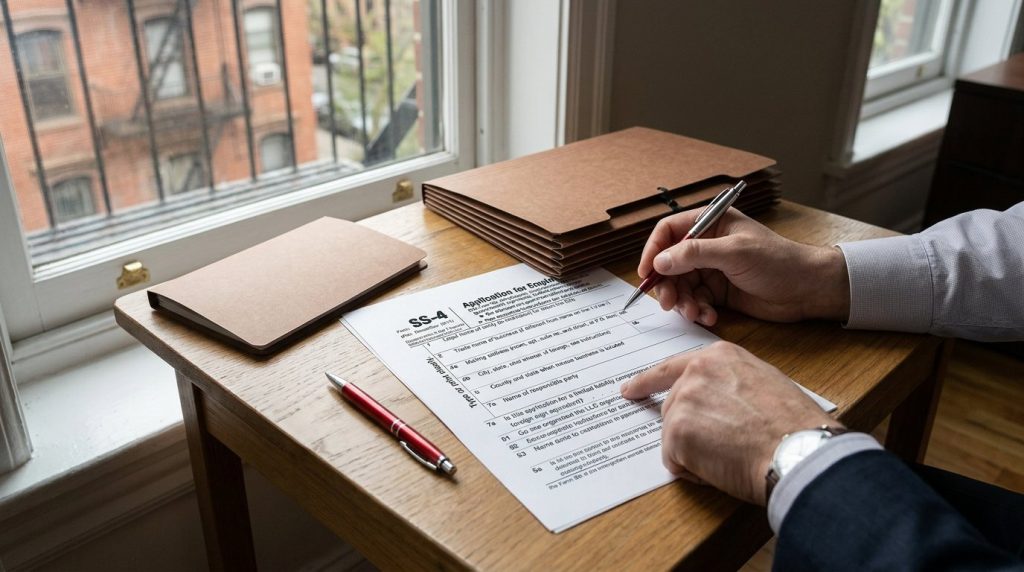
A New York estate may need its own tax ID number even when it has no income. A tax ID number for a New York estate is generally a federal Employer Identification Number (EIN), which the executor or administrator can request from the IRS using Form SS-4. It’s separate from the deceased person’s Social Security number, which remains relevant for the person’s final income tax return.
It’s understandable to wonder whether a federal EIN, a Social Security number, and a New York estate tax number serve the same purpose. They don’t. Understanding which tax ID number for a New York estate applies to each task can help keep estate finances and tax filings organized. This guide explains when an estate may need an EIN, what applying with Form SS-4 involves, and how an estate EIN differs from other tax IDs.
You’ll also learn how the process relates to estate administration, including managing assets and preparing tax returns. Understanding these distinctions can help you take the next steps with greater confidence.
Key Takeaways
- Learn when an estate needs its own EIN, including situations where it has no income.
- See what information a professional uses to prepare an estate’s Form SS-4 application.
- Understand how an estate EIN differs from the deceased person’s Social Security number and New York tax filings.
- Compare online, fax, and mail application methods to understand what can affect processing time.
How a professional handles a Form SS-4 application for an estate
A professional can prepare Form SS-4 for the executor or administrator and check that the estate’s information is consistent. An estate may need Form 1041 for income, and New York State Form ET-706 is generally due within nine months after death, according to the New York State Department of Taxation and Finance.
An EIN supports estate banking and tax administration, while probate authority determines who may act for the estate. As administration concludes, the responsible person can review any remaining filing obligations and handle the estate’s tax closeout. The EIN does not simply cancel itself.
-
Determine who should apply for the estate EIN with professional guidance
Identify the person officially appointed to handle the estate. An executor or administrator generally applies in that representative capacity, and probate appointment helps establish the authority to act. An accountant or another third party may submit the application, but that does not make the preparer the person responsible for the estate.
This distinction matters when family members share responsibilities or an accountant prepares tax filings. It keeps the application connected to the person legally handling the estate, rather than someone assisting only with paperwork.
-
Prepare the information needed for a professional to complete an estate EIN application
Gather the deceased person’s name, address, and Social Security number, along with the executor’s or administrator’s Social Security number. A death certificate can help provide the deceased person’s details. You’ll also need the estate’s mailing address and phone number, and information about whether it plans to hire employees, for example, to operate an ongoing business.
Share these details together so the preparer can complete Form SS-4 accurately. Most estates report zero employees for the application, but the answer should reflect the estate’s circumstances.
-
Determine the estate’s responsible party with professional guidance
Ask the professional to identify the responsible party before submitting Form SS-4. The IRS requires this role to be held by a natural person, not a company. Usually, the individual handling the estate is named, even when an accountant or another designee submits the application.
Keep the responsible party distinct from the application preparer. Even when a firm assists with the application, the executor remains responsible for estate administration and decisions.
- Use professional help when probate authority, estate income, or employee plans make the application less straightforward. An EIN application made directly through the IRS is free, including through Form SS-4; a professional can prepare the information and submit as an authorized designee. For closeout, have the professional review final Form 1041 obligations and other outstanding estate filings, then coordinate the tax records as administration concludes. Settling the estate alone does not establish that every filing is complete.
EIN requirements for estates and trusts
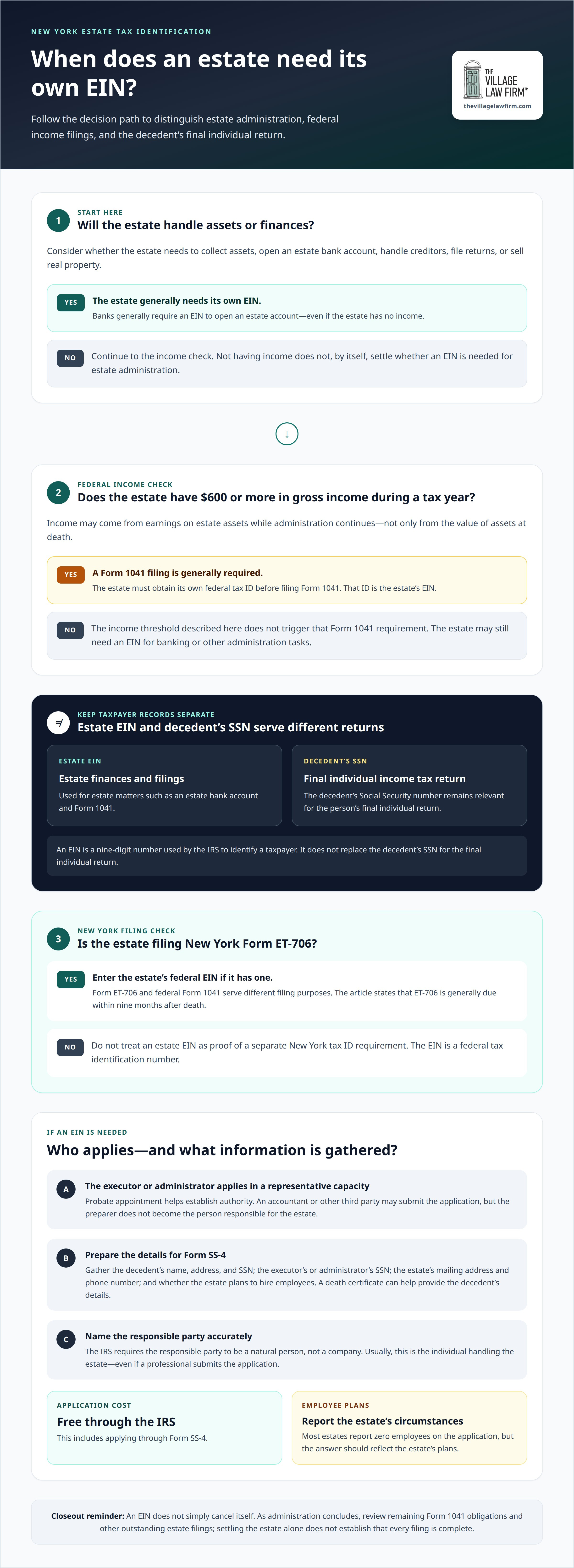
- Consider which estate tasks require a separate federal identification number. An estate generally needs an EIN to collect assets, open an estate bank account, handle creditors, file returns, or sell real property. Banks generally require an EIN to open an estate account, even if the estate has no income. The decedent’s Social Security number is still used for the final individual income tax return, not the estate’s ongoing finances.
- Connect the EIN decision to federal income tax filings. An estate must obtain its own federal tax ID before filing Form 1041. An estate generally must file that return if it has $600 or more in gross income during a tax year. Income can include earnings from estate assets, so an executor should consider what the estate receives while administration continues, not just the value of assets at death.
- Separate federal and New York filing needs. A New York estate filing Form ET-706 should enter its federal EIN if it has one; the number is also called a federal tax identification number. That state form and federal Form 1041 serve different filing purposes, so the executor should match the identifier to the return being prepared. An estate’s need for an EIN does not depend solely on whether it owes estate tax.
- Check whether a trust has its own identification requirement. The IRS says estates and eligible trusts need an EIN, but an estate and a trust are not interchangeable labels on tax paperwork. Identify the entity receiving income or holding assets before preparing Form SS-4. If administration involves both an estate and a trust, clarify which entity needs the number and which returns each must submit. This avoids using the decedent’s SSN or one entity’s EIN for another entity’s records.
Estate EINs compared with other tax identification numbers
A New York estate generally uses a federal EIN for estate business and tax records. For New York State Form ET-706, the estate enters its federal EIN if it has one; that form identifies it as a federal tax identification number. This does not establish a separate state tax ID requirement.
- An EIN is a nine-digit number the IRS uses to identify a taxpayer; it is separate from the decedent’s Social Security number. The executor uses the decedent’s number for the final individual income tax return, while the estate generally needs its own EIN for ongoing finances and filings.
- Use the EIN for estate matters, not as a replacement for every tax identifier. For example, an estate’s bank account and Form 1041 relate to the estate’s EIN. The decedent’s final individual return remains associated with the decedent’s SSN. Keeping those records separate helps prevent income or transactions from being reported under the wrong taxpayer.
- Keep a preparer’s identifier separate from the estate’s number. A person preparing New York State Form ET-706 who is not the executor must provide a federal preparer tax identification number, or PTIN, or a Social Security number. That identifier belongs to the preparer. It does not replace the estate’s EIN or become the estate’s tax identification number.
- Use each identification number for the filing and person or entity it identifies. The administrator can use the estate’s EIN for estate records, while the decedent’s Social Security number applies to the final individual income tax return. A separate trust may also need an EIN if it meets the applicable requirements, so an estate’s EIN should not be assumed to identify the trust.
- Use the federal EIN field on New York’s estate tax return when the estate has an EIN. The New York State Department of Taxation and Finance says Form ET-706 is generally due within nine months after the decedent’s date of death. That filing deadline concerns the state return; it doesn’t turn the preparer’s PTIN or the decedent’s SSN into the estate’s EIN.
Can a professional obtain an estate EIN online, by mail, or by fax, and how long does it take?
- Choose an application method with the estate’s timing needs in mind. The IRS accepts estate EIN applications online, by fax, or by mail. A professional can prepare and submit Form SS-4 as a designated third party, while the individual handling the estate remains the responsible party. Direct IRS applications are free, including online and Form SS-4 applications.
- Use the online route when an immediate decision is useful. A successful IRS online application can issue the EIN immediately, and the application takes about fifteen minutes to complete. The confirmation letter, CP 575, can be downloaded once processing is complete. The online EIN application is available during weekday hours, so timing the submission accordingly can help avoid delays.
- Select fax when the estate needs a non-online submission with a relatively short processing estimate. An estate EIN application sent by fax using Form SS-4 typically takes about four business days. The professional prepares the form and submits it for the executor or administrator, reducing the risk of inconsistent information across the application.
- Allow more time for a mailed Form SS-4. The IRS generally processes a mailed estate EIN application in four to five weeks. That difference matters if a bank account or filing depends on the number. A professional can help coordinate the submission method with the estate’s immediate administration needs, but mail processing remains slower than online or fax processing.
- Keep the confirmation with the estate’s records after issuance. For an online application, retain the CP 575 confirmation PDF alongside documents used for banking and tax filings. If a professional submits as the designee, the executor or administrator should still retain access to the resulting EIN information. For coordinated support with estate filings and administration, contact The Village Law Firm.
The Village Law Firm
The Village Law Firm assists with estate administration and planning. When an EIN application raises questions about probate authority, estate assets, or tax filings, legal guidance can help keep the application aligned with the estate’s overall administration.
Guidance can be especially useful when family members share responsibilities, the estate includes assets in multiple countries, or administration raises questions beyond obtaining an identification number. The appropriate next step depends on the estate’s needs and how its affairs are being handled.
For guidance with an estate matter, contact The Village Law Firm.
Keep the estate’s next decisions aligned
Obtaining a tax ID number for a New York estate is one part of settling its affairs. The decisions that follow affect how assets are managed, filings are coordinated, and family members are served by the estate plan. Treat the EIN as one part of the administration process, not as an isolated form.
The Village Law Firm provides Estate Administration, Estate Planning, and Medicaid Planning. These services address questions that can arise as estate responsibilities develop, including how current administration connects with longer-term planning. The right focus depends on the estate’s needs and the decisions facing those responsible for it.
You don’t have to sort through every estate question at once. A clear conversation can help bring the immediate task into focus and identify the next practical step. Contact The Village Law Firm to discuss your estate matter and move forward with greater clarity.
Frequently Asked Questions
When Is One Required?
An estate generally needs an EIN when it handles money or obligations under the estate’s name. An executor may need one to receive funds in an estate account, manage income earned after death, or complete transactions involving estate property. An EIN may be needed even when the estate has no taxable income, so consider the estate’s administrative tasks as well as whether a tax bill is expected.
Why does an estate need its own EIN?
An EIN gives the estate a separate federal tax identity for financial administration. This helps distinguish estate transactions from the decedent’s personal affairs, especially when income arrives after death or assets are collected over time. Keeping account activity under the estate’s identifier also helps organize records for the executor and tax filings, rather than mixing them with the decedent’s individual tax history.
What is a tax ID number (EIN) for an estate in New York?
An estate EIN is a federal, nine-digit identification number assigned by the IRS to identify the estate as a taxpayer. A New York estate’s tax ID number is not the decedent’s Social Security number or a separate New York State EIN. The estate uses its federal identifier for estate-related financial activity and applicable tax filings.
When does a New York estate need its own EIN?
A New York estate generally needs an EIN when it must act as a separate financial entity, such as when opening an estate bank account, receiving asset proceeds, or reporting estate income. A bank may require the number even if the estate has no income. Consider planned transactions and filing obligations rather than waiting until the estate earns money.
How can a professional apply for an estate EIN from the IRS?
A professional can prepare and submit Form SS-4 to the IRS or assist with an online application. An accountant or other third party may be named as the designee, while the individual handling the estate remains the responsible party. The professional can help align the application with the executor’s role and the estate’s details, reducing confusion about who is applying and who is responsible.
What information should you provide for a professional to apply for an estate EIN?
Gather the decedent’s full name, address, and Social Security number, as well as the executor’s or administrator’s Social Security number. A death certificate can help provide the decedent’s details. You’ll also need the estate’s contact information and whether it plans to hire employees. For example, an estate continuing a business may need to account for employee plans, unlike one with no employees.