
The lowest upfront fee isn’t always the most affordable choice. Finding affordable estate planning in NYC means matching the plan to your assets, family needs, and the documents you actually need, rather than comparing a single price in isolation. The fee depends on the case and is given after a quote request; the scope of the plan, its documents, and any tax or trust planning all affect the cost.
It’s reasonable to want a clear budget before making decisions about your family and legacy. This article explains how flat-fee tiers differ, which documents commonly shape a plan, and how New York’s estate tax rules can affect planning choices. You’ll come away with a practical way to compare options by scope and complexity, so you can focus on value and fit, not just the lowest number.
Key Takeaways
- Compare estate plans by what they cover, not just by the flat-fee tier. The right scope depends on your assets, family needs, and planning goals.
- Understand how New York’s estate tax exemption and cliff may affect the choices available for your estate.
- See how a will, power of attorney, health care proxy, and trust can serve different planning needs.
- Learn when professional estate planning, Medicaid planning, or planning for a family with children may help bring greater clarity to your next steps.
How Much Does Estate Planning Cost in New York?
Estate planning costs depend on the documents, assets, and legal work involved. Compare what each option covers, including trust funding and help with administration.
Attorney Fees and Flat-Fee Packages
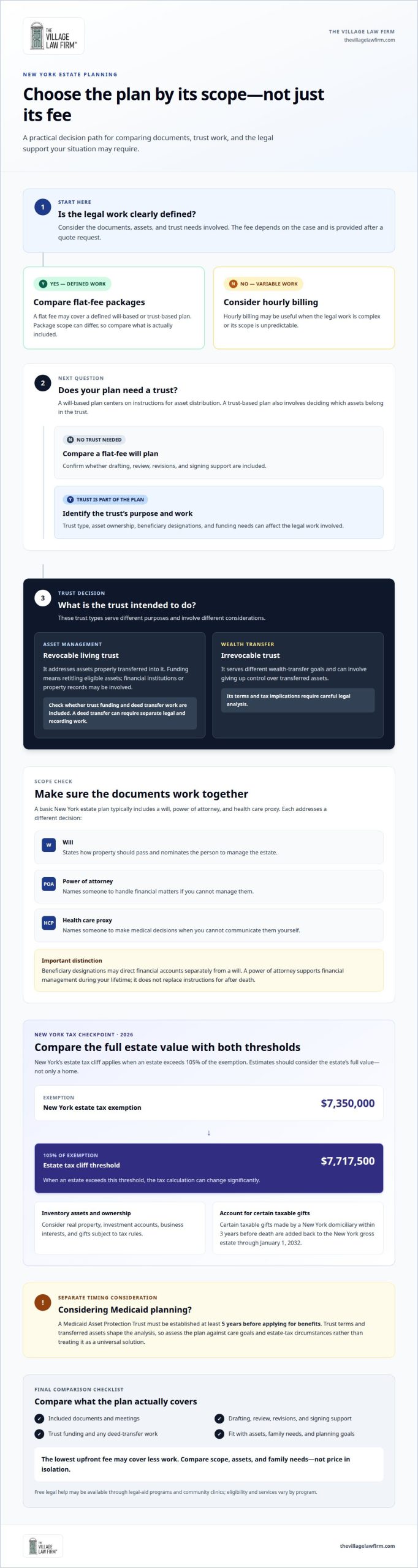
A New York estate and trust attorney may bill hourly for complex matters or offer a flat-fee package for defined work. Flat-fee wills and trust packages differ in scope: a will-based plan centers on instructions for asset distribution, while a trust-based plan also requires decisions about which assets belong in the trust. Compare drafting, review, revisions, and signing support. A fee depends on the case and is given after a quote request; scope, assets, and trust needs affect it.
When choosing affordable estate planning lawyers in NYC, compare the included documents, meetings, revisions, and guidance on trust planning. A lower quote may cover less work than a broader plan.
Trust Funding and Deed Transfer Costs
A revocable living trust only addresses assets properly transferred into it. Trust funding means retitling eligible assets, which may involve financial institutions and property records. A deed transfer can require separate legal and recording work, so clarify whether those steps are included. Funding distinguishes trust planning from a will alone.
An irrevocable trust serves different wealth-transfer goals and can involve giving up control over transferred assets. Its terms and tax implications require careful legal analysis. Trust type, asset ownership, and beneficiary designations all affect the work involved.
| Option | Scope | Key comparison |
|---|---|---|
| Flat-fee will | Will drafting | Confirm review and signing support |
| Revocable trust | Trust planning | Consider funding and deed work |
| Irrevocable trust | Wealth transfer | Assess control and tax implications |
| Hourly attorney | Variable legal work | Useful when scope is unpredictable |
| Free legal help | Program-dependent support | Eligibility and services may vary |
| Voluntary administration | Limited estate administration | Depends on estate property |
Free estate-planning help may be available through legal-aid programs and community clinics, with eligibility and services varying by program. According to the New York State Legislature, voluntary administration is available for estates with $50,000 or less in personal property and no real property.
Choose a plan by matching its scope to your assets, family needs, and desired trust structure.
New York estate tax exemption and cliff
For 2026, New York’s estate tax exemption is $7,350,000, according to the New York State Department of Taxation and Finance. The exemption is not the only planning consideration. New York’s estate tax cliff applies when an estate exceeds 105% of the exemption, a threshold of $7,717,500 for 2026. At that point, the tax calculation can change significantly, so estimates should consider the estate’s full value.
Tax planning starts with an inventory of assets and ownership, not just a home’s value. A New York estate may include real property, investment accounts, business interests, and gifts subject to tax rules. Certain taxable gifts made by a New York domiciliary within 3 years before death are added back to the New York gross estate through January 1, 2032. A consultation can help evaluate how those details affect a blended family or retirement plan.
Medicaid planning raises a separate timing question. A Medicaid Asset Protection Trust must be established at least five years before applying for benefits. That period makes early planning relevant for people considering long-term care, while trust terms and transferred assets shape the analysis. Assess a trust plan against care goals and estate-tax circumstances rather than treating it as a universal solution.
A New York attorney can assess an online will’s provisions, execution, and fit with assets or beneficiary designations. Online forms may not reflect a blended family’s needs or coordinate with a trust, creating conflicting instructions or an ineffective document. New York will execution requirements are addressed under EPTL 3-2.1, and the stated requirement includes two witnesses. Proper signing matters alongside the document’s content.
Low-cost or DIY planning can leave gaps between a will, trusts, and asset ownership, complicating administration for an executor or beneficiary. A legal review can identify mismatches and explain what the documents cover. Choose a plan based on tax exposure, family structure, and the legal work required, rather than price alone.
Documents included in an estate plan
A basic New York estate plan typically includes a will, power of attorney, and health care proxy. Each document addresses a different decision. A will states how property should pass and identifies the person nominated to manage the estate. A power of attorney names someone to handle financial matters if you cannot manage them. A health care proxy names someone to make medical decisions when you cannot communicate them yourself.
These documents work together, but they aren’t interchangeable. A will can address property distributed through the estate, while beneficiary designations on financial accounts may direct those assets separately. A power of attorney can support financial management during your lifetime, but it doesn’t replace instructions for after death. A health care proxy focuses on medical choices, not account access or inheritance. A planning meeting can clarify who should serve in each role and whether they understand your wishes.
Some plans add a trust to address how selected assets are managed or distributed. The right documents depend on the estate’s structure, family relationships, and goals. A straightforward plan may require fewer provisions than one involving a blended family, business interests, or beneficiaries with different needs. An attorney can coordinate the documents so names, responsibilities, and instructions align rather than conflict.
Review the estate plan every 3 to 5 years or after a major life event. Marriage, divorce, a child’s birth, a move, or a substantial change in financial accounts can make earlier choices outdated. Updates may involve changing an executor, revising a beneficiary plan, or replacing a decision-maker who is no longer able to serve. A change to one document can affect the others, so updates should consider the whole plan.
Changes to an estate plan should address a specific need, not add paperwork without purpose. Acquiring property or opening new accounts, for example, may prompt a review of ownership and beneficiary arrangements. A contested family situation may call for clearer instructions and careful coordination. At each review, an attorney can identify what still reflects your wishes, what needs revision, and whether a new document is appropriate.
Flat-fee estate planning tiers
Flat-fee plans define a particular scope of work, not a universal package. For affordable estate planning in NYC, focus on which documents, reviews, and related legal work each plan includes.
Flat-Fee Versus Hourly Billing
A flat fee sets the charge for agreed work, clarifying the scope before drafting begins. Hourly billing tracks time and may suit matters with unpredictable work, such as contested trusts, estate litigation, or planning across jurisdictions. Compare what triggers extra work, how revisions are handled, and whether trust funding or asset transfers fall within the agreed scope.
| Planning option | Typical focus | Compare |
|---|---|---|
| Will-based plan | Will and core documents | Review and signing support |
| Family-focused plan | Children and guardianship choices | Guardian provisions and roles |
| Revocable trust plan | Trust and related documents | Funding and transfer steps |
| Trust plus will | Coordinated trust and will | How assets are addressed |
| Retirement-account review | Account and beneficiary coordination | Whether account instructions align |
| Complex planning | Contested or multi-jurisdictional issues | Whether hourly work fits better |
Services Included in Flat Fees
Flat-fee services for standard estate plans may cover drafting, review meetings, revisions, signing, and notarization. A trust-based plan can require additional coordination, since creating a revocable trust differs from transferring assets into it. The written scope should distinguish document preparation from follow-up work involving property, financial accounts, or beneficiary designations.
Work outside the agreed scope can include later changes, contested matters, or complex transfers. A retirement account, for example, may require beneficiary coordination rather than retitling into a trust. Ask for the scope and billing method in writing, including how added work is handled. The price depends on the case and is given after a quote request; documents, asset structure, trust needs, and complexity affect it. Finding affordable estate planning in NYC means matching scope to your needs, not simply choosing the smallest package.
Choose the tier that matches your family structure, assets, and desired level of trust planning. To discuss a tailored flat-fee estate plan, consider the work your plan needs before selecting a scope.
The Village Law Firm
The Village Law Firm helps New York families bring estate-planning decisions into a clear, coordinated plan. Whether you’re weighing a will against a trust, considering how New York estate-tax rules affect your choices, or aligning documents with your family’s needs, legal guidance can clarify the work involved and the next steps.
Planning needs can change with family circumstances, long-term-care concerns, or the need to administer an estate. The Village Law Firm offers Estate Planning, Medicaid Planning, Planning For Families with Children, and Estate Administration. The right focus depends on your situation. A conversation can help identify which decisions belong in the plan and where documents or existing arrangements need attention.
For help considering your options, contact The Village Law Firm.
Make Your Next Planning Decision With Confidence
The next step is to turn your priorities into a plan that reflects your family, assets, and wishes. Consider whom you trust to make decisions, what you want those decisions to achieve, and which parts of your circumstances may change. These answers can help focus a conversation on what matters to you.
Finding affordable estate planning in NYC isn’t simply about choosing the smallest scope. It’s about understanding what you need, what each proposed service covers, and where legal guidance can bring your decisions together. If you’re ready to move from comparing options to planning, contact The Village Law Firm to discuss your needs.
Start a conversation with The Village Law Firm about your estate-planning goals. A thoughtful next step can make the process feel more manageable and help you move forward with greater clarity.
Frequently Asked Questions
What’s in the Package?
An estate-planning plan should spell out the documents and legal work it covers. Check whether it includes an initial review, drafting, revisions, a signing meeting, and follow-up questions. For example, a couple may need coordinated documents naming decision-makers for each other and their children. A trust plan may also address how assets are titled. The written scope helps you understand what the plan is designed to accomplish.
What Actually Drives the Cost Up?
Added complexity generally means more legal analysis and coordination. A plan involving a business, property held in different ways, international assets, or a blended family may require careful alignment across documents. Trust provisions can also increase the work if they need to account for different beneficiaries or distribution goals. Consider whether standard drafting is enough to address your circumstances accurately.
What Drives the Price Up or Down?
The scope of work is a central pricing factor. A focused will-based plan differs from one requiring trust design, asset coordination, or Medicaid planning. Individual or couple planning, family structure, and the need to revise existing documents also shape the work. Compare plans by included legal services and exclusions, not merely by document count. This helps show whether two proposed scopes are genuinely comparable.
Who Needs Only a Simple Will?
A simple will may suit someone whose wishes are straightforward, whose family arrangements are uncomplicated, and whose assets don’t call for trust planning. Someone seeking to name beneficiaries for property distributed through an estate, for example, may need a narrower plan than someone coordinating a business, a trust, or guardianship choices. A will doesn’t direct every asset automatically, so ownership and beneficiary arrangements still matter.
What Does Estate Planning Typically Cost in NYC in 2026?
There isn’t one typical total that fits every New York City estate plan. The amount depends on whether the work covers a will, trust design, document coordination, or more involved family and asset considerations. For a useful comparison, identify the outcome you need, then compare the legal work included in each proposed scope. A lower-cost package may cover fewer planning tasks, while a broader plan addresses more needs.
How Much Do NYC Attorneys Charge for a Will, Trust, Power of Attorney, and Health Care Proxy?
The fee depends on the documents and legal work involved, so a single figure wouldn’t describe every plan. A will-only matter differs from coordinated work involving a trust, power of attorney, and health care proxy. The Village Law Firm’s pricing depends on the case and is provided after a quote request. The documents needed, trust work, asset structure, and complexity affect the scope.