
A foreign inheritance can trigger U.S. reporting without making the inherited amount taxable income. For foreign inheritance tax issues for U.S. residents in NY, that distinction matters: for 2025, a U.S. resident generally must report foreign gifts and bequests on Form 3520 when the total received from a foreign individual or estate exceeds $100,000, according to the Internal Revenue Service. Income inherited assets earn after receipt may be taxable.
It’s understandable to want a clear answer before moving or using inherited assets. The tax result depends on what you inherited, whether it produces income, and which countries have a connection to the estate.
This article explains when a nonresident noncitizen’s U.S.-situated assets may bring estate tax into play, when Form 706-NA and a transfer certificate matter, and how to think ahead about an inheritance connected to multiple countries. The aim is to help you understand the obligations before making major decisions about the assets.
Key Takeaways
- For a non-U.S. citizen, estate tax exposure can depend on U.S. domicile and U.S.-situated assets, not just where the person lived or held property.
- Form 706-NA and a transfer certificate can matter when a nonresident noncitizen’s estate includes U.S. assets; the filing and transfer process depends on the estate’s details.
- Foreign accounts, investment income, and assets in multiple countries can bring separate reporting or administration considerations, so understand the obligations before making major financial decisions.
- Long-term planning can help coordinate estate administration and protect a legacy when family members or assets are spread across borders.
Do non-US citizens pay estate taxes?
Yes. U.S. estate tax may apply to a nonresident noncitizen’s U.S.-situated assets, while U.S. domicile can bring worldwide assets into the calculation.
Foreign Inheritance and Estate Taxes
Estate taxes are taxes on wealth transferred at death; they differ from income tax on earnings received after an inheritance. For a nonresident noncitizen, the general U.S. estate tax exemption is $60,000, and the maximum rate on U.S.-situs assets is 40%. By comparison, the Internal Revenue Service states that the 2025 U.S. estate tax exemption for U.S. persons is $13.99 million. The distinction can materially change an estate’s taxable amount.
Foreign inheritance and estate taxes may also arise in the country where the deceased lived or held property. Treaties between the United States and some countries may affect double-tax exposure or available exemptions. Separate probate proceedings may be needed where assets are located. In New York, courts may handle an international inheritance when the deceased was a New York resident or owned significant New York property, and may issue ancillary probate orders to help transfer those assets.
Domicile and Residency Status
For U.S. estate tax purposes, domicile generally means living in the United States, even briefly, without intending to leave. It is not simply a matter of citizenship or the address on a document. If a person is considered U.S.-domiciled, worldwide assets may be subject to U.S. estate tax; a nonresident noncitizen is generally taxed on U.S.-situated property instead.
That distinction matters for families with homes, accounts, or other interests in several countries. A will or trust from abroad may be recognized in New York if it meets applicable legal standards, but administration can still involve local court processes. Coordinating documents and asset ownership across jurisdictions can reduce friction for heirs.
Estate tax and account reporting are separate obligations. According to the Financial Crimes Enforcement Network, a U.S. person generally must file an FBAR if aggregate foreign account balances exceed $10,000 at any time during the year. An inherited foreign account may therefore require attention even when the estate tax analysis points elsewhere.
Frequently Asked Questions
Do I have to report inheritance on my taxes?
An inheritance may not be taxable income, but reporting may still be required. For New York residents, foreign inheritance tax issues often begin with separating reporting obligations from tax owed. Requirements depend on who sent the inheritance, its value, and whether the assets generate income after receipt. Keep estate distribution statements and bank records with your tax documents.
Do green card holders get estate tax exemption?
A green card alone doesn’t answer how estate tax applies. The key issue is whether the person was domiciled in the United States for estate tax purposes, which depends on residence and intent. For 2025, the Internal Revenue Service lists a $13.99 million estate tax exemption for U.S. persons. That exemption concerns the estate tax calculation, not whether a beneficiary must report an inheritance.
How much can a non-US citizen inherit?
A beneficiary’s non-U.S. citizenship alone doesn’t determine the amount they may receive. Tax exposure instead depends on the deceased person’s status, the estate’s assets, and where those assets are situated. For example, an inheritance that includes U.S. property may raise different estate tax questions from one consisting only of property abroad. The estate’s governing documents and applicable country rules also affect administration.
Is my estate subject to US tax?
Your estate’s U.S. tax treatment depends on your citizenship and domicile, along with the location and type of your assets. A person domiciled in the United States may have worldwide assets considered for estate tax; a nonresident noncitizen is generally subject to U.S. estate tax on U.S.-situated property. New York property and international holdings can also raise separate administration questions.
What forms do I have to fill out?
The required forms depend on the inheritance and assets involved. Form 3520 may apply to certain foreign gifts or bequests; FBAR or Form 8938 may apply to foreign financial accounts or assets. An estate executor may need Form 706-NA for a nonresident noncitizen’s U.S. estate. An inherited interest in a foreign company can also make Form 5471 relevant, depending on ownership and tax treatment.
Do U.S. residents owe U.S. tax on inheritance received from a foreign relative?
Usually, the inheritance itself isn’t U.S. income, but income the assets earn after receipt may be taxable. For example, rent from inherited foreign real estate or interest from an inherited account can require separate income tax reporting. Understanding foreign inheritance tax issues for U.S. residents in New York also means distinguishing the inheritance from later earnings. Keep transfer and valuation records to document the difference.
Form 706-NA filing and transfer certificates
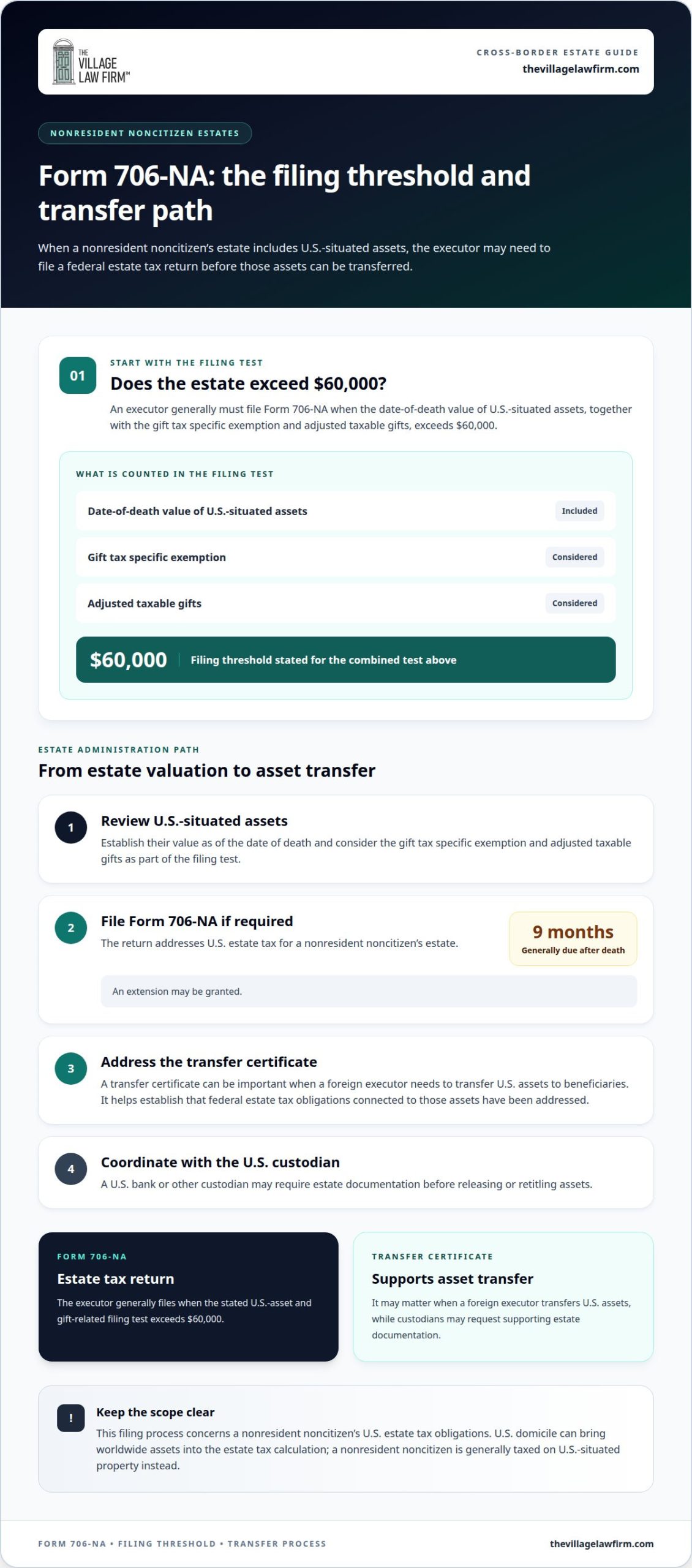
Form 706-NA addresses U.S. estate tax for a nonresident noncitizen’s estate. An executor generally must file when the date-of-death value of U.S.-situated assets, together with the gift tax specific exemption and adjusted taxable gifts, exceeds $60,000. The return is generally due within 9 months after death unless an extension is granted.
A transfer certificate can be important when a foreign executor needs to transfer U.S. assets to beneficiaries. It helps establish that federal estate tax obligations connected to those assets have been addressed. A U.S. bank or other custodian may require estate documentation before releasing or retitling assets, so the executor should coordinate tax filings with transfer records.
Form 3520 serves a different purpose: U.S. recipients use it to report certain foreign gifts and bequests, including reportable inheritances from foreign individuals or estates. Keep distribution statements, estate records, and transfer confirmations together to support the amounts reported. If the inheritance comes through a foreign trust, the trustee typically files Form 3520-A, while the U.S. beneficiary files Form 3520.
Late reporting can carry substantial penalties. For a reportable foreign gift or bequest, the Form 3520 Part IV penalty can be 5% per month, up to 25% of the reportable amount. Filing correctly and retaining evidence of submission helps document compliance; an extension for the income tax return generally extends the Form 3520 deadline.
An inherited interest in a foreign company may also raise a separate reporting question. Form 5471 may be relevant depending on the company’s U.S. tax treatment, the beneficiary’s ownership share, and other circumstances. The company’s country, ownership structure, and national tax rules can affect the analysis. A treaty or foreign tax credit may matter where tax overlaps, but neither replaces required U.S. reporting. Distinguish estate tax filings from beneficiary reporting before arranging a cross-border transfer.
Long-term planning for foreign inheritances
A foreign inheritance can shape financial decisions long after assets are transferred from the estate. For a New York beneficiary, planning means coordinating ownership, documents, and tax reporting across each country involved. Those systems differ, so a federal filing alone may not resolve administration or local obligations abroad.
Start with an asset map listing each account, property, company interest, and trust, along with its location and current owner. Then connect each asset to the governing will or trust and identify who is responsible for transferring it. An apartment in one country and an investment account in another may require separate probate proceedings, and transferring foreign real estate often calls for local conveyancing specialists like ASMA Property Services. Some countries also apply forced heirship rules, which reserve part of an estate for specified heirs.
Exchange rates can change the reported dollar value and the amount a beneficiary ultimately receives. Preserve valuation records and the conversion information used for each tax return, rather than relying on a later estimate. For an inherited investment fund, identify its U.S. tax classification before selling or restructuring it. A foreign fund classified as a PFIC may involve annual reporting, even when no investments are bought or sold.
Trust planning also needs a cross-border review. The trust’s terms, the location of its assets, and the beneficiaries’ residences can affect administration and reporting. The United States has estate and gift tax treaties with 15 countries, and treaty provisions may influence how overlapping tax rules apply. A plan should identify whether a treaty country is involved, without assuming the treaty resolves every tax issue.
Review the plan after a move, marriage, inheritance, or change in asset ownership. Update the asset map and document custodians, and confirm that the will and trust instructions still coordinate across jurisdictions. This helps keep worldwide interests organized before another transfer or estate administration begins.
For coordinated international estate planning, take the next step by bringing the cross-border assets and documents into one planning review.
The Village Law Firm
The Village Law Firm™ helps clarify estate planning and administration decisions that follow an inheritance across borders. When foreign assets, U.S. reporting questions, or separate probate processes overlap, an organized legal plan can help align estate documents with your family’s intentions and the administration of assets.
The Village Law Firm™ provides Estate Planning and Estate Administration for people preparing for future transitions and families managing an estate after a death. Planning for Families with Children and Medicaid Planning address other family and asset-protection needs that may shape a broader estate plan. The right next step depends on whether you’re planning ahead or managing an inheritance now.
Contact The Village Law Firm to discuss your estate planning or administration needs.
Put a Clear Plan in Place
Cross-border inheritance decisions can affect how your family manages assets and carries out your wishes over time. Addressing foreign inheritance tax issues for U.S. residents in NY is not only about completing current filings; it also means keeping your estate documents aligned with your financial circumstances and family priorities as they change.
The Village Law Firm™ provides Estate Planning and Estate Administration to help with planning ahead or managing an estate. Medicaid Planning can also support broader decisions about protecting assets and preparing for future care needs. Start with the question that matters most to you, whether that’s organizing your estate or bringing order to an inheritance process.
Take a considered next step: contact The Village Law Firm today to discuss your needs. A clear plan can make the path ahead feel more manageable.
Frequently Asked Questions
Do I have to report inheritance on my taxes?
An inheritance may not be taxable income, but reporting may still be required. Requirements depend on who sent the inheritance, its value, and whether assets generate income after you receive them. Keep estate distribution statements and bank records with your tax documents. For a foreign inheritance, reporting it and owing income tax are separate questions, so don’t treat one as proof of the other.
Do green card holders get estate tax exemption?
A green card alone doesn’t answer how estate tax applies. The key issue is whether the person was domiciled in the United States for estate tax purposes, which depends on residence and intent. For 2025, the Internal Revenue Service lists a $13.99 million estate tax exemption for U.S. persons. That exemption concerns the estate tax calculation, not whether a beneficiary must report an inheritance.
How much can a non-US citizen inherit?
A beneficiary’s non-U.S. citizenship alone doesn’t determine the amount they may receive. Tax exposure instead depends on the deceased person’s status, the estate’s assets, and where those assets are situated. For example, an inheritance that includes U.S. property may raise different estate tax questions from one consisting only of property abroad. The estate’s governing documents and applicable country rules also affect administration.
Is my estate subject to US tax?
Your estate’s U.S. tax treatment depends on your citizenship and domicile, along with the location and type of your assets. A person domiciled in the United States may have worldwide assets considered for estate tax; a nonresident noncitizen is generally subject to U.S. estate tax on U.S.-situated property. New York property and international holdings can also raise separate administration questions.
What forms do I have to fill out?
The required forms depend on the inheritance and assets involved. Form 3520 may apply to certain foreign gifts or bequests; FBAR or Form 8938 may apply to foreign financial accounts or assets. An estate executor may need Form 706-NA for a nonresident noncitizen’s U.S. estate. An inherited interest in a foreign company can also make Form 5471 relevant, depending on ownership and tax treatment.
Do U.S. residents owe U.S. tax on inheritance received from a foreign relative?
Usually, the inheritance itself isn’t U.S. income, but income the assets earn after receipt may be taxable. For example, rent from inherited foreign real estate or interest from an inherited account can create separate income tax reporting. A foreign inheritance may also require Form 3520 reporting, depending on its source and total value. Keep transfer and valuation records to distinguish inherited property from later earnings.