
U.S. citizenship alone doesn’t determine whether your estate owes tax. A nonresident alien’s U.S. estate is generally subject to federal estate tax on property situated in the United States, with a $60,000 exemption. The Internal Revenue Service sets estate tax rates for nonresident aliens at 18% to 40% above the exemption, so the US estate tax for a non-resident alien with US assets can be a significant planning concern.
It’s understandable to assume the rules for U.S. citizens also apply to foreign nationals, but the exemption and the assets included can differ. This guide explains how domicile affects U.S. tax status, which assets may count as U.S.-situs property, how the exemption and rates work, and how lifetime gifts may be treated. It also explains why the distinction between estate tax and gift tax matters when planning around U.S. property, investments, or transfers to family. These rules can help you identify issues to address in an international estate plan.
Key Takeaways
- Understand why tax domicile, not citizenship alone, can shape how U.S. estate tax rules apply.
- Learn which U.S.-situs assets may be included when assessing a nonresident alien’s estate.
- See how lifetime gifts of cash and intangible property can be treated differently for gift tax purposes.
- Explore how planning for children can fit into a broader strategy for coordinating U.S. assets and family wishes.
What is the federal estate tax exemption for non-residents in 2025?
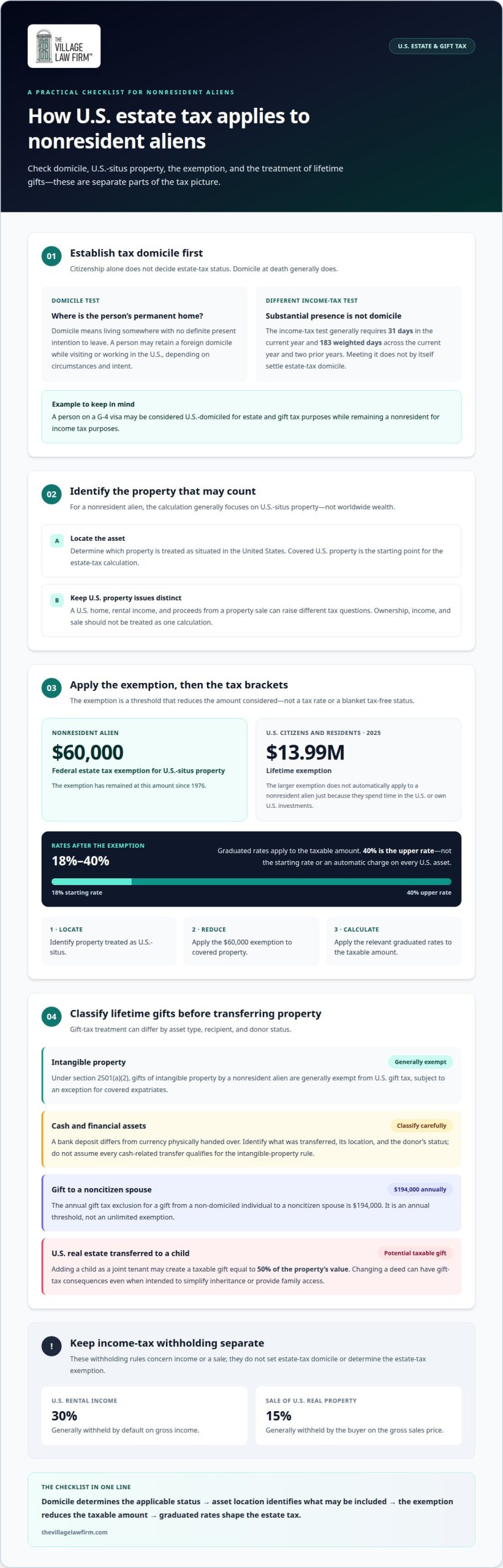
For a nonresident alien, the federal estate tax exemption is generally $60,000 for U.S.-situs property. That is far below the $13.99 million lifetime exemption available in 2025 to U.S. citizens and residents. The distinction matters: the larger exemption does not automatically apply just because someone spends time in the United States or owns U.S. investments.
Estate tax status generally turns on domicile at death, not citizenship alone. Domicile means living somewhere with no definite present intention to leave. A person may retain a foreign domicile while visiting or working in the United States, depending on their circumstances and intent. The key question is where they intend to make their permanent home, not simply where they have spent time.
Income tax residency uses a different test. For U.S. income tax purposes, the substantial presence test generally requires at least 31 days in the current year and 183 weighted days across the current year and two prior years. Meeting that test does not, by itself, settle estate tax domicile. A person on a G-4 visa, for example, may be considered U.S.-domiciled for estate and gift tax purposes while remaining a nonresident for income tax purposes.
Income from U.S. property also follows separate rules. According to the Internal Revenue Service, nonresident aliens’ U.S. rental income is generally subject by default to 30% withholding on gross income. A nonresident alien selling U.S. real property generally faces 15% withholding on the gross sales price by the buyer, according to the Internal Revenue Service. These are income-tax withholding rules, not the estate tax exemption; they do not determine domicile or the estate tax due at death.
For planning, separate three questions: where the owner is domiciled at death, which assets are situated in the United States, and which tax applies during ownership or sale. A U.S. home, rental income, and sale proceeds can raise distinct issues. Treating all three as one tax question can obscure how the $60,000 exemption applies.
Estate tax exemption and tax brackets
For a nonresident alien, the federal estate tax exemption is $60,000 for U.S.-situs property. The exemption has remained $60,000 since 1976. It reduces the value considered for federal estate tax; it does not make every U.S. asset tax-free. The calculation begins with covered U.S. property, rather than the owner’s worldwide wealth.
Treat the exemption as a threshold, not a tax rate. First, identify property treated as situated in the United States. Then determine its value for the estate tax calculation and apply the relevant exemption. The portion above the exemption may be subject to estate tax. The amount below it is not taxed under this calculation, although other filing or tax rules may still apply.
The Internal Revenue Service states that U.S. estate tax rates for nonresident aliens range from 18% to 40% after the exemption. These are graduated rates, so the tax calculation uses applicable rate brackets rather than simply applying the top rate to the entire estate. The 40% figure is the upper rate, not the starting rate or an automatic charge on every U.S. asset.
For example, consider an estate containing U.S.-situs property valued above $60,000. The taxable amount is determined after applying the exemption, and the applicable graduated rates then shape the tax. A precise liability depends on the value and classification of property included in the estate. The exemption alone cannot establish the final bill.
Keep the three parts distinct: asset location determines what may be included, the $60,000 exemption reduces the amount subject to tax, and the 18% to 40% brackets determine rates. This framework helps explain why two estates with similar total wealth may face different U.S. estate tax outcomes. Their U.S.-situs property and taxable amounts may differ, even when their worldwide assets appear comparable.
Lifetime gifts of cash and intangible property
Lifetime transfers can change who owns an asset before the donor’s death, but gift tax treatment depends on what is transferred. For a nonresident alien, U.S. gift tax generally distinguishes intangible property from tangible property. Under section 2501(a)(2), gifts of intangible property are generally exempt from U.S. gift tax, subject to an exception for covered expatriates. That exception makes the donor’s status relevant, not just the asset’s label.
Cash and financial assets need careful classification. A bank deposit, for example, differs from currency physically handed over. Before treating a gift as exempt, identify the property transferred, its location, and the donor’s status. Do not assume the intangible-property rule covers every transfer involving cash or every asset with financial value. Records describing the transfer can help establish what changed hands and when.
Gifts to a noncitizen spouse have a separate annual exclusion. For a gift from a non-domiciled individual to a noncitizen spouse, the annual gift tax exclusion is $194,000. This is an annual threshold, not an unlimited exemption for every transfer between spouses. The amount and nature of each transfer matter, particularly when a transfer combines cash with other property.
Transfers of U.S. real estate illustrate the contrast. If a nonresident alien adds a child as a joint tenant, the arrangement may create a taxable gift equal to 50% of the property’s value. That result differs from the general treatment of intangible property. A deed change can therefore have gift-tax consequences even when the owner intends only to simplify inheritance or provide family access.
Before making a lifetime transfer, classify the asset, identify the recipient’s relationship and status, and document the terms. Consider whether the gift is cash, another intangible asset, or U.S. real estate. Also determine whether the donor falls within the covered-expatriate exception. These distinctions help separate a potentially exempt intangible gift from a transfer that may need further gift-tax analysis.
U.S. estate tax on U.S.-situs assets owned by nonresident aliens
U.S. estate tax generally applies to a nonresident alien’s property situated in the United States. Asset location matters even when the owner’s family, home, and other property are abroad.
Taxation of U.S.-Situs Assets
U.S.-situs assets are property treated as located in the United States for estate tax purposes. A U.S. home or other U.S. real estate can bring estate tax consequences, while overseas assets are not automatically included in the U.S. estate tax base. According to the Internal Revenue Service, nonresident aliens are entitled to an annual gift tax exclusion of $19,000 per recipient in 2025. That exclusion applies to qualifying lifetime gifts, not to the estate tax calculation at death.
Form 706-NA Filing and Deadline
Form 706-NA is the federal estate tax return for a nonresident noncitizen’s estate. A filing obligation depends on the U.S. estate’s value and applicable tax rules; the deadline is measured from the date of death. Beneficiaries seeking a transfer certificate should coordinate the estate’s tax filings and supporting information with the IRS. For executors navigating complex IRS reporting or tax resolution requirements, working with professionals like CJ Business Solutions, LLC can help ensure accounting and filing compliance is properly handled. The certificate process matters because it can affect when U.S. assets held by financial institutions are released.
Cross-Border Estate Tax Calculation
When an estate includes property in several countries, the U.S. calculation focuses on assets treated as U.S.-situs, rather than automatically including worldwide property. The executor identifies and values those U.S. assets, then applies the relevant exemption and tax calculation. For example, U.S. real estate and overseas investment accounts should not be treated as one undifferentiated pool. Their location and classification affect what is included in the U.S. calculation.
Structures for Holding U.S. Assets
Ownership structures can affect how U.S. assets are treated, but they do not eliminate every tax risk. A foreign holding company is not a dependable estate-tax shield for U.S. real estate, and blocker structures face anti-inversion restrictions. A corporation or trust may also add administration and cross-border coordination needs. Consider the asset, intended beneficiaries, and tax consequences together before choosing how to hold U.S. property.
Plan your cross-border estate with coordinated attention to U.S. assets, overseas property, and beneficiary needs.
The Village Law Firm: Planning For Families with Children
The Village Law Firm™ helps families connect estate planning with the needs of raising children and owning assets across borders. Planning for Families with Children can address how your wishes for your children fit into a broader legacy plan, while Planning for Global Families considers the cross-border dimension of your assets.
This planning can be particularly relevant when your family, property, or financial interests span more than one country. Estate Planning can organize your wishes and assets, while Estate Administration can help manage the legal process after a death. A well-coordinated plan considers both the U.S. property that may raise estate tax questions and the people who depend on you.
If you’re ready to discuss your family’s estate planning needs, book an initial call with The Village Law Firm™.
Turn the tax picture into a coordinated plan
Your next step is to bring together ownership, family priorities, and the practical administration of your estate. A plan for U.S. estate tax for a non-resident alien with U.S. assets should account for where property is held, who is meant to receive it, and how those intentions fit across borders. Clear coordination can reduce uncertainty for the people who may need to manage your affairs.
The right approach depends on your assets, family circumstances, and existing arrangements. A focused conversation can help identify which parts of your plan need attention and how to align them. You don’t need to resolve every cross-border question at once. Start by setting out your priorities and the decisions you want your plan to support.
Contact The Village Law Firm to discuss your estate planning next steps. A thoughtful conversation can help you move forward with greater clarity.
Frequently Asked Questions
These answers are general informational content from The Village Law Firm™’s attorneys, not legal advice for an individual estate.
Do non-US citizens pay estate taxes?
Yes. Non-U.S. citizenship alone does not prevent U.S. estate tax from applying. For U.S. estate tax for a non-resident alien with U.S. assets, the key questions are whether the property is treated as U.S.-situs and whether the estate exceeds the applicable exemption. For example, an overseas resident who owns U.S. real estate may have U.S. estate tax considerations despite living outside the country.
Does estate tax apply to foreigners?
Yes, U.S. estate tax can apply to a foreign national’s U.S.-situs property. Consider someone who lives abroad but owns a home in New York: the property’s U.S. location may create federal estate tax exposure. The owner’s domicile at death also matters. Immigration status, citizenship, and income tax residency do not, on their own, resolve the estate tax question.
How much can a non-US citizen inherit?
There is no single inheritance limit for every non-U.S. citizen. The amount depends on the deceased person’s estate plan, asset ownership, and applicable estate tax. A will or trust may direct who receives property, while beneficiary designations can govern certain assets. For a New York family receiving property from overseas, coordinating these documents can clarify intended distributions and reduce confusion during administration.
Is my estate subject to US tax?
Your estate may face U.S. estate tax if you are not a U.S. citizen and own property treated as situated in the United States. Key considerations include your domicile at death, the assets’ location and classification, and their value. A New York residence, for example, deserves attention alongside overseas accounts and property when assessing your estate’s U.S. tax exposure.
What qualifies as U.S.-situs property for a nonresident alien’s estate tax?
U.S.-situs property is an asset treated as located in the United States for estate tax purposes. U.S. real estate is a clear example to examine. Other holdings require attention to their legal form and location, not simply the owner’s residence or where records are kept. For a cross-border estate, classifying each asset helps establish which property enters the U.S. tax calculation.
What is the U.S. estate tax exemption for nonresident aliens?
The federal estate tax exemption for a nonresident alien is generally $60,000 for U.S.-situs property. This differs substantially from the exemption available to U.S. citizens and residents. The exemption reduces the amount subject to estate tax; it doesn’t determine tax by itself. The estate’s asset classification and value, along with applicable graduated rates, shape the final calculation.