
Yes, estate planning can help you choose who will make financial and health care decisions if you’re unable to act, and who will receive your assets after death. Peace of mind estate planning in New York matters because, without a will, state intestacy laws determine how many assets are distributed. A plan puts your choices in writing before others have to make difficult decisions for you.
It’s natural to focus on what happens to your property, but planning also addresses illness or disability. Clear documents can help the people you choose understand your wishes and the responsibilities you entrust to them.
This article explains when an estate plan may help, what wills and trusts can address, and how New York planning can cover health care decisions, incapacity, and death. It also explains why major life changes are a practical time to review your plan, so your documents keep pace with the people and priorities that matter to you.
Key Takeaways
- Review your estate plan after major life changes and revisit it every few years to keep it aligned with your circumstances.
- Consider how wills and trusts address asset distribution, privacy, and the needs of children or family members.
- Choose trusted people to communicate your health care wishes and make decisions if you can’t speak for yourself.
- Plan for disability as well as death by considering who could manage financial matters and carry out your wishes.
Do I need an estate plan?
An estate plan can record your choices for disability and death, not just the distribution of property. In New York, many assets may pass under state intestacy laws if you die without a will or estate plan.
Who Needs an Estate Plan
Adults with assets, children, health care preferences, or trusted decision-makers to appoint can benefit from planning. At age 18, a person is generally a legal adult in most states, so parents may need to revisit how they support an adult child. A will can name guardians for minor children and direct how assets are distributed. Consider whether your current documents reflect your loved ones and priorities.
Steps for Creating or Updating a Plan
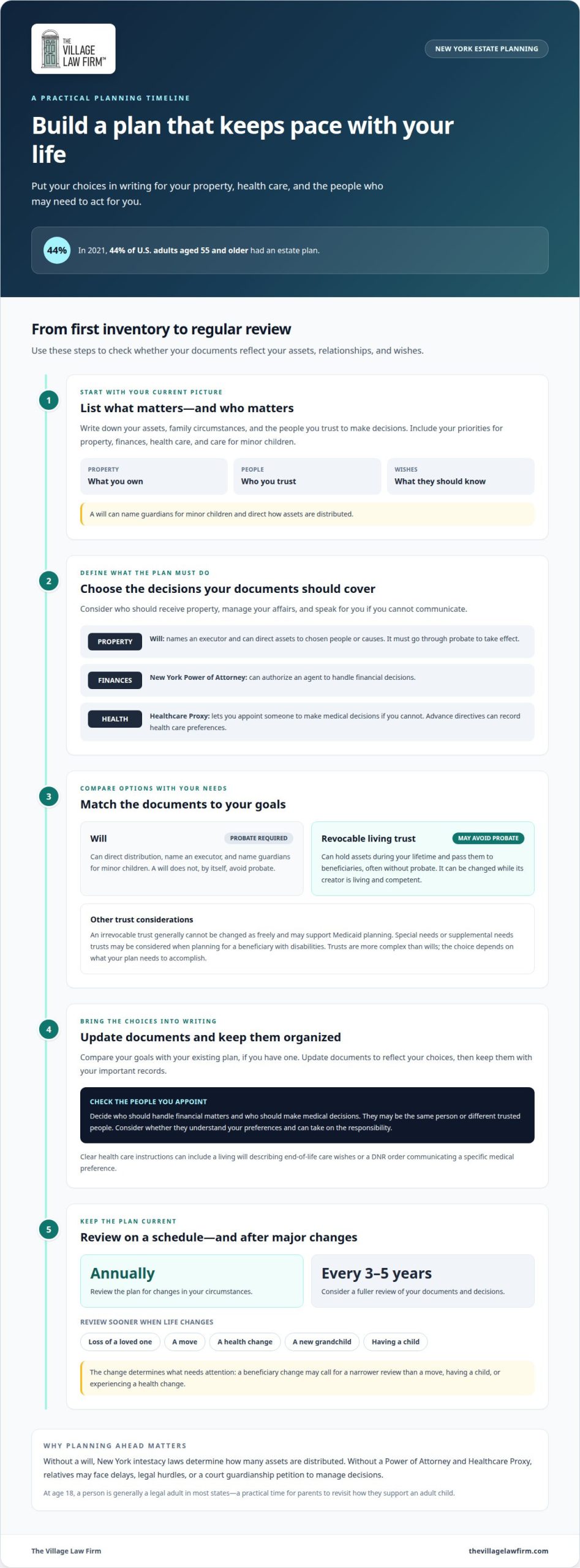
Start by listing your assets, family circumstances, and the people you trust to make decisions. Identify what your documents should address: who receives property, who manages your affairs, and who cares for minor children. Compare those goals with your existing plan, if you have one. Update documents to reflect your choices and keep them with your important records.
Review the plan annually for changes in your circumstances, but consider a fuller review every 3-5 years. In 2021, 44% of U.S. adults aged 55 and older had an estate plan. A review can show whether the plan still reflects your assets, relationships, and wishes. The loss of a loved one, a move, a health change, or a new grandchild can prompt an earlier review.
When reading reviews of Peace of Mind Estate Planning, look for specific comments about clarity, organization, and how updates were handled rather than relying on general praise alone.
A discounted update should not be the only factor in deciding what to revise. Changing a beneficiary may call for a narrower review than moving, having a child, or experiencing a health change. First identify which documents and decisions need attention. The scope of that work determines what an update involves.
What is estate planning?
An estate plan coordinates documents that direct what happens to your assets and who can act for you. For peace of mind, estate planning in New York should reflect your family, property, and priorities, rather than rely on a single document.
Wills, Trusts, and Probate Planning
A will names an executor and can direct assets to chosen people or causes. It can also name guardians for minor children and explain how personal belongings should be distributed. A will must go through probate to take effect, so it does not, by itself, avoid probate. A revocable living trust can hold assets during your lifetime and pass them to beneficiaries, often without probate. A New York Power of Attorney and Healthcare Proxy address financial and medical decisions, respectively.
Trust Options for Family Needs
Trusts can help organize complex assets and clarify how property should pass when family expectations differ. A revocable trust can be changed while its creator is living and competent. An irrevocable trust generally cannot be changed as freely and may support Medicaid planning by protecting certain assets from long-term care expenses while preserving eligibility. Special needs or supplemental needs trusts may be considered when planning for a beneficiary with disabilities. Their terms should reflect that person’s circumstances and the family’s goals. Trusts are more complex than wills, so the right choice depends on what your plan needs to accomplish. Peace of mind estate planning in New York considers how each option fits your family’s needs.
New York Estate Tax Rules
For 2026, estate tax planning centers on the applicable New York exclusion amount and the estate’s taxable value. The threshold is a key consideration for larger estates, alongside asset ownership and transfer arrangements. A careful review considers how wills, trusts, and beneficiary arrangements work together. For estates with substantial assets or complicated family needs, estate planning for complex family and asset needs can help organize these decisions and documents.
Medical powers of attorney and health care directives
In New York, a Healthcare Proxy lets you appoint someone you trust to make medical decisions if you can’t make them yourself. A Power of Attorney can authorize an agent to handle financial decisions. These documents serve different purposes, so consider who should speak for you about treatment and who should manage your finances. The Village Law Firm™ is based in New York City and serves New York residents.
Without a Power of Attorney and Healthcare Proxy, relatives may face delays, legal hurdles, or a court guardianship petition to manage decisions. Consider whether the people you choose understand your preferences and can take on their responsibilities. Discuss how financial and medical authority should be assigned, and whether one person or different trusted people should serve.
Advance directives can record health care preferences for a time when physical or mental incapacity prevents you from communicating. A living will can describe end-of-life care wishes, while a DNR order can communicate a specific medical preference. Discuss the choices that matter to you with the people you appoint. Clear instructions can guide them when decisions become difficult.
When choosing an estate-planning attorney, start by identifying the decisions your documents need to cover. Explain your health care wishes, financial concerns, family circumstances, and long-term care questions. An attorney can help prepare documents that address those priorities and explain how a Power of Attorney and Healthcare Proxy work together. Ask for a clear explanation of each document’s purpose, the authority it grants, and how your named agents should use it. This discussion can help you determine whether existing documents still reflect your wishes and chosen decision-makers.
In New York, a Power of Attorney and a Healthcare Proxy let you appoint trusted people to make financial and medical decisions on your behalf if you cannot. A medical power of attorney lets you designate someone to make medical decisions if you become unable to do so. Advance directives such as living wills and DNR orders can communicate your health care preferences clearly and legally.
In the United States, colleges and medical providers generally cannot share an adult student’s or patient’s information with a parent unless the adult authorizes it. This privacy boundary makes it useful to discuss not only who may make decisions, but also who may receive information, before a crisis arises.
Disability and death planning
Planning for disability and death addresses two different periods: when you’re alive but unable to manage your affairs, and after you die. A financial Power of Attorney can authorize an agent to manage bank accounts, pay bills, collect debts, handle investments, and buy or sell real estate. Choose someone who understands your priorities and can manage these responsibilities. Clear authority can help that person act on your behalf.
Without advance planning, a court may appoint a guardian to manage your affairs. That process can be time-consuming and emotionally difficult for families. For example, an unexpected illness could leave bills unpaid while family members are unsure who can access accounts. A Power of Attorney can name an agent in advance, while a Healthcare Proxy addresses medical decisions. Keep these roles distinct when choosing who should handle each responsibility.
Planning for death focuses on how your wishes should be carried out and who will handle the work. A will can name an executor to oversee its instructions, including distributing assets and addressing debts. Parents can name a guardian for minor children, while a different person can oversee a child’s finances. If you own a business, succession planning can address who takes ownership and manages it if you die unexpectedly.
Connect these documents to real-life needs. Name a primary decision-maker and consider an alternate if your first choice can’t serve. Review whether your executor, agent, and guardian still fit your family’s circumstances after a move, health change, or other major transition. An older loved one’s need for long-term care may also make asset and care planning more urgent. For coordinated guidance, plan for disability and death with estate planning support.
A Power of Attorney can authorize an agent to act if its grantor becomes incapacitated. Without planning, guardianship may involve court proceedings and strain on the family. The firm says many families exhaust their assets within a year after an older loved one needs long-term or nursing home care.
The Village Law Firm
The Village Law Firm™ helps New York individuals and families bring their wishes, decision-makers, and assets into a coordinated plan. Consider turning to the firm when marriage, a new child, a health change, a move, or evolving family needs prompt you to create or revisit your arrangements.
Estate Planning can address decisions during incapacity and after death, while Planning for Families with Children can help parents consider guardianship and their children’s future needs. Medicaid Planning may be relevant when long-term care could affect family assets. If a loved one has died, Estate Administration can help with the work of carrying out the estate.
Every situation calls for a plan shaped around its circumstances, not a one-size-fits-all set of documents. Contact The Village Law Firm™ to discuss your estate planning needs.
Give Your Plan a Clear Next Step
Peace of mind estate planning in New York begins with deciding which unresolved choice matters most to you. Perhaps you want to clarify who should act for you, align family priorities, or understand how care needs may affect your plans. Start with that decision, then let it guide a focused conversation about your next steps.
The Village Law Firm™ offers Estate Planning, Estate Administration, and Medicaid Planning to address needs during life and after a loss. Seek guidance when a life change raises new questions or your existing arrangements no longer reflect your priorities. You don’t need every detail settled before beginning. A clear starting point can make the process more manageable.
Take the next step at your pace. Contact The Village Law Firm to discuss what matters to you and begin shaping a plan around it.
Frequently Asked Questions
What risks can arise from not having an estate plan in New York?
Without a plan, New York law may determine how many of your assets are distributed instead of your personal instructions. Your family may also lack a designated person to handle financial or health care decisions if you become incapacitated and may need court involvement. For example, relatives could be unsure who can manage household bills while you’re unable to act.
What are New York’s estate tax thresholds and estate tax rules for 2026?
For 2026, New York estate tax planning centers on the applicable exclusion amount and the estate’s taxable value. Asset ownership and transfer arrangements should also be considered.