
A trust can hold more than a home, but some assets are better handled another way. The answer to what assets go into a trust may include real estate, bank and non-retirement investment accounts, business interests, and personal property. Retirement accounts generally stay in the account holder’s name, though a trust may be named as beneficiary.
It’s natural to want a clear list, especially when your home, business, and family possessions each require different treatment. Match each asset to how it is owned, how it should pass to beneficiaries, and any rules that apply.
This article explains which assets may fit in a revocable trust, how to transfer a home or business interest, and why ownership details matter. It also explains how a pour-over will can direct certain assets left outside the trust into it, although those assets may still have to go through probate. Understanding that distinction can help you decide what belongs in the trust and what needs a different plan.
Key Takeaways
- Retirement accounts usually remain in the account holder’s name; beneficiary designations need to align with the wider estate plan.
- Putting a home into a trust involves changing its title, and a mortgage can add paperwork and coordination.
- Business interests may support succession planning, but the company’s governing documents can restrict transfers.
- A pour-over will can direct property left outside a trust into it, though that property may still pass through probate.
What Assets Can and Cannot Be Placed in a Revocable Trust?
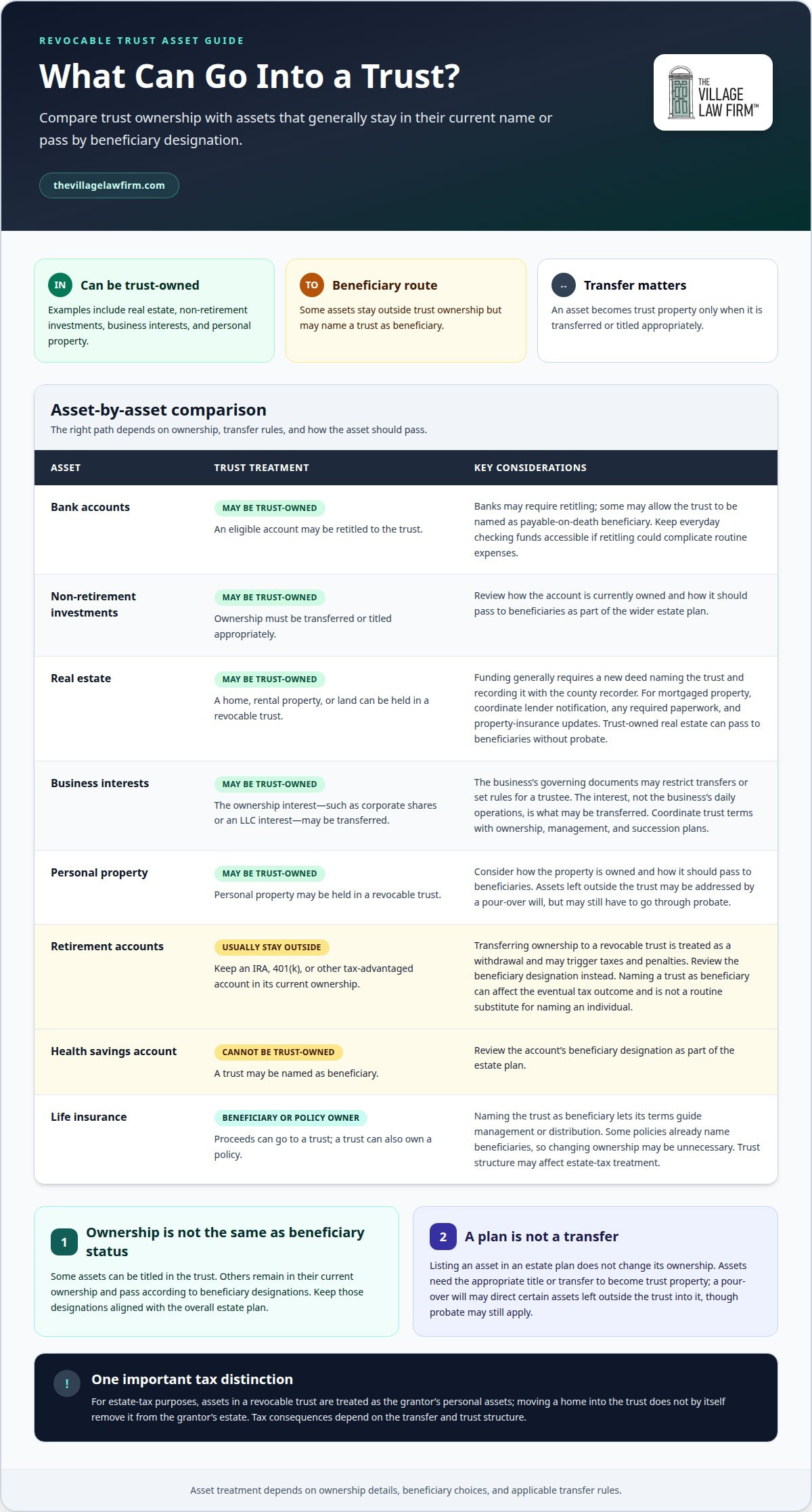
A revocable living trust can hold bank accounts, non-retirement investments, real estate, and personal property. The grantor creates the trust and may serve as trustee, managing its assets during life. If the grantor becomes unable to manage them, a successor trustee can take over. Beneficiaries receive assets under the trust’s terms. To become trust property, assets must be transferred or titled appropriately.
Retirement accounts require different treatment. Don’t retitle an IRA, 401(k), or other tax-advantaged retirement account into a revocable trust. Transferring ownership is treated as a withdrawal and may trigger taxes and penalties. Instead, keep the account in its current ownership and review its beneficiary designation. Naming a trust as beneficiary can affect the eventual tax outcome, so the trust terms and distribution plan matter. Integrating these accounts into a broader strategy with professionals like Evergreen Wealth Management helps ensure that pre- and post-retirement assets fit cleanly into your long-term plan.
Beneficiary designations also determine how some assets pass. Retirement accounts with named beneficiaries generally pass according to those designations, not through the trust’s ownership. Update the custodian’s records after family changes or revisions to your estate plan. Naming a trust as beneficiary may give you more control over distributions, but it is not a routine substitute for naming an individual. For broader guidance on structuring retirement products and lifelong income vehicles within a comprehensive financial plan, zenithwealthgroup.asia offers in-depth analysis on retirement planning options.
Life insurance proceeds can also go to a trust. Naming the trust as beneficiary allows its terms to guide how proceeds are managed or distributed over time. Some policies already name beneficiaries directly, so changing policy ownership may be unnecessary. A trust can also own a policy, but its structure may affect estate tax treatment. The right approach depends on how you want proceeds controlled and distributed.
Other accounts need individual review. A trust cannot own a health savings account, but it may be named as beneficiary. Banks may require an eligible account to be retitled, while others may allow a trust to be named as payable-on-death beneficiary. Keep everyday checking funds accessible if retitling could complicate routine expenses. These distinctions help determine what belongs in the trust and what should pass through beneficiary designations.
Real estate and mortgaged property in a trust
A primary residence, rental property, or land can be held in a revocable trust. Funding steps vary by state, and transferring real estate generally requires a deed recorded with the county recorder.
Funding Real Estate Through a Deed
To fund a trust with real estate, transfer the title by preparing a new deed. The deed names the trust as owner, and recording it with the county recorder documents the change. Simply listing a home in an estate plan does not transfer ownership. The property must be properly funded for the trust to provide its intended benefits.
Mortgaged Property in a Trust
A home with a mortgage can be retitled in a revocable trust’s name. The mortgage remains part of the property’s circumstances, and the lender may require additional paperwork. Coordinate the transfer with lender notification and updates to property insurance. This helps keep ownership records and insurance information aligned after the deed changes.
Tax treatment depends on the type of trust. For estate-tax purposes, assets in a revocable trust are treated as the grantor’s personal assets, so transferring a home into the trust does not, by itself, remove it from the grantor’s estate. An irrevocable trust may offer transfer-tax benefits, and qualifying assets and appreciation may be sheltered from estate tax. Gift and estate tax consequences depend on the transfer and trust structure.
Property in another state can complicate estate administration if it remains outside the trust. Trust-owned real estate can pass to beneficiaries without probate, helping simplify the handling of property in multiple states or counties. An estate plan that accounts for each property’s location can clarify how it should transfer and who will manage it. For coordinated estate planning for real estate, consider how the deeds fit the broader plan.
Business ownership interests
A revocable trust can hold a business ownership interest, such as corporate shares or an LLC interest. The interest, rather than the business’s daily operations, is what may be transferred. Placing it in the trust during the owner’s lifetime can help organize management if the owner becomes unable to act. The trust can also specify how beneficiaries receive the interest or its value.
Transfer rules depend on the business’s governing documents. An LLC operating agreement or corporate documents may restrict ownership changes, while a partnership agreement may set its own limits. For example, an agreement may specify whether a trustee can hold an owner’s interest or what happens after the owner’s death. Review those terms alongside the trust to make sure the planned transfer and later distribution fit the business’s structure.
Cryptocurrency connected to a business also needs a clear management plan. A trustee responsible for cryptocurrency held in trust should be comfortable managing it or have authority to hire someone with relevant expertise. Plan for how the interest will be managed and distributed instead of assuming that naming a successor trustee alone resolves practical access and management issues.
Succession planning is a key reason to place business interests in a trust. If an owner dies or becomes unable to manage their affairs, a successor trustee can act under the trust’s terms, supporting continuity and an orderly transfer to beneficiaries. This may help the trust-owned interest avoid probate, but it does not replace the company’s governing documents or settle operational decisions automatically. A family-owned corporation, for example, may need to coordinate its ownership plan with who will run the company.
Business and organization interests belong in an estate plan only after considering their transfer terms and management needs together. The trust addresses ownership, successor trustees, and beneficiary distributions; corporate, LLC, or partnership documents may determine who can hold or manage the interest. Aligning these documents helps prevent a planned transfer from conflicting with the organization’s rules.
Tangible personal property and pour-over wills
A revocable trust can hold personal property, from household furnishings to valuable collections. A pour-over will can address property left outside the trust at death.
Personal Property and Collectibles
Personal property and collectibles include artwork, antiques, jewelry, and family heirlooms. Assigning valuable pieces to a trust can clarify who receives them and how they are managed. For example, a collection of paintings can be identified as trust property, while everyday belongings may be handled together. Clear records connect each item to its intended distribution.
Personal Belongings and Valuables
Putting belongings in a trust means arranging for them to become trust property, rather than relying only on informal instructions. Jewelry, heirlooms, or a valuable watch may need specific identification if beneficiaries could have different expectations. The trust’s terms can direct distribution, while a separate letter of intent can express preferences for items handled outside the trust. An attorney can help coordinate these choices with your estate plan.
Personal Property Assignments
A personal property assignment transfers covered belongings to the trust. It can be useful for ordinary household items that do not need separate, item-by-item listings. The assignment should match the trust documents and describe the property it covers. Keep it with the trust records so the trustee can identify the belongings intended to be included.
A pour-over will serves as a backstop for assets left outside an existing trust. It directs those assets into the trust after death, but they still go through probate. For example, a personal item acquired after the trust was funded may be covered by the will, but it will not pass through the trust without probate. Retirement accounts pass according to beneficiary designations, not a personal property assignment.
Plan how personal property fits your trust and intended distribution.
The Village Law Firm
The Village Law Firm™ helps New Yorkers coordinate trust and asset decisions as part of an estate plan. If you have questions about ownership or transferring a home, business interest, financial account, or personal property, estate planning can clarify how the pieces fit together. The firm also provides estate administration to help families manage the practical responsibilities that follow a death.
A thoughtful plan considers more than which assets may go into a trust. It coordinates ownership, beneficiary designations, trust terms, and how assets should pass to beneficiaries. This can be especially useful when you have different types of property or family needs that call for careful planning. The goal is a clear structure that reflects your wishes and gives trustees practical direction.
Contact The Village Law Firm to discuss how your assets can fit into an estate plan.
Make Your Estate Plan Work as One
Deciding what assets go into a trust is one part of a broader planning conversation. Consider how your choices fit together over time, particularly as family circumstances, priorities, or responsibilities change. A clear plan gives you a framework to revisit those decisions carefully, rather than leaving important details disconnected.
The Village Law Firm™ helps individuals and families in New York bring these considerations into an estate plan. Its services include Estate Planning, Estate Administration, and Medicaid Planning, addressing different needs as you plan for the future or manage an estate. Thoughtful legal guidance can help you understand how each decision relates to your broader intentions.
You don’t need every detail resolved before beginning a conversation. Bring the questions that matter most, and take the next step toward a plan that reflects your priorities. Contact The Village Law Firm to discuss your estate planning needs.
Frequently Asked Questions
These answers provide general information from The Village Law Firm™ attorneys, not individualized legal advice.
Can you put a 401K or an IRA in a trust?
No. Keep a 401(k) or IRA titled in the account holder’s name; transferring it into a trust is treated as a withdrawal and can trigger taxes and penalties. You can name a trust as beneficiary instead, but that choice affects how proceeds are managed and distributed. For example, trust terms can direct distributions over time rather than giving a beneficiary immediate control.
What is a living trust?
A living trust is a legal arrangement created during your lifetime to hold assets for beneficiaries. The grantor creates it, a trustee manages its property, and beneficiaries receive assets under its terms. With a revocable trust, the grantor can amend or dissolve it while mentally competent. If the grantor becomes unable to manage the assets, a successor trustee can take over.
Why should you establish a trust?
A trust can set out how to manage assets during your lifetime and distribute them after your death. It can also help assets held in the trust pass privately, without public court records. For example, a successor trustee can manage trust property if you become unable to handle financial matters. The trust’s value depends on its terms and the assets placed in it.
Why would a person want to set up a trust?
A person may want clearer control over when beneficiaries receive assets and how those assets are used. For example, trust terms can direct that a beneficiary receive money after turning 18 and use it for college tuition. A trust can also be amended to add a beneficiary, such as a grandchild. These choices let the plan reflect family priorities rather than relying on an unrestricted lump-sum distribution.
What assets can be placed in a trust?
A trust can hold eligible assets such as bank accounts, non-retirement investment accounts, vehicles, land, and personal property. Business interests and cryptocurrency may also be considered, with the trustee’s management responsibilities in mind. Retirement accounts generally remain outside the trust, though a trust can be named as beneficiary. A trust cannot own a health savings account, but it may be named as beneficiary.
How do you transfer real estate into a living trust?
Transferring real estate generally involves preparing a new deed that names the trust as owner and recording it with the county recorder. The deed must reflect the intended change in title. For mortgaged property, coordinate the transfer with lender notification and any requested paperwork, and update the insurance policy. Deed preparation and recording requirements vary by state, so the property’s location matters.