Inheritance is generally separate property in a New York divorce, but that protection can weaken if inherited assets are mixed with marital funds or property. Protecting an inheritance from divorce in NY means preserving its separate character and keeping clear records that trace it. A prenuptial agreement can also set out how existing or future inheritances will be treated.
It’s understandable to want to protect family wealth without adding uncertainty to an important relationship. This article explains New York’s separate-property rules, how commingling and financial contributions can affect an inheritance, and what a prenuptial agreement may provide. It also explains why clear records and careful planning matter when inherited assets are involved.
Key Takeaways
- Inheritance is generally separate property under New York law, but the spouse claiming that status must be able to prove it.
- Mixing inherited funds with shared accounts or using them for jointly owned property can make their separate character harder to establish.
- Account records and documents showing an inheritance’s value and history can help trace assets and support a separate-property claim.
- A prenuptial or postnuptial agreement can address inheritances, but New York requires the agreement to meet formal legal requirements.
Is Inheritance Marital Property in a New York Divorce?
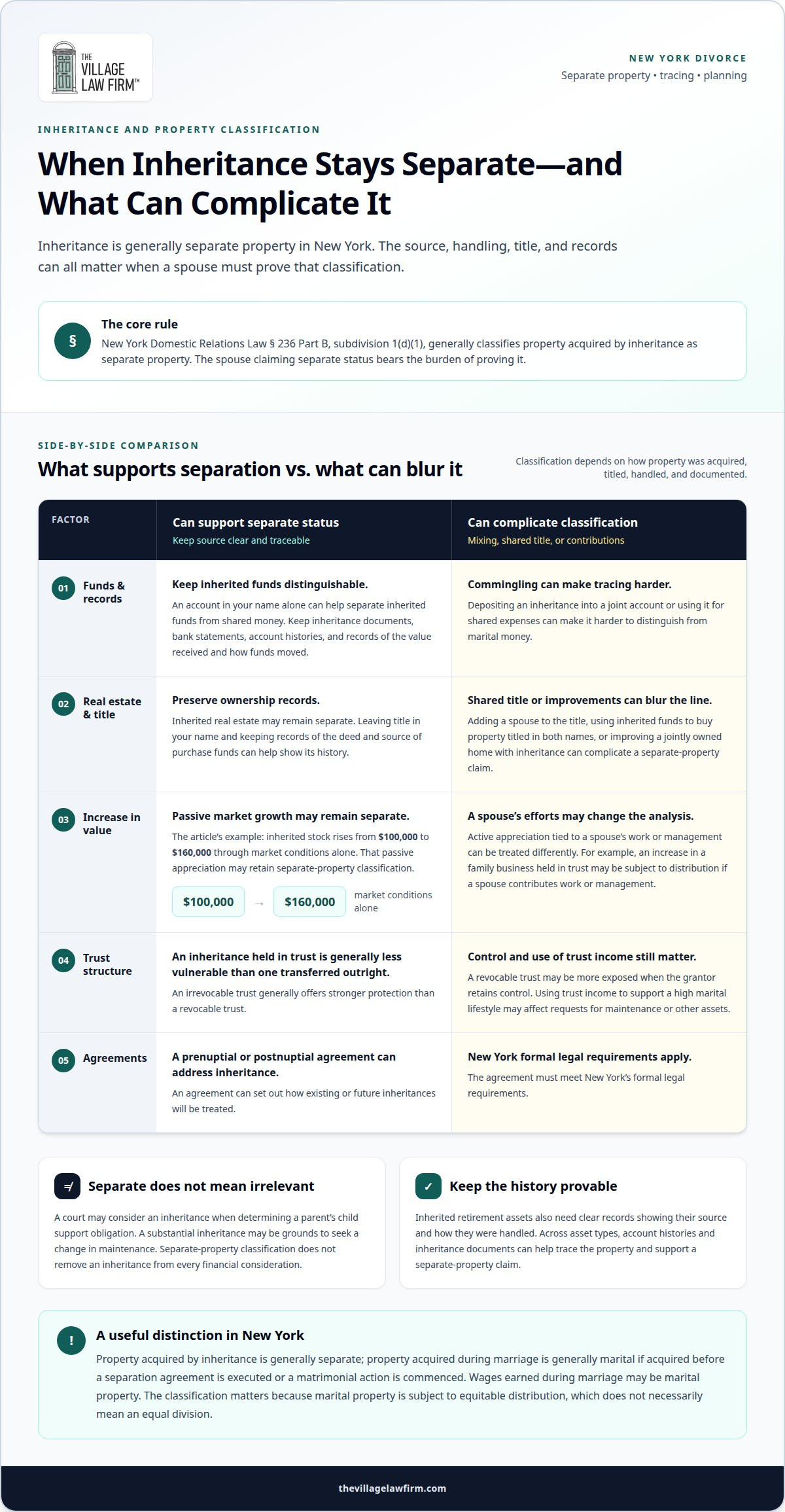
Inheritance is generally separate property in New York, but commingling can complicate how assets are classified. Records and account histories can help show whether inherited funds remained separate.
Commingling Inherited Assets
Commingling occurs when inherited assets are mixed with marital funds or property. For example, depositing an inheritance into a joint account or using it for shared expenses can make it harder to distinguish from marital money. Retitling a home bought with an inheritance to include a spouse, or using inherited funds to improve a jointly owned home, can also blur that line. The resulting classification can affect property division.
Keeping Inheritance Separate and Traceable
Keeping inherited assets separate means preserving a clear record of their source and avoiding unnecessary mixing with marital finances. An account in your name alone can help distinguish inherited funds from shared money, while bank statements, account histories, and inheritance documents can help trace them. Keep records showing the value received and how the funds moved. If inherited real estate is involved, leaving title in your name can help preserve its separate character.
Appreciation of Inherited Assets
Appreciation is the increase in an inherited asset’s value after receipt; its treatment can depend on what caused the increase. Passive growth from market conditions may remain separate property. For example, inherited stock rising from $100,000 to $160,000 through market conditions alone may retain that classification. Active appreciation tied to a spouse’s efforts can be treated differently. If a spouse contributes work or management to a family business held in trust, the resulting increase may be subject to distribution.
Inheritance in Maintenance, Retirement Accounts, and Trusts
Separate-property classification doesn’t remove an inheritance from every financial consideration. A New York court may consider an inheritance when determining a parent’s child support obligation, and a substantial inheritance may be grounds to seek a change in maintenance. Inherited retirement assets also require clear records to establish their source and trace how they were handled. Trust structure matters: an inheritance held in trust rather than transferred outright is generally less vulnerable in divorce. A revocable trust may be more exposed when the grantor retains control, while an irrevocable trust generally offers stronger protection. However, using trust income to support a high marital lifestyle may affect requests for maintenance or other assets.
New York’s treatment of inheritance as separate property
Yes. In a New York divorce, inheritance received by one spouse is generally separate property, not marital assets divided between spouses. Under New York Domestic Relations Law § 236 Part B, subdivision 1(d)(1), property acquired by inheritance is generally separate. This rule covers inherited funds and other property received from someone other than a spouse.
That classification differs from the general treatment of property acquired during marriage. The source of an asset matters: an inheritance comes from someone other than a spouse, while wages earned during marriage may be considered marital property. In a New York divorce, the spouse claiming an asset is separate bears the burden of proving that claim. Classification can affect which property is included in equitable distribution.
Using inherited funds to acquire property titled in both spouses’ names can complicate a separate-property claim. Joint title may indicate shared ownership, even if one spouse supplied the inherited funds. The court may consider how the asset was acquired, titled, and treated during the marriage. That analysis goes beyond asking who initially received the inheritance.
For example, an inherited apartment abroad raises questions about ownership and location, while a custody dispute involving another country is a separate legal matter. The 1980 Hague Convention governs international custody disputes and provides for a child’s return to their country of habitual residence. It does not determine whether an inheritance is separate property in a New York divorce. Keeping the property issue distinct from custody helps clarify what each legal question concerns.
Families with assets in multiple countries may benefit from coordinated planning around how those assets are held and passed on. International estate planning can address cross-border legacy considerations alongside a broader estate plan.
New York’s separate-property and marital-property rules
New York classifies assets as separate or marital before deciding how they may be distributed. The distinction turns on when and how property was acquired, not title alone.
Separate and Marital Property Classifications
New York law generally treats property acquired during marriage as marital property if acquired before a separation agreement is executed or a matrimonial action is commenced. This rule applies regardless of how title is held. Property owned before marriage, received as an inheritance, or given by someone other than a spouse is generally separate property. These categories matter because marital property is subject to equitable distribution, which doesn’t necessarily mean an equal division.
For example, a savings account opened during marriage may be marital property even if it is in only one spouse’s name. A premarital asset may remain separate, but the spouse claiming that classification bears the burden of proving it. New York courts must state the factors considered and the reasons for a property-division decision.
Inherited Real Estate and the Marital Home
Inherited real estate may remain separate property, while using it as a shared marital home can raise questions about its treatment. The deed, source of purchase funds, and spouses’ actions all matter. Adding a spouse to the title can support an argument that the asset became shared. Likewise, using inherited funds to buy a home titled in both spouses’ names may intertwine the inheritance with marital property.
Repairs and upgrades can also matter. If inherited funds pay for improvements to a jointly owned home, they may become harder to distinguish from the couple’s shared investment. For inherited property, the title and records showing its ownership history can help clarify the separate-property claim.
Inherited Funds for Marital Expenses
Using inherited funds for shared expenses can blur the line between separate and marital property. Depositing an inheritance into a joint account and then paying household bills from it can make the original funds harder to trace. The same concern applies when inherited money pays expenses shared by both spouses.
Account statements and transaction histories can show where funds came from and how they were used. If inherited money has already supported marital expenses, New York divorce mediation may allow spouses to agree on recognizing a separate-property contribution despite incomplete tracing records.
Does a prenuptial agreement protect my inheritance?
A prenuptial or postnuptial agreement can define existing and future inheritances as separate property. For couples focused on protecting an inheritance from divorce in New York, a written agreement can make their intentions clear before disputes arise. It must meet New York’s formal requirements to support enforcement of its terms.
Prenuptial and Postnuptial Agreements
A prenuptial agreement is made before marriage; a postnuptial agreement is made after marriage. Either can set out how an inheritance will be treated if the relationship ends. This can be useful when inherited funds, real estate, or other assets are part of a couple’s plans. An agreement can clarify intentions, but later choices, such as commingling inherited money, may still complicate asset classification.
New York requires an agreement defining property as separate to be written and subscribed by the parties. It must also be acknowledged or proven in the manner required for a deed to be recorded. A conversation or informal note about keeping an inheritance separate doesn’t meet those requirements. These formalities matter when planning to protect inherited assets from divorce in New York.
Identifying Inheritances in Agreements
An agreement can identify property already inherited and address inheritances received in the future. Specific descriptions can distinguish inherited real estate from property acquired together during marriage. The terms can explain how an inheritance should be treated, helping both spouses understand the intended classification as their financial circumstances develop.
Life changes may make an older agreement less relevant. A new inheritance, a property sale, or a change in how assets are held may prompt the spouses to revisit its terms. Updating the agreement can keep its treatment of inherited property aligned with current plans. Clear language and proper formalities work together: one records the intended treatment, while the other supports the agreement’s validity.
For broader legacy planning alongside decisions about inherited assets, discuss your estate planning.
The Village Law Firm
The Village Law Firm™ helps individuals and families plan for the orderly transfer and administration of assets. If an inheritance is part of your long-term legacy planning, Estate Planning can help align your wishes, family needs, and estate documents. It’s a useful next step when considering how inherited property fits into your broader plans, including arrangements for family members and future beneficiaries.
Inheritance classification in divorce depends on New York’s property rules and the history of the assets. Estate planning addresses a related but distinct concern: how your assets are managed and passed on. Contact The Village Law Firm™ to discuss your estate planning needs.
Plan for the legacy you want to preserve
Protecting an inheritance from divorce in NY is one part of a broader plan for how your assets will support the people and priorities that matter to you. Consider how your estate documents, family needs, and long-term intentions fit together, especially as circumstances change. A thoughtful plan can help clarify your wishes for those who may later manage or inherit your assets.
The Village Law Firm offers Estate Planning, Estate Administration, and Medicaid Planning to help individuals and families address important legacy decisions. If you’re ready to consider how inheritance fits into your wider plans, contact The Village Law Firm to discuss a path forward. A careful next step can bring greater clarity to the choices ahead.
Frequently Asked Questions
Can a Spouse Claim Part of an Inheritance Indirectly?
Not usually as a direct share of property, but an inheritance can affect financial claims between spouses. A New York court may consider inherited resources when determining child support, even if the inheritance itself isn’t divided. A substantial inheritance may also provide grounds to seek a maintenance change. Those effects concern support obligations, not automatic ownership. These responses are general information from the firm’s attorneys, not legal advice.
Can an inheritance ever be divided in a divorce?
Yes. An inheritance may be included in division if it loses its separate-property character or is treated as marital property. A court can consider how funds were used, how title was held, and whether the spouse claiming separate status can prove it. In mediation, spouses may also agree on how to recognize an inheritance contribution, even when tracing records are incomplete.
What About Appreciation of an Inherited Asset?
Passive appreciation results from outside forces, such as market movement; active appreciation is tied to a spouse’s work or management. If a spouse’s efforts increase the value of inherited business interests, that increase may be treated as marital property even if the original inheritance remains separate. The key distinction is the source of the growth, not simply whether the asset rose in value.
What New York laws govern inheritance and equitable distribution in divorce?
New York Domestic Relations Law § 236 Part B governs equitable distribution; subdivision 1(d)(1) identifies inherited property as separate property. The same law generally defines marital property as property acquired during marriage before a separation agreement is executed or a matrimonial action is commenced, regardless of title. Courts divide marital property equitably, which means a fair division, not necessarily an equal one.
Can an inheritance become marital property in New York through commingling?
Yes. Combining inherited funds with marital money or using them to acquire jointly titled property can make tracing more difficult. For example, transfers through a shared account may obscure which funds paid for a later purchase. Statements and transaction records can help show the path from the inheritance to the asset, giving the court a clearer basis for classification.
How can I keep inherited money separate from marital assets in New York?
Keep inherited funds in an account titled only in your name, and preserve paperwork connecting the inheritance to its current form. If funds move or are used to purchase an asset, retain statements showing each transfer and relevant closing records. Avoid using the account for routine household spending. A clear record of the amount received and how it was invested or held can help demonstrate its history.