

Trustee fees are generally paid from trust assets, rather than directly by the grantor. In New York, the trust document may set compensation as a fixed fee, hourly rate, or graduated commission. If it does not, state law may determine what compensation is permitted. Professional trustee fees in NY may also be based on a percentage of assets, so the trust’s value and the work involved both matter.
It is reasonable to want a clear understanding of the cost before choosing who will manage assets and carry out the trust’s terms. This guide explains who pays trustee fees, how professional and corporate arrangements compare with New York’s statutory commission schedule, and how percentage-based fees can affect a trust over time. The key is to distinguish an agreed fee from a statutory commission and understand how each is calculated. The trust document and the complexity of its assets also shape compensation, so reviewing both can help you assess the arrangement.
Key Takeaways
- Trustee fees generally come from trust assets, and the trust document can shape how compensation is calculated.
- Understand how professional and corporate trustee fees may reflect the trust’s value, assets, and management complexity.
- New York’s statutory commission schedule offers a framework for trustee compensation, with rates that vary by principal tier.
- Compare percentage-based fees with the work involved to see how the arrangement may affect trust assets over time.
Trustee Fees: What Are They and Who Pays?
In New York, trustee compensation may be set by the trust document or governed by state law, and trust assets typically pay the fee. The arrangement affects administration and the amount beneficiaries ultimately receive.
Trust Document Compensation Terms
A trust document can set compensation as a fixed fee, an hourly rate, or a graduated commission. It may also cap the fee or establish different terms for successor trustees. Clear terms define the payment method before administration begins. If the document is silent, applicable state law may determine permitted compensation. In New York, trustees may receive reasonable compensation, as allowed by the court when settling the account.
Assessing Reasonable Compensation
Reasonable compensation reflects the work and responsibility involved, not just a percentage chosen in isolation. Courts may consider the trust’s gross asset value, transactions involving trust funds, time spent on duties, and whether the trustee met the trust’s goals. State and local law also matter. These factors help relate a fee to the actual administration. A trustee who performs legal services connected to official duties may receive compensation the court considers just and reasonable.
Multiple Trustees and Compensation Challenges
New York’s compensation rules can limit the combined commissions when several trustees serve. For principal below $100,000, a sole trustee’s full compensation is apportioned among multiple trustees according to services rendered. For principal from $100,000 to less than $400,000, compensation must be apportioned when more than two trustees serve, unless they agree otherwise in writing. At $400,000 or more, the full compensation of three trustees must be apportioned if more than three serve. Beneficiaries concerned about excessive fees can discuss them with the trustee and consider seeking further review if concerns remain. Courts may order repayment of unauthorized or clearly excessive fees.
Comparing and Negotiating Trustee Fees
To compare fees, review the payment method, services, and expected work together. Professional trustee fees in NY may be negotiated with an individual trustee. A corporate trustee can explain its fees upfront. Consider whether a percentage, hourly rate, or graduated commission fits the trust’s assets and administration needs. Are fees set by law or by the trust agreement? The trust document can set the terms; if it does not, state law and court review may determine reasonable compensation. Before appointment, discuss the proposed method and any fee cap, then put agreed terms in writing.
Professional and corporate trustee fees
Professional fees reflect the trust’s assets and administration needs. Corporate trustees typically use asset-based schedules, sometimes alongside minimum fees.
Individual and Corporate Trustees
An individual trustee may be a professional or a family member, while a corporate trustee is generally a large bank or company presenting itself as a professional trustee. The distinction matters because the fee structure and administration resources can differ. A professional individual may charge an annual fee of 1% to 2% of trust assets. A corporate trustee may charge an annual fee of 0.5% to 2%, often with a minimum.
Corporate administration can provide continuity when duties involve ongoing asset management and fiduciary decisions. Individual trustees may instead agree to hourly compensation, particularly when a percentage of assets would deplete the trust. In either arrangement, consider the fee alongside the work performed, the trust’s assets, and its complexity.
Corporate Trustee Fee Structures
Corporate trustee fees commonly use an annual percentage of assets, sometimes with a minimum charge that can have a greater impact on smaller trusts. The minimum varies by institution and fee schedule. Before agreeing, ask for a clear explanation of how assets are valued, which duties are included, and whether additional charges apply. Corporate fees may be paid annually or twice a year, while quarterly payments are more common.
The same percentage results in a different fee as assets change, so the schedule’s tiers and minimum matter. Professional trustee fees in NY may also reflect asset complexity, including substantial real property. Review the written terms and services covered rather than comparing percentages alone.
For context on how administration fits into long-term planning, estate planning considerations can help frame the role a trust is meant to serve.
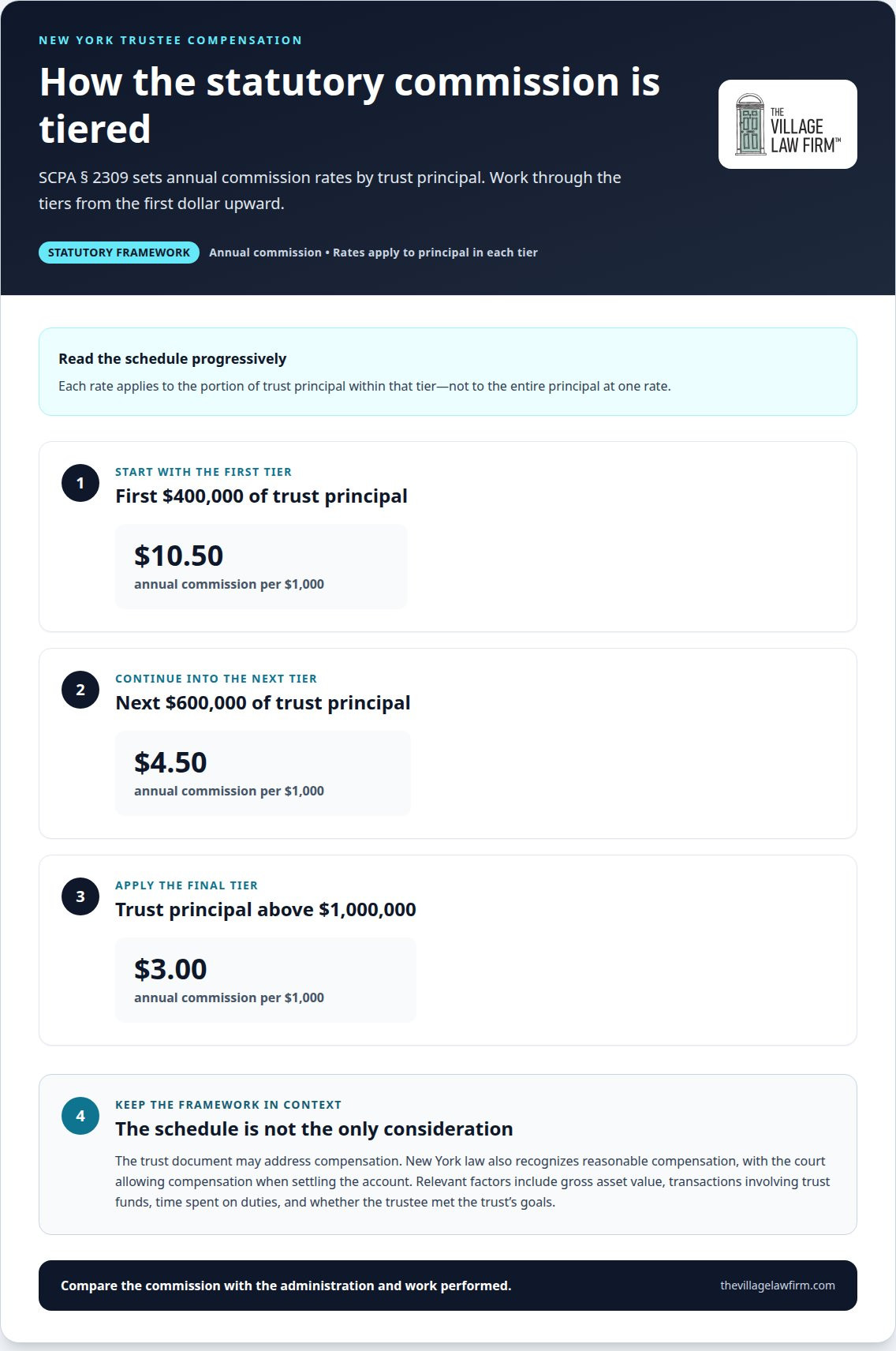
New York statutory trustee fee schedule
New York law provides a statutory structure for trustee commissions, while the trust document may also address compensation. Asset tiers matter because a commission calculated on trust principal changes as the trust grows.
According to the New York State Legislature, trustee commissions are established by Surrogate’s Court Procedure Act (SCPA) § 2309. According to the New York State Legislature, the annual trustee commission rate is $10.50 per $1,000 of the first $400,000 of trust principal. According to the New York State Legislature, the annual trustee commission rate is $4.50 per $1,000 of the next $600,000 of trust principal. According to the New York State Legislature, the annual trustee commission rate is $3.00 per $1,000 of trust principal above the first $1,000,000.
Reasonable and Typical Trustee Fees
New York trustees may receive reasonable compensation, with the court allowing compensation when settling the account. Reasonableness depends on factors such as gross asset value, transactions, time spent, and whether the trustee met the trust’s goals. Professional trustee fees commonly fall around 1% to 2% of assets annually. The statutory schedule provides a separate framework, particularly for beneficiaries assessing commissions against trust administration and the work performed.
What trustee fees are reasonable under New York law? The court considers the trust’s assets, transactions, time spent, goals, and applicable law. What are typical professional trustee fees in New York State? A commonly cited range is 1% to 2% of trust assets annually, though the statutory schedule uses asset tiers.
Fees for Settling or Terminating a Trust
Settling or terminating a trust involves closing the administration and distributing the remaining assets under its terms. Treat this as a general estimate, not the statutory commission schedule: the work and assets involved affect the settlement process.
How much do professional trustees charge for settling or terminating a trust in New York? This settlement estimate is distinct from commissions tied to managing trust principal, so beneficiaries should distinguish the two when reviewing compensation.
Percentage-based trustee fees
A percentage fee links trustee compensation to trust assets, making the rate and calculation base important. Professional trustees commonly charge 1% or 1.5% annually for larger trusts with substantial assets. The arrangement can be straightforward to calculate, but the resulting fee may change as asset values change.
This calculation shows why beneficiaries should look beyond the percentage alone. Ask which assets the fee applies to, how often the trustee calculates it, and which duties it covers. A trust holding investments may require different oversight from one with substantial real property that requires active management. Asset complexity can affect professional compensation.
Compare the percentage with the work performed and the trust’s purpose. A percentage-based fee can continue even when administration demands fluctuate, while an hourly arrangement ties compensation more directly to time. The trust document may establish the payment structure, and an individual trustee may negotiate compensation. For a corporate trustee, request an explanation of the fee schedule and its minimums before appointment. These details help beneficiaries understand what the trustee is entitled to collect.
Keep trustee compensation separate from other professional expenses. An attorney may charge fees for preparing estate tax returns or settling a trust after death. Trust settlement legal work is generally lower when formal court filings or proceedings are not involved. A trustee may also seek additional compensation for extraordinary work, such as litigation or business transactions, supported by records. Separating these costs from an annual asset-based fee makes account statements easier to review.
For a trust document that clearly addresses compensation and protects your planning goals, discuss estate planning with The Village Law Firm.
The Village Law Firm
The Village Law Firm helps connect trustee compensation questions with the broader decisions involved in planning and administering an estate. If you are creating or reviewing a trust, Estate Planning can help clarify how its terms address trustee roles and payment arrangements. When a trust is being administered, Estate Administration can help structure the legal and practical responsibilities involved.
Consider seeking guidance when establishing a trust, reviewing its terms, or addressing questions during administration. The firm also offers Medicaid Planning and Planning for Families with Children, where trust choices may form part of wider family planning. Each decision should reflect the circumstances and goals the plan is meant to serve.
For a thoughtful discussion of your estate planning or administration needs, contact The Village Law Firm.
Make Your Next Planning Decision With Clarity
A clear plan for professional trustee fees in NY starts with a broader question: how should your estate be managed to reflect your priorities and protect the people who matter to you? Trustee compensation is one part of that decision. The terms you set can shape how administration unfolds and how confidently others can carry out your intentions.
The Village Law Firm can help you consider trustee provisions as part of Estate Planning or address questions that arise during Estate Administration. Its Medicaid Planning services can also support broader decisions about preserving and managing assets. Considering these concerns together can help create a plan that feels considered, not fragmented.
You don’t need to resolve every detail alone. Discuss your circumstances and planning priorities with The Village Law Firm. A thoughtful next step can bring greater clarity to the decisions ahead.
Frequently Asked Questions
What are the trustee’s expenses?
A trustee’s expenses are reasonable out-of-pocket costs related to managing the trust, separate from compensation for services. The trust bears these costs, reducing the assets available to beneficiaries. For example, a trustee may report a management expense separately from a commission or hourly fee. Reviewing expense entries alongside account records helps beneficiaries understand what was spent, why it related to administration, and how it differs from the trustee’s payment.
When and how is the trustee paid?
Trustees may be paid quarterly, annually, or biannually, depending on the payment arrangement. A trustee generally receives compensation from trust assets, rather than a direct payment from the grantor. If annual commissions are retained, New York requires a statement for beneficiaries with an interest in income, dated no more than 30 days before the relevant period ends. That statement helps connect compensation with the trust’s accounting period.
How do New York corporate trustees calculate annual trustee fees?
Corporate trustees generally calculate annual fees using an asset-based schedule, then apply any stated minimum. Market schedules commonly range from 0.5% to 2% of trust assets annually, and the trustee may consider asset value and complexity. Review how the schedule defines the assets used in its calculation, including whether it uses a valuation date or tiered rates. The written fee terms clarify how changes in trust value affect compensation.
How do professional trustee fees compare with individual or family trustee fees in New York?
Professional trustees commonly charge more than a family member serving without a commission, but the arrangement depends on the trust and the work. A typical non-professional trustee fee is described as 0.25% of trust assets, or 25 basis points. A family member may receive no commission. If a percentage would deplete the trust, a non-professional trustee may instead charge hourly compensation.
What services are included in professional trustee fees, and what costs are billed separately?
The written fee arrangement defines which trustee duties the professional fee covers, so read the fee schedule and trust terms together. Work outside that scope may involve separate professional expenses. For instance, attorney fees may arise after a death for preparing estate tax returns or settling the trust. Extraordinary trustee work, such as litigation or business transactions, may also lead to a request for additional compensation supported by records.
Can beneficiaries challenge or reduce a professional trustee’s fees in New York Surrogate’s Court?
Yes. Beneficiaries concerned about excessive compensation can raise the issue with the trustee and petition probate court for review if it remains unresolved. The court may consider the trust’s terms, assets, transactions, time spent, and whether the trustee met the trust’s goals. A court may reduce compensation if the trustee failed to follow the trust terms, or order repayment of fees that were unauthorized or clearly excessive.