A Queens estate doesn’t automatically pass through probate. Estate administration services in Queens, NY can help identify and secure estate assets, address valid debts and applicable taxes, and distribute what remains. In New York, probate generally applies when there’s a valid will, while administration applies when there isn’t one.
It’s understandable to expect a clear sequence, but the right process depends on the will, how assets are held, and who is entitled to act. A trust or an account with a named beneficiary, for example, may pass outside the Surrogate’s Court probate process.
This guide explains what administration involves, when probate may apply, and how beneficiaries and legal representation fit in. Timelines vary: an uncontested matter may take several months, while disputes, tax issues, or complex assets can extend the process. Understanding the steps can help you prepare and keep the work more orderly.
Key Takeaways
- Whether an estate goes through probate depends in part on whether there’s a valid will and how its assets are held.
- Estate income can bring tax filing obligations: according to the Internal Revenue Service, an estate must file an income tax return if its assets generate more than $600 in annual income.
- Beneficiaries may need representation when they dispute a will, question an executor’s conduct, or disagree about inherited property.
- An administrator’s work includes securing assets, addressing debts and expenses, keeping records, and accounting for the estate before distributing what remains.
Do all Queens estates go through probate?
No. Whether probate applies depends on the will, the decedent’s last residence, and how assets pass.
Probate and Intestate Administration
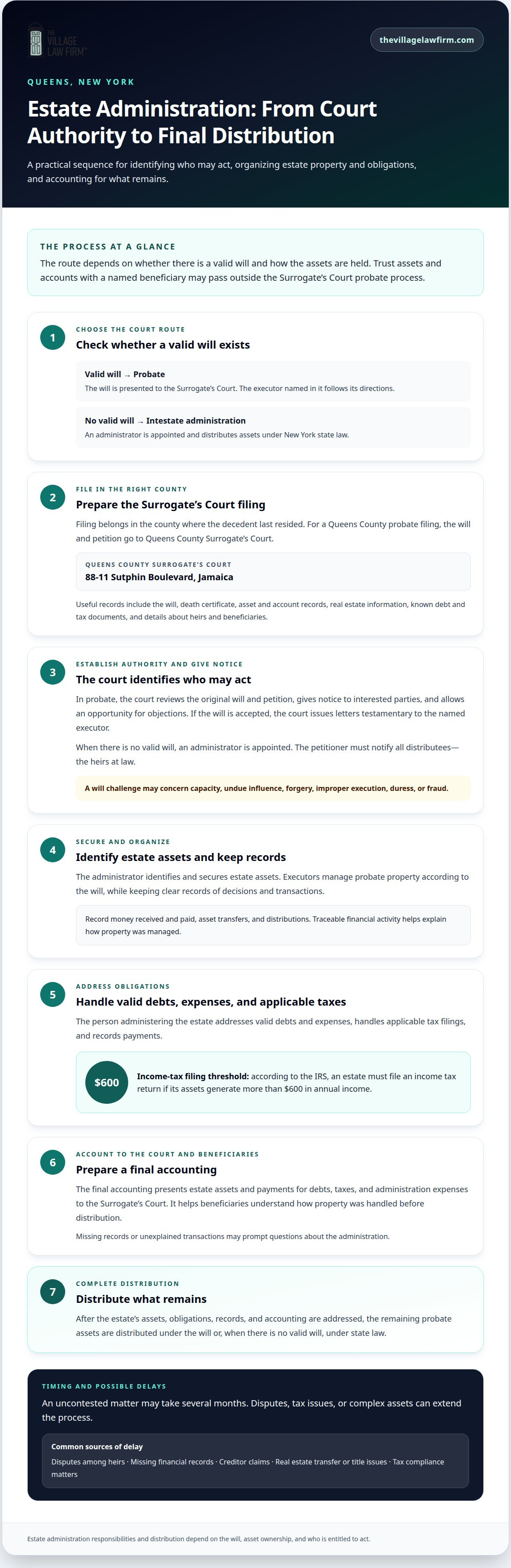
New York uses probate when a valid will is presented; without one, intestate administration applies. An executor named in a will follows its directions, while an administrator is appointed when no valid will exists and distributes assets under state law. For Queens, Manhattan, Brooklyn, or Nassau County matters, identify the decedent’s last residence because filing belongs in that county.
Opening an Estate in Surrogate’s Court
Opening probate requires filing the will and a petition with the Surrogate’s Court in the county where the person last resided. Queens County filings go to Queens County Surrogate’s Court at 88-11 Sutphin Boulevard in Jamaica. The court issues letters testamentary to the executor named in the will, establishing authority to manage estate assets, including real estate, and carry out distributions.
Court-Supervised Will Validation
Probate is the court-supervised process for validating a will. The Surrogate’s Court considers the original will and petition, gives notice to interested parties, and allows an opportunity for objections. If accepted, the will guides distribution of probate assets. A challenge may raise questions about mental capacity, undue influence, forgery, improper execution, duress, or fraud, turning an otherwise orderly filing into a contested proceeding.
For tax obligations, an estate must file an income tax return if its assets generate more than $600 in annual income, according to the Internal Revenue Service.
For a Queens County filing, gather the will, death certificate, asset and account records, real estate information, and known debt and tax documents. Details about heirs and beneficiaries help prepare the required filings and notices.
Choose legal counsel with experience in New York Surrogate’s Court filings and estate accounting. Ask how they will explain next steps and document decisions.
Confirm that the attorney is authorized to practice law and has relevant experience with probate and intestate matters. When reviewing feedback, look for recurring comments about clear communication, responsiveness, and careful recordkeeping, rather than promised outcomes.
Beneficiary representation and inheritance disputes
Inheritance conflicts can affect distributions, court filings, and the transfer of Queens property. Clear communication early on can help identify the issue and keep estate records orderly.
Heir Disputes and Administration Challenges
Disputes may concern a will, an administrator’s appointment, or how estate assets are managed. When multiple people have equal priority to administer a New York estate, the court may require agreement or resolve the dispute at a hearing. A beneficiary or heir may also petition to remove an executor or administrator suspected of wasting or embezzling assets.
Preventing or Resolving Family Disputes
An executor should act in the estate’s best interests and keep records of decisions and transactions. Accurate updates to beneficiaries can clarify what has been collected, paid, or remains unresolved. If a disagreement concerns the will’s validity, a beneficiary may raise grounds such as undue influence, lack of mental capacity, forgery, improper execution, duress, or fraud.
Real estate can create a separate dispute. Heirs, for example, may disagree about selling a family home or transferring its title. A New York partition lawsuit may seek a court-ordered sale of disputed property. Title issues or disagreements about ownership can delay distribution while the parties address the property’s status.
Common delays include disputes among heirs, missing financial records, creditor claims, real estate transfer and title issues, and tax compliance matters.
For guidance on an inheritance conflict or estate process, consider estate administration support.
What is Estate Administration?
Estate administration organizes a decedent’s property, obligations, records, and distributions. Who is responsible depends on whether a valid will exists or intestacy applies.
Administrator Duties and Final Accounting
When there’s no valid will, New York law generally gives a surviving spouse priority to serve as administrator, followed by children and other close relatives. The petitioner must notify all distributees, meaning heirs at law. The administrator identifies and secures estate assets, addresses valid debts and expenses, handles applicable tax filings, and keeps accurate records of money received and paid.
A final accounting presents estate assets and payments for debts, taxes, and administration expenses to the Surrogate’s Court. It helps beneficiaries understand how property was managed before remaining assets are distributed. Reviewing the accounting can also raise questions about missing records, unexplained transactions, or a potential challenge to the administration.
Executor and Trustee Fiduciary Duties
New York’s Estates, Powers and Trusts Law governs executor and trustee fiduciary obligations. An executor must manage estate property according to the will and act in the estate’s and beneficiaries’ best interests. A successor trustee carries out the trust’s terms, accounts to beneficiaries, and transfers trust assets as directed.
Careful records help show how each decision served the estate or trust. Documenting a payment, asset transfer, or distribution, for example, makes the transaction easier to explain to beneficiaries. Executors and trustees should keep financial activity distinct and traceable throughout their responsibilities.
Letters Testamentary and Executor Responsibilities
When a will is admitted to probate, the Surrogate’s Court issues letters testamentary to the executor named in it. These letters establish the executor’s authority to act for the estate. The executor locates and secures assets, keeps records, pays valid debts and applicable taxes, and distributes what remains according to the will.
That authority comes with practical responsibilities. Before distributing property, for example, the executor must account for estate obligations and document transactions. Beneficiaries can use those records to understand the administration and raise specific concerns through the appropriate process.
Executor and Administrator Fees
New York law governs executor and administrator compensation, and the calculation depends on the role and estate circumstances. The estate’s financial records and the work involved are relevant to understanding the amount claimed.
Beneficiaries reviewing a proposed payment should examine the accounting and supporting transaction records. If they dispute the calculation, an estate attorney can explain how the applicable rules relate to the estate’s administration.
Administration timelines and legal representation
Queens estate timelines depend on the petition, whether heirs agree, and which assets require attention. New York sets no fixed statutory deadline for closing an estate, so the court and estate matters that remain unresolved shape when it can be settled.
An uncontested Queens petition typically results in Letters Testamentary or Letters of Administration within a few months. An uncontested estate with a clear will can close in under a year. These are different milestones: receiving authority to act does not mean the estate is ready for final distribution.
Tax issues, contested proceedings, or complicated assets can extend administration to two years or more. A dispute over a Queens property, for example, may need resolution before its title can transfer. Missing financial records, creditor claims, and tax compliance can also delay the accounting and distribution process.
New York law doesn’t require a person administering an estate to have legal representation. Still, an attorney can prepare the petition, help address beneficiary notices, organize court accountings, and guide the administrator through disputes or complex assets. The deceased person’s county of residence determines where the petition is filed, while estate records and unresolved obligations shape the work that follows.
For beneficiaries, legal representation can help clarify rights, review estate information, and raise concerns through the proper court process. For an executor or administrator, counsel can help organize filings and explain the steps needed before distributing assets. Rather than focusing only on how quickly a matter can close, identify the issue that remains unresolved and what action may address it.
Discuss estate administration guidance for help understanding the petition, timing factors, and next steps.
The Village Law Firm
The Village Law Firm helps families bring structure to estate matters and plan for future transitions. Its Estate Administration services guide executors and administrators through the responsibilities involved in settling an estate, while Estate Planning helps individuals prepare for how their assets and wishes will be handled.
Consider seeking legal guidance if you’re unsure which court process applies, need help understanding your role, or have questions about beneficiaries, records, or estate assets. Depending on your circumstances, future planning may also involve Medicaid Planning or Planning For Families with Children.
Discuss your estate administration questions with The Village Law Firm to identify a clear next step for your situation.
Take the Next Step With Clarity
Start by defining what needs attention first. Consider which decisions are time-sensitive, what information remains unclear, and who in the family should be part of the conversation. A focused discussion can turn a complicated situation into a manageable set of priorities.
Choosing estate administration services in Queens, NY also means finding guidance suited to the estate and the people involved. Bring questions about responsibilities, unresolved concerns, or what comes next. You don’t need every detail organized before starting a conversation; clarity can develop as the issues are discussed.
Contact The Village Law Firm to discuss your situation and identify a thoughtful next step. You can move forward with greater confidence, one decision at a time.
Frequently Asked Questions
What does an executor have to do?
An executor must carry out the will while keeping decisions and financial records accountable. If a deceased person owned a home and bank accounts, for example, the executor must track how each asset is handled and preserve records of payments and distributions. Beneficiaries can review that information to understand the estate’s transactions and identify questions that need a clear response.
What is Probate?
Probate is the Surrogate’s Court process for validating a deceased person’s will and recognizing the executor’s authority. A will directs how probate assets should be distributed, but some property may pass through a separate ownership arrangement or beneficiary designation. For example, a named beneficiary on an account may receive that asset outside the will’s distribution process.
Can an executor be personally liable in New York?
An executor may face personal exposure if mishandling estate assets breaches fiduciary duties. New York’s Estates, Powers and Trusts Law governs executor fiduciary obligations, and a beneficiary or heir may petition to remove an executor suspected of wasting or embezzling assets. If you’re concerned about a transaction, focus on the supporting records and the specific conduct at issue.
What Happens If Someone Dies With No Will?
If someone dies without a valid will, New York intestacy laws determine who inherits, and the Surrogate’s Court appoints an administrator. A surviving spouse generally has priority, followed by children and other close relatives. If no eligible person accepts responsibility, the Public Administrator may handle the estate. A small estate may qualify for simplified voluntary administration when personal property is $50,000 or less, subject to exclusions.
What happens if heirs disagree about the administration?
If people with equal priority seek appointment, the court may require agreement or resolve the issue at a hearing. Heirs can also challenge a will based on grounds such as undue influence or improper execution. For disputed family property, a partition lawsuit may seek a court-ordered sale. Identifying whether the conflict concerns appointment, conduct, the will, or real estate helps clarify the court issue involved.
What estate administration services are available in Queens, NY?
In Queens, The Village Law Firm provides Estate Administration for families navigating the legal process after a death. The firm also offers Estate Planning, Medicaid Planning, Planning For Families with Children, and planning for global families, including international estate planning and cross-border estate administration. These services address distinct needs, from administering an estate to preparing for future asset and family decisions.