
If you couldn’t speak for yourself during a serious medical crisis, would your family know whom to turn to or what choices you’d want respected? Choosing an advanced directive lawyer New York residents can consult can help you address those questions before they become urgent.
It’s understandable to be unsure which documents fit your circumstances. A health care proxy, living will, and medical orders serve different purposes, and no single plan suits every person or family. Clear guidance can help you understand each document’s role and limits, choose someone you trust to communicate your wishes, and prepare loved ones for decisions they might otherwise have to make without direction.
This article explains how healthcare directives can fit into a broader estate plan and what a New York lawyer can help clarify about your wishes, decision-makers, and family circumstances. You’ll also find questions to ask when evaluating counsel, so you can assess whether the guidance is tailored to your needs.
Key Takeaways
- A health care proxy, living will, and financial power of attorney address different planning needs. Understanding their roles can help you identify what to discuss with counsel.
- An advanced directive lawyer New York residents consult should explain document options and formalities clearly, while considering your values, family dynamics, and existing estate plan.
- Prepare for a planning conversation by gathering current documents, noting your goals, and listing questions you want answered.
- Choosing someone to communicate your healthcare wishes is an important decision. Consider who understands your preferences and can speak for you if you cannot.
- The Village Law Firm provides estate-planning counsel for healthcare directives, which may be considered alongside other estate-planning goals based on your circumstances.
Why consider an advanced directive lawyer in New York before a healthcare crisis?
Illness or injury can make it difficult to communicate healthcare choices. Advance directives let you record relevant wishes and identify who may communicate or make decisions on your behalf, giving loved ones clearer direction in a stressful situation. Planning ahead also gives you time to discuss your preferences before a crisis arises.
A healthcare directive communicates your medical wishes or names someone to make healthcare decisions; a financial power of attorney grants authority over financial matters, not medical choices. Neither document replaces every other part of an estate plan or covers every situation. For a broad introduction to these plans, see this overview of an advance healthcare directive.
What does an advanced directive lawyer help you clarify?
An advanced directive lawyer New York residents consult can help turn broad concerns into a focused planning conversation. What matters to you in medical care? Who do you trust to speak for you? Do family relationships or existing estate documents raise questions that should inform the plan? The documents to consider depend on your circumstances, so there’s no universal checklist.
Legal counsel can explain the purpose and limits of available documents and help you understand the formalities that may apply in New York. That can help you avoid relying on a form without understanding what it covers. Questions about medical treatment itself are best discussed with you and your healthcare providers.
When might New Yorkers start this conversation?
You don’t need to wait for a health crisis or a particular age. A new diagnosis, a change in family circumstances, caregiving responsibilities, or another major life transition can prompt you to review how your wishes would be communicated. Even if you’re healthy, you can decide whom you trust and make sure that person understands your preferences.
A conversation with an advanced directive lawyer New York clients may seek as part of estate planning can connect healthcare planning with broader goals without assuming everyone needs the same documents. This is general information, not legal or medical advice for your situation. A lawyer can explain legal options; your healthcare team can address questions about your care.
Which advance healthcare documents may matter under New York law?
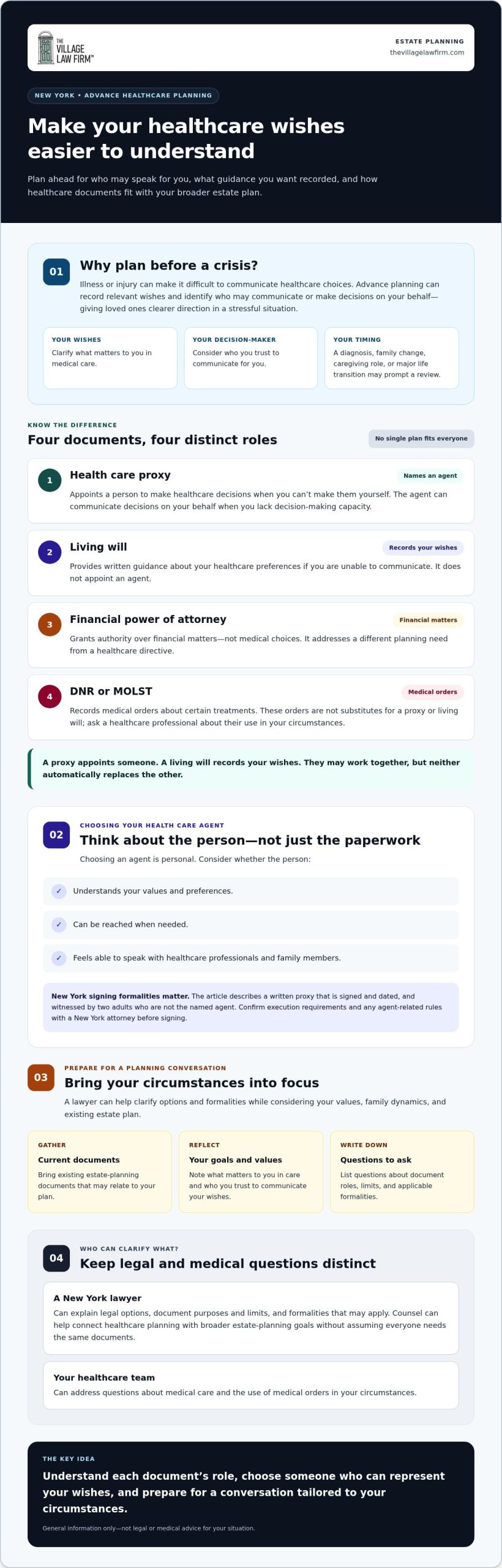
New York planning documents serve different purposes. A health care proxy appoints a person to make healthcare decisions when you can’t make them yourself. A living will records your wishes about medical care and can help guide decisions if you’re unable to communicate. They may work together, but neither automatically replaces the other. The New York State Bar Association’s guide to Living Wills and Health Care Proxies offers an overview of how the documents differ.
| Document | Main purpose | Practical distinction |
|---|---|---|
| Health care proxy | Names a health care agent | The agent can communicate decisions on your behalf when you lack decision-making capacity. |
| Living will | Records healthcare wishes | Provides written guidance about care preferences; it doesn’t appoint an agent. |
| Financial power of attorney | Grants authority over financial matters | Addresses finances, not healthcare decisions. |
| DNR or MOLST | Records medical orders about certain treatments | These are medical orders, not substitutes for a proxy or living will. Ask a healthcare professional about their use in your circumstances. |
How does a New York health care proxy work?
Choosing an agent is a personal decision. Consider whether the person understands your values, can be reached when needed, and feels able to speak with healthcare professionals and family members. Under the New York requirements reflected in current guidance, the proxy is written, signed and dated, and witnessed by two adults who aren’t the named agent. Confirm execution requirements and any agent-related rules with a New York attorney before signing, since formalities matter.
How is a living will different from a health care proxy?
A living will communicates your wishes; a proxy appoints someone to make decisions. Some people may find it useful to have both, giving the agent written guidance while allowing them to address circumstances the document may not anticipate. If instructions are unclear or conflict with other documents, ask an attorney to review how they fit together.
A DNR order concerns resuscitation, while a Medical Orders for Life-Sustaining Treatment (MOLST) form translates treatment preferences into medical orders for patients with serious health conditions. These involve clinical decisions, so discuss whether they’re appropriate with your healthcare team. Confirm current New York rules, forms, and eligibility with qualified professionals before relying on them.
An advanced directive lawyer New York residents consult can explain how these documents fit into an individual estate plan without assuming everyone needs the same set. If you’re considering how healthcare planning fits with broader estate-planning counsel, raise the question with The Village Law Firm.
How do you choose an advanced directive lawyer in New York?
The right counsel should help you understand your options, not leave you with unfamiliar terms and unanswered questions. When evaluating an advanced directive lawyer New York residents might consider, notice whether the lawyer explains document choices and relevant New York formalities in plain language, and makes room for your priorities and concerns.
Look for a conversation that takes account of your values, family dynamics, and existing estate documents. A health care proxy or living will may need to be considered alongside a will, trust, or financial power of attorney. The New York State Bar Association’s guide to advance directives can help you become familiar with key terms before speaking with counsel, but it can’t assess how your own documents fit together.
What questions should you ask during an initial conversation?
Use the discussion to understand both the legal approach and the working relationship. You might ask:
- Based on the goals I’ve described, which healthcare planning documents should I consider, and why?
- How will you check for consistency with my existing will, trust, or financial power of attorney?
- Who will prepare the documents and explain signing steps?
- What follow-up questions or document review are included in the work, and how will I communicate with the legal team?
Listen for direct answers about the scope of representation and review process. A lawyer should explain what the engagement covers without promising a particular outcome. Clear expectations make it easier to decide whether the approach suits your needs.
When might a form or general estate plan be insufficient?
A template can be a useful starting point, and not everyone needs an attorney to complete a straightforward document. But a form may not resolve questions about what your instructions mean, whether signing steps have been followed, or how the document relates to your other plans. Those issues can matter when family relationships are complex, loved ones disagree, or your wishes need careful explanation.
For example, you may know whom you trust but feel unsure how to describe the decisions you want that person to communicate. An individualized discussion can surface those questions before you sign, rather than leaving your agent to interpret unclear wording later.
Choosing an advanced directive lawyer New York families can work with also depends on communication and fit. The Village Law Firm provides estate-planning counsel that includes healthcare directives tailored to individual and family needs. If you’re considering how this planning may fit with your broader estate-planning goals, a conversation can help identify questions to address.
How can you prepare for a New York advance-directive meeting?
A little preparation can make the conversation more focused, even if you haven’t settled every decision. You don’t need to share private medical details in advance. Start with what you want the plan to accomplish, who you trust to communicate your wishes, and what you’d like answered. For broader context, review this New York estate planning guide.
What information should you bring or consider?
Gather what you can, but don’t let missing paperwork keep you from starting. This checklist can help you make good use of the meeting:
- 1. Clarify your goals. Note the values or concerns you want your healthcare plan to reflect, such as who should speak for you and what you want that person to understand.
- 2. Collect existing documents. Bring available health care proxies, living wills, wills, trusts, and financial powers of attorney. If you’re unsure whether a document matters, include it and ask.
- 3. Think through decision-makers. List a potential agent and alternate choices. Consider why you trust them, whether they understand your preferences, and what you’d like to ask about their responsibilities.
- 4. Flag family or cross-border factors. Note relevant family circumstances, relatives who may have different expectations, or connections to another country that could affect coordination.
- 5. Write down questions. Ask what options may fit your goals, how signing and storage will be addressed, and when to review the documents.
You can describe your priorities without sharing more health information than you’re comfortable disclosing at this stage. The goal is to identify what needs discussion, not to arrive with every answer already decided.
What happens after the documents are drafted?
Before concluding the process, ask the lawyer to explain the signing steps, where to keep completed documents, and how your chosen agent or other relevant people can access them if needed. Confirm what follow-up or review is part of the legal engagement instead of assuming those details.
Once your documents are in place, consider telling your chosen agent that you’ve named them and discussing the preferences you want them to understand. You don’t need to share every private detail, but a thoughtful conversation can help prevent surprise. A new diagnosis, changed family circumstances, or updated wishes may be a reason to ask whether professional review is appropriate.
If you’re ready to organize your questions and existing documents, contact The Village Law Firm about estate planning. An advanced directive lawyer New York residents work with can help clarify how healthcare planning relates to individual and family circumstances.
How can The Village Law Firm help with advance directives in New York?
The Village Law Firm provides estate-planning counsel that includes healthcare directives tailored to individual and family needs. For someone seeking an advanced directive lawyer New York residents can consult, that guidance can help connect healthcare wishes and decision-makers with broader planning goals, while recognizing that the right documents depend on each person’s circumstances.
What can readers expect from a tailored planning conversation?
A useful discussion can begin with what you want your plan to communicate, whom you trust to speak for you, and whether existing documents or family circumstances raise questions. You can also ask how healthcare directives may fit alongside other estate-planning goals. Recommendations should follow a review of your situation and applicable legal requirements, not a one-size-fits-all checklist.
The Village Law Firm’s broader planning services include Medicaid planning. If concerns about long-term care are among your planning priorities, its New York Medicaid planning guidance offers related context. Whether that topic belongs in your discussion depends on your needs; it isn’t a required part of every healthcare-directive plan.
What is a sensible next step if you are ready to plan?
Start simply. Before reaching out, make a brief list of your planning goals, any existing directives or estate documents you can locate, and the questions you want answered. You don’t need to have every decision made. Sharing what’s clear and where you’re uncertain can help frame a focused conversation.
Ask the firm to confirm its current service details and how healthcare-directive planning may fit into the estate-planning counsel it provides. There’s no need to rush. A thoughtful discussion can help you understand the options and decide what next step makes sense for you.
To discuss healthcare-directive planning in New York, contact The Village Law Firm. Bring your questions and any relevant documents you have. The conversation can begin with what matters most to you.
Put Your Healthcare Wishes Into a Clearer Plan
Advance planning is about more than completing paperwork. It means understanding how a health care proxy, living will, and other planning documents differ, choosing someone you trust to communicate your wishes, and checking that your documents work together. The right approach depends on your priorities, family circumstances, and existing estate plan.
An advanced directive lawyer New York residents consult can help clarify those choices and explain relevant legal formalities in accessible terms. The Village Law Firm provides estate-planning counsel for healthcare directives tailored to individual and family needs, and serves clients in New York City.
You don’t need every answer before beginning. Gather the documents you have, note what matters most, and bring your questions to a conversation with counsel. A thoughtful first step can make your wishes easier for the people you trust to understand.
Discuss your advance-directive planning with The Village Law Firm. Start at your own pace, with a clearer sense of what you want your plan to communicate.
Frequently Asked Questions
Is a health care proxy the same as an advance directive?
No. A health care proxy is one form of advance healthcare planning: it names someone who may communicate or make healthcare decisions for you if you can’t make them yourself. “Advance directive” can refer more broadly to documents that record care preferences, including a living will. New York terminology and requirements can depend on the document and circumstances. If you have existing paperwork or specific medical concerns, ask a qualified New York lawyer or healthcare professional how it applies.
Do I need a lawyer to create an advance directive in New York?
Not everyone needs a lawyer to begin planning, and publicly available forms may be a starting point. An advanced directive lawyer New York residents consult can help identify which documents relate to your goals, review how they fit with existing estate planning, and explain applicable signing requirements. Individual advice may be especially useful if family circumstances are complex or instructions need coordination. Confirm current New York requirements before signing, particularly if you’re relying on a form you found online.
What documents are considered advance directives in New York?
New Yorkers commonly discuss a health care proxy and written care instructions often called a living will. A financial power of attorney handles financial authority, not healthcare decisions. DNR and Medical Orders for Life-Sustaining Treatment (MOLST) documents concern specific medical orders and circumstances, so they aren’t interchangeable with a proxy or living will. Ask a New York lawyer or healthcare professional which documents may apply to your situation, and verify current requirements before relying on general information.
Can I choose a family member as my health care agent in New York?
You may consider a family member, but the best choice is someone you trust to understand your priorities and communicate them clearly, including under pressure. Think about the person’s availability, ability to advocate, and whether family disagreements could make the role difficult. New York has requirements for appointing an agent, so confirm current eligibility and signing rules with a lawyer before completing the document. Discussing your wishes with the person beforehand can also help them understand what the role may involve.
What should I bring to an advance directive lawyer consultation?
Bring any healthcare directives, wills, trusts, and powers of attorney you can locate. A short list of your goals, questions, and potential agents can help focus the discussion. You might also note family circumstances or other planning considerations you want counsel to understand. You don’t need to have every decision settled or disclose private medical details in advance. The meeting can help clarify which issues need attention and what steps may follow.
Can an advance directive be changed after it is signed?
It may be possible to change or revoke a planning document, but the correct method can depend on the document and current New York law. Keep track of copies and let relevant people know if your instructions change. Before replacing or destroying a signed document, ask a lawyer how to make the change properly and whether related documents should be reviewed too. A change in health, family circumstances, or preferences may be a reason to revisit your plan.
How does an advance directive fit into a broader New York estate plan?
Healthcare directives address healthcare decision-making or care preferences; wills, trusts, and financial powers of attorney serve different planning purposes. Reviewing relevant documents together can help identify gaps or instructions that may need clarification. There’s no single combination that suits everyone. A New York estate-planning lawyer can discuss how healthcare documents relate to your broader goals and circumstances, including family considerations. Bring existing documents to the conversation so counsel can understand what you already have in place.