
Could a lifetime of building a New York legacy vanish in a single tax season because your assets were too successful? For many families, the New York estate tax cliff turns a hard-earned Manhattan brownstone into a liability rather than a gift. You’ve worked meticulously to provide for your children, yet the complexity of New York’s 2026 tax laws, specifically the $7,350,000 exemption limit, creates a sense of profound uncertainty. It’s natural to feel anxious about leaving heirs with illiquid assets that trigger a massive, immediate tax bill.
This guide demonstrates how estate planning with life insurance serves as a sophisticated bridge, converting that anxiety into a sanctuary of order and liquidity. We’ll explore how to leverage irrevocable trusts to shield death benefits from the 16% state tax rate and ensure your family remains secure without being forced into a fire sale of the family home. By the end, you’ll have a clear, professional roadmap to protect your wealth, minimize the tax burden, and provide immediate cash for your loved ones.
Key Takeaways
- Discover how to protect illiquid assets, like a Manhattan brownstone, from forced liquidation by transforming life insurance into an immediate source of cash for your heirs.
- Learn how sophisticated estate planning with life insurance utilizes Irrevocable Life Insurance Trusts to shield your policy’s death benefit from the New York estate tax cliff.
- Understand the strategic differences between term and permanent insurance to select the right vehicle for your family’s long-term security and legacy goals.
- Explore practical methods for ensuring an equitable distribution of wealth among your children, allowing you to pass down specific properties without creating family conflict.
Beyond the Death Benefit: Why Life Insurance is Essential for NY Estate Planning
Many professionals view life insurance through a narrow lens of disaster recovery. They see it as a check that arrives to replace a salary. In the context of sophisticated estate planning with life insurance, we view it as a strategic asset. It’s the fluid capital necessary to protect static wealth. For a New York professional whose net worth is tied up in a multi-million dollar brownstone or a private practice, their estate is often land-rich but cash-poor. Without liquid funds, heirs might be forced to sell the family home just to satisfy the state tax bill. Estate-based life insurance serves as a tool for instant estate creation, ensuring that the moment a legacy begins, the cash required to sustain it is already present.
The Role of Liquidity in Complex Estates
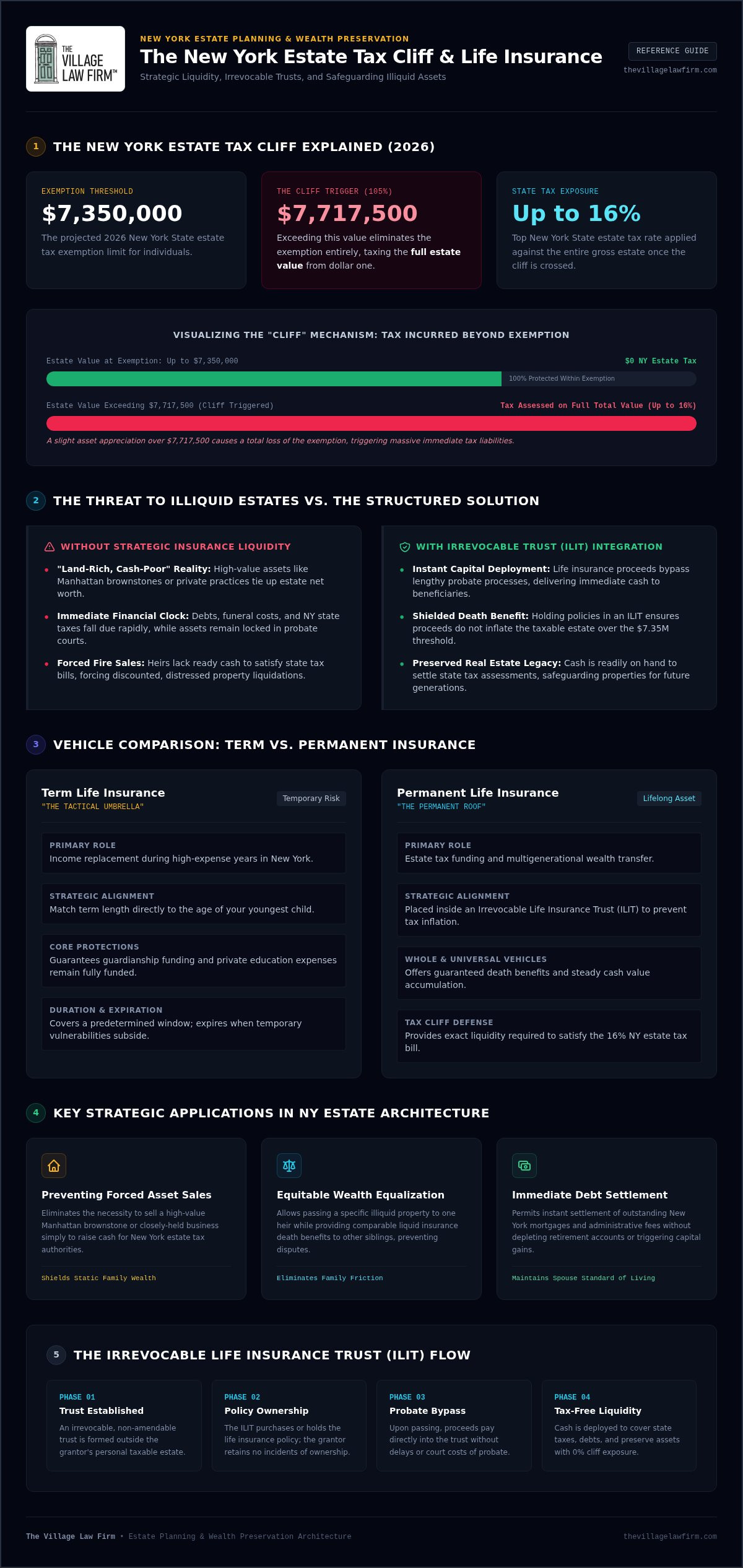
When a loved one passes, the financial clock starts ticking immediately. Debts, funeral costs, and administrative fees don’t wait for the slow gears of the probate courts to turn. Because insurance proceeds generally bypass the lengthy probate process, they provide immediate relief. This capital acts as a sanctuary of order during a time of emotional chaos. If your assets are tied up in real estate, your heirs might lack the cash to pay the New York estate tax cliff. In 2026, if an estate exceeds $7,717,500, the tax applies to the entire value, not just the overage. To manage this, many families utilize an irrevocable, non-amendable trust to hold the policy. This structure ensures liquidity is available when the tax bill arrives, preventing a forced sale of cherished property.
Replacing Income vs. Protecting a Legacy
Early in your career, life insurance is about survival. It’s a tactical safety net meant to replace a paycheck so your family can buy groceries and pay tuition. As you move into advanced legacy planning, the strategy shifts toward wealth transfer. It’s no longer just about replacing income; it’s about ensuring your lifestyle and legacy continue without disruption. This might mean using a policy to pay off a New York mortgage immediately, or ensuring a surviving spouse can maintain their standard of living without liquidating retirement accounts. It’s the difference between merely surviving and thriving for generations to come. By integrating these tools, you transform a simple death benefit into a comprehensive shield for your family’s future.
Choosing the Right Vehicle: Term vs. Permanent Insurance in a Legacy Strategy
Choosing between term and permanent insurance is like choosing between a sturdy umbrella and a permanent roof. One protects you during a specific storm, while the other offers a sanctuary for generations. Successful estate planning with life insurance requires a deep understanding of how these vehicles interact with your broader financial goals. You must decide if you’re solving for a temporary risk or building a permanent structure to house your family’s future wealth. This decision impacts not just your premiums, but the very foundation of your heirs’ security. If navigating policy qualification feels challenging due to pre-existing health conditions or hazardous occupations, discover Special Risk Term to explore specialized coverage options.
Term Life for New York Parents
Term life insurance is the tactical choice for families in their high-expense years. In New York, where the cost of living and education is uniquely high, parents often use term policies to cover the “what-ifs” until their children reach adulthood. We recommend matching the term length to the age of your youngest child. This ensures that guardianship and private education remain fully funded even in your absence. It’s a foundational step in NYC Estate Planning: 2026 Parent’s Guide to Legal Security, providing peace of mind during the years when your family is most vulnerable.
Permanent Insurance for Asset Protection
Permanent insurance, including whole and universal life, serves a different purpose. It’s a strategic tool for lifelong protection and estate tax funding. Unlike term policies that expire, permanent coverage stays with you, offering a guaranteed payout that can be used to navigate the New York estate tax cliff. By placing these policies within an Irrevocable Life Insurance Trust (ILIT), you ensure the proceeds don’t increase your taxable estate. This is vital for New Yorkers whose assets might otherwise be consumed by the state’s aggressive tax rates.
Whole life offers fixed premiums and a steady cash value accumulation, acting as a stabilizing force when markets feel unpredictable. Universal life provides more flexibility, allowing you to adjust premiums as your financial situation evolves. Both options provide high-end benefits like cash value growth, which can be a lifeline for senior care or Medicaid planning. The ability to fund a lifetime of care without exhausting your children’s inheritance is a hallmark of a meticulous plan. When you begin estate planning with life insurance, you’re choosing a partner to help you navigate these complexities with compassion and precision.
The Irrevocable Life Insurance Trust (ILIT): Shielding Assets from the NY Estate Tax Cliff
Owning your own life insurance policy feels like the natural choice, but in the world of high-stakes legacy protection, it’s often a costly mistake. If you hold “incidents of ownership” over a policy, the IRS and New York State consider the death benefit part of your taxable estate. For a New Yorker with a $5 million policy and a $4 million home, this simple ownership structure could trigger a massive tax bill that otherwise wouldn’t exist. An ILIT acts as a dedicated reservoir of liquidity, providing the immediate cash necessary to settle New York estate taxes without forcing the liquidation of family businesses or real estate. By transferring ownership to a trust, you effectively remove those millions from the tax man’s reach while ensuring the funds are available exactly when your heirs need them most.
ILIT vs. Individual Ownership
The gap between federal and state tax thresholds is where many New York families find themselves vulnerable. While the federal exemption has risen to $15 million, the 2026 New York exemption sits at a much lower $7,350,000. Under New York State estate tax rules, there’s no portability between spouses, meaning you can’t simply inherit your partner’s unused exemption. Even more dangerous is the “cliff.” If your estate exceeds the exemption by even a small margin, you lose the exemption entirely. Sophisticated estate planning with life insurance involves using a trust to keep your total estate value below this threshold. This strategy isn’t about avoiding responsibility; it’s about meticulous precision. You can learn more about these specific triggers in our guide to the New York Estate Tax Exemption 2026 & 2026: Navigating the Cliff. The trust document allows you to dictate exactly how the money is used, ensuring it pays taxes first and supports your family second.
Understanding Crummey Powers and Gift Taxes
Funding an ILIT requires a specific rhythm of contributions and notices to remain tax-compliant. To pay the policy premiums, you’ll typically gift money to the trust. Because the trust is irrevocable, these gifts could technically count against your lifetime gift tax exemption. However, we use “Crummey powers” to qualify these transfers for the annual $19,000 gift tax exclusion. Each time you contribute, the trust beneficiaries receive a “Crummey notice” giving them a limited window to withdraw the funds. They don’t actually take the money, but the mere right to do so satisfies the tax authorities that the gift is a “present interest.” This methodical process allows you to fund a large legacy strategy without eroding your lifetime exemptions. It’s a high-end approach that maintains legal flexibility within a rigid, protective environment.
Strategic Applications: Solving Complex Family and Business Challenges
Estate planning with life insurance solves human problems, not just mathematical ones. While previous sections focused on shielding wealth from the New York tax cliff, this sophisticated tool also addresses the friction inherent in complex family dynamics and business structures. It serves as a stabilizer, ensuring that your legacy doesn’t create conflict among heirs or chaos within a professional firm. By using insurance as a flexible source of capital, you can craft a plan that is both fair and functional.
Equalizing the Legacy
Many New York families face the challenge of indivisible assets. If your primary wealth is a $10 million Manhattan brownstone or a family-owned art gallery, you can’t easily split it three ways. Forced sales often lead to resentment and the loss of a family landmark. We solve this through inheritance equalization. Consider a family where one child manages the family business while two others pursue different careers. You can leave the business to the active child and use life insurance proceeds to provide an equivalent cash inheritance to the others. This prevents family conflict by ensuring a fair distribution rather than a strictly equal one that might paralyze the asset.
This strategy also extends to protecting vulnerable family members. For parents of children with disabilities, estate planning with life insurance can fund a Special Needs Trust. This provides a lifetime of care and financial security without disqualifying the child from essential government benefits. It’s a meticulous way to ensure your child’s lifestyle continues exactly as you intended.
Cross-Border and International Strategies
New York professionals often hold assets across the globe, from London flats to Tokyo investments. Managing tax exposure in multiple jurisdictions simultaneously is a significant burden. US-based life insurance is a powerful tool for clients with global assets because it provides immediate liquidity to cover foreign estate duties. This prevents the need to navigate complex international probate processes just to pay a tax bill. Our 2026 Guide: International Estate Planning in New York details how these strategies shield your global footprint from unnecessary erosion.
For business owners in Chelsea or the Financial District, insurance is equally vital for succession. A buy-sell agreement funded by life insurance ensures that if a partner passes, the surviving partners have the cash to buy out the heirs. This keeps the firm operational and provides the grieving family with immediate liquidity. It’s a partnership mindset that replaces uncertainty with a clear, professional path forward. If you’re ready to protect your business and family, contact us to build a strategic inheritance plan.
Crafting Your Shield: How The Village Law Firm Integrates Insurance into Your Total Plan
A static stack of legal documents is not a plan; it’s a snapshot in time. In New York, where tax laws shift and real estate values fluctuate, a transactional approach leaves your family vulnerable to the very chaos you seek to avoid. Successful estate planning with life insurance requires more than just purchasing a policy and drafting a Will. It demands a meticulous integration of your financial vehicles and your legal trust structures. At The Village Law Firm, we provide a white-glove portfolio review to ensure your insurance isn’t just a line item, but a fully operational shield for your legacy.
We don’t work in a vacuum. A sophisticated plan requires seamless collaboration with your financial advisors and CPAs—such as the tax and accounting professionals at wrightaa.com—to align your death benefit with your broader wealth management strategy. This partnership ensures that when the time comes, there are no administrative hurdles, liquidity gaps, or unexpected tax liabilities. We replace the uncertainty of “what if” with a sanctuary of order. By looking at the totality of your assets, we ensure that your estate planning with life insurance actually performs when your family needs it most.
The Partnership Approach to Planning
We view our role as a steady urban guide. The complexity of New York law can feel like overwhelming chaos, but our structured process leads you toward a state of calm. We walk alongside you through every stage of the legacy journey, ensuring your documents reflect your evolving life and global assets. If you’re ready to move from anxiety to a profound sense of security, working with a dedicated Estate Planning Attorney New York: Protecting Your Legacy is the essential first step toward order.
Your Next Steps to Security
Your path to a fully funded estate plan begins with a thorough audit of your current holdings. Many professionals unknowingly trigger the New York estate tax cliff because their policies remain in their own names, a mistake that can cost heirs millions. We review existing policies for “incident of ownership” risks that could unnecessarily inflate your taxable estate. By scheduling a sophisticated consultation, you can align your insurance with your trust structure, ensuring every dollar serves its intended purpose. The result is true peace of mind. You’ll know that your Manhattan home, your business, and your children’s future are protected by a plan built with technical precision and a deeply human touch.
Securing a Legacy of Order and Clarity
The transition from professional success to a lasting family legacy doesn’t happen by accident. It requires a meticulous bridge between today’s assets and tomorrow’s security. You’ve discovered how sophisticated estate planning with life insurance transforms illiquid New York real estate into immediate cash, effectively shielding your heirs from the aggressive state tax cliff. Whether you’re equalizing an inheritance among children or protecting complex international assets, these strategies replace unpredictability with a sanctuary of order. Your hard work deserves a plan that is as resilient as the city you call home.
The Village Law Firm provides the specialized NYC estate tax expertise and comprehensive international asset protection necessary to navigate this landscape with confidence. We offer a white-glove, compassionate legal service that treats your family’s future as a partnership rather than a transaction. Don’t leave your legacy to the whims of shifting regulations or probate delays. Schedule a sophisticated consultation to secure your family’s legacy today. You’ve built something remarkable; now is the time to ensure it remains a source of stability for generations to come.
Frequently Asked Questions
Does life insurance count as part of my estate for tax purposes in New York?
Yes, life insurance proceeds are generally included in your taxable estate if you hold any “incidents of ownership” at the time of your death. In New York, this is a critical detail because the 2026 estate tax exemption is $7,350,000. If your home, investments, and insurance payout combined exceed this limit, your heirs could face the state tax cliff. Transferring ownership to a trust is a common way to remove these assets from your taxable estate.
What is an Irrevocable Life Insurance Trust (ILIT) and do I need one?
An ILIT is a specialized legal vehicle designed specifically to own your life insurance policy. It acts as a protective shield, keeping the death benefit outside of your personal estate for tax purposes. You might need one if your total assets, including insurance, put you near the New York tax threshold. It provides a sanctuary of order, ensuring that liquidity is available to pay taxes without exhausting other family legacies or business interests.
Can I use life insurance to pay for my New York estate taxes?
Yes, providing liquidity is one of the primary reasons for estate planning with life insurance. When an estate is land-rich but cash-poor, heirs often struggle to pay the New York estate tax bill, which is due within nine months of death. The insurance payout provides immediate cash to settle these obligations. This prevents the forced sale of family homes or businesses, allowing your loved ones to maintain their lifestyle during a difficult transition.
How does life insurance help if I have minor children in NYC?
Life insurance provides a vital safety net to ensure your children’s needs are met if you aren’t there. In New York, where education and living costs are uniquely high, these funds can be directed into a trust to cover private school tuition, healthcare, and daily expenses. It ensures that the guardians you’ve appointed have the financial resources to maintain your children’s current standard of living without facing significant financial strain or uncertainty.
What happens to my life insurance policy if I move out of New York?
Your life insurance policy remains valid regardless of where you live, but the tax implications may shift significantly. Different states have varying estate tax exemptions and rules regarding trust ownership. If you move, it’s essential to review your plan with a professional to ensure your strategy aligns with your new state’s laws. We often help clients with international and cross-border planning to ensure their legacy remains secure across different jurisdictions and legal environments.
Is term life or permanent life insurance better for estate planning?
The better choice depends on your specific goals. Term insurance is a tactical tool for income replacement during your children’s younger years. Permanent insurance is a strategic asset for estate planning with life insurance because it provides a guaranteed payout to cover estate taxes or fund a long-term legacy. Most sophisticated plans use permanent coverage to ensure liquidity is available exactly when the estate needs it, regardless of when that time comes.
Can life insurance help protect my home from Medicaid recovery?
While life insurance itself doesn’t stop Medicaid estate recovery, it plays a vital role in your broader Medicaid planning strategy. Proceeds from a policy can be used to pay off debts or reimburse the estate, potentially saving a family home from being sold to satisfy Medicaid claims. By integrating insurance into a comprehensive plan, you create a financial buffer that protects your most cherished assets from being consumed by long-term care costs or state recovery efforts.
How do Crummey powers work in a life insurance trust?
Crummey powers allow you to fund your ILIT using the annual gift tax exclusion, which is $19,000 per recipient in 2026. When you contribute money to the trust for premium payments, the beneficiaries are given a temporary right to withdraw those funds. They typically choose not to, but the mere existence of this right satisfies the tax authorities that the gift is a present interest. This methodical process keeps your lifetime exemptions intact while funding your legacy.