
What if a document meant to protect your finances gives someone more authority than you intended, or isn’t accepted when it’s needed? Choosing a power of attorney lawyer NYC residents can rely on means looking beyond signature lines. New York’s execution rules include notarization and two witnesses, so the details matter.
Planning ahead can feel simpler when you first decide whom to trust with important financial matters. A power of attorney should reflect your circumstances, the authority you want to grant, and the person you choose as agent. It serves a different purpose from a Health Care Proxy, which addresses healthcare decisions.
This guide explains what a New York power of attorney can and can’t do, what to ask a prospective lawyer, and how to choose your next steps. You’ll learn what to discuss about an agent’s authority, how execution and acceptance concerns fit into planning, and why a generic form may not address your needs. The aim is to help you consider a power of attorney as part of a broader estate plan.
Key Takeaways
- A power of attorney gives an agent authority to act within defined limits. Clarify which financial tasks you want them to handle.
- Use New York’s Statutory Short Form as a reference point, then ask qualified counsel how its wording and authority fit your circumstances.
- A power of attorney lawyer NYC residents consult can help assess whether a standard form fits their goals, agent choice, and wider estate plan.
- Before a consultation, gather existing estate-planning documents, define your priorities, and note questions or deadlines so you can leave with clear next steps.
What Does a Power of Attorney Lawyer in NYC Help You Plan?
Choosing someone to act on your behalf is consequential. You’re placing trust in that person while deciding how much authority they should have and when they may use it. A power of attorney lawyer NYC residents consult can help clarify those choices as part of a broader estate plan. Services vary, so confirm whether a particular firm drafts or reviews powers of attorney.
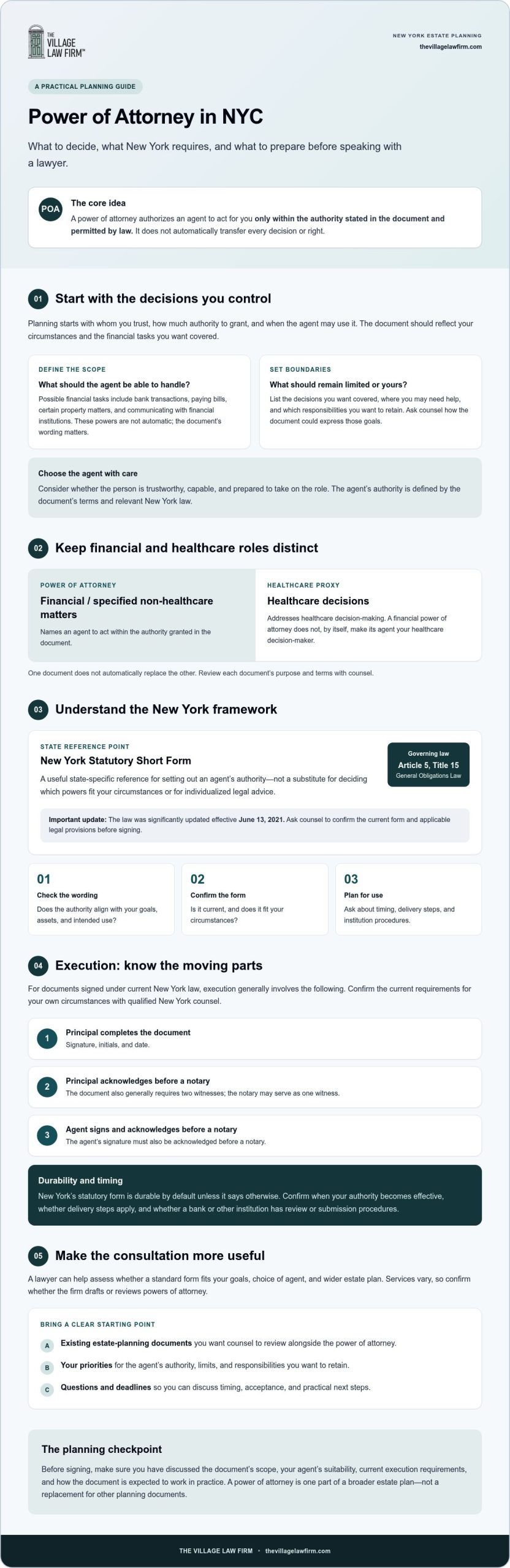
A power of attorney authorizes an agent to act for you only within the authority stated in the document and permitted by applicable law. It does not automatically transfer every decision or right. You remain the person granting authority, often called the principal. The agent’s role is defined by the document’s terms and relevant New York law. For a high-level introduction to terms such as principal and agent, see Power of attorney.
What decisions can a financial agent be authorized to handle?
Depending on the document and applicable law, financial tasks may include managing bank transactions, paying bills, handling certain property matters, or communicating with financial institutions. These are possible powers, not automatic powers in every document. The exact authority depends on the wording and the rules that apply.
Before choosing language, list the decisions you want covered. Consider where you may need help, which responsibilities you want to retain, and whether specific powers should be limited. Then ask qualified New York counsel how the document could address those goals. Don’t assume a familiar form grants the authority you have in mind.
How is a power of attorney different from a healthcare proxy?
A power of attorney generally concerns financial or other specified non-healthcare matters. A healthcare proxy addresses healthcare decision-making. One document doesn’t automatically replace the other, and naming an agent under a financial power of attorney doesn’t, by itself, make that person your healthcare decision-maker. Review each document’s purpose and terms with counsel.
Keeping these roles distinct can make your plan easier to understand and discuss with the people you appoint. The Village Law Firm advises on estate planning matters, including wills, trusts, and healthcare directives. Its New York estate planning guidance offers a broader perspective on coordinating planning documents. Ask prospective counsel which documents fit your circumstances and confirm whether they currently handle power of attorney matters.
Which New York Power of Attorney Details Should You Understand?
New York’s statutory form is a useful starting point, but it doesn’t replace checking what authority you intend to grant or how the document will be used. The governing law is Article 5, Title 15 of New York’s General Obligations Law, which was significantly updated effective June 13, 2021. The New York State Bar Association’s overview of the New York Statutory Short Form Power of Attorney can help explain the framework.
What should readers know about New York’s statutory form?
The statutory form provides a state-specific reference for setting out an agent’s authority. It doesn’t tell you which powers suit your circumstances or replace individualized legal advice. A power of attorney lawyer NYC residents consult can review whether the document’s language aligns with their goals, assets, and intended use. Ask counsel to confirm the current form and applicable legal provisions before signing.
What execution and effectiveness questions should you ask?
For documents signed under current New York law, execution generally involves the principal’s signature, initials, and date, acknowledgment before a notary, and two witnesses. The notary may also serve as one witness. The agent must sign and have the agent’s signature acknowledged before a notary. Ask counsel to confirm current requirements for your circumstances, including when the authority becomes effective and whether any delivery steps apply.
New York’s statutory form is durable by default unless it says otherwise. Still, confirm how timing works under your document and whether a bank or other institution you expect to deal with has review or submission procedures. A sound plan considers both legal execution and practical use.
Before finalizing, review four points:
- Document scope: Which financial matters should the agent handle, and what limits or instructions should be clear?
- Agent selection: Is the person trustworthy, capable, and prepared to take on the role?
- Execution: Have qualified New York counsel confirm current signing, acknowledgment, witness, and delivery requirements?
- Safekeeping: Where will the signed document be stored, and who needs to know how to locate it?
Use this checklist to frame a focused conversation with counsel. For broader estate-planning context, explore The Village Law Firm’s estate-planning perspective.
Should You Use a Form or Hire a Power of Attorney Lawyer in NYC?
A form may be a useful starting point for understanding the process, but it can’t decide whom you trust, what authority fits your needs, or how the document should work with your other plans. That doesn’t mean everyone needs a lawyer or that a generic form is automatically invalid. The right choice depends on your circumstances and whether you can confidently assess the wording, execution, and intended use.
New York has a statutory power of attorney framework, explained in the New York State Bar Association’s overview of the New York Statutory Power of Attorney. A power of attorney lawyer NYC residents consult may help assess how the document’s terms align with their goals. Ask whether the lawyer currently drafts or reviews these documents, since services vary by firm.
When might individualized legal guidance be especially useful?
Consider tailored advice if your circumstances involve a blended family, business interests, more than one residence, or assets across borders. These factors may affect whom you appoint, what authority you grant, and how the document fits with your other estate-planning arrangements. For cross-border concerns, see this overview of international estate planning in New York.
How can you assess an NYC power of attorney lawyer?
Ask about the lawyer’s New York estate-planning experience and familiarity with your specific goals. Find out how they evaluate an agent’s powers, possible safeguards, and coordination with existing documents. Before engaging anyone, confirm the scope of work, communication expectations, and fees directly with the firm.
| Decision factor | Question to ask | When to verify carefully |
|---|---|---|
| Scope and wording | Does the form clearly reflect the authority I intend to grant? | You’re uncertain about limits, instructions, or how the document may be used. |
| Agent choice | Is this person prepared to act, and does the document fit my family situation? | There are competing family expectations or complex relationships. |
| Coordination | How does this document fit with my existing estate-planning documents? | You have business interests, multiple residences, or international assets. |
| Legal review | Can you explain the work, communication process, and fees? | You need help confirming current New York requirements or intended use. |
Use your answers to decide whether self-preparation feels appropriate or individualized review would give you greater clarity. If you’re considering power of attorney planning alongside broader estate planning, you can ask The Village Law Firm about its estate-planning services and confirm whether it handles power of attorney matters.
How to Prepare for a Power of Attorney Consultation in NYC
A focused first meeting starts with your priorities, not legal terminology. Before speaking with a power of attorney lawyer NYC residents are considering, identify what you want the document to accomplish and what questions you need answered. You don’t need to have every decision settled.
What information should you bring to the first meeting?
- Define your goals. Note the financial responsibilities you may want an agent to handle, any limits you’re considering, and concerns about how the authority should be used.
- Identify potential agents. List the people you’re considering and think about their willingness, judgment, and practical availability to take on the role.
- Gather existing documents. Bring available wills, trusts, healthcare directives, or prior powers of attorney so counsel can understand how your planning fits together.
- Flag relevant assets and institutions. If particular property, accounts, businesses, or financial institutions may be involved, note them and ask whether they affect the document’s intended use.
- Write down questions and timing concerns. Mention any upcoming transaction, travel, or other deadline. Ask counsel to confirm current New York signing and execution requirements for your situation.
Requirements can depend on the document and applicable law, so don’t rely on assumptions about signatures, witnesses, notarization, or when an agent may act. Ask the firm in advance which materials it prefers. You may not need to provide every document at an initial meeting.
What should you ask before retaining counsel?
Ask who will handle the matter, how the firm communicates during the process, and what drafting or review work is included. Request a clear explanation of fees before deciding whether to proceed. Also confirm directly whether the firm currently drafts or reviews powers of attorney. The Village Law Firm offers estate planning, but ask whether power of attorney work is within its current services.
If you’re planning for children, consider how your broader family-planning priorities relate to your other estate documents. This guide to estate planning for NYC families with children may help you frame those questions.
Once you’ve gathered your notes and confirmed the firm’s scope, you’ll be better prepared to assess your options and agree on practical next steps. To discuss broader estate-planning questions, contact The Village Law Firm and ask whether power of attorney planning is within the firm’s current services.
Choosing Your Power of Attorney Lawyer in NYC: A Clear Next Step
Selecting a power of attorney lawyer NYC residents can trust starts with a few connected questions: What do you want the document to accomplish? What authority is appropriate? Who is the right agent? What execution requirements apply, and how should the document fit with your broader estate plan?
A consultation is an opportunity to clarify those questions and understand your options. It isn’t a promise of a particular outcome, and you don’t need to arrive with every decision made. The goal is to leave with a clearer view of what requires legal advice and which steps make sense for your circumstances.
What should a thoughtful planning process leave you with?
You should have a clearer understanding of the authority you’re considering, the responsibilities involved, and any questions that remain unresolved. You can assess whether a potential agent is willing and practically able to serve, and explain how you expect the document to be used. Where appropriate, consider how it coordinates with other estate-planning materials, such as a will, trust, or healthcare directive.
Use the discussion to identify open items rather than press for a quick answer. For example, counsel may need to review existing documents or confirm how current New York requirements apply before advising on execution. A careful process makes room for those details.
How can you take the next step with confidence?
The Village Law Firm is a New York City practice offering estate planning and administration, including counsel on wills, trusts, and healthcare directives. The firm also provides international estate planning, which may be relevant for clients with global assets. Ask directly whether it currently drafts or reviews powers of attorney before retaining counsel for that specific work. You can also confirm who would handle the matter, what the engagement includes, and how fees and communication are explained.
Choosing counsel is ultimately about fit: whether the lawyer understands your goals, explains relevant choices clearly, and can address how the document relates to your estate plan. If you’re considering broader estate-planning needs, contact The Village Law Firm to discuss your situation and ask whether power of attorney drafting or review is among its current services.
Take the Next Step Toward a Clearer Estate Plan
Choosing a power of attorney lawyer NYC residents can work with starts by clarifying the document’s purpose, the authority you’re considering, and the person you may appoint. Confirm New York’s current execution requirements with qualified counsel, and consider how the document fits alongside your will, trust, or healthcare directive. A focused discussion can help you understand your options and identify questions that still need attention.
The Village Law Firm is a New York City estate-planning practice offering counsel on wills, trusts, healthcare directives, and international estate planning. Ask directly whether the firm currently drafts or reviews powers of attorney before making plans for this specific document.
Discuss your New York estate-planning needs with The Village Law Firm, and ask whether power of attorney services are available. A clear conversation is a practical first step toward planning with greater confidence.
Frequently Asked Questions
Is a power of attorney valid in New York if I use an online form?
It may be, but validity depends on whether the document meets current New York requirements and is completed and executed properly, not simply on where you obtained it. An online form may not address your intended authority or circumstances. Before relying on one, ask a New York attorney to review the document and confirm execution details, especially if you plan to present it to a bank or another institution.
Can a power of attorney give someone control over my finances immediately?
That depends on the document’s terms and applicable New York law. Don’t assume an agent’s authority always begins immediately or only after a particular event. Ask counsel to explain how the proposed language affects your ability to manage your own finances, when the agent may act, and what safeguards may be appropriate for your situation. Clear answers can help you decide what authority to grant.
What does a New York power of attorney lawyer do?
A power of attorney lawyer NYC residents consult may help clarify your goals, assess a prospective agent, explain the authority described in a document, and review how it fits with your estate plan. The lawyer can also discuss applicable execution requirements. Services vary by firm, so confirm directly whether the lawyer drafts or reviews powers of attorney. Don’t assume every estate-planning practice offers this specific service.
Do I need a lawyer to create a power of attorney in NYC?
Not everyone necessarily needs a lawyer, but tailored advice may be helpful if you’re uncertain about the authority, agent, document language, or execution process. Family dynamics, business or other assets, and coordination with existing estate documents can raise questions a general form may not resolve. If you’re unsure, ask qualified New York counsel to explain current requirements and how they apply to your circumstances before relying on a document.
How do I choose someone to act as my agent under a power of attorney?
Consider whether a potential agent is trustworthy, exercises sound judgment, is willing to serve, and can manage the responsibilities you’re considering. Practical availability matters too. The right choice depends on your circumstances and the authority in the document. Discuss with counsel whether naming a backup agent or including safeguards fits your needs, and how any proposed arrangements work under current New York law.
Can a power of attorney cover healthcare decisions in New York?
A financial power of attorney generally addresses financial authority, not healthcare decision-making. In New York, a separate healthcare document, commonly a Health Care Proxy, addresses who may make healthcare decisions for you. Don’t assume that naming an agent in a financial power of attorney gives that person healthcare authority. Ask New York counsel which documents fit your goals and how to complete and store them appropriately.
What should I bring to a power of attorney consultation?
Bring any existing estate-planning documents, a short list of goals and questions, and information about people you’re considering as agents. Note relevant accounts, institutions, business interests, or cross-border assets if they may affect how you expect to use the document. Ask the firm in advance which materials it prefers. The meeting can help identify issues for legal review, though it doesn’t guarantee a particular outcome or timeline.