
A beneficiary’s death doesn’t automatically cancel an inheritance. In New York, what happens when a trust beneficiary dies depends first on the trust’s terms and when the beneficiary died. If the beneficiary outlives the person who created the trust but dies before receiving the inheritance, the share generally passes into the beneficiary’s own estate. If the beneficiary dies first, the trust’s instructions and any named contingent beneficiary shape what happens next.
It’s understandable to expect a deceased beneficiary’s children to inherit that share. But New York’s anti-lapse rules for wills generally don’t apply to trusts, so descendants don’t automatically take a beneficiary’s place under a trust. The trust document controls. This article explains how the timing of a death affects distribution, when a contingent beneficiary may receive a share, and why a will’s anti-lapse protections may not settle a trust question. You’ll see which terms guide the outcome and how the rules differ when someone dies before or after the person who created the trust.
Key Takeaways
- New York’s anti-lapse rule may let a deceased beneficiary’s descendants take their place, but the beneficiary’s relationship to the person who made the will matters.
- When a beneficiary survives the person who created the trust but dies before receiving a distribution, the share generally becomes part of the beneficiary’s own estate.
- A contingent beneficiary can provide a named alternative recipient; the exact wording determines when that person may receive the share.
- According to the New York State Legislature, a beneficiary or distributee who dies within 120 hours after the decedent is treated as having predeceased them.
Anti-lapse laws and a deceased beneficiary’s descendants
In New York, a beneficiary’s death before the testator can redirect a will gift under a narrow statutory rule. The outcome depends on the family relationship, whether the beneficiary left descendants, and the will’s wording.
New York Anti-Lapse Rules
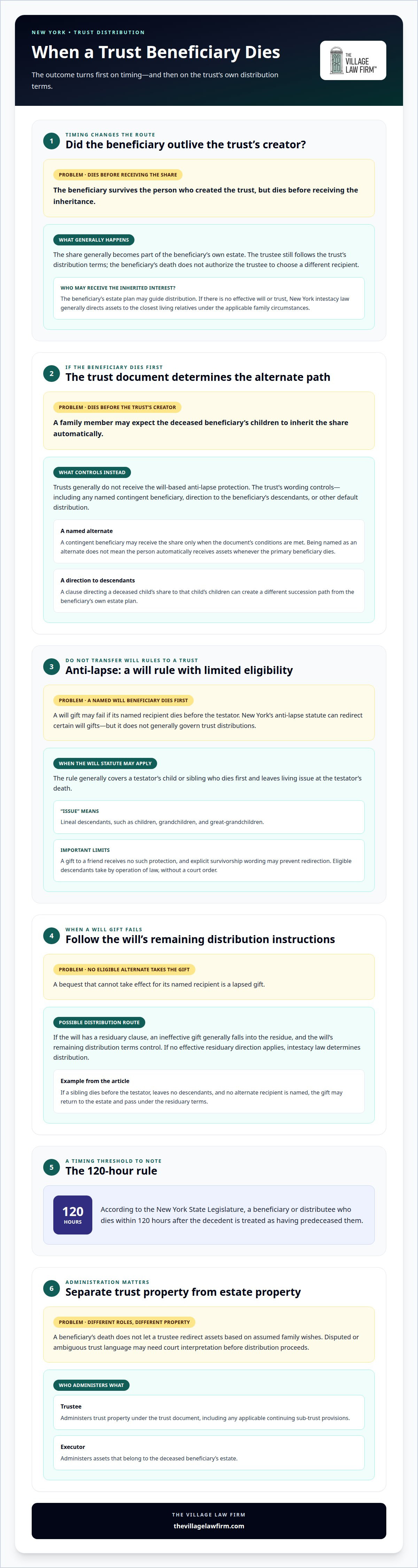
New York’s anti-lapse statute can substitute a deceased beneficiary’s surviving descendants when a qualifying will gift would otherwise fail. It generally covers a testator’s child or sibling who dies first and leaves living issue at the testator’s death. Issue includes lineal descendants, such as children, grandchildren, and great-grandchildren. Eligible descendants take by operation of law, without a court order. A gift to a friend receives no such protection, and explicit survivorship wording may prevent redirection.
Lapsed Gifts and Residual Distribution
A lapsed gift is a bequest that cannot take effect for its named recipient. If a New York will contains a residuary clause, an ineffective gift generally falls into the residue, where the will’s remaining distribution terms control. For example, if a sibling dies before the testator, leaves no descendants, and no alternate recipient is named, the gift may return to the estate and pass under the residuary terms. If no effective residuary direction applies, intestacy law determines distribution.
This distinction matters because the anti-lapse statute generally addresses gifts under wills, not trust distributions. The trust’s terms govern what happens to a beneficiary’s share, and statutory anti-lapse protection generally does not apply to trusts. For example, if a trust names a child but says nothing about descendants taking that child’s share, the will-based rule alone does not redirect the trust property. The trust language and any alternate-beneficiary provisions control.
Does New York inheritance or estate tax apply to a deceased beneficiary’s trust interest? The anti-lapse statute determines who may receive a failed will gift, not its tax treatment. Tax consequences for a trust interest depend on the trust and applicable tax rules, so this statute alone does not establish whether tax applies.
What happens if a beneficiary dies before receiving their inheritance?
For families asking what happens when a trust beneficiary dies in New York, timing and the trust document are central. If the beneficiary survives the person who created the trust but dies before receiving the share, that inheritance generally passes into the beneficiary’s own estate. The trustee must still follow the trust’s distribution terms; the beneficiary’s death doesn’t authorize the trustee to choose a different recipient.
The beneficiary’s own estate plan then helps determine who receives the inherited interest. For example, if the beneficiary’s will leaves their property to a spouse, the trust share that passes into the estate may be handled under that will. If the beneficiary has no effective will or trust, New York intestacy law generally directs assets to the closest living relatives under the applicable family circumstances.
What if the beneficiary dies before the trust’s creator? The trust may name a contingent beneficiary, direct the share to descendants, or provide another default distribution. A clause directing a deceased child’s share to that child’s children can create a different succession path from the beneficiary’s own estate plan. The document’s exact wording determines which route applies.
When deciding what happens when a trust beneficiary dies in New York, a trustee should establish whether the beneficiary died before or after the grantor, then identify the trust terms that address that timing. The trustee follows those instructions, including any continuing sub-trust provisions, and shouldn’t redirect assets based on assumed family wishes. If the trust language is disputed or ambiguous, court interpretation may be needed before distribution proceeds.
The executor administers assets that belong to the deceased beneficiary’s estate, while the trustee administers trust property under the trust document. If the beneficiary’s estate has no appointed fiduciary, the original decedent’s estate fiduciary may amend the probate petition to include the beneficiary’s distributees and notify them. This distinction helps separate estate administration from trust administration.
Contingent beneficiaries in wills and trusts
A contingent beneficiary is an alternate recipient named to inherit if the primary beneficiary cannot take. For example, a will might name Maya first and her brother Daniel as contingent. Daniel’s gift depends on the will’s conditions, including whether Maya dies before the testator. A trust can name the same kind of alternate, but its own distribution terms control. A contingent beneficiary doesn’t automatically receive assets merely because the primary beneficiary has died.
Clear naming can reduce uncertainty during probate or trust administration. An estate plan can identify an alternate by name and explain when that person takes, such as if the primary beneficiary dies before the person who created the plan. It can also direct a deceased child’s trust share to that child’s descendants. The instructions matter: naming “Daniel” as an alternate differs from directing a share to Maya’s children. Trustees and estate representatives follow the document rather than choosing a substitute themselves.
If a will names no contingent beneficiary, a failed gift may pass to the residuary beneficiaries under an effective residuary clause. If the will has no effective residuary distribution or substitute residuary beneficiaries, New York intestacy law determines who inherits. For a trust, the trustee follows the trust’s default distribution terms; the will’s residuary clause does not automatically control trust assets. If neither document supplies an effective alternate route, distribution depends on the applicable succession rules.
Review account designations separately. A bank account, retirement fund, or insurance policy may name its own primary and contingent beneficiaries, and that designation takes precedence over a will or trust. For example, a policy naming Daniel as contingent may pass to him under its designation, even if Maya’s will names someone else. An attorney can help align those designations with estate-planning instructions so probate and other distributions reflect the intended plan.
How a beneficiary’s death affects a will or trust
Timing and document type shape the transfer. New York’s rules for wills and a trust’s terms can produce different results for the same family.
Outcomes by Trust Type
A revocable, irrevocable, or testamentary trust follows its governing instrument, but each begins in a different way. Under New York EPTL § 7-1.16, a lifetime trust is irrevocable unless it expressly provides that it is revocable. A testamentary trust is created under a will and takes effect through that instrument. How does the outcome differ? The trust type affects which document sets the terms; the beneficiary’s death alone does not supply a new distribution instruction.
Trust Terms and New York Law
The trust document identifies who receives a deceased beneficiary’s share, while applicable New York law supplies rules the document cannot displace. A trustee follows named successor beneficiaries, descendant provisions, or default terms. New York’s will anti-lapse statute generally does not redirect a trust distribution. The trust’s language, read alongside applicable statutory rules, determines the recipient, not assumptions about family intent.
If a New York trust beneficiary dies before the grantor or settlor, the trust’s succession terms determine whether the share passes to descendants, another named beneficiary, or a default recipient. The beneficiary’s children do not automatically inherit under the will anti-lapse statute merely because they are descendants. During administration, the trustee must apply the trust’s terms to the beneficiary’s death and the assets held for that share.
Timing also matters under New York law. According to the New York State Legislature, under EPTL 2-1.6, a beneficiary or distributee who dies within 120 hours after the decedent is treated as having predeceased the decedent. That rule can affect a will’s transfer and resulting estate administration. It does not replace the need to interpret a trust’s distribution instructions. For a disputed or unclear provision, obtain legal guidance before distributing the affected assets.
The Village Law Firm
The Village Law Firm helps New York families bring clarity to estate planning and estate administration decisions, including questions about a deceased trust beneficiary’s share. When trust language, beneficiary designations, or family circumstances create uncertainty, careful legal analysis can help identify which instructions govern and what administration requires. The firm also provides Medicaid Planning and Planning For Families with Children, connecting inheritance questions with broader family and legacy considerations where relevant. For a beneficiary’s death, the next step is understanding the trust or will terms alongside the facts that affect distribution. Contact The Village Law Firm to discuss your situation.
Give Your Estate Plan a Clear Next Step
A beneficiary’s death can expose gaps between a trust, a will, and the family’s current circumstances. Consider whether the documents still reflect the people you intend to protect and how you want assets managed. Understanding what happens when a trust beneficiary dies in New York is a starting point; aligning the estate plan with your priorities can help reduce uncertainty for those who will carry it forward.
The Village Law Firm can help you consider these questions through Estate Planning or, when a death has already occurred, Estate Administration. Medicaid Planning may also be relevant when long-term care considerations affect your plans. The right focus depends on whether you are preparing for the future or managing an inheritance now.
Take a deliberate next step with guidance tailored to your circumstances. Contact The Village Law Firm to discuss your estate planning or administration needs and move forward with greater clarity.
Frequently Asked Questions
What happens to a beneficiary’s interest when they die under a New York trust?
The trust’s distribution terms determine whether the interest continues, passes to a successor, or enters the beneficiary’s estate. For example, a trust may keep assets in a continuing sub-trust rather than distribute them outright. The relevant distinction is whether the beneficiary died before or after the person who created the trust, and whether the document makes the interest conditional or names another recipient.
What happens if a beneficiary dies after the grantor but before trust distributions are made?
If the beneficiary survived the grantor, the inheritance generally passes into the beneficiary’s own estate, even if the trustee had not yet distributed it. The beneficiary’s will or trust can then direct how that interest passes. If the beneficiary left no effective estate plan, New York intestacy law generally directs assets to the closest living relatives, according to the applicable family circumstances.
How are a deceased beneficiary’s trust distributions handled by the executor or estate in New York?
The trustee administers the trust share under its terms; the executor of the beneficiary’s estate handles property that passes into that estate. If the deceased beneficiary’s estate has no appointed fiduciary, the fiduciary for the original decedent’s estate may amend the probate petition to include the deceased beneficiary’s distributees and notify them. The governing documents determine whether a distribution belongs in the beneficiary’s estate.