A no-contest clause can put a beneficiary’s inheritance at risk if they challenge a will. In New York, a no-contest clause may be enforced even when the beneficiary has probable cause to contest the will, although the law protects certain actions from triggering forfeiture.
It’s understandable to read the clause as a simple warning: challenge the will and lose your inheritance. The reality is more nuanced. New York courts strictly construe no-contest clauses, and the specific conduct involved matters.
This article explains what a no-contest clause means, why it’s used, and how New York courts interpret and enforce it. You’ll learn which steps may be protected, when a challenge can put a bequest at risk, and why the will’s wording matters.
Key Takeaways
- A no-contest clause can put a beneficiary’s inheritance at risk, so understand what the will says before deciding how to respond.
- New York courts read these clauses narrowly, and the nature of the action matters when deciding whether forfeiture applies.
- Some probate steps may be permitted without triggering a clause, but the statutory exceptions have specific boundaries.
- Learn how careful estate planning can clarify intentions and reduce uncertainty for beneficiaries.
What Is a No-Contest Clause in a New York Will?
A no-contest clause, also called an in terrorem clause, makes a beneficiary’s gift conditional on not challenging the will. If a beneficiary contests the will and the clause applies, they may lose the inheritance the will gives them. A no-contest clause in a will in New York can therefore affect whether a beneficiary risks estate litigation.
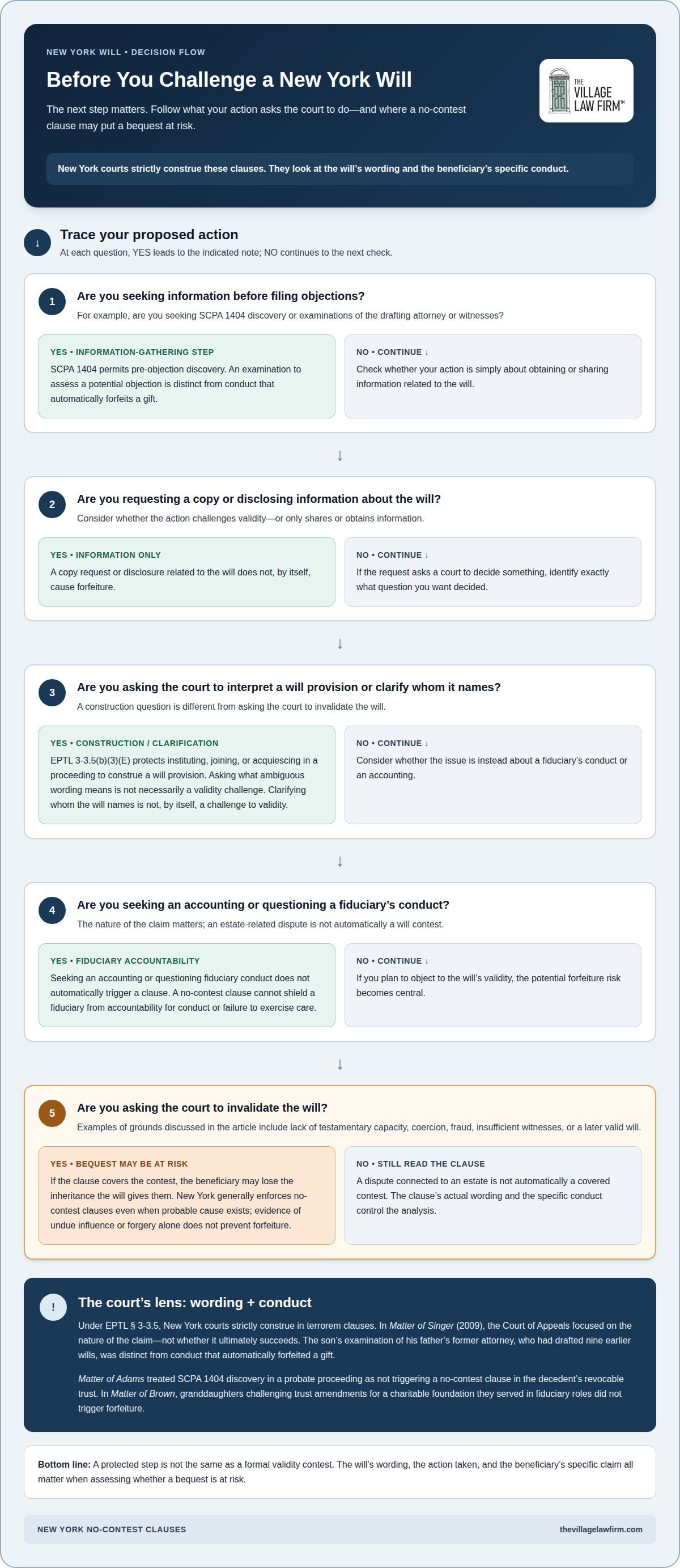
The risk has limits. EPTL § 3-3.5(b) lists conduct that cannot trigger forfeiture, whatever the clause says. New York beneficiaries may use SCPA 1404 discovery before formally objecting to a will. This process can include examinations of the drafting attorney and witnesses. A beneficiary can also disclose information related to a will without forfeiting a benefit.
Trust-related disputes require attention to the beneficiary’s role and claim. In Matter of Adams, a beneficiary’s SCPA 1404 discovery in the probate proceeding did not trigger a no-contest clause in the decedent’s revocable trust. In Matter of Brown, granddaughters challenging trust amendments for a charitable foundation they served in fiduciary roles did not trigger forfeiture. A clause also cannot shield a fiduciary from accountability for conduct or failure to exercise care.
Questions about a beneficiary’s identity differ from challenges to a will’s validity. Asking a court to clarify whom a will names is not, by itself, a challenge to whether the will is valid. Likewise, seeking an accounting or questioning a fiduciary’s conduct does not automatically trigger a clause. The nature of the claim matters.
Unlike states that may protect a good-faith challenge supported by probable cause, New York generally enforces no-contest clauses even when probable cause exists. Evidence of undue influence or forgery may support probable cause, but that alone does not prevent forfeiture under New York law.
Before deciding whether to object, an interested party can seek information through SCPA 1404 examinations, including testimony from the drafting attorney and witnesses. A copy request or disclosure related to the will does not itself cause forfeiture. The principal risk of contesting is losing the inheritance specified in the will, alongside the demands of estate litigation. Legal expenses depend on the dispute’s scope and complexity.
New York’s strict construction of in terrorem clauses
New York courts strictly construe in terrorem clauses under EPTL § 3-3.5. The Court of Appeals described them as enforceable but disfavored in Matter of Singer (2009). Strict construction means a court examines the clause’s actual wording rather than expanding it to cover every dispute connected to an estate. The will as a whole also helps show the testator’s intent.
Matter of Singer illustrates why the nature of the conduct matters. The son examined his father’s former attorney, who had drafted nine earlier wills. The attorney might have had relevant information about possible undue influence involving a later will. The Court of Appeals held that the nature of the claim, not whether it ultimately succeeds, determines whether the clause is triggered. An examination to assess a potential objection is distinct from conduct that automatically forfeits a gift.
Will construction proceedings have a specific statutory protection. EPTL 3-3.5(b)(3)(E) says that instituting, joining, or acquiescing in a proceeding to construe a will provision does not cause forfeiture under an in terrorem clause. For example, asking a Surrogate’s Court to interpret ambiguous wording is not necessarily a challenge to the will’s validity. The court considers what the clause covers and what the beneficiary actually asked it to decide.
There is no single contest deadline to apply without the details of the probate proceeding and its notice. A contest proceeds through objections in Surrogate’s Court. SCPA 1404(4) permits a party to examine specified witnesses and other people before or after filing objections. The drafting attorney’s testimony or an attesting witness’s examination may help clarify the will’s circumstances before objections are filed.
Strict construction does not eliminate the consequences of a challenge covered by a clause. It requires courts to connect the will’s wording with the beneficiary’s specific conduct. For example, asking the court to interpret a distribution term differs from objecting to invalidate the will. That distinction shapes how New York courts assess the clause and the beneficiary’s claim.
Meaning and purpose of no-contest clauses
A testator may use a no-contest clause to discourage beneficiaries from challenging a will and prolonging probate. Its practical force comes from the inheritance at risk: a beneficiary who contests the will and loses may forfeit the gift provided for them. The clause does not prevent every dispute. Instead, it requires a beneficiary to weigh the possible consequences before filing objections.
Consider a hypothetical estate where a decedent leaves 75% to a girlfriend and 25% to his daughter. If the daughter receives the 25% bequest, a clause could put that inheritance at risk if she brings a covered contest and loses. If she receives nothing under the will, there is no gift for the clause to take away, so its deterrent effect is weaker. The example shows why the clause’s practical impact depends on what the will gives each beneficiary.
The purpose is to reduce contests over the testator’s chosen distribution, not to make every question about the estate impossible. A beneficiary may need information before deciding whether to object. In New York, SCPA 1404 permits pre-objection discovery in probate, including examinations of the drafting attorney and attesting witnesses. That process can help clarify circumstances surrounding the will before a formal filing.
Grounds for contesting a will may include lack of testamentary capacity, coercion, fraud, insufficient witnesses, or a later valid will. Each raises a different question about how the document was made or whether it reflects the decedent’s intent. A clause makes the beneficiary weigh possible forfeiture against the strength of those grounds. It does not establish the facts by itself.
For someone drafting a will, the distributions and no-contest clause should work together. A gift gives the clause something meaningful to protect, while clear terms help beneficiaries understand the intended consequences. In New York, careful drafting can support an orderly probate process without treating protected discovery or every request for clarification as a contest.
New York enforceability of no-contest clauses
New York recognizes and enforces no-contest clauses in wills under EPTL § 3-3.5. A beneficiary who challenges a will and loses may forfeit the bequest provided by that document. The rule applies even when the beneficiary had probable cause, so evidence supporting a challenge doesn’t automatically protect an inheritance.
New York’s approach matters to beneficiaries considering allegations of undue influence or lack of capacity. Probable cause may support a will challenge, but it is not a general exception to forfeiture. Before objecting in Surrogate’s Court, a beneficiary should consider both the factual basis for the claim and the inheritance at risk.
EPTL § 3-3.5 also identifies specific limits. A clause cannot cause forfeiture for a contest alleging forgery or revocation by a later will when the contest is brought with probable cause. An incompetent person or an infant may oppose probate without adverse consequences under a no-contest clause. These protections are distinct from a broad good-faith exception.
New York law also permits a beneficiary, upon a showing of special circumstances, to seek a deposition from someone whose testimony may be substantially relevant to whether objections should be filed. In Matter of Singer, the Court of Appeals allowed the examination of the testator’s former attorney, who might have had relevant information about possible undue influence. That examination did not itself trigger forfeiture.
The practical takeaway is that probable cause alone does not prevent enforcement. The claim’s legal basis, the clause’s terms, the bequest at risk, and any statutory protection all matter. A challenge involving suspected undue influence differs from a qualifying forgery claim under the statute.
If you’re drafting or revisiting a will, discuss your estate plan and how its terms may affect beneficiaries.
The Village Law Firm
The Village Law Firm helps individuals bring clarity to estate decisions, including how a will’s terms may affect beneficiaries. Through Estate Planning, the firm can help you consider how to express your wishes and how provisions such as a no-contest clause fit into your broader plan. If you’re administering a loved one’s estate, Estate Administration can help you navigate the responsibilities and questions that arise.
Consider speaking with The Village Law Firm when preparing or revising a will, or when a beneficiary’s concerns raise questions about an estate. A careful review can put the clause in context with the will’s distributions and your broader intentions.
Contact The Village Law Firm to discuss your estate planning or administration questions.
Shape the next chapter of your estate plan
A no-contest clause in a New York will should serve a clear purpose within a broader plan, rather than stand alone as a warning. Consider whether its language reflects your intentions, how each beneficiary is provided for, and whether the plan still fits your family and assets. These decisions can help you move from uncertainty toward a more deliberate legacy.
The Village Law Firm offers Estate Planning, Estate Administration, and Medicaid Planning to support clients planning for the future or managing an estate. If you’re weighing how a clause fits your wishes or facing questions about an estate, contact the firm to discuss a clear next step.
Contact The Village Law Firm to discuss your circumstances and move forward with greater clarity.
Frequently Asked Questions
Are no-contest clauses enforceable in New York?
Yes. New York recognizes no-contest clauses, and a beneficiary may forfeit a bequest by bringing a covered challenge and losing. Probable cause alone doesn’t prevent enforcement. For example, someone who receives a specific gift under a will should consider whether an objection could put that gift at risk. Both the clause’s wording and the nature of the requested relief matter.
What are the exceptions to enforcing a no-contest clause in New York?
New York law protects certain actions from forfeiture. Examples include a contest alleging forgery or revocation by a later will, when brought with probable cause, and opposition to probate by an infant or legally incompetent person. The law also protects specified conduct, such as seeking an interpretation of will language or certain pre-objection discovery. These exceptions are limited and do not create a general safe harbor for every dispute.
Can a beneficiary challenge a will without forfeiting their inheritance in New York?
Sometimes, but a direct challenge to the will’s validity can risk the beneficiary’s bequest, even if there’s probable cause. Before filing objections, an interested party may use SCPA 1404 procedures to examine specified witnesses. A beneficiary may also ask the Surrogate’s Court to interpret unclear terms rather than seek to invalidate the will. The distinction between those requests and a formal contest can be consequential.
Does a no-contest clause apply to challenges to trusts or other estate documents in New York?
A trust may contain its own no-contest clause, but New York has no statute specifically addressing such clauses in trust agreements. The trust’s wording and the nature of the beneficiary’s claim matter. For example, asking a court to require a fiduciary to make distributions required by the trust differs from attacking the trust itself. A clause in a will does not automatically govern every separate estate document.
What counts as probable cause to contest a will in New York?
Evidence of undue influence or forgery may support probable cause. But probable cause alone generally does not prevent forfeiture in New York. A contest alleging forgery or revocation by a later will is protected when brought with probable cause.
What is the deadline and process for contesting a will in New York Surrogate’s Court?
The deadline depends on the probate proceeding and its notice. A contest proceeds through objections in Surrogate’s Court; SCPA 1404 permits examinations of specified witnesses, including the drafting attorney and attesting witnesses, before or after objections are filed.