
For estate planning for business owners in NYC, commonly used tools include wills, trusts, buy-sell agreements, life insurance planning and plans for who will run the business if an owner dies or becomes incapacitated. Estate tax exposure can be an important consideration when planning how business interests pass to heirs. The right combination depends on the business, ownership structure and family goals.
It’s natural to focus on keeping the business running and providing for the people who depend on you. A carefully coordinated plan can address both, while also considering how taxes may affect the value transferred or the liquidity available to pay estate expenses. This article explains how trusts, buy-sell agreements and life insurance arrangements can fit into a succession plan, and what New York and federal estate tax considerations may matter. You’ll come away with a clearer view of the decisions that can help bring order to a complex transition.
Key Takeaways
- See how wills, trusts and buy-sell agreements can help define what happens to business interests when an owner dies or becomes incapacitated.
- Learn how life insurance ownership and an irrevocable life insurance trust may support business continuity, inheritance planning and estate liquidity.
- Identify the succession decisions that can prepare a business for a change in leadership, including who may take on key roles.
- Understand why business valuation, estate liquidity and eligibility for tax provisions matter when assessing potential estate tax exposure.
What are some commonly used estate planning tools for business owners?
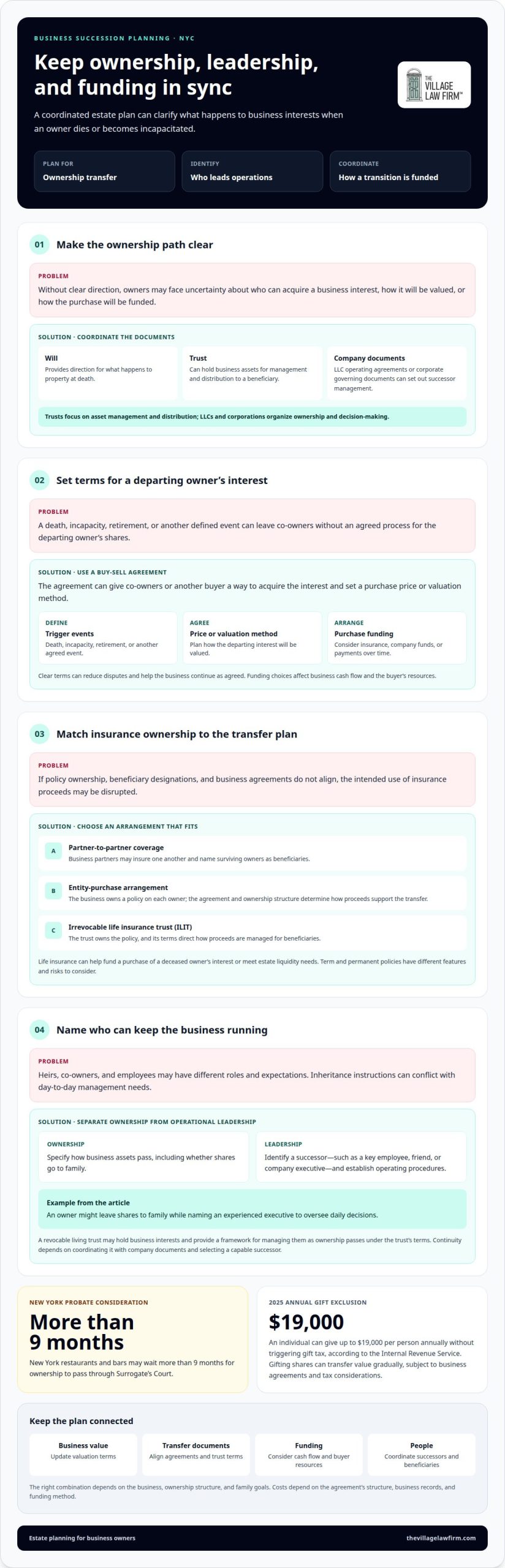
A will, trust, buy-sell agreement, and business governing documents each address a different part of ownership. A trust can hold business assets and allow a trustee to manage them for a beneficiary. An LLC operating agreement or a corporation’s governing documents can set out how successor management works. Trusts focus on asset management and distribution; LLCs and corporations organize ownership and decision-making. Your plan should coordinate these tools with your family and transfer goals.
A buy-sell agreement sets out what happens to an owner’s shares after death, incapacity, retirement, or another defined event. It can give co-owners or another buyer a way to acquire the departing owner’s interest and establish a purchase price or valuation method. Clear terms can reduce disputes and help the business continue as agreed. Without an agreement, owners may face uncertainty about who can buy the interest, how it will be valued, and how the purchase will be funded.
Funding determines whether a planned transfer is practical. An agreement may use life insurance, company funds, or payments over time to finance a purchase. Each option has different implications for business cash flow and the buyer’s resources. Planning should account for valuation updates, legal and administrative work, and the financial effect of a transition. Costs depend on the agreement’s structure, the business’s records, and the funding method, rather than a universal price.
Lifetime gifts may also form part of ownership planning. In 2025, an individual can give up to $19,000 per person annually without triggering gift tax, according to the Internal Revenue Service. The annual gift exclusion for 2025 is $19,000 per person, according to the Internal Revenue Service. Gifting shares can transfer value gradually, but business agreements and tax considerations shape how those gifts fit the larger plan.
New York probate can affect when business assets are transferred. New York restaurants and bars may wait more than 9 months for ownership to pass through Surrogate’s Court. If an owner dies without a will or succession plan, state law determines where the business goes, leaving no owner-created direction for its transfer. These outcomes make coordinated ownership documents and a succession arrangement valuable planning tools.
Life insurance ownership and irrevocable life insurance trusts
Life insurance can provide funds to purchase a deceased owner’s business interest or help meet estate liquidity needs. Business partners may insure one another and name the surviving owners as beneficiaries. In an entity-purchase arrangement, the business owns a policy on each owner. The agreement and ownership structure determine who receives the proceeds and how they support the transfer. Term and permanent policies have different features and risks to consider in light of the business’s needs.
An irrevocable life insurance trust, or ILIT, is another ownership structure to consider. The trust owns the policy, and its terms direct how the proceeds are managed for beneficiaries. Policy ownership, beneficiary designations, and business agreements need to work together: inconsistent documents can interfere with the intended use of insurance proceeds. An estate planning attorney can review how the trust fits with your other assets and estate tax considerations. Life insurance planning should support the succession arrangement, not sit apart from it.
For a restaurant or bar, a revocable living trust may help maintain continuity after the owner’s death. The trust can hold business interests and provide a framework for managing them as ownership passes under the trust’s terms. That continuity depends on coordinating the trust with company documents and selecting a capable successor. For example, a restaurant owner might name a trustee familiar with the business’s operations, rather than relying only on a beneficiary who has no management role.
Choosing trustees is a practical decision. One trustee could oversee financial assets while another handles business operations. Assigning distinct responsibilities can separate investment oversight from day-to-day decisions. Beneficiary designations should also reflect your goals, such as preserving business interests for a child involved in the company while providing other assets to family members. An executor handles estate administration, so that role should coordinate with the trustees and the business transition plan.
For owners integrating policy ownership and trust terms with broader estate planning, a coordinated review can clarify who manages assets and how insurance proceeds support the transition. Consider the business’s liquidity needs, intended beneficiaries, and trustee roles together. This makes the purpose of each policy and trust easier to understand and maintain.
Business succession planning
A succession plan connects business ownership, leadership, and family inheritance within your estate plan. It can identify who takes responsibility and how operations continue after death or incapacity.
Succession Planning Within an Estate Plan
Business succession planning coordinates a company’s transition with its owner’s estate plan. It matters because heirs, co-owners, and employees may have different roles and expectations. A comprehensive plan can identify successors, specify how business assets pass, and establish operating procedures. For example, an owner might leave shares to family while naming an experienced executive to oversee daily decisions. Discussing these goals together can help prevent conflicting instructions.
Leadership Continuity
Leadership continuity means identifying who can direct the business if its owner is unavailable. A succession plan can name a key employee, friend, or company executive to help run operations after death or incapacity. It should also describe key roles, essential business processes, and the transition timeline. If the company owns real estate, the plan can clarify who handles property decisions alongside customer and employee needs. Clear responsibilities support continuity during a difficult transition.
Identifying and Designating Successors
Preparing successors means assessing who can take on each role and giving them opportunities to develop before a transition. An owner might identify a family member for long-term leadership and an executive for immediate operational decisions. The plan should record those roles, explain how authority transfers, and set out how employees and customers will be informed. Naming a successor alone may not prepare that person to lead. A clear timeline and defined responsibilities make the designation more practical.
Review succession arrangements as your business, ownership, and family circumstances change. A new partner, a shift in company strategy, or a real estate transfer can affect who should lead and which assets pass to heirs. Coordinating these decisions with estate planning helps keep ownership intentions and operating procedures aligned. The plan should address both who receives business interests and who can act when continuity matters.
Estate tax considerations for business owners
For estate planning for business owners NYC, assess the value of the entire estate, including business interests. New York’s estate tax exemption threshold is approximately $7.16 million in 2026, with a top rate of 16% on estates above that threshold. A company’s value can affect whether an estate faces tax and how much liquidity heirs need. For estate tax purposes, the business valuation date is the owner’s date of death.
Liquidity matters because heirs may need funds for estate tax without selling the company or disrupting operations. A plan can consider life insurance, available cash, and how ownership agreements coordinate a transfer. Buy-sell agreements can establish purchase terms, but their valuation method and funding structure should fit the wider plan. An attorney can review those terms alongside your other assets and beneficiaries.
Some estates may qualify for payment deferral under Section 6166. Under Section 6166 of the tax code, more than 35 percent of a business owner’s adjusted gross estate must be related to business interests to qualify for the described estate tax deferral, according to the Internal Revenue Service. Eligible estates may pay deferred estate tax in 10 annual installments, with the first installment not due until 5 years after the owner’s death. Eligibility can shape liquidity planning.
Valuation and ownership structure also matter. Properly documented minority-interest and lack-of-marketability discounts can reduce a business interest’s taxable value by 20% to 40% under New York and federal law. An S corporation or LLC may involve special tax rules. A planning attorney can consider valuation support, state rules, beneficiaries, and transfer strategies together, including whether lifetime gifts fit the owner’s goals. Estate planning for business owners NYC also needs to account for the company’s structure and the owner’s intended legacy.
Tax planning works best when coordinated with ownership and succession decisions. Discuss estate planning for business interests to consider how those pieces fit your priorities.
The Village Law Firm
The Village Law Firm™ helps New York business owners coordinate company interests, family priorities, and estate plans. Through Estate Planning, the firm can help address how ownership may transfer, who will manage assets, and how trusts and tax considerations fit your broader legacy goals. Estate Administration helps families manage the legal and practical responsibilities that follow a death. Planning for Families with Children and Medicaid Planning may also be relevant when family or care needs shape long-term decisions.
Consider reviewing your plan when ownership changes, you identify a successor, or your documents no longer reflect your intentions. A thoughtful review can connect business decisions with the people and assets you want to protect. Book an initial call with The Village Law Firm™ to discuss your estate planning needs.
Make your next planning conversation count
A sound plan needs more than well-drafted documents. It also depends on a shared understanding among the people who may manage the business, inherit its interests, or carry out your wishes. Decide how you’ll communicate those responsibilities and keep a clear record of the decisions behind them. This preparation can help family members and business leaders act with greater clarity during a difficult transition.
Thoughtful estate planning for business owners in NYC connects business continuity with personal priorities. The Village Law Firm™ helps New York families consider these priorities through Estate Planning, Estate Administration, and Medicaid Planning, with guidance shaped around their broader legacy goals.
Contact The Village Law Firm to discuss a plan that reflects what matters to you. A considered next step can bring greater order to the decisions ahead.
Frequently Asked Questions
These answers are general informational content from The Village Law Firm™’s attorneys, not individualized legal advice.
Why is succession planning critical for family-owned businesses in estate planning?
Succession planning matters because a family business can represent both a livelihood and a shared inheritance. A relative may be suited to ownership but not daily leadership, while an employee may be equipped to manage operations without inheriting shares. Planning can distinguish these responsibilities and address family expectations before a transition. That clarity can help preserve working relationships as the family considers how business ownership fits its broader legacy.
How do I prepare for my company’s transition in my estate plan?
Begin by defining what a successful transition means for your family and company. For example, you may want a child to inherit an ownership interest while an experienced executive manages operations. Identify the business documents, ownership records, and estate planning documents that need to work together. Then consider how the plan should respond to a sale, retirement, or unexpected absence, and communicate the intended roles to the people affected.
How do you approach identifying and addressing the estate planning issues particular to a specific situation?
A tailored review considers how ownership, family priorities, assets, and existing documents interact. For example, if one child works in the company and another does not, the plan can address business leadership separately from inheritances. The review can also consider whether you own a business interest personally or through an entity, and how unexpected incapacity could affect decision-making. These details help identify potential conflicts between documents and goals.
Incapacity Planning: What Happens If You Cannot Run the Business?
If illness or injury prevents you from managing the company, operations may be disrupted unless someone has authority and a clear role. A power of attorney can support incapacity and continuity planning by naming an agent for financial matters. Business documents can also clarify who handles operational decisions. For example, you might designate a trusted executive to manage daily work while an agent addresses your personal financial affairs.
What is Portability for Estate and Gift Tax?
Portability refers to a possible election concerning the estate and gift tax exemption. It may allow a surviving spouse to account for a deceased spouse’s unused exemption when planning future transfers. The election and the estate’s circumstances matter, so portability belongs in a broader review of gifts, ownership, and tax exposure. Treat it as a planning consideration, not an automatic feature that applies without action.
What would you say is the single biggest misstep business owners make?
A major misstep is allowing business changes to outpace your estate plan. A new partner, a shift in ownership, or a family member joining the company can make earlier documents inconsistent with your current intentions. For example, an outdated plan may name someone who no longer has the expected role. Revisiting the plan after meaningful changes helps keep ownership, leadership, and family expectations aligned.