
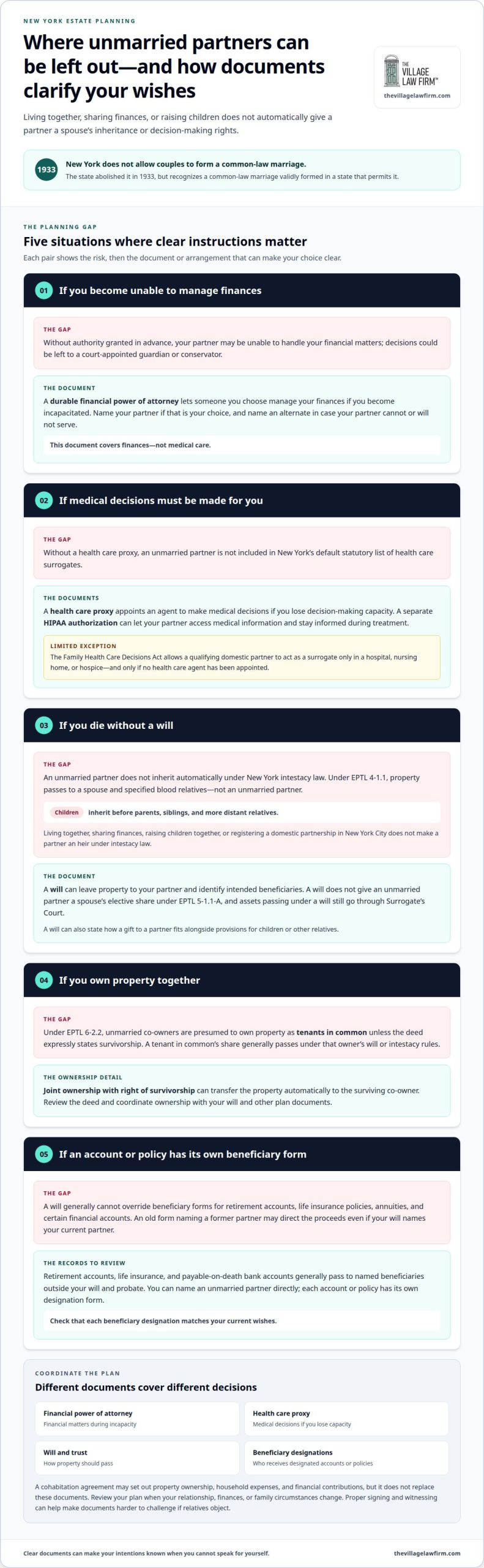
New York does not allow couples to form a common-law marriage: the state abolished it in 1933. It does recognize a common-law marriage validly formed in a state that permits them. Estate planning for unmarried couples in NYC therefore needs to make each partner’s wishes clear in legal documents.
Living together for years, sharing finances, or raising children can feel like the foundation of a family. But these ties don’t automatically give an unmarried partner the inheritance or decision-making rights of a spouse. That gap can leave important choices to relatives or the courts if a partner dies or becomes unable to speak for themselves.
This guide explains what New York rules mean for you and how planning can help protect your partner. Learn which documents address financial and medical decisions, how inheritance and property ownership work, and where tax rules differ for unmarried partners. Understanding these issues can help you make considered choices about the future you’re building together.
Key Takeaways
- New York doesn’t allow couples to form a common-law marriage, so living together alone won’t establish spousal rights.
- Use estate planning documents to name who can manage financial matters and make medical decisions if you can’t.
- Without a will or appropriate ownership arrangements, an unmarried partner may not inherit from you under New York intestacy rules.
- Review beneficiary designations and understand how New York’s estate and gift tax rules may affect what your partner receives.
What documents do unmarried couples need?
An estate plan should identify who can manage your finances and make medical decisions if you become unable to act. For unmarried partners, estate planning for unmarried couples in NYC means coordinating documents for these distinct needs. Review them after significant life changes instead of assuming one agreement covers every decision.
Durable Financial Powers of Attorney
A durable power of attorney authorizes someone you choose to manage your finances if you become incapacitated. Naming your partner can give them authority to handle financial matters instead of leaving decisions to a court-appointed guardian or conservator. This document is central to estate planning for unmarried couples in NYC because it addresses finances during incapacity. Name an alternate in case your partner can’t or won’t serve. The document covers finances, not medical care.
Health Care Proxies
A New York health care proxy appoints an agent to make medical decisions if you lose decision-making capacity. Naming your partner makes your choice clear rather than relying on default hospital-surrogate rules. A financial power of attorney and a health care proxy serve different roles, so one doesn’t replace the other. A HIPAA authorization can also let your partner access medical information and stay informed during treatment.
Creating and Updating an Estate Plan
Coordinate your plan by assigning each role and stating how property should pass. A will, trust, beneficiary designations, health care proxy, and power of attorney address different matters. A cohabitation agreement may set out property ownership, household expenses, and financial contributions, but it doesn’t replace these documents. Review the plan when your relationship, finances, or family circumstances change.
Check that retirement accounts and insurance name your intended beneficiaries; those designations can direct assets outside a will. Consider whether a revocable living trust fits your wishes, such as letting a surviving partner remain in a shared home. Assets generally need to be transferred into the trust for it to work as intended. Proper signing and witnessing can also help make documents harder to challenge if relatives object.
Does an unmarried partner inherit anything in New York?
An unmarried partner doesn’t inherit automatically under New York intestacy law. Estate planning for unmarried couples in NYC should specify who receives property and who can administer the estate, rather than relying on the history of your relationship.
Intestacy and Unmarried Partner Rights
Intestacy is the process for distributing property when someone dies without a will. Under New York EPTL 4-1.1, an estate passes to a spouse and specified blood relatives, not an unmarried partner. If the deceased has children, they inherit before parents, siblings, and more distant relatives. Living together, sharing finances, or raising children together doesn’t change that order.
New York City domestic partnership registration doesn’t make a partner an heir under intestacy law or give them priority to administer the estate. Under SCPA 1001, the surviving spouse and then other distributees generally have priority to serve as administrator. An unmarried partner who isn’t a distributee may lack authority to manage estate affairs, even after a long relationship. That distinction makes inheritance planning different from simply recording a partnership.
Wills and Inheritance
A will can leave property to an unmarried partner, but assets passing under a will still go through Surrogate’s Court. The will identifies intended beneficiaries; it doesn’t give the partner a spouse’s elective share under EPTL 5-1.1-A. Clear instructions can also help explain how a gift to a partner should fit alongside provisions for children or other relatives.
For estate planning for unmarried couples in NYC, review property ownership as well as the will. Under EPTL 6-2.2, unmarried co-owners are presumed to hold property as tenants in common unless the deed expressly states survivorship. A tenant in common’s share generally passes under that owner’s will or intestacy rules. Joint ownership with right of survivorship can transfer the property automatically to the surviving co-owner. Retirement accounts and other assets with beneficiary designations follow their own terms. Coordinate these records so the intended recipient is clear. Explore estate planning for unmarried partners.
Can my partner make medical decisions for me without a health care proxy?
Without a health care proxy, your unmarried partner isn’t included in New York’s default statutory list of healthcare surrogates. A health care proxy can let you appoint someone to make medical decisions if you later lose decision-making capacity. Naming your partner directly makes your choice clear.
The Family Health Care Decisions Act allows a qualifying domestic partner to act as a surrogate only in a hospital, nursing home, or hospice, and only if no health care agent has been appointed. This limited option doesn’t provide the clear direction of a health care proxy. A HIPAA authorization can separately let your partner access medical information.
Beneficiary designations address another part of your plan: who receives certain accounts or policies after your death. Retirement accounts, life insurance, and payable-on-death bank accounts generally pass to named beneficiaries outside your will and probate. You can name an unmarried partner directly on retirement accounts and insurance, but each account or policy has its own designation form.
A will generally can’t override beneficiary forms for retirement accounts, life insurance policies, annuities, and certain financial accounts. For example, if an old form names a former partner, that designation may direct the proceeds even if your will names your current partner. Review each form alongside your will, especially after a relationship change.
A trust can coordinate support for your surviving partner and children. For example, it can provide for your partner during their lifetime, then direct the remaining trust assets to the couple’s children. This differs from naming one beneficiary to receive an account outright. Compare the trust terms with current account designations to ensure the documents express compatible intentions, not conflicting instructions.
Estate and gift tax differences for unmarried partners
For a jointly owned home, make the deed’s survivorship terms clear and consider trust instructions or a life estate. A revocable living trust can provide that a surviving partner may remain in the home. If you rent, address continued occupancy in the lease and estate plan instead of assuming that living together settles the issue.
Tax rules can also shape what an unmarried partner receives. New York’s basic estate-tax exclusion for individuals dying in 2026 is $7.35 million, according to the New York State Department of Taxation and Finance. New York’s estate-tax exclusion can be reduced and eventually eliminated when a taxable estate exceeds the threshold by more than 5%. An unmarried partner inheriting assets from a taxable estate may face tax consequences that differ from those for a spouse.
Federal marital deduction and portability benefits are available to married spouses, not unmarried partners. Lifetime gifts between unmarried partners that exceed the annual exclusion are reportable. The estate’s size, asset ownership, and intended recipient are therefore important planning considerations. An estate planning attorney can help assess how those factors fit together under New York law.
Relationship status matters beyond taxes. New York abolished the formation of common-law marriages in 1933, while recognizing a common-law marriage validly formed in a state that permits them. New York City domestic partnership registration doesn’t make a partner an heir under intestacy law or give them priority to administer an estate. Unmarried partners should use clear documents for inheritance and decision-making if either becomes incapacitated.
For a home, coordinate the deed or trust with your written wishes; for a rental, consider occupancy terms alongside your plan. These steps can clarify how a surviving partner may remain, while reducing uncertainty for relatives. Plan your estate with The Village Law Firm to address inheritance, tax exposure, and housing wishes in one coordinated plan.
The Village Law Firm: Estate Planning
The Village Law Firm™ helps unmarried couples create estate plans that reflect their wishes and circumstances. Estate Planning can coordinate wills, trusts, beneficiary choices, and decision-making documents so each partner’s intentions are clear. Consider this support when deciding how to protect a shared home, provide for a surviving partner, or account for children and relatives.
Planning needs can change with health, family, or financial circumstances. The firm offers Medicaid Planning and Planning For Families with Children, alongside Estate Administration when a loved one’s affairs need attention. The right focus depends on the decisions your plan must address, not a one-size-fits-all checklist. For guidance on your next steps, book an initial call with The Village Law Firm™.
Make your next step a deliberate one
For unmarried couples in NYC, estate planning is more than preparing documents. It makes your shared intentions visible and creates a clearer path through future decisions. Start by talking together about what matters most: the home you share, the people you trust, and the future you hope to shape. Then turn those priorities into a plan that reflects your lives rather than relying on assumptions.
You don’t need every decision settled before beginning. A focused conversation can help identify what needs attention now and what should evolve as circumstances change. The Village Law Firm can help you move from broad concerns to a considered plan shaped around your priorities. Contact The Village Law Firm to discuss your next step. Thoughtful planning can give both partners greater clarity and a steadier foundation for the future you’re building together.
Frequently Asked Questions
These answers are general information from the firm’s attorneys, not legal advice for a specific situation.
Does New York recognize common law marriage?
No. New York ended the formation of common-law marriages in 1933, so living together or sharing finances in New York doesn’t create a marriage. The state does recognize a common-law marriage validly formed in a state that permits them. For couples without that recognized marital status, written planning documents can clarify wishes about property, finances, and care.
Does registering as domestic partners give my partner inheritance rights?
No. New York City domestic partnership registration doesn’t make your partner an heir under New York intestacy law or give them priority to administer your estate. For example, registration alone won’t direct a solely owned bank account to your partner after your death. A will and updated beneficiary forms can state your intended recipients, while property ownership documents determine how jointly held assets pass.
What About Children From Prior Relationships?
Children from prior relationships make clear inheritance instructions especially important. A will can name intended beneficiaries and nominate a guardian for a child, but a New York court makes the final appointment based on the child’s best interests. A trust can also provide for a surviving partner during their lifetime, then pass remaining trust assets to children, including children from earlier relationships.
What Happens Without a Plan?
Without a plan, New York intestacy rules direct an estate to a spouse and specified blood relatives, not an unmarried partner. Relatives may also have priority to administer the estate. A partner may have difficulty accessing accounts held only in the deceased person’s name, and medical decisions may fall to someone else. Written appointments and beneficiary forms address different gaps.
What estate planning documents should unmarried couples in New York City have?
Consider a will, durable financial power of attorney, health care proxy, and beneficiary designations for accounts such as retirement plans and insurance. A HIPAA authorization can address access to medical information. A revocable trust may fit plans involving assets or support for a surviving partner. Keep documents consistent with one another, and name alternate decision-makers in case your first choice can’t serve.
Does an unmarried partner inherit automatically under New York intestacy law?
No. An unmarried partner isn’t included among the spouse and specified blood relatives who inherit under New York EPTL 4-1.1. A will can leave assets to a partner, but property passing under a will goes through Surrogate’s Court. Some assets, such as accounts with beneficiary designations or jointly owned property with survivorship rights, may transfer under their separate terms.