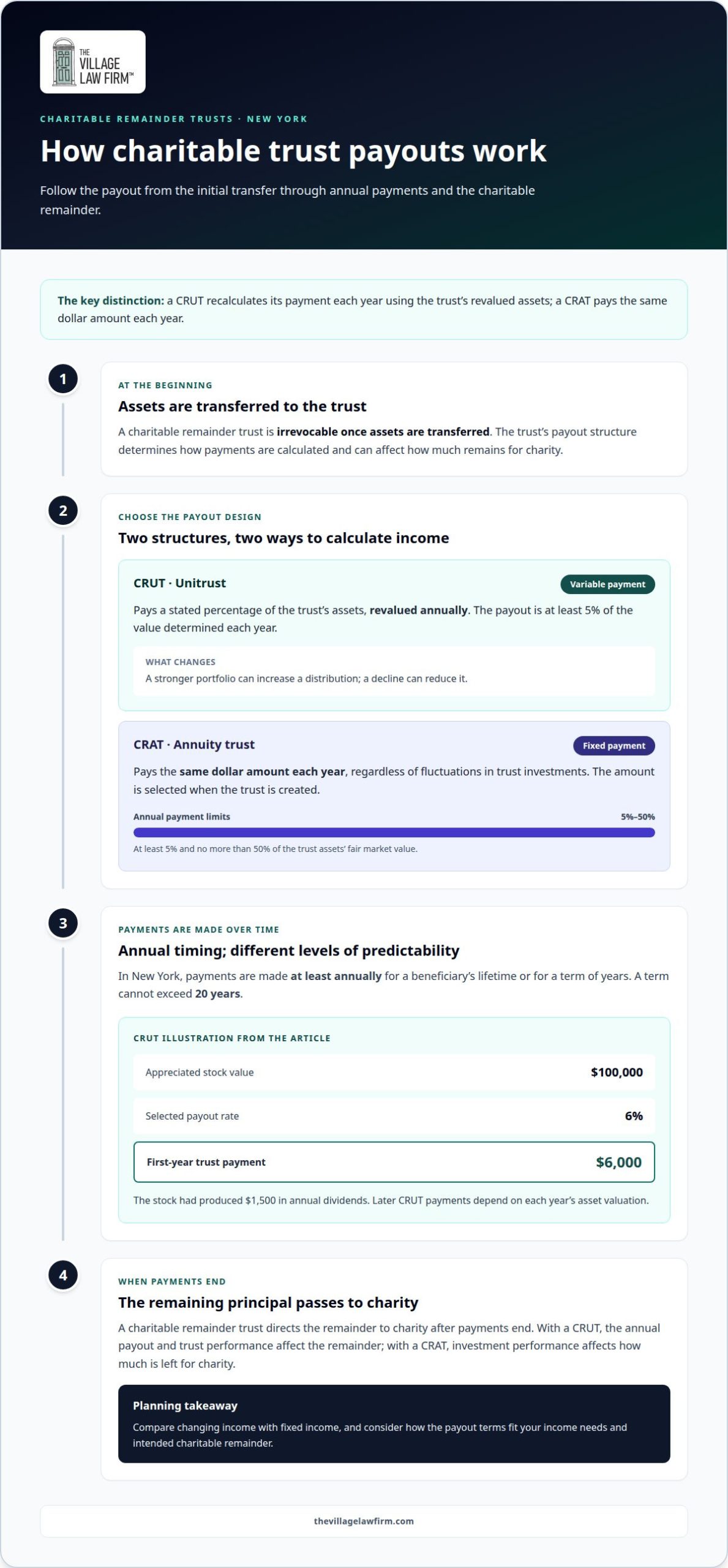
The payout structure is the key difference: a charitable remainder unitrust recalculates its payment each year based on the trust’s revalued assets, while a charitable remainder annuity trust pays the same dollar amount each year. In New York, payments are made at least annually for a beneficiary’s lifetime or a term of years, and the term can’t exceed 20 years. According to the Office of the Law Revision Counsel, a CRAT’s annual payment must be at least 5% and no more than 50% of the trust assets’ fair market value.
It’s understandable to focus on the income a trust may provide. But the payout also affects how much may remain for charity and how the arrangement fits into your broader plans. A charitable remainder trust in NY is irrevocable once assets are transferred, so consider its structure carefully before establishing it.
This article explains how CRUT and CRAT payouts work, which charitable deductions may apply, and how a charitable remainder trust may fit into estate tax planning. It also compares the payout methods and the choices that shape the result.
Key Takeaways
- Compare the two payout structures against your need for income that can change over time or remain predictable.
- Understand how the trust’s assets and terms shape a potential charitable deduction and the amount ultimately passing to charity.
- Consider how a charitable remainder trust may fit alongside your broader estate and legacy plans.
- Explore the trust’s terms, tax considerations, and intended beneficiaries as part of a carefully coordinated estate plan.
Charitable deductions and estate tax planning
A charitable remainder trust in New York may provide a federal income tax charitable deduction when the grantor establishes and funds it. The deduction reflects the charitable interest, not the trust’s entire asset value. Its calculation can depend on the type of trust, the payout terms, the beneficiaries’ ages, and the applicable federal rate. A deduction also isn’t the same as tax savings: the value of the deduction and its effect on income taxes are separate calculations.
Consider Susan’s example. At a 32% tax bracket, that deduction saves her $92,915 in the example. The calculation uses a 5.2% charitable midterm federal rate. These figures illustrate how the deduction is determined; they aren’t a standard result for every donor. The assets, payout design, and other personal circumstances shape the calculation.
Estate planning raises a separate question: what happens to the transferred assets and the remaining principal? A charitable remainder trust may remove assets from the donor’s taxable estate while directing the remainder to charity after payments end. Some donors also use a separate irrevocable insurance trust. When that trust owns a life insurance policy, its proceeds aren’t included in the donor’s gross estate. Income from the charitable remainder trust may fund gifts to the insurance trust for premiums, helping provide for heirs.
Establishment and administration costs depend on the trust’s assets, type of trust, trustee arrangements, and ongoing administrative needs. The price depends on the case and is given after a quote request. Compare those costs with the intended charitable remainder, income needs, and potential deduction before deciding whether the structure fits your lifetime and estate plans.
Charitable remainder unitrusts (CRUTs)
A charitable remainder unitrust recalculates its annual payout based on the trust’s current asset value. Payments may rise or fall as investments change, and both the payout rate and trust performance affect the charitable remainder.
Unitrust payment structure
A CRUT pays its noncharitable beneficiary a stated percentage of the trust’s assets, revalued annually. According to the Archdiocese of New York, the payout is at least 5% of the trust’s value as valued each year. The trustee applies the chosen rate to the annual valuation, so a stronger portfolio can increase a distribution, while a decline can reduce it. This variable structure matters if you need income that may adjust with investment results rather than stay fixed.
Illustrative unitrust example
George and Mary Carlson’s example shows how the calculation works. Their appreciated stock was worth $100,000, and they selected a 6% payout rate for their charitable remainder unitrust. The trust’s first-year payment was $6,000, compared with the $1,500 in annual dividends they had received from the stock. The example makes the trade-off tangible: the initial income changed, but later payments depend on each annual valuation.
A CRUT may hold securities or other contributed assets, and it can accept additional assets after establishment. This flexibility can matter as your holdings or charitable plans evolve. If funded with low-yielding property, such as unimproved real estate, the trust may sell that asset and invest the proceeds to generate income. The trustee’s management and the payout terms affect how this approach supports income and legacy goals.
Before settling on a payout rate, consider how changing annual distributions would fit your income needs and how much value you want to remain for charity. A carefully coordinated legacy planning approach can help place the CRUT’s terms in the context of your broader estate plan.
Charitable remainder annuity trusts (CRATs)
A CRAT exchanges transferred assets for fixed annuity payments and a charitable remainder. This predictability may suit beneficiaries who prefer set payments over distributions that change with investment values.
Annuity trust payment structure
A CRAT pays the same dollar amount each year, regardless of fluctuations in trust investments. According to the Office of the Law Revision Counsel, U.S. House of Representatives, a charitable remainder annuity trust must pay its noncharitable beneficiary an annual amount of at least 5% of the trust’s value. According to the Office of the Law Revision Counsel, U.S. House of Representatives, a charitable remainder annuity trust’s annual payment to its noncharitable beneficiary may not exceed 50% of the fair market value of the assets. The payment amount is selected when the trust is created, so the beneficiary can plan around a defined income stream.
New York rules and trustee requirements
In New York, registration depends on when the charitable remainder interest becomes current. A trust with a current charitable interest must register with the Office of the New York State Attorney General no later than six months after that interest becomes current. Filing requirements for charitable remainder trusts can depend on the trust’s circumstances. The trustee manages investments and may be the donor, a bank, or another financial institution. These duties matter because investment decisions and registration requirements affect administration.
Risks and disadvantages
A CRAT is irrevocable once assets are transferred, so the donor gives up control of them. Fixed payments also don’t automatically increase when trust investments grow, and investment performance affects the amount left for charity. Distributions may have tax consequences for beneficiaries. Weigh these trade-offs against the charitable deduction, the donor’s income needs, and the intended gift.
A charitable remainder trust differs from a donor-advised fund, which directs assets toward charitable grants rather than providing a payment stream to retained beneficiaries. A charitable gift annuity is an arrangement with a charity that provides payments in exchange for a contribution. A CRAT, by contrast, holds assets in a trust and distributes the remainder to charity. The choice depends on whether predictable income, control over charitable distributions, or a trust structure best fits the donor’s goals.
How charitable remainder trusts work
A charitable remainder trust transfers assets into an irrevocable structure that supports beneficiaries and a designated charity. Its payout design, tax treatment, and remainder terms should work together.
Unitrust and annuity trust comparison
A charitable remainder unitrust recalculates payments using the trust’s annually valued assets, while an annuity trust pays a fixed dollar amount. Investment changes can affect unitrust income, but annuity payments remain level. Both structures provide income before the remaining principal passes to charity. The right form depends on whether beneficiaries prioritize variable payments or a predictable amount.
IRS creation requirements
Creating a CRT involves an irrevocable transfer to a trust, naming noncharitable beneficiaries and a qualified charitable remainder recipient. The charitable remainder recipient should be an organization that qualifies as a charity. According to the Office of the Law Revision Counsel, U.S. House of Representatives, a charitable remainder trust can pay income to the donor or other named individuals for life or for a period of no more than 20 years. These terms define who receives income and when charity receives the remainder.
Under the four-tier system, distributions retain the tax character of the trust’s income categories. That character determines how recipients report distributions for income tax purposes.
Minimum funding amount
Funding needs depend on the assets transferred, the chosen payout, beneficiary ages, and the charitable remainder the trust must preserve. A CRT may be funded with cash, securities, appreciated assets, or other property. Rather than choosing an amount in isolation, the trust design weighs projected payments against the principal intended for charity, linking the funding decision to your estate planning goals.
Payout rates, terms, and remainder requirements
A CRT’s payout is either a fixed annuity or a percentage of revalued trust assets. The term may last for beneficiaries’ lives or a period capped at 20 years, as described above. At termination, remaining principal goes to the designated charity. Establishing and funding a New York trust involves selecting assets, beneficiaries, trustee, payout structure, and charitable recipient, then transferring assets under the trust terms.
To align the trust structure with your beneficiaries and estate plan, discuss your estate planning options.
The Village Law Firm
The Village Law Firm™ helps individuals incorporate charitable intentions into a broader estate plan. A charitable remainder trust affects more than income: its irrevocable terms shape beneficiary payments, the assets left to charity, and how the trust fits with other legacy decisions.
Consider an estate planning review when comparing a CRUT with a CRAT, naming beneficiaries, or coordinating the trust with plans for children. The right structure depends on how you balance income needs, charitable goals, and control over assets. Medicaid planning may also be relevant when considering how a trust fits into your broader financial and care planning.
For guidance on how these decisions fit together, book an initial call with The Village Law Firm™.
Bring Your Giving Goals Into Focus
Before choosing a charitable remainder trust in NY, consider how your charitable intentions fit with the life you want your assets to support. Begin by clarifying your priorities: who should benefit during your lifetime, what legacy you hope to leave, and how the arrangement fits your family and financial picture. Aligning these aims can make each next decision more purposeful.
The Village Law Firm™ offers Estate Planning, Estate Administration, and Medicaid Planning. These services can help you consider trust decisions in the context of your estate and future needs. If you’re weighing whether a charitable remainder trust belongs in your plan, book an initial call to discuss the legal considerations and questions that need thoughtful attention.
Contact The Village Law Firm to discuss your estate planning goals. A considered next step can help you move forward with greater clarity and confidence.
Frequently Asked Questions
What is a charitable remainder trust and how does it work in New York?
A charitable remainder trust in New York is an irrevocable arrangement that can provide income to named beneficiaries before the remaining assets pass to charity. For example, a donor may transfer appreciated securities to the trust, which can hold or sell them under its terms. The trust may be created during the donor’s lifetime or through testamentary documents that take effect at death.
What are the federal and New York tax benefits of a charitable remainder trust?
A charitable remainder trust may provide a federal income tax charitable deduction when established and funded, based on the value of the charitable interest. Transferring appreciated assets may also allow the trust to sell them without capital-gains tax at that time, and the assets may be removed from the donor’s taxable estate. These federal benefits don’t establish a separate New York tax deduction; state tax treatment depends on the trust and the donor’s circumstances.
How are CRT distributions taxed under the four-tier system?
Under the four-tier system, distributions retain the tax character of the trust’s income categories. That character determines how recipients report the amounts for income tax purposes.