
Updating a power of attorney in NY is generally the principal’s decision: you can revoke it if you have the mental capacity to do so. Signing a new power of attorney doesn’t automatically cancel an earlier one, so the new document should expressly revoke prior powers if that’s your intent. A county clerk filing isn’t strictly required to revoke a power of attorney, but giving written notice to the agent and others who have relied on it matters.
Changing an agent can feel unsettling, especially if you’re unsure whether the old document remains in effect or the agent will cooperate. The key is to make your decision clear, document the revocation, and notify the people and organizations that need to know. This article explains who can make or change a power of attorney in New York, how revocation and filing work, and what to do if an agent continues acting after notice.
Key Takeaways
- Make a revocation clear by identifying yourself, the date, and the agent whose authority you’re ending.
- If an agent continues acting after receiving notice, alert the banks and other organizations that have dealt with them.
- When preparing a replacement document, review who is named and which powers they’ll receive, as well as the signing requirements.
- Thoughtful estate planning can help align your power of attorney with your wider wishes for your assets and family.
Do You Need to File or Record the Revocation?
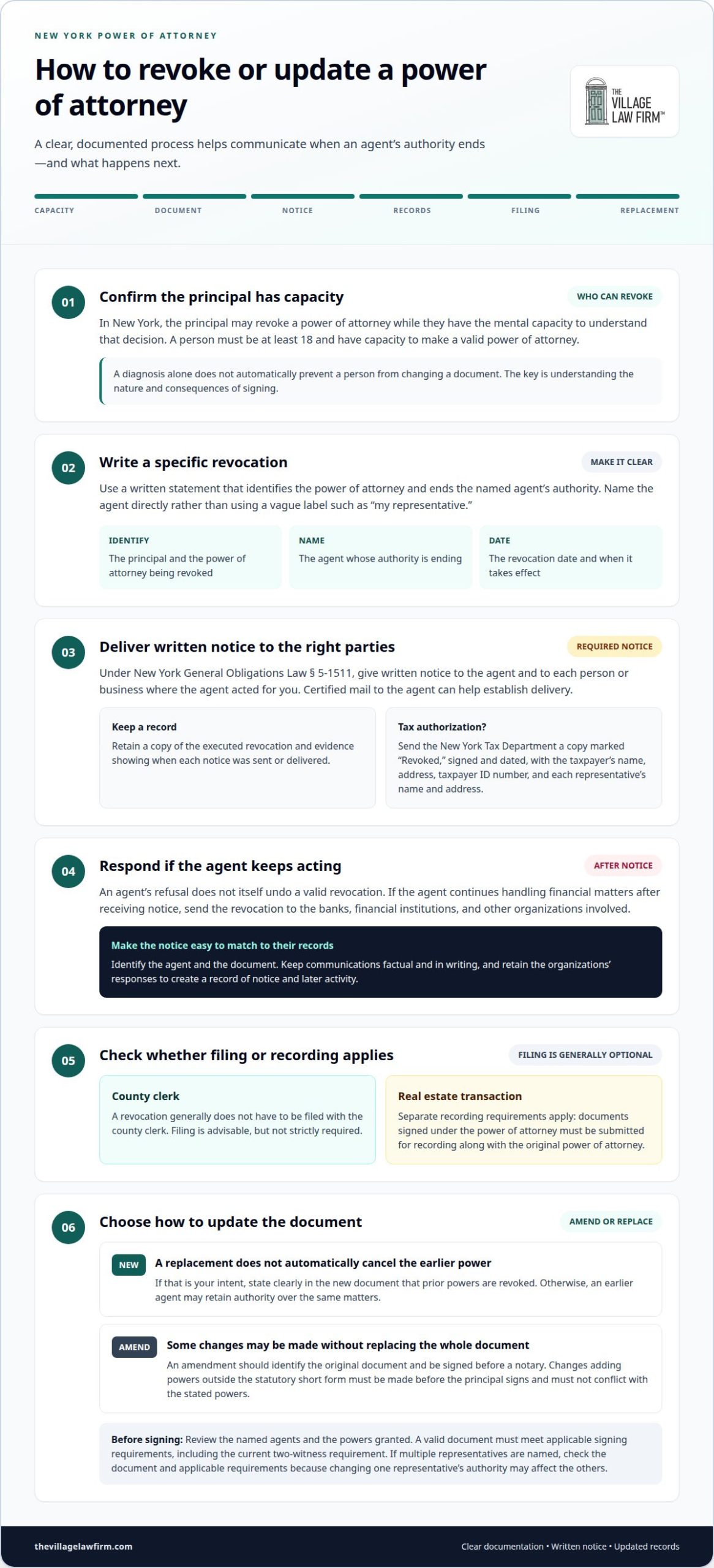
No. A New York power-of-attorney revocation generally doesn’t have to be filed with the county clerk. Filing is advisable, not strictly required, and real estate transactions have separate recording requirements.
Drafting a Revocation Document
A revocation document is a written statement that identifies the power of attorney and ends the named agent’s authority. Include your name, the revocation date, and the name of the agent whose authority you’re ending.
Be precise about the document and what the revocation does. Name the agent directly rather than referring vaguely to “my representative.” Clear wording helps banks and other organizations understand which authority you intend to revoke and when the revocation takes effect.
Notice and Filing of Revocation
Notice means delivering written revocation to the agent and to any person or business where the agent acted for you. New York law requires this notice under GOL 5-1511. Send the document to the agent by certified mail to help establish delivery.
Filing a power-of-attorney revocation with the county clerk is advisable, but generally not required. A power of attorney also generally doesn’t need to be filed unless it is used for real estate. For a New York real estate transaction, documents signed under the power of attorney must be submitted for recording along with the original power of attorney.
Effects on Agents and Their Actions
Once a valid revocation takes effect and the appropriate parties receive notice, the agent no longer has authority under that document. If the agent acts afterward, notify the banks, financial institutions, and other organizations they dealt with. Provide the revocation so those organizations can update their records and respond to the change in authority.
Check how the document appoints multiple representatives. How co-agents must act depends on the terms of the power of attorney. When a document appoints multiple representatives, changing one representative’s authority may affect the other appointments, so check the document and applicable requirements. If a representative withdraws, the document becomes invalid, and the taxpayer must file a new one for any representatives they want to retain.
Who can make a power of attorney?
In New York, a person must be at least 18 years old and have capacity to make a valid power of attorney. The principal can revoke it while they have the mental capacity to understand that decision. A diagnosis alone, such as bipolar disorder, doesn’t automatically prevent a person from changing a document; the key is understanding the nature and consequences of signing.
A statutory short form is not the only permissible wording. New York’s statutory language may substantially conform to the form rather than match it exactly, and the short form is identified in General Obligations Law section 5-1513. A valid document must still meet applicable signing requirements, including the current two-witness requirement.
A key issue in updating power of attorney in NY is whether a new document expressly revokes earlier powers. Signing a replacement doesn’t automatically revoke an earlier power of attorney under GOL 5-1511. State clearly in the new document that prior powers are revoked if that is your intent. Otherwise, an earlier agent may retain authority over the same matters, and agents may act separately unless the principal specifies that they must act together.
In some circumstances, you can change an agent or the powers granted without replacing the entire document. New York permits modifications that add powers outside the statutory short form before the principal signs, as long as they don’t conflict with the stated powers. An amendment should identify the original document and be signed before a notary. For substantial changes, updating power of attorney in NY may be clearer if you revoke the existing document and prepare a new one.
For a taxpayer’s power of attorney, send the New York Tax Department a copy marked “Revoked,” signed and dated. Include the taxpayer’s name, address, taxpayer ID number, and each representative’s name and address in the written statement. This clearly communicates the change to the institutions handling the tax authorization.
What If the Agent Refuses to Accept the Revocation?
An agent’s refusal doesn’t itself undo a valid revocation. Under New York General Obligations Law 5-1511, the principal must give written notice to the agent and to any person or business where the agent acted. Keep a copy of the executed revocation and evidence showing when each notice was sent or delivered.
New York agents have a fiduciary duty to follow the principal’s wishes or act in the principal’s best interest. That duty doesn’t allow an agent to disregard a revocation. If the agent continues handling financial matters after receiving notice, send the revocation to the banks, financial institutions, and other organizations involved. Identify the agent and the document so each organization can match the notice to its records.
Keep communications factual and in writing. For example, if a former agent contacts a bank after receiving the revocation, notify the bank in writing and retain its response. This creates a clear record of notice and subsequent activity, and helps distinguish actions taken before the revocation from those taken afterward.
If illness or a loss of trust prompts the change, the principal may revoke the power of attorney while they have mental capacity. The agent’s capacity and the principal’s capacity are separate questions. Review the signed document for a named successor or co-agent, then state in writing which appointment you’re revoking. Under New York rules, revoking one representative’s authority on a power of attorney naming multiple individuals revokes the power for all representatives listed. If a representative withdraws, check whether the remaining appointments are still effective and whether a new document is needed.
Don’t rely on a conversation alone. Deliver written notice to the agent and each organization where they acted, including any bank holding the principal’s account. If there’s disagreement about the document’s effect or the agent continues acting, a New York lawyer can review the records and help clarify the next legal step. Keep the revocation, proof of delivery, and related correspondence together.
Legal help with changes to a power of attorney
A power of attorney lets someone act on your behalf, so changes should reflect your intentions. In New York, legal review can help coordinate the document, signing formalities, and any revocation.
Legal Help With Updates
Legal help with an update may include reviewing the existing power of attorney and preparing a change that fits its terms. This can matter when you’re changing an agent, adding authority, or making significant changes to financial or estate decisions.
A lawyer can compare the original document with your proposed changes and identify whether an amendment or replacement is clearer. New York General Obligations Law section 5-1503 allows modifications adding powers outside the statutory short form before the principal signs, if those powers don’t conflict with the stated ones. An amendment should refer to the original document and be signed before a notary.
Review the signing requirements, too. New York’s current power-of-attorney requirements include two witnesses. An old form used after June 13, 2022, is invalid if it fails to meet that requirement. Clear drafting also helps distinguish new authority from powers you intend to revoke.
Costs and Risks of Updating
The cost of updating a power of attorney in New York depends on the case and is provided after a quote request. Relevant factors include whether you need an amendment or a replacement, how extensive the changes are, and whether related documents require review.
Updating a power of attorney without legal review can result in an unclear amendment, conflicting provisions, or a document that doesn’t meet signing requirements. For example, a change might name a new agent but fail to revoke the former agent’s authority. A document that misses required formalities may also fail to make the intended change.
If an agent change affects your estate plan or another transaction, have the documents reviewed together. Discuss your power-of-attorney changes as part of a considered estate-planning review.
The Village Law Firm: Estate Planning
The Village Law Firm™ helps individuals and families coordinate power-of-attorney decisions with a broader estate plan in New York. Consider estate planning support when replacing an agent, adjusting authority, or coordinating the document with plans for your family and assets.
A power of attorney works best when it reflects your current wishes and fits with the rest of your planning. For families with children, a change in who can act on your behalf may need to be considered alongside guardianship and asset-planning decisions. The Village Law Firm™ also provides Medicaid Planning and Estate Administration.
If you’re considering a change or preparing a replacement document, book an initial call with The Village Law Firm™ to discuss your estate-planning needs.
Make Your Next Planning Decision With Clarity
A power of attorney is one part of a broader plan for who may act on your behalf and how your wishes are carried out. As your family, assets, or priorities change, consider whether the document still reflects the decisions you want others to make. Updating a power of attorney in NY can be an opportunity to align the document with your wider estate plan.
The Village Law Firm™ offers Estate Planning, Estate Administration, and Medicaid Planning in New York. If you’re considering a change, the firm can help you understand how the document fits your planning needs and decide on next steps.
Contact The Village Law Firm to discuss your estate-planning priorities. A clear plan can help you move forward with greater confidence.
Frequently Asked Questions
Can I have more than one agent?
Yes. A New York power of attorney may appoint multiple agents, but the document should clarify whether they must act together. Co-agents generally act jointly unless the document says otherwise. This distinction affects practical decisions: if two agents are appointed jointly, neither can act alone under that arrangement. You can also name a successor agent to step in if an appointed agent can’t serve.
What are the New York requirements for changing or revoking a power of attorney?
A principal with mental capacity may revoke a power of attorney. A replacement should clearly state whether earlier documents are being revoked. Give written notice to the agent and organizations where the agent acted. A change that adds authority to the statutory short form must not conflict with its stated powers. The document’s signing and acknowledgment requirements also matter for a valid change.
How do I complete and sign a new New York power of attorney form?
Identify the principal and chosen agent, then select the authority the agent should receive. Review each modification carefully to ensure the wording reflects the intended scope, especially if it adds powers beyond the statutory short form. The principal and agent must sign, date, and acknowledge the form. Complete the required witness and notary formalities so the document is properly executed.
Does a New York power of attorney need notarization and witnesses?
Yes. A New York power of attorney requires two witnesses who aren’t named as agents or permissible gift recipients. A notary may serve as one witness, and the person taking the acknowledgment may also act as a witness. Both the principal and agent must sign, date, and duly acknowledge the form. The agent must sign before a notary public before acting under it.
What happens to an old New York power of attorney after I sign a new one?
An earlier power of attorney doesn’t automatically end when you sign a new one. If you want to revoke the old document, state that clearly in the replacement. Otherwise, both documents may grant authority over the same matters, creating uncertainty about which agent may act. Review the older document’s scope and identify it clearly in the revocation.
Can I update a New York power of attorney if I lack mental capacity?
Generally, no. The principal needs mental capacity to make or revoke a power of attorney in New York. A durable power of attorney that was already executed remains effective if the principal later becomes incapacitated, according to its terms. Its existing authority continues, but the principal can’t make a new selection or revoke the document without the capacity required to do so.