
What if the greatest risk to your family’s wealth isn’t a single tax bill, but the gaps between your documents, assets, and intentions? For New York families with substantial or complex estates, those gaps can be easy to miss. A will may be an important starting point, but it may not address every family circumstance, business interest, property, or asset held abroad.
If you’re considering high net worth estate planning NYC, start by looking at how your documents, assets, and family priorities fit together. New York and federal estate-tax rules don’t always align, and cross-border holdings can add another layer of coordination. This guide explains key New York and federal considerations, explores how family priorities and international assets may affect planning, and outlines when to involve an estate-planning attorney. The goal is to clarify what deserves attention and what a thoughtful next step may look like.
Key Takeaways
- See why high net worth estate planning NYC calls for a coordinated view of your assets, family priorities, and future administration, not just a document checklist.
- Learn why New York and federal estate-tax rules need separate attention, and why thresholds and filing requirements should be checked for your circumstances and the relevant year.
- Consider how wills and trusts can serve different purposes, and why a trust alone doesn’t automatically resolve tax or probate concerns.
- Prepare for a planning discussion by clarifying your goals, gathering key records, naming decision-makers, and taking stock of property, business interests, financial assets, and existing documents.
- Use focused questions to assess an attorney’s experience with complex New York estates and cross-border considerations, as well as their approach to communication and advisor coordination.
Why high-net-worth estate planning in NYC calls for more than a will
A will matters, but it’s one part of a larger plan. A family may have a Manhattan residence, investment accounts, a business interest, property elsewhere, and relatives with different needs. These assets may be owned or managed in different ways. A coordinated plan considers how each asset fits with the family’s wishes and who would handle it if the owner became incapacitated or died.
Comprehensive estate planning is a coordinated legal process for organizing assets, decision-making, family protection, and future administration around your priorities, not simply signing a will. That broader view helps frame practical questions: who should make decisions, how should loved ones be provided for, and what steps may be needed to carry out your wishes? For a foundational overview, see estate planning.
Is there a legal definition of high net worth?
“High net worth” isn’t a universal legal category or an automatic test for which planning tools someone needs. Complexity depends on more than total asset value. Ownership structures, family circumstances, business responsibilities, assets in other jurisdictions, and personal goals can all shape the planning conversation. That’s why high net worth estate planning NYC should begin with a complete picture, not an assumed wealth cutoff.
Which parts of a family legacy need planning?
Look beyond a balance sheet. List NYC and other real estate, financial accounts, business interests, existing legal documents, and the people who may need protection or authority to act. Family priorities matter too. A plan for young children, for example, may raise different questions from a plan for adult beneficiaries or relatives with particular support needs.
Consider both lifetime decision-making and what happens after death. Wills, trusts, and healthcare directives can address different needs, but their roles depend on individual circumstances. A coordinated review can also identify whether foreign assets or family ties across borders call for attention in more than one jurisdiction. The Village Law Firm provides counsel on estate planning and administration, including international planning where relevant.
Privacy and future administration deserve attention alongside distribution. Ask who may need access to information, who should be prepared to act, and whether your documents reflect current ownership and family wishes. For a broader introduction to New York planning, see Estate Planning Attorney New York: Protecting Your Legacy in 2026. The goal isn’t to add documents for their own sake. It’s to consider the legal plan, the assets, and the people responsible for carrying out your wishes together.
How New York and federal estate-tax planning fit into a NYC estate plan
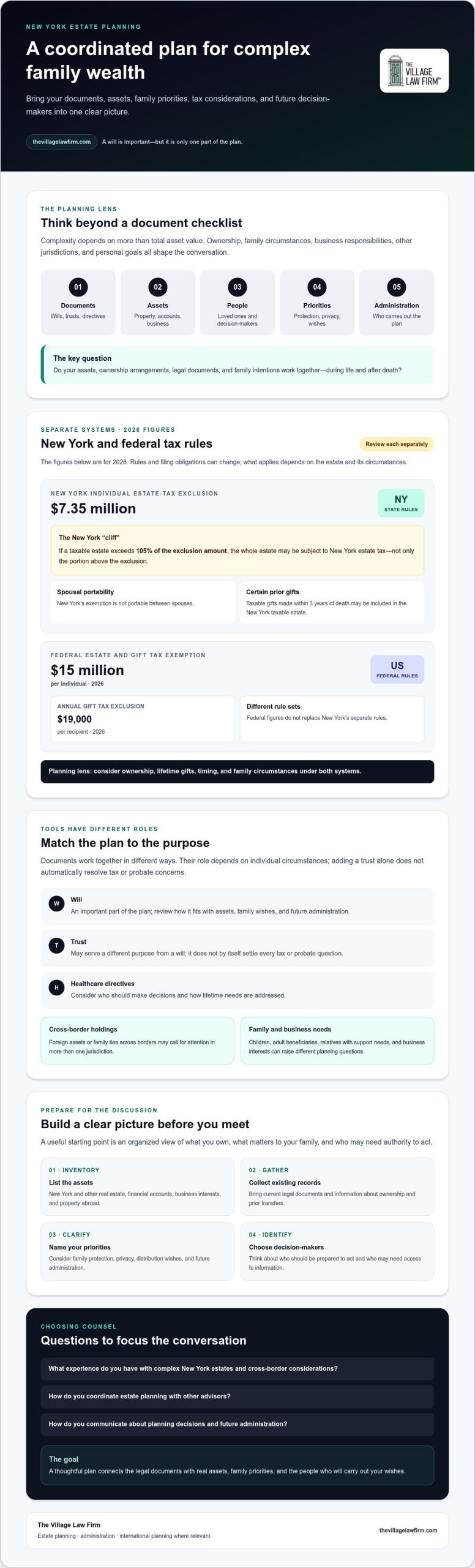
New York and federal estate taxes are separate systems. Assess each on its own terms, then consider how asset ownership, lifetime gifts, and family circumstances affect the overall picture. The figures below are for 2026. Rules and filing obligations can change, and what applies depends on the estate and the relevant circumstances.
What should NYC families understand about New York estate tax?
For 2026, New York’s individual estate-tax exclusion amount is $7.35 million. The state also has a tax “cliff”: if a taxable estate exceeds 105% of that amount, the whole estate may be subject to New York estate tax, not only the portion above the exclusion. Review current details from the New York State estate tax resource, including rules that may apply to residents and nonresidents.
New York’s exemption isn’t portable between spouses, and certain taxable gifts made within three years of death may be included in the New York taxable estate. These features make timing, ownership, and prior transfers important questions to raise. For a deeper discussion, see New York Estate Tax Exemption 2026 & 2026: Navigating the ‘Cliff’ with Confidence.
How do federal rules and lifetime gifts enter the conversation?
The federal estate and gift tax system has its own exemption and reporting rules. For 2026, the federal estate and gift tax exemption is $15 million per individual, and the annual gift tax exclusion is $19,000 per recipient. These federal figures don’t replace New York’s separate rules. A gift may also raise questions about its timing, ownership, and treatment under state law.
| 2026 consideration | Federal | New York |
|---|---|---|
| Estate-tax exclusion | $15 million per individual | $7.35 million per individual |
| Gift-tax consideration | $19,000 annual exclusion per recipient | No state gift tax; certain gifts within three years of death may be added back |
| Spousal portability | Available under federal rules, subject to applicable requirements | Not available for the state estate-tax exemption |
These figures are a starting point, not a personal tax calculation. The value and ownership of real estate, business interests, investment accounts, and other property may affect what needs review. Filing requirements also depend on the estate and applicable law; New York’s estate-tax return is generally due nine months after death. For high net worth estate planning NYC, a legal consultation can help identify which assets, gifts, and jurisdictions need coordinated attention. You can discuss estate-planning questions with The Village Law Firm.
Which planning tools fit complex assets, family goals, and global ties?
Choosing documents is only part of the work. A sound plan also considers how each asset is titled, who is named to receive it, and who can act if you can’t make decisions yourself. For high net worth estate planning NYC, the right combination depends on your assets and priorities, not on a one-size-fits-all document package.
When might a will, trust, or supporting document be relevant?
A will can state how property covered by it should be distributed and may name guardians for minor children. A trust can provide instructions for managing assets held in it, which may be useful when timing, oversight, or support for beneficiaries matters. But creating a trust doesn’t automatically eliminate taxes or every probate concern. Its effect depends on its terms, how assets are titled, and the circumstances involved. For focused trust considerations, see Irrevocable Trust Attorney NYC: Sophisticated Asset Protection for 2026.
Other documents address different needs. A healthcare directive can communicate medical-care wishes and appoint someone to act; a power of attorney can authorize an agent to handle specified financial matters. Beneficiary designations on accounts or policies may direct those assets separately from a will, so review them alongside the broader plan. The IRS explains federal rules in its guide to federal estate tax, but document choices still require attention to individual circumstances and applicable law.
What changes when assets or family connections cross borders?
Foreign real estate, overseas accounts, citizenship, and residence can raise questions that a domestic-only review may not uncover. More than one country’s laws and procedures may affect ownership, succession, or administration. Don’t assume a U.S. will or trust settles every foreign requirement. The relevant documents and jurisdictions need to be considered together. For families managing multi-generational wealth across jurisdictions, looking at institutional-scale structures—such as when you learn more about Vieyra Family Office—demonstrates the level of coordination required for international holdings.
Make a list of where property and accounts are located, where family members live, and any citizenship or residency connections. This gives counsel a practical starting point for identifying which jurisdictions may need review. If these circumstances apply, 2026 Guide: International Estate Planning in New York offers related context. The Village Law Firm provides international estate planning and cross-border estate administration, including counsel for families with assets across borders.
How to prepare for high-net-worth estate planning in New York City
A little preparation can make a planning conversation more focused. You don’t need every answer in advance. Bring a clear view of what matters to you, what you own, and where you’d like guidance.
- Clarify your priorities. Consider who you want to protect, how you’d like decisions handled if you become incapacitated, and what you want to happen to your property and business interests. Note family needs, charitable intentions, and concerns about future administration.
- Map your assets. Make a high-level inventory of NYC and other real estate, financial accounts, business interests, and property or accounts abroad. Note how each asset is owned and whether someone is named to receive it.
- Gather key records. Collect existing wills, trusts, healthcare directives, beneficiary information, and relevant ownership records. Keep sensitive documents secure; ask the professionals you consult how they prefer to receive them.
- Identify decision-makers and questions. List the people named in your documents or whom you may want to appoint. Write down unresolved questions about family needs, business continuity, property, incapacity planning, or cross-border assets.
What records and questions should you bring?
A simple asset map can be more useful than a pile of unorganized paperwork. For each major asset, note its type, location, owner, and any known beneficiary designation. Flag gaps or uncertainties rather than trying to resolve them alone. This gives counsel a practical starting point for reviewing whether your documents and ownership details align with your priorities.
Bring questions about how your plan may address family responsibilities, future administration, and property in more than one jurisdiction. For broader New York planning context, see Estate Planning Attorney New York: Protecting Your Legacy in 2026.
How can you coordinate your professional team?
List your existing legal, tax, and financial advisors, along with the questions each one helps address. Ask how estate counsel will account for New York law and any other relevant jurisdiction, and whether coordination with your other advisors is appropriate for your circumstances. Tax treatment, asset ownership, and family goals may intersect, but each professional’s role should be clear. For guidance on wealth planning, insurance protection, and tax strategies to bring into that discussion, visit Potros Financial.
For high net worth estate planning NYC, this preparation helps turn a broad concern into a structured discussion about goals, records, and jurisdictions. To discuss your planning priorities with the firm, bring your questions and asset overview to the conversation.
Choosing high-net-worth estate planning counsel in NYC: a clear next step
The right counsel should help you understand how your documents, assets, family priorities, and relevant jurisdictions fit together. Look for a clear discussion of the work involved, how information will be reviewed, and how questions will be handled. You should leave a planning conversation with a better sense of what needs attention, not with promises of a particular outcome.
What should you ask an estate-planning attorney?
Use the conversation to understand the attorney’s approach and whether it fits your circumstances. Consider asking:
- How will you learn about my assets, family priorities, ownership arrangements, and existing documents?
- How do you review New York-specific and federal planning considerations, and how do you check for changes that may affect my plan?
- What is included in the proposed scope of work, and how will document review, revisions, and communication be handled?
- How do you coordinate with a client’s tax or financial advisors when their input is relevant?
- If I have foreign property, accounts, or family ties abroad, how will you identify issues that need review in another jurisdiction?
Clear answers can help you assess whether the process will address the parts of your estate that matter most. For international matters, ask specifically how counsel will coordinate with appropriate professionals in other jurisdictions. The Village Law Firm provides international estate planning and cross-border estate administration, including experience handling complex cross-border probate and international asset distribution.
What happens after an initial planning conversation?
A first discussion is generally a chance to describe your goals, identify the assets and family circumstances that may need attention, and explain what documents you already have. Counsel may then review relevant information and discuss possible planning options, the work involved, and any open questions. Recommendations and documents should reflect your circumstances and the applicable legal review, rather than a template applied to every family.
Ask how the firm will communicate next steps, what information it needs, and whether coordination with your other advisors may be useful. For high net worth estate planning NYC, a practical next step is to begin a focused conversation about your priorities and concerns. Contact The Village Law Firm to discuss your estate plan when you’re ready.
Take the next step toward a coordinated estate plan
Strong high net worth estate planning NYC starts with your priorities and the full picture of your assets, not a single document or assumed wealth threshold. New York and federal tax rules operate separately, so a plan should account for applicable law, ownership details, and your family’s circumstances. Wills, trusts, healthcare directives, and beneficiary designations each have distinct roles, while property or family ties abroad may call for cross-border attention.
The Village Law Firm advises on wills, trusts, and healthcare directives tailored to family needs. For families with international assets or connections, the firm also handles international estate planning and cross-border estate administration. A conversation can help identify which assets, goals, and jurisdictions deserve attention and what questions to address next.
Discuss your estate-planning priorities with The Village Law Firm. You don’t need every answer before you begin. A focused conversation can bring greater clarity to the decisions ahead and help you move forward with confidence.
Frequently Asked Questions
What is considered high net worth for estate planning?
There’s no universal legal definition or fixed wealth threshold that determines whether someone needs high-net-worth estate planning. Complexity depends on factors such as asset types, ownership, family circumstances, business interests, goals, and property held in other jurisdictions. A family with several properties or international assets may have planning questions that differ from someone with similar wealth held in a few accounts. Review your full circumstances rather than relying on a single cutoff.
Does New York have its own estate tax?
Yes. New York has a state estate tax separate from the federal system. For 2026, the New York basic exclusion amount is $7.35 million per individual. The state also has a cliff: when a taxable estate exceeds 105% of the exclusion, the entire taxable estate may be subject to New York estate tax. Whether tax or filing obligations apply depends on the estate, residency, and law in effect at the relevant time.
Can a trust reduce estate taxes in New York?
A trust doesn’t automatically reduce New York or federal estate taxes. Its effect depends on the trust’s terms, how assets are transferred or titled, the family’s circumstances, and applicable law. Trusts may also serve goals beyond tax planning, such as managing assets for beneficiaries. Before establishing or changing a trust, review its purpose, tax consequences, and administration with qualified counsel familiar with your New York estate and overall plan.
How much does high-net-worth estate planning in NYC cost?
There isn’t one standard fee for high-net-worth estate planning in NYC. The scope may depend on the number and type of assets, existing documents, family needs, tax questions, and whether cross-border issues require attention. Ask the attorney to explain the proposed work, fee arrangement, document review, revisions, and any separate costs before proceeding. A clear scope helps you understand what the engagement includes without assuming every estate requires the same services.
What happens if I own property or other assets outside the United States?
Foreign property or accounts may raise questions about local ownership, succession, transfer, or administration rules. The relevant analysis can depend on where the asset is located, how it is held, and the owner’s citizenship or residence. Don’t assume a U.S. will or trust addresses every foreign requirement. Tell estate counsel about overseas holdings and family ties so they can identify which jurisdictions and appropriate professionals may need coordinated review.
Do I need an estate-planning attorney if I already have a will?
A will is valuable, but it may not address every planning need. Your asset ownership, beneficiary designations, family circumstances, and wishes for decision-making during incapacity may call for a review of other documents or arrangements. An attorney can assess whether your will and related records still reflect your priorities and applicable New York law. This is especially useful after major changes in family, assets, business interests, or international connections.
How often should a high-net-worth estate plan be reviewed?
Review your plan after a major life or financial change, such as marriage, divorce, a birth, a significant asset change, a business transition, or acquiring property abroad. It’s also sensible to revisit documents periodically with counsel, since your priorities and applicable laws may change. There’s no single review schedule that fits every family. A review can check whether asset ownership, beneficiary information, decision-makers, and documents remain aligned with your intentions.