
A family connection must be proved, not simply asserted. A kinship hearing in New York determines who the deceased person’s legal heirs are and who is entitled to inherit. Claimants must establish their relationship by a preponderance of the evidence, described as 51%.
If you’re trying to establish your place in a family line, a kinship hearing in New York can feel uncertain, especially when records are incomplete or relatives disagree. Knowing what the court examines can clarify the next steps. This article explains what a kinship hearing decides, which records and testimony may help prove a relationship, and what may happen if kinship isn’t established.
You’ll also learn how scheduling, pretrial conferences, and discovery fit into the case, and why a hearing may take longer than expected. Understanding the process can help you see what the court needs to determine and what may follow from its decision.
Key Takeaways
- Understand what the court decides and why claimants must establish both their family relationship and whether closer relatives exist.
- Learn which records and testimony can help build a clear, well-supported account of your family history.
- See how pretrial conferences, discovery, and hearing dates shape the process and its timeline.
- Find out what may happen to estate assets when kinship isn’t established or no relative comes forward.
- Understand who may seek a kinship determination and how the court evaluates competing claims.
What is a kinship hearing?
A kinship hearing in New York is a Surrogate’s Court proceeding to determine a deceased person’s legal heirs and who may inherit. The court evaluates evidence of family relationships and applies the estate’s intestacy rules when there is no will.
The proceeding concerns inheritance, not placing a child with relatives. Kinship foster care and New York’s KinGAP program address child welfare and permanency, not distribution of a deceased person’s estate. Kinship foster care places a child with a relative as a foster caregiver, while KinGAP provides assistance connected to a relative’s guardianship of a child in foster care.
When Kinship Proceedings Are Needed
A kinship proceeding may be needed when heirs are unclear, relatives dispute their status, or a Public Administrator needs the court to identify who can receive estate assets. It may also arise when several people seek appointment as administrator or distant relatives, such as cousins, claim inheritance. The court must establish who is legally entitled to inherit before estate property can be distributed.
Requesting a Kinship Hearing
A person seeking to start the proceeding files a petition in the Surrogate’s Court of the county where the deceased person lived at death. A potential heir may also assert a claim when another party’s petition or estate accounting affects their claimed inheritance. The petition and supporting evidence help the court identify the relationship at issue and the people whose interests may be affected.
Parents and relatives don’t gain custody rights through an estate kinship hearing. Relatives may present evidence supporting their claimed heirship, while a parent’s inheritance rights depend on the applicable succession rules and family relationship. Child custody and foster-care decisions follow a separate process.
Financial assistance for kinship caregivers belongs to the separate child-welfare context. Depending on the child’s placement and guardianship circumstances, support may include foster-care maintenance payments or KinGAP assistance. These programs aren’t distributions from a deceased person’s estate.
Surrogate’s Court Procedures and Referees
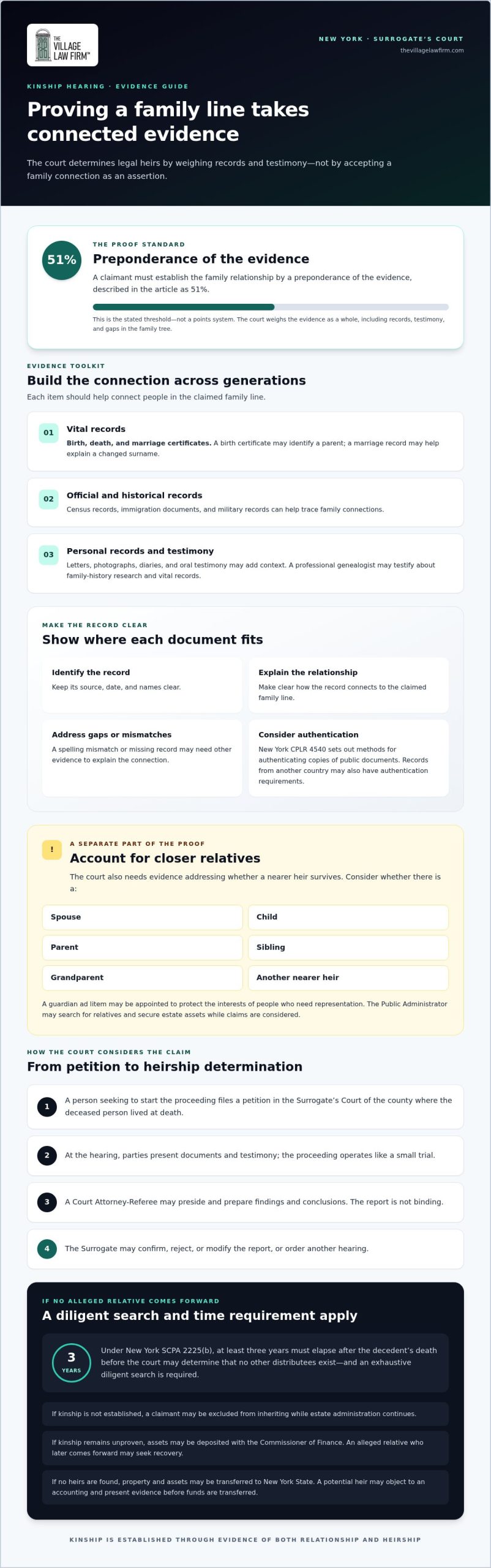
The hearing operates like a small trial: parties present documents and testimony, and the court weighs whether the proof establishes heirship. A claimant must prove the relationship by a preponderance of the evidence, described as 51%. A Court Attorney-Referee may preside and prepare findings of fact and conclusions; the referee’s report isn’t binding, and the Surrogate may confirm, reject, or modify it, or order another hearing.
Evidence must also support the family tree’s dates and connections. Under New York EPTL § 9-1.3, a male younger than 14 years of age and a female younger than 12 are presumed incapable of having children, according to the New York State Legislature. That rule can matter when the claimed lineage depends on a parent-child link formed at an age covered by the statute.
Surrogate’s Court may appoint a guardian ad litem to protect the interests of people who need representation in the proceeding. The Public Administrator may also be involved in administering an estate. The hearing record, referee’s report, and guardian ad litem’s recommendations inform the court’s determination of heirship.
What Happens if Kinship is Not Proven or if No Alleged Relative Comes Forward?
A claimant who cannot establish a family connection may be excluded from inheriting, while the estate’s administration continues. The court weighs the evidence as a whole, including records, testimony, and gaps in the family tree. A claim must meet the preponderance standard, described as 51%. An assertion alone does not establish that someone is entitled to inherit.
Evidence can include birth, death, and marriage certificates, census records, immigration documents, military records, letters, photographs, diaries, and oral testimony. Each item should help connect people across generations. A birth certificate, for example, may identify a parent, while a marriage record may explain a changed surname. A professional genealogist may testify about family-history research and vital records.
Document quality matters. New York CPLR 4540 sets out methods for authenticating copies of public documents offered as evidence, according to the New York State Legislature. For records from another country, authentication and certified translation requirements may also apply, where professional language providers like Dialog One can assist in preparing documents for the court. Keep the document’s source, date, names, and relationship to the claimed family line clear. A mismatch in spelling or a missing record can require other evidence to explain the connection.
A claimant should also account for closer relatives. The court needs evidence addressing whether a spouse, child, parent, sibling, grandparent, or another nearer heir survives. A guardian ad litem may be appointed to ensure alleged heirs prove their cases. The Public Administrator may search for relatives and secure estate assets while the court considers the claims.
If no relative comes forward, the court cannot simply treat an unverified family story as proof. Under New York SCPA 2225(b), at least three years must elapse after the decedent’s death before the court may determine that no other distributees exist, and an exhaustive diligent search is required. The search may involve available records and efforts to locate possible heirs.
If kinship remains unproven, estate assets may be deposited with the Commissioner of Finance. An alleged relative who later comes forward may seek recovery. If no heirs are found, property and assets may be transferred to New York State. A potential heir may also object to an accounting and present evidence supporting the claim before funds are transferred.
Careful administration helps preserve the record of a search and the status of estate assets. For guidance on how estate administration addresses an estate’s legal and procedural demands, consider the steps involved in your matter.
Proving a family relationship to a decedent
A claimant must show how each generation connects them to the deceased person. The court needs evidence of the claimed relationship and whether closer relatives exist. A family tree is a useful organizing tool, but the alleged heir must support each branch with records or testimony. A gap between parent and child can weaken the path to inheritance.
Build the family line from the decedent outward, documenting each parent-child link. Birth and death certificates can identify relatives and dates, while marriage records can clarify name changes. Census, immigration, and military records may help fill gaps. For example, a marriage record connecting two surnames can explain why a descendant’s birth certificate uses a different family name.
Explain what each document establishes. A certificate naming a parent supports one link, but it doesn’t necessarily establish every generation between that parent and the claimant. Pair documents where possible, and identify differences in spelling, dates, or names. A clear timeline helps the court see how the evidence fits together.
Some family records may be unavailable, especially when relatives lived in different places or records use inconsistent names. Use other evidence to address the specific gap. A letter, photograph, diary, or family-history book may provide context alongside vital records. Explain how each item connects to a person and relationship rather than submitting it without context.
Witness testimony can explain family history that documents leave incomplete. A disinterested witness who knew the decedent may describe the decedent’s relatives and family connections. The witness should explain how they knew the family and what they personally observed. For example, a longtime family friend may recognize people in photographs or describe how relatives were known within the family.
The person claiming to be next of kin cannot testify about their own relationship to the decedent, because that testimony is treated as hearsay in the kinship proceeding. This makes independent records and disinterested witnesses especially important. Prepare witnesses to address what they know directly, such as names, family relationships, and events they personally observed.
A professional genealogist may testify as an expert on family-history and vital-records research. Their work can help organize records into a family tree and explain how sources support particular connections. The testimony should clarify the research process, including which documents support each link and where evidence remains uncertain. A family tree alone cannot replace the underlying records.
Proof must also address whether closer relatives survive. Trace the relevant branches far enough to show why a more immediate heir does not take priority. A guardian ad litem may review the claim, and the court may consider the records, witness testimony, and any resulting report. Organizing evidence by relationship helps the court assess the family line and determine who may inherit.
Kinship hearing scheduling and discovery
In a New York kinship proceeding, the judge or referee usually schedules a pretrial conference, allows time for discovery, and sets a hearing date. This gives the parties a chance to identify disputed family links, organize records, and prepare testimony before presenting their cases. The schedule depends on the court’s directions and the work needed to address the evidence.
A pretrial conference helps define what the hearing must resolve. The judge or referee can identify contested relationships, discuss the proof each side intends to present, and set expectations for exchanging evidence. If two claimants rely on different versions of a family tree, for example, the conference can clarify which links remain disputed and what records or witnesses may address them.
Discovery is the period for developing and reviewing evidence before the hearing. Parties can organize relevant vital records, identify witnesses, and examine documents that support or challenge an alleged family connection. Connect each record to a specific relationship instead of presenting papers without explanation. This makes the evidence easier to assess at the hearing.
At the hearing, claimants present their proof and witnesses may testify. A witness should be prepared to explain what they personally know about the family, and documents should be arranged so each claimed link is easy to follow. An attorney representing a claimant can help organize the presentation and address questions from the other parties or the court.
How long does a kinship hearing take in New York? A kinship hearing may take years rather than weeks to conclude. The time depends on how many family relationships are disputed, whether records and witnesses are available, and how much evidence remains to be gathered.
There is also a separate timing point for the guardian ad litem. The proceeding’s timeline states that it typically takes about 2-4 months from the time counsel is retained for a guardian to begin acting. That interval concerns the guardian’s start, not the entire case or the final distribution of estate assets.
Keep the proof deadline in view. In a New York kinship proceeding, the claimant must complete all proof within one year of the hearing date or objections will be dismissed. Identify missing records and witness needs early, then track what remains outstanding as discovery proceeds.
For claimants in New York City or elsewhere in the state, scheduling can involve court conferences, evidence exchange, witness preparation, and the hearing itself. A clear list of disputed issues helps keep those tasks focused. The court’s schedule and the completeness of the evidence shape when the matter is ready for a decision.
Who can request a kinship hearing in New York?
A petitioner starting a kinship proceeding must file a petition in the Surrogate’s Court for the county where the deceased person lived at death. The petition asks the court to resolve who qualifies as an heir or administrator. A potential heir may also appear to assert an inheritance claim. Filing the petition and claiming heirship are related steps, but they serve different purposes.
A Public Administrator may request a kinship proceeding when appointed to administer an estate and the rightful recipients remain uncertain. The proceeding can help determine who is entitled to the estate’s assets. A Public Administrator may collect property, address debts, and account to the court while heirship is resolved. The petition belongs in the Surrogate’s Court tied to the decedent’s county of residence.
Competing applicants for estate administration may also prompt a kinship proceeding. If several people seek appointment, the court can examine their blood relationships to the deceased and determine who should serve. For example, two relatives may claim a closer connection or offer different accounts of the family line. They must support those claims with evidence, not merely state them in a petition.
Distant relatives, including cousins, may claim inheritance when closer relatives are absent or the family tree is unclear. A claimant must establish the relationship and address whether nearer heirs exist. Someone alleging kinship may attend the hearing and present supporting records or testimony. The court considers the evidence before determining legal heirship.
Kinship issues can arise during probate even when a will exists. Next of kin may need notice when a will is offered for probate, and uncertainty about family relationships may require the court to identify those relatives. A kinship proceeding may also arise in an intestate estate, where New York’s intestacy rules govern distribution. The question is who qualifies under those rules, not simply who was closest to the deceased.
If a Public Administrator files an accounting, a potential heir may object to prevent estate funds from being deposited with the Commissioner of Finance. This gives the claimant an opportunity to contest the accounting and develop evidence supporting heirship. Keep the petition, objections, family records, and claimed relationships consistent. A clear account helps the court distinguish a request to administer the estate from a claim to inherit.
Estate administration involves managing an estate while the court determines who should receive its assets. If you need help understanding administration alongside an unresolved family claim, discuss estate administration.
The Village Law Firm: Estate Planning
The Village Law Firm helps individuals and families plan for the future through Estate Planning, including Planning for Families with Children. If a kinship dispute has highlighted uncertainty about who may inherit or manage assets, estate planning can help you document your wishes and provide clearer direction for your loved ones. After a death, Estate Administration addresses the process of managing and distributing an estate.
These services meet different needs: an active kinship proceeding concerns the court’s determination of heirs, while planning can help organize your own affairs before they become disputed. Consider estate planning when family circumstances, assets, or responsibilities change, and estate administration when you’re handling a decedent’s affairs.
Contact The Village Law Firm to discuss the estate planning or administration questions that matter to your family.
Make a clear plan for what comes next
A kinship hearing in New York may bring family history and future responsibilities into sharp focus. Once immediate estate questions are addressed, consider what would make your own wishes easier for loved ones to understand. Clear planning can help put important decisions in order before circumstances change.
The Village Law Firm can help you consider Medicaid Planning as part of a broader approach to protecting your future. The right next step depends on the questions you need to resolve, whether they concern care planning, family responsibilities, or organizing your affairs. You don’t need to solve everything at once. Begin with the issue that matters most to you and your family.
For thoughtful guidance on planning ahead, contact The Village Law Firm. A considered conversation can help you identify a practical path forward and bring greater clarity to the decisions ahead.
Frequently Asked Questions
What Is a Kinship Proceeding?
A kinship proceeding asks a New York Surrogate’s Court to identify a deceased person’s legal heirs. It can arise during administration when family relationships relevant to inheritance are unclear or disputed. The proceeding is distinct from deciding how a child should be placed with relatives. Its focus is the decedent’s family tree and who qualifies to inherit under New York law.
What is Kinship and How Can a NYC Kinship Attorney Help You?
In an estate case, kinship means a legally relevant family relationship to the deceased person. A New York City attorney familiar with Surrogate’s Court matters can help explain the issues, organize evidence, and show how each claimed family connection fits together. For example, counsel can help identify a missing link between a claimant’s records and the decedent’s family line, and explain the procedural steps involved.
What is a kinship hearing in New York Family Court?
An inheritance kinship hearing is generally held in Surrogate’s Court, not Family Court. The proceedings address different matters: Surrogate’s Court determines heirs and inheritance rights, while a child-welfare matter involving a relative’s care of a child is separate. If court papers concern a child’s placement rather than a deceased person’s estate, read the proceeding’s title and stated purpose carefully to identify the issue before the court.
What happens at a New York kinship hearing?
The court considers claimants’ evidence and testimony about family relationships, then determines legal heirship. A Public Administrator may be involved if appointed to administer the estate, and the Attorney General may attend when required by New York law. The court’s order determines heirship for the parties involved. Follow the court notice and be ready to explain how your evidence supports your claim.
What documents should I bring to a kinship hearing in New York?
Bring records that connect you to the deceased person through each generation, such as birth, death, and marriage records, along with relevant census, immigration, or military documents. Family photographs, letters, diaries, or books may provide context. Arrange the materials by relationship and note what each item helps establish. If names or dates differ across records, prepare a concise explanation linking the entries to the same relative.
How can I find legal aid or an attorney for a kinship hearing in New York?
Start by identifying whether you need help proving heirship in Surrogate’s Court or managing estate administration after an heirship decision. Ask about the attorney’s experience with the specific proceeding, evidence preparation, and court process. The Village Law Firm offers Estate Administration for estate matters and Estate Planning for future arrangements. Those offerings address estate administration and planning needs, rather than serving as a substitute for identifying counsel for a contested heirship claim.