
Planning for future care isn’t about predicting every possibility. It’s about making sure your choices and priorities are clear when decisions need to be made. An elder law attorney Queens NY families consult can help connect care planning with Medicaid questions, financial authority, and the legal documents that guide loved ones. Starting early can give your family more time to consider options thoughtfully.
It’s understandable to feel uncertain about future care, how Medicaid planning relates to your circumstances, or who could make health and financial decisions if you can’t. A useful plan isn’t one-size-fits-all. It should reflect your wishes, assets, family relationships, and concerns.
This article explains which planning issues to address, including wills, powers of attorney, advance medical directives, and Medicaid planning. You’ll also learn what information to gather before speaking with an attorney, so the conversation can focus on your priorities. With decades of experience in New York estate law, The Village Law Firm provides tailored guidance and clear communication to help bring order to complex decisions and support a plan suited to you and your family.
Key Takeaways
- An elder law attorney Queens NY families work with can help connect care preferences, financial considerations, and family priorities in a coordinated plan.
- Medicaid planning and legal documents serve different purposes. Understanding how they fit together can clarify eligibility questions and decision-making authority.
- Map your concerns across care, decision-making authority, estate documents, and family needs to see where your planning may need attention.
- Before a consultation, gather relevant records and existing wills, trusts, powers of attorney, or advance directives. Prepare questions about your priorities.
- Tailored estate and Medicaid planning can help you identify which documents and next steps make sense for your circumstances.
What an Elder Law Attorney in Queens, NY Can Help You Plan For
A search for an elder law attorney Queens NY families can turn to often begins with a specific concern: a parent’s diagnosis, a change in care needs, or uncertainty about who can handle important decisions. But elder law planning isn’t limited to one document or a crisis. It brings related legal, financial, and care questions into focus while keeping the person’s wishes and family circumstances at the center.
Elder law planning organizes legal authority, financial considerations, and future care choices so a person’s wishes can guide decisions as circumstances change. The broader field can include financial planning and long-term care considerations, as outlined in Elder Law in the United States. The right plan depends on the individual. A family planning well in advance may have time to review options, while a recent health or caregiving change can make certain decisions more pressing.
When should a Queens family consider elder law planning?
Consider planning when care needs begin to shift, a diagnosis raises questions about future support, or a family member takes on new caregiving responsibilities. These changes can prompt practical questions: Who should help manage financial matters if needed? How should care preferences be communicated? Do existing documents still reflect the person’s wishes?
Planning ahead can leave more room to discuss those questions before circumstances become more difficult. That doesn’t mean every family needs the same documents or must take every step at once. Age alone doesn’t determine whether legal planning is appropriate. Health, wishes, finances, and family circumstances all matter. When a decision is urgent, focus first on the issue at hand, then consider broader planning as circumstances allow.
Which concerns can elder law planning address?
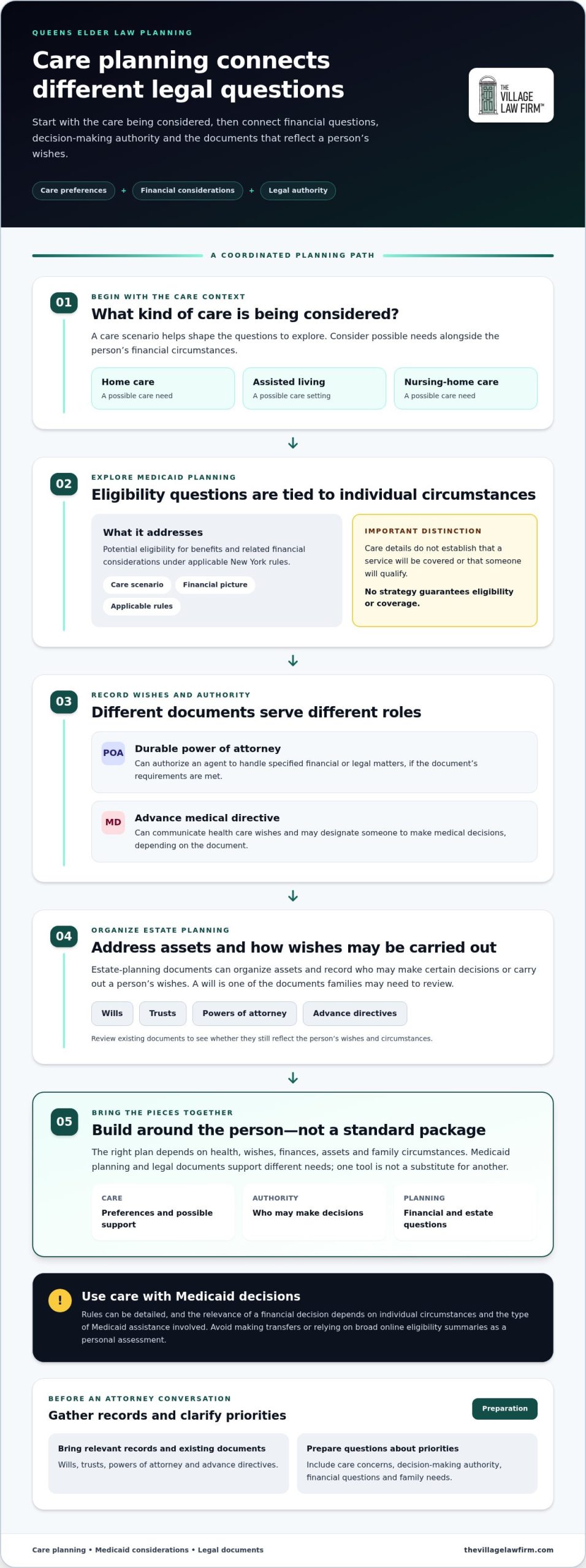
Several planning needs may arise at the same time, but they serve different purposes. Medicaid planning addresses eligibility and financial considerations under applicable New York rules. Future care planning focuses on preferences and the support a person may need. Estate-planning documents address how assets are handled and who may make certain decisions if the person can’t act for themselves.
A diagnosis, for example, may lead a family to review care preferences, financial questions, and existing documents together. But one legal tool won’t resolve every concern. Priorities depend on health, finances, family structure, and personal wishes. A discussion of Medicaid planning for New Yorkers can help explain why Medicaid considerations deserve careful attention alongside estate planning. The goal is to identify which questions need attention and how they relate, rather than to fit every family into a standard package.
How Medicaid Planning and Legal Documents Support Care Decisions
Medicaid planning and estate-planning documents can both matter when a family prepares for future care, but they answer different questions. Medicaid planning focuses on eligibility and financial considerations under applicable New York rules. Legal documents can record wishes or authorize someone to act if a person can’t make or communicate certain decisions. An elder law attorney Queens NY residents consult can help assess how these needs relate without treating one tool as a substitute for another.
Medicaid planning addresses potential eligibility for benefits and related financial considerations, while general estate planning organizes assets and records who may make decisions or carry out your wishes. No document or planning strategy guarantees Medicaid eligibility or coverage. Outcomes depend on individual facts and the rules that apply.
What does Medicaid planning address in New York?
Planning may consider possible home care, assisted living, or nursing-home needs alongside a person’s financial circumstances and the type of care being considered. These details can shape the questions to explore, but they don’t establish that a particular service will be covered or that someone will qualify. For general federal program information, consult Official Medicaid Information. New York eligibility and planning questions require attention to applicable state rules.
A useful discussion starts with the care scenario the family is considering and the financial picture that may affect planning. Avoid making transfers or relying on broad online eligibility summaries as a personal assessment. Rules can be detailed, and the relevance of a financial decision depends on individual circumstances and the type of Medicaid assistance involved.
Which documents can record health and financial wishes?
Different documents serve distinct roles. A durable power of attorney can authorize an agent to handle specified financial or legal matters if the document’s requirements are met. An advance medical directive can communicate health care wishes and may designate someone to make medical decisions, depending on the document. Discuss how each document works under New York law and whether it fits the person’s preferences.
- Durable power of attorney: Sets out an agent’s authority to act on financial or legal matters.
- Advance medical directives: Record health care preferences and decision-making arrangements.
- Will: States how property should be distributed through the estate after death.
- Revocable living trust: Provides an estate-planning structure for assets placed in the trust.
A will or revocable living trust does not, by itself, guarantee Medicaid eligibility. These tools address estate-planning goals, while Medicaid planning examines separate considerations. The right combination depends on what you want to accomplish, whom you trust, and your family’s circumstances. The Village Law Firm’s New York estate planning overview explains how estate-planning documents fit into a broader plan.
If you’re weighing care questions alongside decisions about financial authority or your estate, organizing them together can help show what needs attention first. The Village Law Firm provides tailored estate and Medicaid planning for New Yorkers, with decades of experience in New York estate law. Explore planning support from The Village Law Firm and consider which questions to raise in a planning conversation.
How to Assess Your Elder Law Needs Before Choosing a Plan
Before deciding which documents or strategies to pursue, make a clear inventory of what’s happening now and what you want to prepare for. A concern about future care may also raise questions about financial authority, Medicaid planning, or how your estate should be handled. Mapping those needs can help you and an elder law attorney Queens NY residents rely on focus on your circumstances instead of starting with a standard package of documents.
Use this framework to sort the main areas. It’s a starting point, not a legal determination. One concern can involve more than one tool, and the right approach depends on the person’s situation.
| Planning area | Questions to consider | Possible focus |
|---|---|---|
| Care planning | Are care needs changing, or are you preparing for possible future support? | Clarify care preferences and financial questions related to care. |
| Decision authority | Who would you trust to handle financial or health decisions if you couldn’t? | Review whether documents reflect your wishes and chosen decision-makers. |
| Estate documents | Do you have a will or trust, and does it reflect your current intentions? | Consider how your estate should be organized and distributed. |
| Family priorities | Are there caregiving responsibilities, family needs, or differing expectations to account for? | Identify priorities that may shape the plan and family discussions. |
Which planning questions should come first?
Start with anything that needs attention now: a care transition, uncertainty about who can make decisions, or a document that no longer reflects your wishes. Then separate immediate concerns from longer-term goals, such as organizing an estate or preparing for possible future care. Write down whom you trust to act, what matters most to you, and where family members may need clarity. Priorities can shift as health, assets, and family circumstances change.
Planning is useful before a crisis, too. Addressing questions earlier may allow more time for careful discussion, but not every family needs to complete every step at once. If a change has already occurred, focus first on the most pressing decisions, then consider what else needs review.
How do you recognize a plan tailored to your situation?
A tailored plan takes account of your family structure, care concerns, finances, and personal preferences. Each recommendation should connect to a goal you’ve identified and explain how different tools may work together. For example, a family focused on future care may also need to review decision-making authority, while a change in family circumstances could prompt a fresh look at estate documents. The same checklist won’t produce the same plan for everyone.
Clear explanations matter, including a candid discussion of options and costs. The Village Law Firm discusses pricing transparently during the initial consultation. You should leave the conversation with a clearer understanding of the choices being considered and how they relate to your priorities, without feeling pushed toward a one-size-fits-all solution.
How to Prepare for an Elder Law Attorney Consultation in Queens
A little preparation can make a legal consultation more focused, especially if your family is balancing care questions with financial or estate concerns. You don’t need every answer or document before the meeting. A clear summary of what’s happening, what matters most, and what you hope to understand gives the conversation a useful starting point. If you’re looking for an elder law attorney Queens NY families can consult, use these steps to organize your thoughts.
- Identify your main concerns. Note what prompted the conversation, such as a change in care, questions about decision-making, or a desire to review an existing plan. Separate issues that need attention now from longer-term questions.
- Gather relevant records. If available, bring existing wills, trusts, powers of attorney, and advance medical directives. Note when each was prepared or last reviewed. These documents aren’t a universal prerequisite, but they can help frame a discussion about your current plan.
- Write down questions. List what you want explained, including possible planning options, how they relate to your goals, and what information may be needed to assess them.
- Describe your priorities. Summarize care concerns, family responsibilities, and whom you trust to help with decisions. Include a high-level overview of relevant financial circumstances, without putting sensitive account details in a general written summary.
What information should you organize beforehand?
Bring what you have, not what you think you’re supposed to have. An older document can still help identify what was planned and whether it reflects your wishes today. Make a short note about health or care concerns, the family members involved in caregiving, and any questions about financial responsibilities. A broad picture of relevant assets can help guide the discussion. Share sensitive details through appropriate channels rather than including them in an informal summary.
What should you ask about process and communication?
A productive consultation should help you understand how recommendations connect to your goals. Ask how planning options and their trade-offs will be explained, what information may be useful as the discussion continues, and how you’ll receive updates or follow-up guidance. You can also ask how costs are communicated. The Village Law Firm discusses pricing transparently during the initial consultation, so you can understand the cost conversation without relying on a guess or assumed fee.
For background before your meeting, review estate planning for New York families and note any questions it raises. The goal isn’t to select legal documents on your own. It’s to arrive ready to explain your circumstances and hear how a plan may be tailored to them.
Bring your questions as they are. Arrange a planning conversation with The Village Law Firm to discuss your family’s concerns and possible next steps.
How The Village Law Firm Supports Queens Families with Tailored Planning
Good planning should reflect the life it’s meant to support. The Village Law Firm helps New Yorkers bring estate planning and Medicaid planning into a considered plan shaped by their goals, family relationships, assets, and concerns. For Queens families looking for an elder law attorney Queens NY, that means discussing not only which documents may be relevant, but also what you want them to accomplish and how care or family needs may affect the plan.
The firm’s estate-planning work can include wills, revocable living trusts, durable powers of attorney, and advance medical directives. Each serves a different purpose. A will or trust can help organize estate goals, while powers of attorney and advance medical directives address decision-making authority. Medicaid planning raises separate eligibility and financial questions. Bringing these topics into one conversation can help clarify how they relate without assuming one document or strategy is right for every family.
What does a tailored planning relationship look like?
The Village Law Firm emphasizes a partner approach, clear communication, and guidance shaped around your circumstances. Your family structure, assets, concerns, and personal preferences all inform the planning discussion. Rather than treating a standard set of documents as the answer, the firm explains how potential options connect to the goals you’ve identified. That clarity can help you make considered decisions, even when your family’s priorities are complex or still taking shape.
Planning can require attention over time. Through the firm’s Partnership Service, clients receive annual plan reviews and document maintenance. These features are specific to that service. A review offers an opportunity to revisit whether a plan still reflects your circumstances as family needs or priorities change, while document maintenance supports keeping the plan organized. The firm brings decades of experience in New York estate law to this work, alongside an emphasis on thoughtful, attentive support.
Open communication about costs helps set expectations. The firm discusses pricing transparently during the initial consultation, so you can raise affordability questions and understand the cost conversation as you consider possible planning steps. The focus is on what fits your needs and priorities, not a universal solution.
What is a clear next step for Queens residents?
Begin with the questions you’ve gathered and the concerns you most want to address. You don’t need to arrive with a finished plan. A conversation can help organize which issues deserve attention, how estate and Medicaid planning may relate to your goals, and what options are appropriate to explore. The Village Law Firm’s approach is grounded in honest communication and tailored guidance for New Yorkers.
When you’re ready, talk with The Village Law Firm about your planning needs. Bring your priorities, questions, and concerns. The firm will discuss your situation and pricing during the initial consultation, helping you consider a thoughtful next step for yourself and your family.
Take the Next Step Toward a Plan That Fits
Your family’s priorities may shift as care needs, finances, or relationships change. Turn your most important questions into a conversation about what deserves attention now and what can be planned for over time. You don’t need to have every detail settled before you begin.
For Queens families considering an elder law attorney Queens NY, The Village Law Firm brings decades of experience in New York estate law to tailored Medicaid and estate-planning services for New Yorkers. The firm discusses pricing transparently during the initial consultation. For clients seeking continuing attention to their plan, the Partnership Service includes annual reviews and document maintenance.
Start with the concerns that matter most to you and the people you care about. Schedule an initial conversation with The Village Law Firm to discuss your priorities and possible planning steps. A thoughtful conversation can help make a complicated set of decisions feel more manageable and give you a clearer path forward.
Frequently Asked Questions
Is elder law different from estate planning?
Yes. Elder law often addresses aging-related questions such as care arrangements, Medicaid planning, and authority to make decisions, while estate planning focuses on organizing instructions for assets and family needs. For example, a person may review a will as part of estate planning and separately consider who could manage financial matters during incapacity. The areas can overlap. A New York attorney can help clarify which concerns are relevant to your situation.
Can an elder law attorney help with Medicaid planning in Queens?
Yes. An elder law attorney Queens NY families consult can help explain how Medicaid planning relates to finances, possible care needs, and broader estate-planning goals. The discussion may differ depending on whether someone is considering home care or another care setting, as well as on their individual circumstances. The Village Law Firm provides Medicaid Planning for New Yorkers. Don’t rely on old eligibility figures or assume a particular strategy will result in approval.
When should I speak with an elder law attorney?
Consider speaking with an attorney when a health change raises new questions, caregiving responsibilities shift, or you’re unsure who could act on a loved one’s behalf. It can also be useful to review plans after a major family change, such as marriage, separation, or the birth of a child. There’s no universal age or single trigger. Timing depends on what has changed and which decisions your family needs to address.
What documents should I bring to an elder law consultation?
If you have them, bring your current or previous will, trust, durable power of attorney, and advance medical directive. Note when each was signed or last reviewed, and flag any names or instructions that may no longer reflect your wishes. A short written list of questions can also help keep the meeting focused. If some records are missing, you can still explain your concerns and discuss what may be useful next.
Does Medicaid planning guarantee that I can qualify for benefits?
No. Medicaid planning cannot promise eligibility or a specific benefit. Decisions depend on current New York rules, the type of care involved, and the person’s financial and other individual circumstances. For example, a family considering home-based support may need a different discussion from one preparing for nursing-home care. Before making financial decisions based on assumptions, seek an individualized review of how the applicable requirements relate to your situation.
How much does an elder law attorney in Queens cost?
There isn’t a reliable generic estimate for legal fees because the work depends on the services and planning needs involved. The Village Law Firm communicates pricing transparently and discusses costs during the initial consultation. Use that conversation to understand the proposed scope of work, what it is intended to address, and how the costs relate to your priorities. Don’t assume a particular fee or pricing model in advance.
Can I update my estate plan if my health or family situation changes?
Yes. A change in health, family responsibilities, or finances can be a reason to review your estate plan. For instance, you may want to check whether the people named in your documents still reflect your wishes or whether instructions need reconsideration. Whether changes are appropriate depends on your circumstances and existing documents. The Village Law Firm’s Partnership Service includes annual plan reviews and document maintenance, supporting ongoing attention to your plan.