

A healthcare proxy form in New York must be signed in the presence of two witnesses who are at least 18 years old. Neither witness can be the person appointed as your health care agent. You don’t need to notarize the form or hire a lawyer to complete it.
Getting the signatures right matters, but the healthcare proxy form in New York is only one part of making your wishes clear. This guide explains how to complete and witness the form, what authority your agent has, and how a living will or specific medical directives can add detail. You’ll also learn how to choose an agent and prepare to discuss your preferences, giving the people involved clearer guidance if you can’t speak for yourself.
Key Takeaways
- Choose one health care agent at a time, and consider naming an alternate in case your first choice can’t act.
- Talk through your medical values with your agent, family, and health care providers so your wishes are understood beyond the form.
- A living will or specific written directives can give your agent clearer guidance, especially about life-sustaining treatment and artificial nutrition or hydration.
- Use New York’s official health care proxy form and follow its signing instructions carefully; separate medical orders, such as MOLST, have their own requirements.
- Review how your health care wishes fit into your broader estate plan, particularly if you’re planning for children or considering Medicaid.
What is a Health Care Proxy?
A New York health care proxy lets you appoint someone to make health care decisions if you can’t communicate or make them yourself. New York Public Health Law Section 2980 et seq. recognizes health care proxies and establishes the appointment process. The person you appoint is your health care agent. Their role is to represent your wishes, not simply choose what they personally prefer.
According to the New York State Department of Health, you can appoint only one health care agent at a time. You may also name an alternate agent to step in if your primary agent is unable, unwilling, or unavailable. Choose someone who can listen carefully, communicate with providers, and make difficult decisions in line with your values. Before naming them, discuss the responsibilities directly and make sure they understand your preferences.
Your agent’s authority doesn’t begin simply because you’re ill or receiving care. It takes effect after your attending physician determines, to a reasonable degree of medical certainty, that you’ve lost the capacity to make health care decisions. Your agent may then make decisions within the authority granted by the proxy and your expressed wishes. For artificial nutrition or hydration, New York requires the agent to have specific knowledge of your wishes.
Prepare by talking with your chosen agent, family or close contacts, and health care providers. Explain what matters to you in situations such as serious illness, inability to communicate, or decisions about life-sustaining treatment. A health care proxy appoints your decision-maker; a separate document, such as a living will, can record specific treatment preferences. These conversations help your agent interpret your instructions when a situation isn’t described word for word.
Are there special New York health care proxy rules for minors, nursing homes, or mental health care? A proxy addresses health care decisions, while these settings may involve additional legal or care considerations. When preparing instructions, consider the person’s age, care environment, and specific needs.
How can I change or revoke a New York health care proxy? If your choice or wishes change, prepare an updated proxy and communicate the change to your current and newly named agents, family, and providers. Make sure everyone involved can access your current instructions, not an outdated copy.
What happens if someone in New York has no health care proxy? They haven’t appointed an agent through a proxy, so decisions must follow other applicable New York processes. Without a named agent, the person has less direct control over who speaks for them if they cannot communicate.
Health care proxy form completion and witnessing
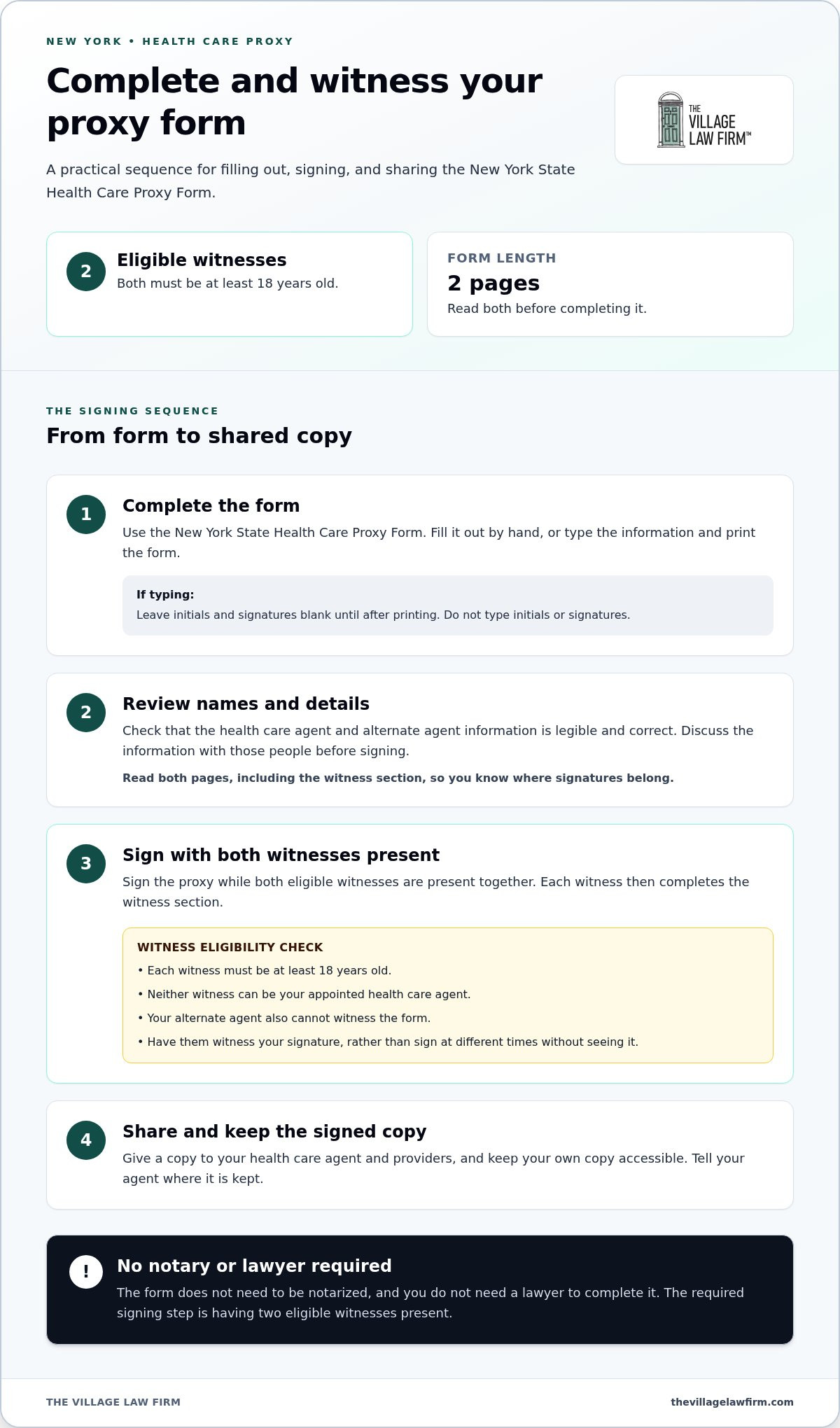
Start with the New York State Health Care Proxy Form, then complete it by hand or on a computer and print it. If you type your information, leave initials and signatures blank until after printing. The printed form records your health care agent and alternate. Review each entry before signing to make sure names and details are legible.
New York requires you to sign the proxy in the presence of two witnesses, each at least 18 years old. Neither witness can be your appointed health care agent. A person named as your alternate agent also cannot witness the form. Choose two eligible adults who can be present together when you sign, rather than asking them to sign at different times without seeing your signature.
Use this practical sequence:
- Complete the form by hand or type the information and print it.
- Review the agent and alternate information with those people before signing.
- Sign while both witnesses are present, and have each witness complete the witness section.
- Give a copy of the signed proxy to your agent and health care providers, and keep your own copy accessible.
The New York form is two pages long. Read both pages before completing it, including the witness section, so you know where signatures belong. If you use a computer, print the form before signing. Don’t add typed initials or signatures, because the witness procedure requires you to sign in the witnesses’ presence.
Does a New York health care proxy need to be notarized or filed with a government office? No notarization is required, and you don’t need a lawyer to complete the form. You must sign in the presence of two eligible witnesses. Keep the completed form and share copies with the people involved in your care.
After signing, tell your agent where the copy is kept and give your providers a copy for their records. If you prepare a replacement proxy, distribute the updated version so your agent and care team can find the current document. Keeping an accessible copy helps avoid confusion about whom you appointed.
New York living wills and self-determination
A health care proxy names someone to make medical decisions when you can’t make them yourself. A living will records your treatment wishes for situations when you may be unable to communicate. A power of attorney has a separate legal role, so it isn’t a substitute for naming a health care agent.
New York recognizes health care proxies by statute, but has no specific statute recognizing living wills and no official state living-will form. Clear, detailed language is therefore especially important. New York courts require “clear and convincing proof” that a person, while competent, gave clear and unequivocal instructions to terminate life-sustaining measures. Broad statements about not wanting to be kept alive may leave important questions unresolved.
The New York Court of Appeals addressed this issue in Matter of O’Connor. It held that casual, unspecific statements did not meet the clear-and-convincing-proof test for refusing life support. For example, a general comment about not wanting machines may not explain which treatments you mean or the circumstances covered. A written directive can describe those details more precisely.
Start by identifying the values behind your choices. Consider what outcomes you would find acceptable, which treatments concern you, and whether your preferences depend on the chance of recovery. Then write instructions that name specific situations and treatments instead of relying on general phrases. Discuss the document with your health care agent and providers so they understand how your instructions reflect your priorities.
That planning supports a broader right to make decisions about your own care. In Cruzan, the U.S. Supreme Court stated in 1990 that a competent person has a liberty interest under the Due Process Clause in refusing medical treatment. New York’s highest court has also held that a patient’s common-law right to decline medical treatment is guaranteed. Clear instructions help others understand how that choice applies to your circumstances.
How does a New York health care proxy differ from a living will or power of attorney? A proxy appoints your health care decision-maker; a living will records treatment instructions. A power of attorney is a separate document and doesn’t, by itself, name your health care agent under the proxy.
Use the documents for their distinct purposes: the proxy gives a trusted person authority to act when the legal conditions are met, while a living will provides written guidance about your wishes. Review them together for consistency. If your health, relationships, or beliefs change, revise your instructions and share the current versions with your agent and providers.
Writing specific advance directives
A health care agent can make better-informed decisions when your written instructions explain what matters to you. In New York, a separate document, such as a living will, can record treatment preferences alongside your proxy. Specify the circumstances and treatments you mean. For example, distinguish a temporary condition with a reasonable prospect of recovery from a situation in which you would refuse life-sustaining measures.
Use plain, specific language. Identify the treatment or decision, the situation in which your preference applies, and any limits or conditions. Avoid relying only on phrases such as “no extraordinary measures.” That wording may leave your agent and providers unsure what you consider extraordinary. Share the final document with them and discuss examples that clarify your meaning.
New York uses other documents for particular medical instructions. Each serves a different purpose, so don’t treat them as interchangeable:
- Living will: records your preferences in writing and can provide guidance to your agent about treatment choices.
- Out-of-hospital DNR form: records a do-not-resuscitate instruction for the out-of-hospital setting. A doctor must sign this form.
- MOLST form: records medical orders. It must be signed by a physician, nurse practitioner, or physician assistant.
- VSED directive: addresses voluntary stopping of eating and drinking. The directive described here can be used anywhere in the United States.
Some New York doctors are willing to sign a MOLST form when a patient could reasonably be expected to die within one year or lives in a long-term care facility. A MOLST is a medical order, while a living will sets out the person’s expressed wishes. Discuss the intended use of each document with your care team, especially if your instructions concern resuscitation or other specific interventions.
To prepare, list the decisions you want addressed. Write your preference for each situation, then review the wording with your agent and providers. Ask whether an example could be misunderstood, and replace vague phrases with clear directions. Keep the documents together, tell your agent where they are, and give your providers current copies.
Specific directives work best as part of a coordinated plan. Compare each document with your proxy so your written preferences and your agent’s role are clear. If your wishes change, update the relevant instructions and make sure your agent and providers have the current versions.
Where can I get the official New York health care proxy form?
The New York State Department of Health provides information, legal forms, and instructions for appointing a health care proxy in New York State. Its Health Care Proxy Form is available online in multiple languages. Use the state form as your starting point and read the instructions before filling in names or signing.
Choose a language you can read comfortably and review the entire form before completing it. The form is two pages long, so check both pages for spaces requiring your information or signature. If you’re helping a family member, read the instructions together and let them choose their agent. A relative’s assistance shouldn’t replace the person’s own choices.
Use each document for its intended purpose:
- New York State Health Care Proxy Form: names the person authorized to make health care decisions when the required conditions apply.
- Form instructions: explain how to complete the proxy and appoint an agent.
- Living will: records treatment preferences to guide an agent and care team.
- MOLST form: records medical orders, with signatures required from a physician, nurse practitioner, or physician assistant.
Keep the proxy and any separate directives distinct. The proxy appoints a decision-maker; a living will records your wishes. A MOLST form is a medical order, not a replacement for the proxy. For example, someone can use a proxy to name an agent and a separate written directive to describe treatment preferences. Share relevant documents with the agent and providers involved in care.
Federal law requires hospitals, nursing homes, home health care services, hospice programs, and health maintenance organizations participating in Medicare or Medicaid programs to give patients written information about living wills or equivalent advance directives. This information helps patients understand advance-directive options in those care settings. It doesn’t replace reading New York’s proxy instructions or completing the state form.
Before signing, confirm that the form reflects your decisions and that your named agent understands the role. Follow the New York form’s witness instructions, give copies to the appropriate people, and keep your own copy accessible. If you prepare a new proxy later, share the updated version so your agent and providers can refer to your current wishes.
The Village Law Firm: Estate Planning
The Village Law Firm helps you incorporate health care decisions into a broader estate plan. A health care proxy and written medical wishes can sit alongside plans for your assets and the people who depend on you. If you’re planning for children, coordinating Medicaid planning, or reviewing an existing plan after a major life change, consider how these decisions fit together.
Estate Planning can help organize your intentions and the documents that express them. The right next step depends on your family circumstances, assets, and the decisions you want addressed. A thoughtful review can help you see how your health care instructions align with the rest of your plans.
To discuss your planning needs, contact The Village Law Firm.
Make Your Wishes Part of a Larger Plan
Your health care instructions are most useful when they remain connected to the people and plans that matter to you. As your family circumstances, priorities, or assets change, consider whether your health care documents still reflect your intentions. A healthcare proxy form in New York is one part of the picture, alongside broader decisions about protecting your legacy and supporting loved ones.
The Village Law Firm offers Estate Planning, Estate Administration, and Medicaid Planning. These services can help you address related planning needs and consider how your wishes fit within your wider plans. If you’re ready to take that next step, contact The Village Law Firm to discuss your planning goals.
Clear planning gives the people you trust meaningful direction. Move forward at your own pace, with your priorities at the center.
Frequently Asked Questions
Are witnesses necessary?
Yes. Your New York health care proxy needs two adult witnesses who are at least 18 years old, and neither can be your appointed agent. A named alternate agent can’t witness it either. Arrange for both witnesses to be present when you sign, then have them complete the witness statements. For example, a friend and neighbor may serve if neither is named as your agent or alternate.
Can you appoint more than one person to act as agent at the same time?
No. New York allows one health care agent to serve at a time. According to the New York State Department of Health, you can name an alternate to act if your primary agent can’t, won’t, or isn’t available to serve. An alternate is a backup, not a second agent making decisions alongside the first. Discuss the role with both people so they understand the order you selected.
How many copies should you sign?
Give a copy of the completed, signed proxy to your agent and the health care providers involved in your care. Keep a copy where someone you trust can find it, and make additional copies for other providers who need your instructions. The number of copies depends on who needs access. If you replace the document, distribute the current version and make clear which copy should guide your care.
What if you move?
Treat a move as a prompt to review your proxy, especially if you leave New York. Update contact details if they’ve changed, and make sure your agent and new providers can access the document. If you move to another state, review the document against that state’s requirements before relying on it there. Revisit your chosen agent as well if the move changes who can communicate with your care team.
What is the test that must be met?
If you mean when an agent may begin making decisions, your attending physician must determine, to a reasonable degree of medical certainty, that you’ve lost the capacity to make health care decisions. A different standard applies to certain written instructions: New York courts require clear and convincing proof of clear, unequivocal directions to end life-sustaining measures. Keep these standards distinct.
What is a New York health care proxy and what decisions can an agent make?
A health care proxy names someone to make health care decisions if you lose the ability to decide or communicate. The agent’s choices should reflect your known wishes and the authority granted in the document. For example, an agent may discuss treatment options with your providers. Decisions about artificial nutrition or hydration require the agent to have specific knowledge of your wishes.
How do I fill out a New York health care proxy form?
To complete a healthcare proxy form in New York, review both pages of the state form and its instructions. Enter your chosen agent’s information and, if you wish, an alternate’s details. You can write by hand or type the information and print the form; don’t type initials or signatures before printing. Then sign with both eligible witnesses present and give copies to your agent and providers.
What are New York’s signing and witness requirements for a health care proxy?
A healthcare proxy form in New York must be signed in the presence of two witnesses who are at least 18 years old. Neither your appointed agent nor your alternate agent may witness it. The form doesn’t need notarization, and a lawyer isn’t required to complete it. Before signing, confirm the agent details are accurate, then make sure both witnesses complete their portions of the document.