
What if a spouse’s refusal to contribute toward care could affect Medicaid eligibility now, yet leave the couple facing financial exposure later? For New Yorkers considering spousal refusal Medicaid NY, those are separate questions. Both deserve careful attention before any documents are filed.
It’s understandable to worry that long-term-care costs could put the community spouse’s financial security at risk. New York permits spousal refusal in certain Medicaid situations, but it isn’t a way to hide assets or erase every possible responsibility. The state may seek recovery from the refusing spouse, so immediate eligibility is only part of the picture.
This article explains the general purpose and limits of spousal refusal, the role of disclosure and supporting documents, and what potential recovery may mean for a couple’s finances. It also outlines questions to consider before deciding whether this approach fits your family. With clear information and tailored guidance from New York Medicaid counsel, you can weigh the options in light of your circumstances.
Key Takeaways
- Spousal refusal Medicaid NY is a planning choice, not a blanket waiver of responsibility or a way to make assets invisible.
- Identify the Medicaid program and care involved, and understand what financial information the application requires before deciding how to proceed.
- Consider eligibility and possible later recovery separately. The consequences depend on the circumstances and applicable New York rules.
- Gather care details, financial records, existing planning documents, and Medicaid correspondence to support a more informed discussion.
- Tailored Medicaid Planning can help you assess options and potential consequences with compassionate guidance grounded in decades of New York estate-law experience.
What Does Spousal Refusal Mean for Medicaid in New York?
Planning for long-term care can put two urgent concerns side by side: arranging care for one spouse and preserving stability for the other. New York’s spousal refusal rules may be relevant, but the term can sound more sweeping than it is. It doesn’t mean a spouse can step away from every financial question or obligation.
In plain English, spousal refusal is a legal position in which a spouse who isn’t applying for Medicaid declines to make their income or resources available for the applicant spouse’s care. New York Social Services Law § 366(3)(a) addresses this concept. How the law applies depends on the Medicaid program, the care involved, the couple’s circumstances, and current rules. It is an option to assess, not a universal shortcut to eligibility.
Who Is the Community Spouse in a New York Medicaid Application?
The applicant spouse is the person seeking Medicaid and the covered care at issue. The community spouse is the spouse who isn’t applying for institutional care. These terms distinguish the person receiving care from the spouse who remains outside that setting and may have separate financial needs.
For example, if one spouse applies for Medicaid to help cover nursing home care while the other continues living at home, the spouse seeking coverage is the applicant and the spouse at home is generally called the community spouse. These labels help frame whose eligibility is being assessed and whose resources may be relevant. They don’t determine the outcome by themselves.
What Spousal Refusal Does, and Does Not, Mean
Spousal refusal concerns whether the non-applicant spouse will make resources available for the applicant’s care. It doesn’t make the couple’s finances invisible, remove the need to respond truthfully to information requests, or automatically prevent later recovery efforts. A refusal and an application’s disclosure requirements are separate matters. What information is required and how resources are treated can depend on the program and the couple’s circumstances.
New York law recognizes spousal refusal in certain Medicaid contexts, while the state may retain rights to seek recovery from a refusing spouse. Consider that possibility before acting. Eligibility at the application stage and potential financial exposure later are distinct legal questions.
Spousal refusal may affect whether a spouse qualifies for Medicaid now, but it doesn’t automatically settle who may bear financial consequences later.
That distinction is central to understanding spousal refusal Medicaid NY. First identify the care and Medicaid program involved, then review the application requirements and possible consequences of taking this position. Rules can differ by program, and details such as how an asset is owned or what care is being sought may matter. Treat spousal refusal as a decision requiring a fact-specific review, not as a promise that the community spouse’s finances are fully protected.
How Spousal Refusal Can Affect Medicaid Eligibility in New York
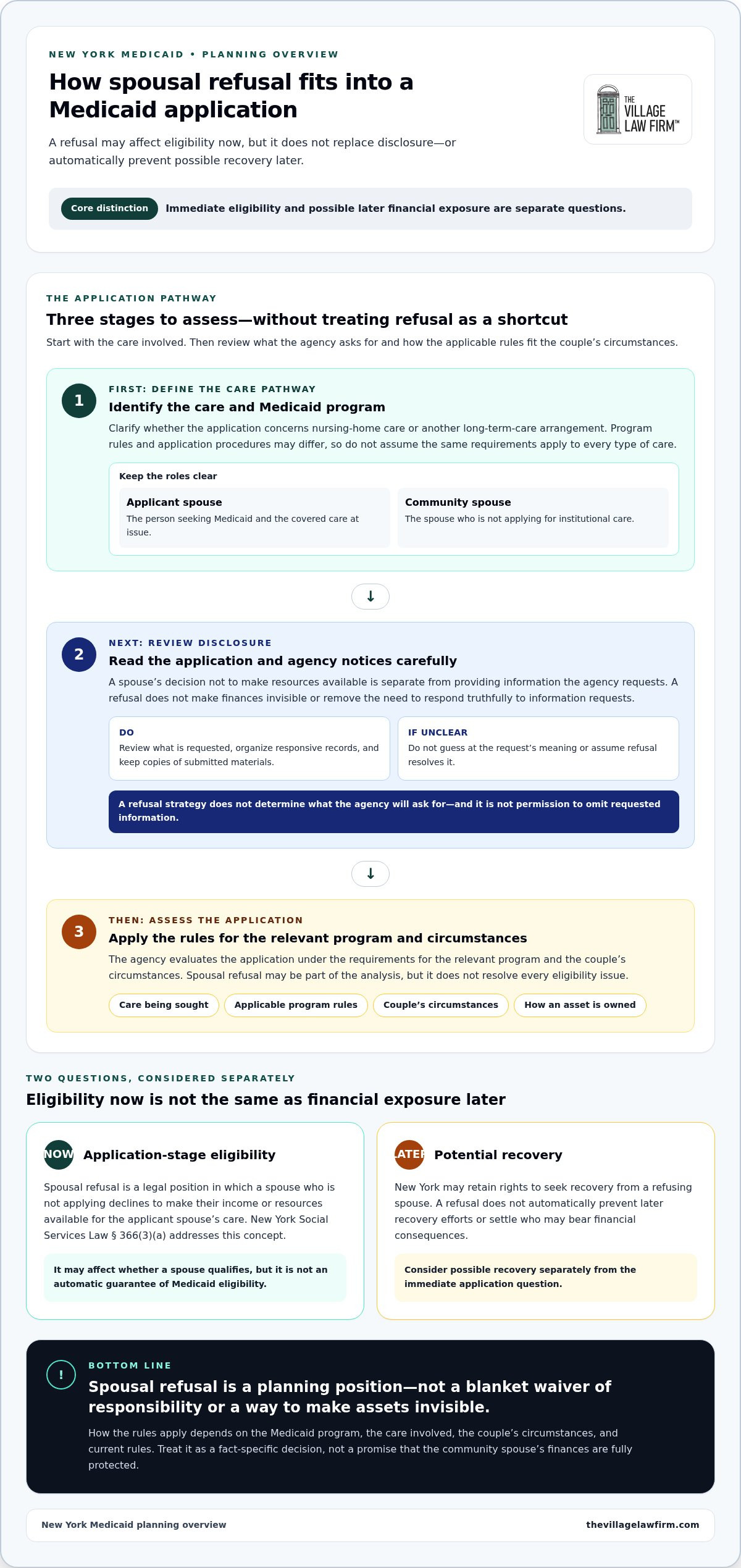
Spousal refusal is one part of a Medicaid application. It doesn’t replace the application, determine which eligibility rules apply, or remove the need to respond to requests for information. Start by identifying the care pathway, then review the application requirements and assess how refusal may affect eligibility.
- Identify the care and Medicaid program. Clarify whether the application concerns nursing-home care or another long-term-care arrangement. Program rules and application procedures may differ, so don’t assume the same requirements apply to every type of care.
- Review what information is requested. Read the application and agency notices carefully. A spouse’s decision not to make resources available is separate from providing information the agency requests.
- Assess eligibility under the applicable rules. The agency evaluates the application under the requirements for the relevant program and the couple’s circumstances. Spousal refusal may be part of the analysis, but it doesn’t resolve every eligibility issue.
Spousal refusal is a planning position, not an automatic guarantee of Medicaid eligibility. Keep the immediate application question separate from possible financial exposure later. The New York City Bar Association on Spousal Refusal discusses the role of refusal for community Medicaid applicants. Its discussion offers legal perspective, while the requirements for a particular application depend on the specific case.
What Information May the Medicaid Application Require?
An application may call for detailed information about the applicant’s circumstances and household finances, along with documents supporting the answers. A refusal strategy doesn’t determine what the agency will ask for, and it isn’t permission to omit requested information. Review current New York State Department of Health guidance and agency notices for the applicable pathway. Organize responsive records and keep copies of submitted materials.
Be precise and transparent. If a request is unclear, don’t guess at its meaning or assume the refusal resolves it. Focus on what the agency is asking the applicant or spouse to disclose, separately from whether the spouse intends to contribute to care.
Why Eligibility Depends on the Care and Medicaid Program
Nursing-home Medicaid and other long-term-care arrangements may involve different rules or administrative procedures. Don’t assume a rule or form for one pathway applies to another. Before relying on spousal refusal, identify the relevant program and review its specific requirements with New York Medicaid counsel.
Individualized planning can help organize a complicated decision. A New York Medicaid planning discussion can map the care pathway, application disclosures, and relevant rules before you act. The Village Law Firm™ provides tailored Medicaid Planning grounded in decades of New York estate-law experience. Explore New York Medicaid planning guidance as you consider the questions that apply to your family.
New York Spousal Refusal: Potential Recovery Risks and Alternatives
One important risk is easy to miss: how Medicaid treats an application and whether the state may later pursue recovery are separate questions. A spouse’s refusal may affect eligibility, but it shouldn’t be mistaken for a complete release from financial exposure. Keep that distinction in mind when weighing spousal refusal Medicaid NY as part of a long-term-care plan.
Can New York Seek Recovery from a Refusing Spouse?
New York Social Services Law § 366(3)(a) recognizes spousal refusal in the Medicaid context. That doesn’t mean a refusing spouse is automatically protected from every later claim. New York may seek recovery from a spouse who refuses to make resources available, but whether that happens and what legal steps may apply depend on the circumstances and current law. Don’t assume recovery is certain, or that it can’t happen.
For a particular family, relevant questions include which Medicaid program is involved, what care is being covered, what the application disclosed, and what legal authority applies to the state’s potential claim. Medicaid eligibility alone doesn’t answer whether the state can pursue recovery afterward. The possibility of recovery also doesn’t establish that a claim will be made in an individual case. A New York attorney can review the applicable authority and facts before you rely on an assumption about exposure.
How Does Spousal Refusal Compare with Other Planning Options?
Spousal refusal is one possible approach, not the only way to consider care costs and a spouse’s financial security. Other Medicaid planning may involve reviewing existing ownership, income, and estate arrangements, or considering steps suited to the family’s circumstances. This is a high-level comparison, not a recommendation to transfer or retitle assets without legal advice. Each option has different implications and may not suit every situation.
Timing can shape the available choices. A family planning before care is urgently needed may face different considerations from one responding to an immediate care need or an active Medicaid application. Existing financial arrangements, the type of care, and the family’s priorities also matter. Consider both the near-term application and possible longer-term consequences, rather than focusing only on whether resources may be treated differently today.
Before choosing an approach, identify what your family needs to plan for: qualifying for the relevant care, understanding potential recovery exposure, maintaining financial stability for the community spouse, or coordinating Medicaid planning with broader estate plans. The answers may point to different strategies. New York Medicaid planning guidance can help frame those choices, with advice tailored to the program, timing, assets, care needs, and family circumstances.
How to Prepare Before Making a Spousal Refusal Decision in New York
Before taking a position on spousal refusal, bring the relevant facts together. A clear picture of the care need, finances, and Medicaid application can help you ask focused questions and understand the choices ahead. Preparation isn’t a do-it-yourself legal filing, and it can’t establish eligibility on its own.
Documents and Facts to Organize for a Planning Review
Start with an overview of both spouses’ financial and care circumstances. Gather the records you have, but don’t assume this list replaces the agency’s specific requests.
- Income and resources: Collect recent records showing income, bank and investment accounts, property, and other significant resources.
- Ownership details: Note how assets are titled or held, including which resources are owned separately or jointly.
- Existing planning documents: Set aside wills, trusts, powers of attorney, and other estate-planning documents that may relate to financial decisions.
- Care information: Gather records or correspondence describing the care being considered, the provider or setting, and the applicant’s current needs.
- Medicaid paperwork: Keep copies of any submitted application, agency letters, requests for information, and responses.
Use these documents to prepare a factual summary, not to draw legal conclusions. If records conflict or you’re unsure how an asset should be described, flag the question for review rather than changing or omitting information. The Medicaid agency’s requests determine what must be provided. A checklist simply helps you prepare for that process.
Questions to Resolve Before Signing or Submitting Anything
Write down questions before a meeting or application step. This keeps the discussion focused on your family’s actual priorities.
- Which Medicaid program and care arrangement does the application concern?
- What information and documentation may be requested from each spouse, even if one intends to refuse to contribute resources?
- How could the proposed approach affect the eligibility review, and what circumstances may affect the result?
- Could there be later recovery exposure, and what current New York authority applies to the family’s situation?
- How do the timing of the care need and the couple’s existing financial arrangements affect the options?
- Do all forms and supporting documents accurately describe the spouses’ finances and circumstances?
Don’t sign or submit a statement you don’t understand. Discuss unresolved questions with New York Medicaid counsel, especially when an application is underway or care decisions are time-sensitive. Spousal refusal Medicaid NY may sound like a single form or step, but a sound planning decision accounts for documentation, eligibility review, and possible consequences together.
For a tailored review of the choices and records involved, explore Medicaid planning in New York. The Village Law Firm™ offers compassionate, individualized Medicaid Planning informed by decades of experience in New York estate law. You can discuss your New York Medicaid planning questions before deciding how to proceed.
New York Medicaid Planning with The Village Law Firm™
A Medicaid decision can affect more than an application. It may shape how a family approaches care, finances, and the community spouse’s stability. The Village Law Firm™ provides Medicaid Planning to help New York families understand their choices before acting, including how a spousal-refusal strategy may intersect with disclosures, eligibility review, and potential consequences.
There isn’t one approach that suits every couple. The care being considered, the spouses’ financial circumstances, existing plans, and family priorities all matter. The firm tailors its guidance to those facts, with clear communication and a compassionate approach grounded in decades of experience in New York estate law. The aim is to help you understand the decision, not to promise a particular Medicaid outcome or eliminate every risk.
What Tailored Medicaid Planning Can Help Clarify
Planning can bring the relevant questions into focus. Review how your circumstances relate to New York Medicaid rules, what information may need to be disclosed, and which potential consequences deserve attention before a decision. This connects the legal details to practical concerns, such as arranging care while considering the needs of the spouse who remains at home.
Consider asset-protection decisions alongside care needs and family priorities, rather than in isolation. A strategy that initially seems appealing may carry implications for your household. The Village Law Firm™ explains relevant choices in accessible language and considers how they fit your situation. Spousal refusal Medicaid NY is one possible planning question, not a one-size-fits-all answer. Other options may warrant discussion depending on your circumstances.
A tailored discussion can also distinguish what is known from what still needs review. You may have questions about application disclosures, documents already submitted, timing, or potential recovery. An individualized review can help identify which issues apply to your family and which need closer examination under current New York law. The goal is clarity, so you can weigh the trade-offs with a fuller understanding.
A Clear Next Step for New York Families
Bring organized records and questions to an initial consultation. Care information, financial documents, existing estate-planning papers, and Medicaid correspondence can give the discussion useful context. You don’t need every answer before you begin. Open communication helps identify what needs attention and how the planning discussion can be tailored to your family.
Costs are discussed transparently during the initial consultation, so you can understand them as part of the conversation. If you’re weighing spousal refusal or other care-planning choices, discuss the circumstances that matter to you. Discuss your New York Medicaid planning needs with The Village Law Firm™.
Make Your Next Medicaid Planning Decision with Clarity
The next step doesn’t have to be a rushed commitment. Consider what matters most to your family, identify the questions that remain, and seek advice that reflects your circumstances. A thoughtful conversation can help turn uncertainty into a clearer path forward.
For families weighing spousal refusal Medicaid NY, individualized legal guidance can connect the rules to real care needs and family priorities. The Village Law Firm™ provides tailored, compassionate Medicaid Planning with transparent communication and decades of experience in New York estate law. No single strategy fits every household; a useful discussion starts with understanding yours.
Bring your questions and the information you’ve gathered to an initial consultation. You can discuss your concerns and understand the planning process before deciding how to proceed. Discuss your New York Medicaid planning needs with The Village Law Firm™.
Frequently Asked Questions
Is spousal refusal allowed in New York for Medicaid?
Yes. New York recognizes spousal refusal in Medicaid planning, but that doesn’t mean every spouse or care arrangement receives the same treatment. A family considering nursing-home care should identify the specific Medicaid pathway and review its current application instructions rather than rely on a general description of spousal refusal Medicaid NY. New York State Department of Health materials and advice from New York Medicaid counsel can help clarify which rules apply.
Can a spouse refuse to provide financial information for a New York Medicaid application?
No. Refusing to make resources available and withholding information are different matters. If an application asks about accounts, property, or ownership, don’t assume a refusal allows the spouses to leave those answers blank. Review the application and any follow-up notices, and keep copies of what’s submitted. If a question is unclear or concerns the non-applicant spouse, seek guidance before responding so the information is accurate and complete.
What happens if a spouse refuses to contribute to Medicaid long-term-care costs in New York?
The refusal may affect how the applicant’s eligibility is assessed, but it doesn’t resolve every financial or legal issue. The agency reviews the application under the rules for the care and program involved, and New York may have potential recovery avenues depending on the facts and applicable law. Consider separately what the application requires now and whether later exposure could affect the community spouse.
Can New York recover Medicaid costs from a spouse who used spousal refusal?
Potential recovery is a risk to examine, not an outcome to assume. Whether New York has a basis to pursue a claim, and what process could apply, depends on current authority and the family’s circumstances. A spouse shouldn’t treat refusal as protection from every claim, but a family also shouldn’t assume recovery will occur. Counsel can analyze the relevant program, care arrangement, records, and current New York law before you decide.
Does spousal refusal guarantee Medicaid eligibility in New York?
No. The applicant must still meet the requirements for the Medicaid program and care being sought, and the application must address the requested information and documentation. A refusal doesn’t resolve questions about how a particular resource is owned or whether other eligibility criteria are met. Treat spousal refusal as one issue in a broader review, not as a promise of coverage or a particular financial result.
Is spousal refusal the same as Medicaid asset protection in New York?
No. Spousal refusal addresses whether a non-applicant spouse makes resources available in connection with the applicant’s Medicaid case. Asset protection is a broader planning goal involving other legal and financial considerations. If you’re reviewing an existing trust, property title, or other arrangement, consider how it fits with the care plan, timing, and current rules. Don’t assume one planning choice resolves every concern.
When should a New York family discuss spousal refusal with a Medicaid planning attorney?
Speak with a New York Medicaid planning attorney before signing or submitting a refusal, changing ownership, or making transfers connected to an application. That gives your family an opportunity to discuss disclosure, possible recovery, timing, and the applicable care program before acting. Bring available financial records, care details, estate-planning documents, and agency letters. Even if a deadline is approaching, organized questions can help focus the discussion on decisions that need attention.