

What if the value of a family limited partnership has less to do with tax savings than with who controls family assets and how decisions are made? For New York families, a family limited partnership is first a governance structure. It separates management authority from ownership interests, which can shape how a family holds and transfers wealth over time.
It’s understandable to focus on potential tax benefits or wonder whether an FLP is simply another name for an LLC or trust. The right fit depends on more than the label. This guide explains how an FLP works, how general and limited partners differ, and where the structure may fit within a coordinated estate plan. You’ll also learn what to weigh when reviewing asset ownership, administration, family roles, and New York legal and tax considerations, and how an FLP compares with other planning approaches. The goal is to help you identify practical questions for a legal review of whether the structure supports your family’s needs.
Key Takeaways
- A family limited partnership separates management roles from ownership interests, with the governing agreement setting out how the family structure operates.
- For a family limited partnership New York families are considering, formation, governance, transfers, and ongoing administration all warrant careful review under applicable state law.
- An FLP, LLC, and trust serve different purposes. Compare how each handles control, ownership, administration, and coordination with your estate plan.
- An FLP doesn’t automatically protect assets from every creditor or claim. The purpose, timing, documentation, and administration of the arrangement can matter.
- Before deciding, define your goals, inventory assets, consider family roles, and coordinate partnership planning with wills, trusts, beneficiary designations, and ownership records.
What Is a Family Limited Partnership in New York, and How Does It Work?
Families may want an orderly way to manage selected assets during their lifetimes and plan how interests could pass to the next generation. A family limited partnership (FLP) can provide a shared structure, but its value depends on how the partnership is designed and operated. The agreement, the partners’ conduct, and applicable law shape who makes decisions and what rights each person holds.
In brief: An FLP is a partnership in which family members own partnership interests, rather than each directly owning a share of every asset held by the partnership. The governing agreement sets out the interests and the partnership’s rules. For a foundational overview of the Family Limited Partnership structure, see this neutral reference.
How do general and limited partner roles differ?
The agreement assigns management authority and economic rights, so the roles aren’t identical in every FLP. A general partner commonly manages partnership affairs and makes decisions within the authority allowed by the agreement and applicable law. That role also carries responsibilities tied to managing the partnership.
Limited partners hold interests that may entitle them to economic benefits, such as a share of distributions, while having a different role in management. But “limited partner” doesn’t automatically mean a person has no rights or bears no risks. The governing documents and law matter. Before choosing roles, decide who will manage assets, how decisions will be made, and what should happen if a partner dies, becomes unable to act, or wants to transfer an interest.
What assets and family goals might an FLP address?
An FLP might be considered for selected investment assets, interests in a family business, or real estate, depending on the family’s goals and circumstances. It may provide a framework for shared governance and continuity while allowing the family to plan transfers of partnership interests over time. That doesn’t make an FLP appropriate for every asset or household.
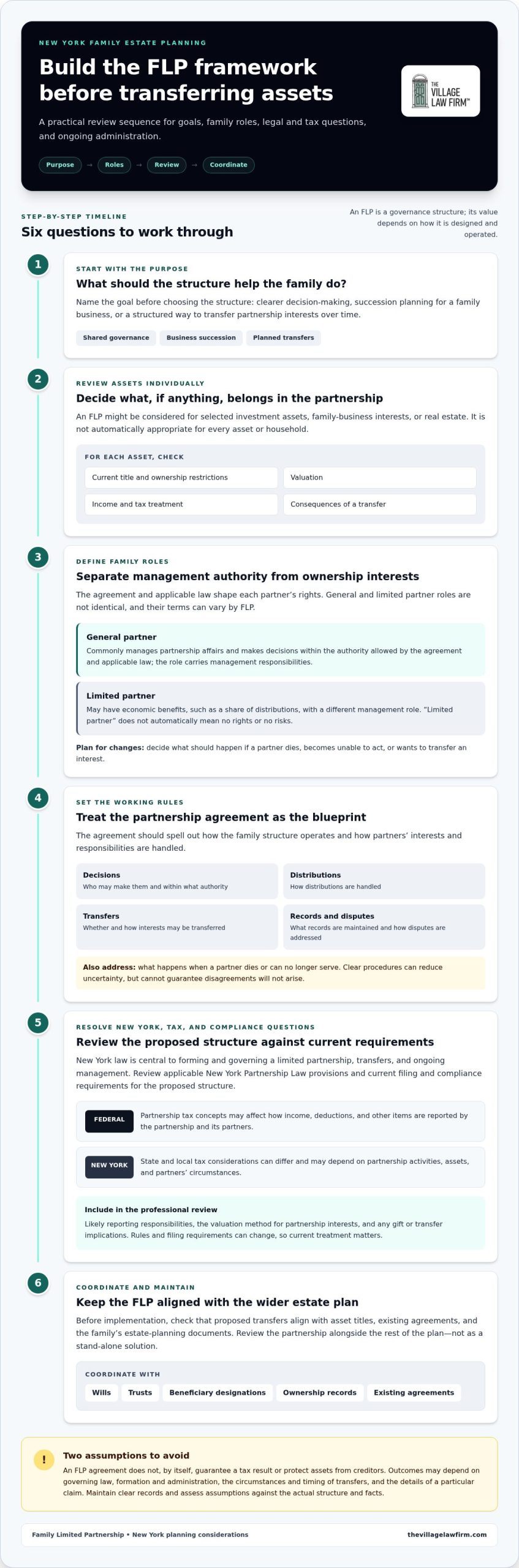
Start with the purpose. Is the family seeking clearer decision-making, a succession plan for a business, or a structured way to transfer interests? Then review each asset individually. Its current title, ownership restrictions, valuation, income and tax treatment, and transfer consequences may affect whether it belongs in a partnership and how a transfer should be handled. A family limited partnership New York plan should be reviewed alongside the family’s wider estate-planning documents, not treated as a stand-alone solution.
Which New York Legal and Tax Questions Should Families Resolve First?
Before transferring assets or ownership interests, establish the legal and administrative framework. New York law is central to forming and governing a limited partnership, handling ownership transfers, and managing the partnership over time. The applicable provisions of New York Partnership Law and current filing and compliance requirements should be reviewed for the proposed structure. A family limited partnership New York plan should be built around those rules, not a generic template.
The partnership agreement is the working blueprint. It should address who can make decisions, how distributions are handled, what records are maintained, whether and how interests may be transferred, how disputes are addressed, and what happens when a partner dies or can no longer serve. Clear procedures can reduce uncertainty about expectations, but they can’t guarantee that disagreements won’t arise. New York requirements and the family’s assets, relationships, and goals shape the drafting choices.
What tax and compliance questions need professional review?
Tax analysis is separate from the question of whether the partnership is well documented. Federal partnership tax concepts may affect how income, deductions, and other items are reported by the partnership and its partners. New York State and local tax considerations can differ and may depend on the partnership’s activities, assets, and the partners’ circumstances. An overview such as Fidelity on FLP strategies can provide background, but it doesn’t replace advice based on your family’s facts.
Before implementation, review likely reporting responsibilities, the valuation method for partnership interests, and any gift or transfer implications. The review should also consider whether proposed transfers align with asset titles, existing agreements, and the family’s estate-planning documents. Rules and filing requirements can change, so current federal, state, and local treatment matters more than a general description or past advice.
What should families avoid assuming?
An FLP agreement does not, by itself, guarantee a tax result or protect assets from creditors. The outcome may depend on the governing law, how the partnership is formed and administered, the circumstances and timing of transfers, and the details of a particular claim. Treating partnership property as personal property or failing to maintain clear records can create complications. Any tax or creditor-protection assumptions should be assessed against the actual structure and facts.
Resolving these questions early helps families understand both the intended arrangement and the work required to maintain it. An estate-planning review can also coordinate the partnership with wills, trusts, and other planning documents.
Family Limited Partnership vs. LLC or Trust: Which Structure Fits the Goal?
An FLP, LLC, and trust are distinct planning tools, not interchangeable labels. Start the comparison with what you want to accomplish, which assets are involved, and how family members will participate. No structure is universally best. Each has different ownership, decision-making, and administrative considerations that should be assessed as part of the family’s broader estate plan.
Family limited partnership: Holds assets in a partnership owned through partnership interests. Its agreement establishes partner roles and procedures, making it a possible fit when family governance and planned transfers of interests are central goals.
LLC: Holds assets through an entity owned by its members. Its operating agreement sets out management and member rights. It may be considered when the family wants entity-based ownership and governance, but the legal, tax, and transfer effects depend on the details.
Trust: Holds property under a trust arrangement administered by a trustee for beneficiaries. Its terms guide the trustee’s authority and the use or distribution of trust property, making it a different tool for managing assets for others or coordinating transfers.
Compare across the same questions: What is the intended purpose? Who controls decisions? Who owns the entity or beneficial interests? What records and ongoing administration are involved? How will the structure coordinate with wills, trusts, and other estate-planning documents?
When might an FLP differ from an LLC?
An FLP uses partnership interests and partner roles, while an LLC uses membership interests and management provisions in its operating agreement. Either structure can establish a framework for family ownership and decision-making, but their terms and legal treatment differ. Neither automatically provides stronger asset protection or lower taxes. Liability, tax, and transfer outcomes depend on the structure, governing documents, applicable law, and how the arrangement is implemented and maintained.
How does an FLP differ from a trust in an estate plan?
An FLP is an entity that owns partnership property, while family members own partnership interests. A trust holds property for beneficiaries and is administered by a trustee under its terms. Their roles and purposes differ, and one doesn’t necessarily replace the other. In some plans, a trust and an FLP may have coordinated roles, subject to careful review of ownership and documents. For related reading, see Irrevocable Trust Attorney NYC: Sophisticated Asset Protection for 2026 and Essential Estate Planning for New York Families.
When evaluating a family limited partnership in New York, compare each option against the family’s assets, relationships, and intended outcomes. A coordinated estate-planning review can clarify how the pieces fit together without treating any one structure as a shortcut.
What Risks and Misconceptions Should New York Families Consider?
An FLP can create a framework for managing and transferring selected assets, but it isn’t an automatic shield from creditors or claims. The structure’s name alone doesn’t determine the legal outcome. For a family limited partnership New York families are considering, the purpose and timing of transfers, the documents, and how the partnership is actually administered may all matter.
Does a family limited partnership automatically protect assets?
No. No entity or estate-planning structure should be treated as absolute protection. In a dispute, the relevant facts and transactions may be examined under applicable law. That can include how assets were transferred, when the transfer occurred, what purpose it served, whether the records support that purpose, and whether the family followed the partnership’s procedures. Creditor and transfer rules can be fact-specific, so New York legal analysis should be current and tailored to the circumstances.
Be cautious of claims that forming an FLP alone prevents a creditor from reaching assets or guarantees a particular result. A plan designed without a clear, legitimate purpose or maintained only on paper may not serve the family as intended. Before relying on an FLP for protection, review the assets, existing obligations, proposed transfers, and relevant law with legal counsel. This section is general information, not individualized legal advice.
What practical burdens can an FLP create?
An FLP requires ongoing attention. Depending on the arrangement, the family may need to maintain partnership records, track ownership and transfers, make and document formal decisions, and address tax reporting. Partnership property and personal property also need to remain distinct in practice, not just in the agreement.
Good governance involves people as well as paperwork. Partners should understand who is responsible for decisions, how distributions are considered, and what happens if a manager can no longer serve or family members disagree. Succession plans should account for changes in family circumstances and align with the partnership agreement. Clear communication and records can support orderly administration, though they can’t guarantee that disputes won’t arise.
Weigh these obligations against the potential planning benefits. If the family’s goals, asset ownership, and willingness to follow ongoing procedures don’t align with the structure, another approach may be more suitable. An FLP is not a substitute for individualized legal and tax advice, and it can’t guarantee a creditor, tax, or estate outcome. For help evaluating how a structure fits your estate plan, review estate-planning options.
How to Evaluate an FLP as Part of Your New York Estate Plan
Start with your family’s objectives, not the entity. A family limited partnership New York families consider should support a clear purpose and fit the people, assets, and planning documents already in place. A practical review can move through five steps:
- Define the goals. Identify what you want to address, such as continuity in managing selected assets or a planned transfer of ownership interests.
- Inventory the assets. Record what is owned, by whom, and under what title or agreement.
- Assess family roles. Consider who will make decisions, who may hold interests, and how succession should work.
- Compare structures. Weigh an FLP against an LLC, trust, or other approach based on the intended outcomes and administrative responsibilities.
- Coordinate implementation. Review the proposed arrangement alongside estate documents, beneficiary designations, and ownership records.
For tailored New York estate-planning guidance, review your New York estate-planning options.
What information should a family gather before planning?
Bring a clear picture of the current arrangement. Useful records include:
- Asset ownership and title information, including business interests and real estate
- Existing partnership, operating, or other business agreements
- Wills, trusts, beneficiary designations, and relevant tax records
- The people involved in family decisions and the family’s succession goals
- Details of domestic assets and, where applicable, foreign assets or cross-border family circumstances
This preparation can reveal whether the proposed partnership aligns with existing ownership and instructions, or whether related documents need coordinated review.
How can legal counsel coordinate the structure with the wider plan?
Legal counsel can assess the family’s priorities, review asset ownership and existing estate documents, and compare whether an FLP or another structure better supports the intended plan. Where tax questions arise, coordination with tax advisers can help ensure that the legal design and tax analysis address the same facts.
Beneficiary designations and ownership records deserve particular attention. They may direct assets separately from a will or trust, so the family should understand how each interacts with partnership interests and the rest of the plan. If foreign assets or cross-border circumstances are involved, include those details in the review. A coordinated assessment can bring the moving parts into clearer view and help you decide on a deliberate next step.
Make Your Next Estate-Planning Decision With Clarity
An FLP is one possible way to organize family ownership and plan transfers, but it isn’t a universal solution or a guaranteed shield from claims. Its suitability depends on your goals, assets, family roles, governing documents, and willingness to maintain the structure. Comparing an FLP with an LLC or trust can clarify which approach fits, while coordination with estate documents and ownership records keeps the wider plan in view.
For a family limited partnership New York families are considering, thoughtful planning starts with the details of that family’s circumstances. The Village Law Firm provides New York estate-planning and estate-administration counsel tailored to individual and family needs. Where foreign assets or cross-border circumstances are part of the picture, the firm’s international estate-planning experience can bring those considerations into the review.
To discuss how an FLP may fit with your family’s estate plan, contact The Village Law Firm.
Frequently Asked Questions
What is a family limited partnership in New York?
A family limited partnership is a partnership in which family members hold interests under a governing agreement. The agreement and applicable New York law help determine management authority, economic rights, transfer rules, and responsibilities. Families may consider an FLP for wealth or succession planning, but it isn’t a guaranteed tax or asset-protection solution. Its legal and tax effects depend on the family’s circumstances, the documents, and how the partnership is administered.
How does a family limited partnership work?
Family members may contribute or transfer assets to a partnership in exchange for partnership interests, subject to legal and tax review. The agreement sets out governance terms, including decision-making, distributions, and transfers. Partners don’t necessarily have identical roles or rights. For a family limited partnership New York families are considering, accurate records and consistent administration matter, and the consequences of contributions or transfers depend on the documents and applicable law.
Is a family limited partnership a good idea in New York?
An FLP may suit some families, but it isn’t the right structure for everyone. Consider which assets are involved, whether the family needs a formal governance framework, who will manage the partnership, and whether the family can maintain its records and other responsibilities. Compare it with alternatives as part of the wider estate plan. A New York attorney can assess how current law and the family’s specific goals affect the decision.
Does a family limited partnership protect assets from creditors?
No, an FLP shouldn’t be treated as an automatic shield from creditors or claims. The outcome may depend on applicable law, the timing and purpose of transfers, the partnership agreement, and how the parties actually operate the entity. Creditor-related rules are fact-specific and can change. Before transferring property or relying on a particular protection, have a qualified attorney review the family’s circumstances and the proposed arrangement.
What is the difference between a family limited partnership and an LLC?
An FLP and an LLC are distinct legal entities, with different ownership concepts and governing documents. An FLP uses partnership interests and partner roles; an LLC generally uses membership interests and management provisions in an operating agreement. The better fit depends on the family’s goals, assets, preferred decision-making structure, succession needs, and applicable law. Neither structure automatically provides stronger protection or more favorable tax treatment.
How is a family limited partnership taxed in New York?
Tax treatment depends on the partnership’s structure, activities, ownership, transactions, and applicable federal and New York rules. Reporting responsibilities may involve both the partnership and its partners, but the specific requirements can’t be determined from a general description. Before forming an FLP or transferring assets, seek current advice from qualified legal and tax professionals who can review the family’s facts and distinguish federal considerations from New York State and local ones.