

Agreement among relatives doesn’t give anyone automatic authority to manage a loved one’s estate. In New York, the answer to “what is an administrator of an estate in New York” starts with the Surrogate’s Court. When someone dies without a will, the court may appoint an administrator and authorize that person to act. A relative may be willing to serve, but willingness alone isn’t enough.
If you’re unsure whether an executor or administrator is needed, or what court papers permit, it’s understandable to have questions. Estate administration can become more complicated when there are unpaid debts, disagreements among relatives, or assets outside the United States. The administrator’s role is important, but it has limits.
This article explains when New York may appoint an administrator, how the appointment process generally works, and what the administrator is responsible for, from identifying assets to addressing valid obligations and distributing what remains. It also explains how an administrator differs from an executor and when legal guidance may help with a complex or cross-border estate.
Key Takeaways
- Learn what is an administrator of an estate in New York and when the court may appoint one instead of an executor.
- Understand the general steps to seek appointment and receive formal authority from Surrogate’s Court.
- See how an administrator’s responsibilities include identifying, safeguarding, accounting for, and administering estate property.
- Recognize why unresolved claims, missing records, or family disagreements can complicate the process.
- Gather key information, including a death certificate, will search results, asset records, and family details, before taking action.
What Is an Administrator of an Estate in New York?
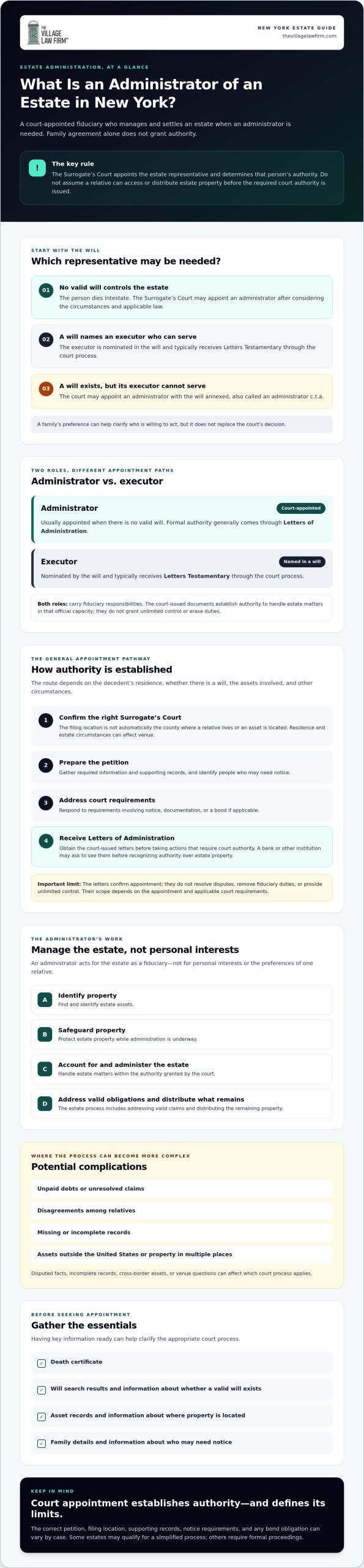
An administrator of an estate in New York is a fiduciary appointed by the Surrogate’s Court to manage and settle an estate when a court appointment is required. If you’re asking “what is an administrator of an estate in New York,” the key point is that this person receives authority through a court process. Family members can’t create that authority just by agreeing who should take charge.
An administrator acts for the estate, not for personal interests or the preferences of one relative. The court’s appointment determines what the administrator is authorized to do. Even close relatives shouldn’t assume they can access or distribute estate property before the required court authority is issued.
When does New York appoint an estate administrator?
New York commonly appoints an administrator when someone dies intestate, meaning without a valid will that controls the estate. The Surrogate’s Court considers the circumstances and applicable law to determine who may serve. Family agreement can help clarify who is willing to act, but it doesn’t replace the court’s decision.
A will doesn’t always mean the person named as executor can serve. If a will is admitted to probate but no executor is able or qualified to act, the court may appoint an administrator with the will annexed, also known as an administrator c.t.a. The appropriate petition and appointment route depend on the estate’s circumstances. Some estates may qualify for a simplified process, while others require formal proceedings.
Administrator versus executor: what is the difference?
An executor is nominated in a will. An administrator is appointed by the court, usually when there’s no valid will. If a will exists but the nominated executor can’t serve, the court may appoint an administrator with the will annexed. Both roles carry fiduciary responsibilities, but they follow different appointment pathways.
A family’s preference or a nomination alone doesn’t give someone unrestricted authority to administer estate property. The court issues formal documents establishing the representative’s authority. An administrator generally receives Letters of Administration, while an executor typically receives Letters Testamentary. These documents establish the representative’s authority to handle estate matters in that official capacity.
To identify the next step, first determine whether there’s a valid will and whether a nominated executor can serve. Then confirm which court process applies. If facts are disputed, records are incomplete, or assets are outside the United States, legal guidance can help clarify the route through New York’s court-supervised process.
How Does an Administrator Get Authority in New York?
Knowing what is an administrator of an estate in New York is only the starting point. A person who expects to serve must follow the appropriate court process and receive formal authority before acting as the estate’s representative. The details depend on the decedent’s residence, whether there’s a will, the assets involved, and other circumstances.
At a high level, the process generally involves:
- Confirming the right court: Identify the Surrogate’s Court with jurisdiction over the estate.
- Preparing the petition: Gather the required information and supporting records, and identify people who may need notice.
- Addressing court requirements: Respond to requests involving notice, documentation, or a bond if applicable.
- Receiving appointment documents: Obtain Letters of Administration before taking actions that require court authority.
Which New York Surrogate’s Court handles the estate?
The right filing location isn’t automatically the county where a relative lives or where an asset is located. The decedent’s residence and the estate’s circumstances can affect venue. For example, a New York City estate may involve a different county court depending on where the person lived. If the decedent lived outside New York or owned property in multiple places, additional jurisdiction questions may arise. Confirm the current venue rules and court before filing.
What are Letters of Administration?
Letters of Administration are court-issued documents that formally show someone has been appointed administrator. A bank or other institution may ask to see them before recognizing the administrator’s authority to handle an estate account or other property. The letters don’t erase the administrator’s fiduciary duties, resolve disputes, or grant unlimited control. Their scope depends on the appointment and applicable court requirements.
Filing and notice requirements, supporting records, and any bond obligation can vary by case. Don’t assume another estate’s paperwork or court instructions will apply to yours. Confirm what’s required before signing documents, moving assets, or paying claims. If the estate includes property or administration issues outside the United States, coordinating across jurisdictions may add another layer to the process.
For help understanding the court-supervised steps, New York estate administration guidance can help you assess what the process may involve for your family’s circumstances.
What Are an Administrator’s Duties and Limits in New York?
An administrator’s authority comes with a duty to handle estate matters carefully and for the benefit of the estate’s interested parties. A useful way to understand what is an administrator of an estate in New York is this: An administrator acts for the estate and its interested parties, not for personal benefit.
In practice, the administrator’s work may include:
- Identifying estate property: Locate accounts, real estate, personal property, and records that may help establish what belongs to the estate.
- Safeguarding assets: Take reasonable steps to preserve estate property and keep it separate from personal funds.
- Keeping clear records: Track assets collected, expenses, communications, and decisions so the estate’s activity can be explained.
- Administering the estate: Review obligations, address valid claims as appropriate, and distribute remaining property according to applicable law and court requirements.
The exact responsibilities depend on the estate and the authority granted by the court. An administrator should also keep interested parties appropriately informed. A formal accounting may be required in some circumstances, but whether it’s needed and how it proceeds depend on the case and applicable rules.
How does an administrator handle assets, debts, and distributions?
Start by building a reliable inventory. Gather available account statements, property records, and information about assets held in another state or country. Keep estate funds separate from personal money, and document transactions as they happen rather than relying on memory. If ownership of an account or asset is unclear, don’t assume it belongs to the estate or distribute it before the issue is resolved.
Claims and bills also need review. The administrator should assess whether an obligation is valid and how it should be handled under the applicable rules. Not every demand should be paid automatically. Once obligations and other administration issues have been addressed, distributions must follow the governing intestacy rules and any court requirements. Family preferences alone don’t determine who receives estate property.
Can an administrator be personally responsible for mistakes?
An administrator has a fiduciary role, which means decisions must be made responsibly for the estate rather than for personal advantage. Estate obligations generally belong to the estate, but an administrator may face personal exposure for certain breaches of duty. The outcome depends on the facts and applicable law.
Risks can arise from distributing property before claims are resolved, using estate funds for personal expenses, or keeping records too incomplete to explain what happened. Pause before taking consequential action. Legal advice may be especially helpful when a claim is disputed, ownership is uncertain, family members disagree, or assets require coordination across jurisdictions.
What Challenges Can Arise During New York Estate Administration?
A court appointment establishes the administrator’s role, but it doesn’t automatically resolve every question about access, ownership, or control. An institution may require specific court documents, and an asset may have a joint owner, beneficiary designation, or other feature that affects whether it belongs to the estate. Confirm the asset’s status and the administrator’s authority before trying to transfer or distribute it.
Practical obstacles can also slow the process. Records may be missing, account information may be incomplete, claims may be disputed, or interested parties may disagree about what should happen next. Keep a careful record of what has been found, what remains uncertain, and communications with family members. This helps ground decisions in available facts rather than assumptions.
What if family members disagree about the administrator?
Relatives may have different views about who should serve or how the estate should be handled. New York law sets appointment priorities, but the applicable priority and procedure should be checked against current law and the estate’s circumstances. An objection may require further court involvement, but it doesn’t establish in advance how the court will decide.
Keep relevant messages and documents, and avoid contested transfers or promises about distributions while the disagreement is unresolved. Before taking a step that could affect another interested party’s rights, consider getting legal advice. A neutral, well-documented process can help distinguish a legal issue from a family misunderstanding.
What if the estate includes property outside New York?
New York authority may not, by itself, be enough to administer real property located in another state. A separate proceeding, often called ancillary probate, may be needed in the jurisdiction where that property is located. Requirements depend on the location and the asset. For a closer look at this issue, read this guide to ancillary probate in New York.
Property outside the United States can raise additional questions about local law, taxes, and the documents institutions require. Don’t assume that one court process resolves every issue across borders. The answer to what is an administrator of an estate in New York may be clear, while the authority needed to deal with a particular asset still requires careful review.
If an estate involves disputed interests or property in multiple jurisdictions, consult the firm about New York estate administration and the coordination the circumstances may require.
Steps Before Serving as a New York Estate Administrator
Before signing papers, filing a petition, paying a claim, or distributing property, pause to organize what you know and identify what still needs confirmation. Understanding what is an administrator of an estate in New York includes recognizing that responsible administration starts with reliable information and the right court authority, not assumptions or family requests.
What information should a prospective administrator gather?
Create a working file with the records available to you. Separate confirmed facts from estimates and unanswered questions. A practical starting checklist includes:
- Death and will information: Obtain a death certificate and collect results of any will search, along with any will or related papers you find.
- Asset records: Gather available bank and investment statements, property information, insurance details, and records showing how assets are titled or who may receive them.
- Obligations and correspondence: Keep bills, creditor letters, tax-related records, and communications about claims together for review.
- Family and interested-party details: Prepare a list of known relatives and others who may have an interest in the estate. Store addresses and sensitive personal information securely.
Don’t fill gaps with guesses. Mark an account balance as an estimate if you haven’t confirmed it, and note where records are missing or ownership is unclear. This gives the court and any legal adviser a more useful picture of the estate and helps prevent assumptions from shaping important decisions.
When can an estate administration attorney help?
Consider legal guidance if relatives dispute who should serve, court paperwork or authority is unclear, assets are difficult to identify, or claims raise questions you can’t confidently resolve. Property or administration issues outside the United States may add another layer of legal and document coordination. Counsel can explain the process and responsibilities in light of the circumstances, without guaranteeing a particular timeline or result.
If you’re planning ahead rather than responding to a death, the firm’s New York estate planning guide offers a starting point for considering how a plan may address future estate administration.
For help assessing next steps in your family’s situation, you can discuss New York estate administration with The Village Law Firm. A clear review of the records, family circumstances, and any cross-border issues can help you approach the process with greater confidence.
Take the Next Step With Greater Clarity
Understanding what is an administrator of an estate in New York starts with one essential point: the Surrogate’s Court appoints the administrator and grants authority to act. From there, the administrator must handle estate property carefully, keep clear records, and follow applicable law when addressing obligations and distributions.
Before taking action, organize the available records and note what remains uncertain. A disputed appointment, unclear asset, or property in another jurisdiction may call for careful legal review. You don’t have to work through every court question alone.
The Village Law Firm provides estate administration services in New York, including support with cross-border administration when assets or legal issues extend beyond the United States. Speak with The Village Law Firm about New York estate administration to discuss your family’s circumstances and possible next steps.
With reliable information and thoughtful guidance, you can approach the process with greater confidence and care.
Frequently Asked Questions
Who can be appointed as an estate administrator in New York?
The court appoints an eligible person under New York’s applicable rules, which establish priorities among potential administrators. The surviving spouse generally has priority, followed by people such as children and grandchildren, subject to the law and the estate’s circumstances. Being a relative or having family support doesn’t itself confer authority. If potential administrators disagree or no eligible person is willing to serve, the court process may require additional steps.
What is the difference between an administrator and an executor?
An executor is nominated in a will, while an administrator is appointed by the Surrogate’s Court, commonly when there’s no valid will. If a will exists but the nominated executor can’t serve, the court may appoint an administrator with the will annexed. Both roles involve fiduciary responsibilities, but their appointment pathways differ. Neither should assume they can act for the estate before receiving the required authority.
What are Letters of Administration in New York?
Letters of Administration are documents issued by the Surrogate’s Court as formal evidence of an administrator’s appointment and authority. Banks and other institutions may request them before allowing the administrator to handle estate property. The letters don’t remove fiduciary duties or permit actions beyond the authority granted. Review the court’s terms and confirm what documentation an institution requires before attempting to access or transfer an asset.
Can an estate administrator sell property in New York?
An administrator may be able to sell estate property, but appointment alone doesn’t mean every asset can be sold without limits or further steps. The administrator must follow the authority granted by the court and applicable legal requirements. The answer may depend on the kind of property, the circumstances, and whether court involvement is needed. Before listing real estate or transferring valuable property, confirm the administrator’s authority for that specific action.
Is an estate administrator personally responsible for the deceased person’s debts?
An administrator generally handles valid debts as obligations of the estate, not as personal debts merely because they accepted the appointment. But that doesn’t mean every claim should be paid automatically. The administrator should review claims and keep clear records. Personal exposure may arise in certain circumstances, such as mishandling estate funds or making unauthorized distributions. If a claim is disputed or estate assets may not cover obligations, seek legal guidance before acting.
How long does it take to appoint an estate administrator in New York?
There isn’t one reliable appointment timeline for every New York estate. The process can depend on the court’s requirements, the completeness of the petition and supporting records, notice issues, and any objections or disputes. Appointment timing is also different from the time needed to finish administering the estate. A straightforward New York estate administration typically takes 9 to 18 months overall, but that isn’t a promise or an estimate of appointment timing.