
What happens if the person you trust to handle your affairs knows you have digital assets but can’t lawfully or practically reach them? A password list, a will, and an account’s own settings can each play a different role. Thoughtful estate planning for digital assets New York residents can use starts by separating three things: who owns an asset, who has legal authority to manage it, and how that person can securely access it.
Online accounts, photos, and financial records may matter to your family, but deciding which ones to document and how to prepare clear instructions takes care. This guide explains the New York legal framework, including how fiduciary authority and service-provider tools can affect access, and why access doesn’t automatically mean ownership.
You’ll learn how to identify accounts and files worth documenting, coordinate your estate-planning documents with a secure, maintainable inventory, and consider when international connections call for additional care. The goal is a plan your fiduciaries can understand and use while protecting your privacy and wishes.
Key Takeaways
- Identify online records and accounts that may matter to your family, finances, or business, including assets you might not immediately think to document.
- Understand how New York’s Article 13-A addresses fiduciary access, and why naming someone to serve doesn’t automatically give them access to every account or communication.
- Compare estate documents, provider settings, asset inventories, and secure access instructions to understand what each may help with and what it can’t guarantee.
- Start your estate planning for digital assets New York plan with an inventory. Record each account’s provider, purpose, ownership, business relevance, and recovery arrangements before organizing access details.
- Consider legal guidance when digital assets involve cryptocurrency, an online business, multiple owners or fiduciaries, or accounts and assets connected to other countries.
Estate Planning for Digital Assets New York: A Practical Starting Point
Before you change account settings or share access details, make a simple inventory. For each account, note the provider, what it is used for, who owns or uses it, and whether it supports a business. Keep credentials in a separate, protected location. This gives you a useful starting point for reviewing your New York estate documents and deciding which assets need particular attention.
What Counts as a Digital Asset in a New York Estate Plan?
Family memories, financial records, and business operations often live behind a screen. To build a useful estate inventory, start with the legal category, then identify what you own or have a right to use and how a fiduciary might locate it.
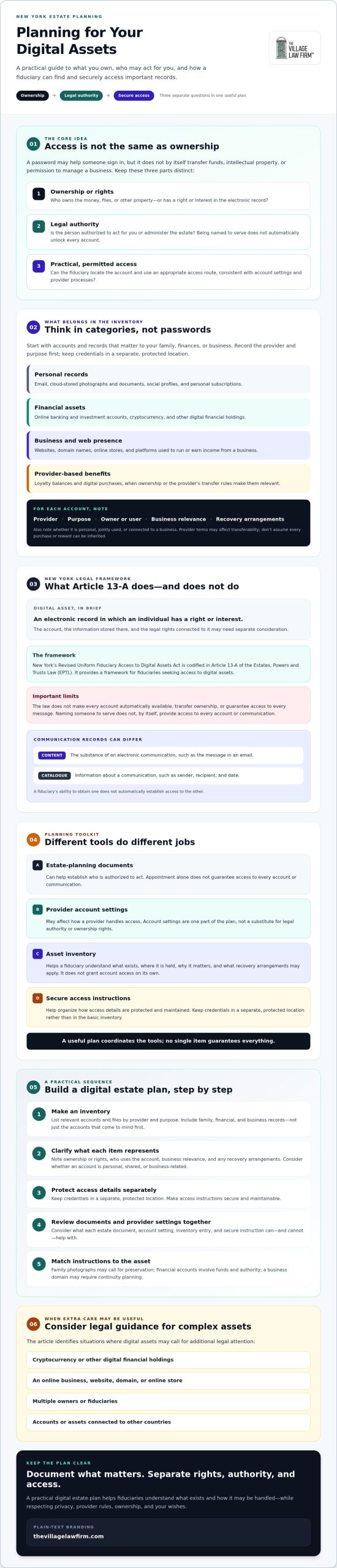
New York’s Estates, Powers and Trusts Law describes a digital asset as an electronic record in which an individual has a right or interest. The record may be personal or financial, but an account login isn’t the same as ownership of everything inside the account. A password may help someone sign in; it doesn’t, by itself, transfer funds, intellectual property, or permission to manage a business.
In brief: A digital asset is an electronic record you have a right or interest in. The account, the information stored there, and the legal rights connected to that information may need separate consideration. For a broader overview, see What is a digital asset?
Which digital assets should New Yorkers include in an inventory?
Think in categories rather than trying to remember every password. Include accounts that hold meaningful information or value, or that involve ongoing responsibilities:
- Personal records: Email, cloud-stored photographs and documents, social profiles, and personal subscriptions.
- Financial assets: Online banking and investment accounts, cryptocurrency, and other digital financial holdings.
- Business and web presence: Websites, domain names, online stores, and platforms used to run or earn income from a business.
- Provider-based benefits: Loyalty balances and digital purchases, if ownership or the provider’s transfer rules make them relevant.
Record the provider and purpose first, not the password. Note whether an account is personal, jointly used, or connected to a business. Provider terms may affect whether an account or balance can be transferred, so don’t assume a family member can inherit every digital purchase or reward.
Why sentimental files and financial assets need different planning
Different assets call for different instructions. Your family may want a collection of cloud-stored photographs, while access to an online bank account involves funds and authority to manage them. A digital business asset, such as a domain used by an online store, may require continuity planning rather than simple access to files.
New York law also distinguishes the content of an electronic communication, such as an email’s message, from its catalogue information, such as sender, recipient, and date. A fiduciary’s ability to obtain one doesn’t automatically establish access to the other. In estate planning for digital assets New York, note what each asset is, who has a right or interest in it, and what your fiduciary may need to do. Credentials and legal authority are related, but they aren’t interchangeable.
How New York Law Addresses Digital Asset Access and Fiduciary Authority
New York’s Revised Uniform Fiduciary Access to Digital Assets Act, codified in Article 13-A of the Estates, Powers and Trusts Law (EPTL), provides a framework for fiduciaries seeking access to digital assets. It doesn’t make every account automatically available, transfer ownership, or guarantee access to every message. The New York State Bar Association’s Committee on Digital Assets reflects the legal community’s ongoing attention to these issues.
Keep three questions separate: Does the person have authority to act for you? Do they have permission to access the account or its communications? And who owns the money, files, or other property connected to it? For example, authority to administer an estate doesn’t by itself mean an executor inherits funds held in an account or may read every email.
What authority may an executor, agent, or trustee need?
An executor acts under a will and the estate-administration process. An agent acts under a power of attorney during the principal’s lifetime, within the authority granted in that document. A trustee manages trust property under the trust’s terms. These roles aren’t interchangeable, and the relevant document can affect the authority available for digital assets.
Fiduciaries must act within their lawful authority and applicable duties, including handling information responsibly and respecting confidentiality. A fiduciary’s appointment alone shouldn’t be treated as blanket permission to enter accounts or access communication content. Under Article 13-A, user directions matter: a custodian-provided online tool may control if used; otherwise, directions in an estate-planning document may be relevant. Access to message content can require the user’s express consent.
Why account-provider rules and user directions matter
Provider tools, terms, identity checks, and procedures can shape how an account is handled after death or incapacity. Review each provider’s current legacy-contact or inactive-account settings directly, and keep a record of your choices. Don’t assume a direction entered with one service applies to another, or that an account setting settles who owns the underlying asset.
For estate planning for digital assets New York, coordinate provider settings with your will, trust, or power of attorney. If the directions appear inconsistent, or you want a fiduciary to access private communications, ask a New York estate-planning attorney to review the documents and consent language together. This is especially important when more than one fiduciary or a foreign provider is involved.
Legal information, not legal advice: This overview is general and doesn’t determine your rights or a fiduciary’s authority in a particular situation. The applicable documents, provider procedures, and facts matter. A New York attorney can help coordinate digital-asset instructions with your broader estate plan.
If your documents need to account for online assets, New York estate planning guidance can help you consider how digital instructions fit with your will, trust, or power of attorney.
Digital Asset Planning Options: Compare Documents, Account Settings, and Secure Records
A dependable digital plan uses several tools because each solves a different problem. Estate documents address legal authority, provider settings communicate account-specific directions, and an inventory helps fiduciaries know what exists. None replaces the others, and none alone guarantees access, transfer, or recovery.
Which planning tool addresses each digital-asset problem?
| Planning tool | Purpose and what it may help with | What it can’t guarantee |
|---|---|---|
| Estate documents | A will, trust, or power of attorney can address fiduciary roles and include instructions or authorization relevant to digital assets. Have a New York attorney review the document and how it fits your plan. | Being named as a fiduciary doesn’t necessarily provide access to every account or communication, transfer ownership, or override all provider procedures. |
| Provider settings | Where offered, a service’s legacy or inactive-account tools can record account-specific directions and preferences. | Settings apply to that provider, may change, and don’t determine who owns assets connected to an account. |
| Asset inventory | A current list of providers, account purposes, asset types, ownership, and business relevance can help a fiduciary locate what needs attention. | An inventory identifies assets. It doesn’t grant legal authority or access. |
| Secure access instructions | A protected record or password manager may help an authorized person locate credentials or recovery information through a planned process. | Possessing credentials doesn’t establish permission, ownership, or a provider’s willingness to grant access. |
Think of the tools as coordinated layers. A list may point to a cryptocurrency account, for example, while estate documents address who may act and a secure record identifies where recovery information is held. That still doesn’t guarantee access, successful recovery, or legal transfer.
How to document access without exposing passwords
Don’t put live passwords, private keys, or recovery phrases in a will. A will may be shared or become part of a court process, and credentials can change. A password list can also become a security risk if it’s outdated or stored where unintended people can find it.
Instead, consider a reputable password manager or another protected record, and carefully decide how an authorized fiduciary could locate or use it. Keep instructions separate from legal documents when appropriate, and review the arrangement with legal and cybersecurity professionals. For cryptocurrency, documenting a private key or recovery phrase doesn’t itself make the asset recoverable or transferable.
In estate planning for digital assets New York, the aim is to align legal instructions with practical, secure records. Review them together, then update them when accounts, fiduciaries, or provider settings change.
How to Create a Digital Estate Plan in New York, Step by Step
A useful plan starts with knowing what exists, not collecting passwords. Build it gradually. Your inventory can help you and your fiduciaries see what may need attention, while your legal documents and secure access arrangements address separate needs.
Build a useful digital asset inventory
Use a protected inventory to map your digital life without placing credentials in the list. Group assets so you can review them methodically:
- Personal: Email, social profiles, financial accounts, and subscriptions.
- Business: Websites, domains, online stores, and work platforms.
- Cryptocurrency: Exchange accounts and self-custody wallets.
- Sentimental files: Cloud-stored photographs, videos, and documents.
For each item, note the provider, account purpose, who owns or uses it, whether it supports a business, and any existing recovery arrangement. Record where the asset is held and how a fiduciary can find the relevant provider, but keep passwords, private keys, and recovery phrases out of the inventory. Flag self-custody wallets, such as Lumo Wallet, and accounts tied to ongoing business for careful review.
Coordinate documents, provider settings, and periodic reviews
Once you know what needs planning, use these steps to bring the pieces together:
- Decide what matters. Mark accounts or files your fiduciaries may need to locate, manage, preserve, or close. Separate personal records from assets connected to another person or a business.
- Choose intended fiduciaries. Consider who should handle estate matters and who can responsibly follow secure access instructions. Record their role and the tasks you expect them to address.
- Review your estate documents. Ask a New York estate-planning attorney to consider whether relevant will, power-of-attorney, and trust provisions align with your wishes and each fiduciary’s role. Documents should work together, not leave conflicting instructions.
- Check provider settings. Review each service’s available legacy or inactive-account options directly. Note your selections and where the settings can be reviewed or changed.
- Store access instructions securely. Keep a separate, protected record of where credentials or recovery information are held, and establish a carefully considered way for an authorized person to locate it.
- Set a review habit. Revisit the inventory and instructions after a major family, business, account, or technology change. Update the plan when a provider, fiduciary, or recovery arrangement changes.
Thoughtful estate planning for digital assets New York means coordinating practical records with legal documents while keeping sensitive information protected. A New York estate-planning attorney can help review how digital instructions fit your broader plan. Discuss your estate planning documents with The Village Law Firm.
When New York Digital Asset Planning Calls for Legal Guidance
Some digital assets are straightforward to list but harder to plan for. Consider legal review if your plan involves cryptocurrency, an income-producing website or online business, assets used or owned by more than one person, or multiple fiduciaries who may need to coordinate. These situations can raise questions about ownership, authority, privacy, and continuity that a basic account list can’t resolve.
Bring an inventory and note what you want each fiduciary to do. A New York estate-planning attorney can review how those wishes fit your broader plan and identify issues that may need further attention. This is general information, not advice about your particular circumstances.
When digital accounts connect to foreign assets or business interests
A platform may operate in one country, its users or business operations may be elsewhere, and the related property may have a different ownership structure. Those connections can raise cross-border questions, and you shouldn’t assume New York law alone governs every issue. Coordinated review can help clarify what needs to be examined. For broader context, see international estate planning in New York.
How digital assets fit into a complete New York estate plan
Digital instructions work best as part of a plan that reflects your family priorities, intended fiduciaries, and relevant legal documents. The aim isn’t simply to give someone a way into an account. It’s to make clear what they’re authorized to manage, what information should remain private, and how digital property relates to your other assets and responsibilities. For foundational context, explore estate planning in New York.
For estate planning for digital assets New York, take a practical first step: gather your inventory, identify sensitive or complex accounts, and discuss authority, privacy, and provider-specific concerns with counsel. The Village Law Firm can help you consider how digital assets fit within a tailored New York estate plan.
Put a Clear Digital Legacy Plan in Place
A practical digital estate plan brings three pieces together: an inventory that helps fiduciaries identify what exists, clear legal instructions about their authority, and secure access information kept separate from documents that may be shared during estate administration. Remember, access isn’t the same as ownership, and account settings or credentials alone may not settle who can manage an asset.
Start small. List the accounts and files that matter, note who owns or uses them, and flag any cryptocurrency, business platforms, or international connections for review. Then consider how your digital instructions fit your broader estate plan and your family’s priorities. Thoughtful estate planning for digital assets New York can help bring legal documents and practical records into alignment without treating every account the same way.
The Village Law Firm provides estate planning and administration in New York, along with international estate planning and cross-border estate administration. To discuss how digital-asset instructions fit your wider plan, contact The Village Law Firm about a New York estate plan.
Frequently Asked Questions
Is cryptocurrency included in a New York estate plan?
Yes. Cryptocurrency may be property with financial value and deserves consideration in a New York estate plan. How it’s held matters: an exchange account and a self-custody wallet can involve different access arrangements. Record where the asset is held and where secure instructions are stored, but don’t put private keys or recovery phrases in an ordinary will. Ask an attorney to review ownership, document language, and secure storage. No plan can guarantee recovery or transfer.
Can an executor access my email and social media accounts in New York?
Not automatically in every case. An executor’s appointment doesn’t guarantee access to every account or message. New York’s Article 13-A, directions you made through a provider’s available tool, your estate documents, and the provider’s procedures may all affect what a fiduciary can access. Account settings and processes vary, so review them directly. An inventory can help your executor locate accounts, while a New York attorney can assess authority and consent issues for your circumstances.
What happens to digital assets if I die without a digital estate plan?
Your loved ones may have trouble identifying accounts, following provider procedures, or determining whether a digital asset belongs to you, your business, or someone else. But it isn’t safe to assume every account will be lost or automatically available. The outcome can depend on the asset, applicable law, estate authority, and provider policies. An inventory and coordinated estate documents can give fiduciaries a clearer starting point before they need to act.
Does a will give someone access to all my online accounts?
No. A will may name an executor and state your intentions, but it isn’t a universal login credential or a guarantee that every account or communication will be accessible. Under New York’s digital-asset framework, provider directions, the relevant documents, the type of record, and the fiduciary’s authority can matter. Keep current credentials separate from a will, and get legal guidance on coordinating estate instructions with account-specific settings.
Should I put my passwords in my will?
Generally, no. A will may be disclosed during estate administration, and passwords, private keys, or recovery phrases can change or become exposed. Consider keeping access details in a secure, separate record and making a careful plan for how an authorized person can locate it. Don’t assume possession of credentials grants legal authority. Coordinate secure storage with your attorney and cybersecurity practices, especially for sensitive financial accounts or cryptocurrency.
How often should I update my digital asset inventory?
Review it after meaningful changes, such as opening or closing an important account, changing fiduciaries, starting an online business, acquiring cryptocurrency, or changing recovery arrangements. A periodic review can also help catch outdated provider settings or missing instructions. Keep the inventory focused on what exists, who owns or uses it, and where secure directions are stored, not exposed passwords. Ask your attorney whether a major change also calls for updates to your estate documents.
Do I need a lawyer for digital asset estate planning in New York?
Legal guidance can be especially useful if your plan involves cryptocurrency, business accounts, multiple fiduciaries, sensitive communications, or international connections. An attorney can help coordinate digital instructions with your broader estate plan and explain how New York law may apply without promising access to a particular account. For estate planning for digital assets New York residents can start by gathering an inventory, then discuss questions of authority, ownership, and privacy with counsel.