
Can Medicaid help pay for long-term care without putting your family home and savings at risk? The concern is understandable, especially when private care in New York City can strain a carefully built nest egg. A plan to qualify for Medicaid without losing assets NY families have spent years building starts with understanding how Medicaid treats different assets, rather than assuming everything you own must be spent first.
It’s wise to be cautious: eligibility rules are complex, and the look-back period can affect which planning options are available. In 2026, New York’s 30-month look-back for Community Medicaid remains unenforced, while nursing home Medicaid has a 60-month look-back. That distinction matters, and the rules may change. This checklist explains the 2026 income and resource framework, the difference between countable and potentially exempt assets, and legal strategies that may help protect a home and family legacy while planning for care. The right approach depends on your circumstances, but a clear roadmap can help you make informed decisions.
Key Takeaways
- Understand how the type of long-term care you need can shape your New York Medicaid planning options.
- Distinguish potentially exempt assets from countable resources before making financial decisions.
- Explore legal planning tools that may help preserve assets, including trusts and strategies for urgent care needs.
- Use a practical checklist to organize your finances, consider your care timeline, and account for international holdings.
- See how to qualify for Medicaid without losing assets NY families hope to preserve, with planning tailored to their circumstances.
Navigating the 2026 New York Medicaid Landscape
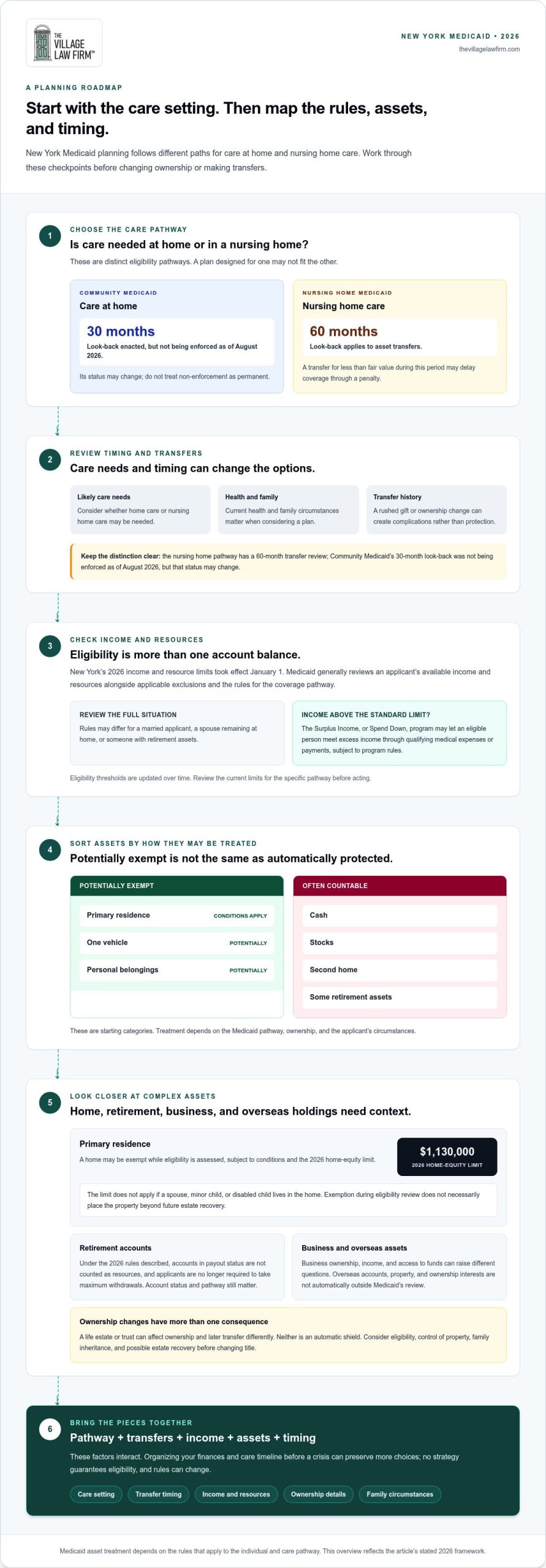
New York Medicaid planning begins with a question that can shape the entire strategy: is care needed at home or in a nursing home? These are distinct eligibility pathways, with different transfer rules and planning considerations. Treating them as one set of rules can lead to costly assumptions, especially when care needs arise suddenly.
New York’s treatment of different resources, along with the current Community Medicaid look-back status, means that a simple “spend everything first” assumption may not fit your situation. Careful, individualized planning matters. No strategy guarantees eligibility, and rules can change.
Institutional vs. Community Medicaid: Two Different Paths
Nursing home Medicaid has a 60-month look-back for asset transfers. A transfer made for less than fair value during that period may result in a penalty that delays coverage. Community Medicaid, which can help fund care at home, has a different and evolving rule: although a 30-month look-back was enacted, it was not being enforced as of August 2026. That status may change, so don’t treat it as a permanent exemption.
The care setting matters. A plan designed for home care may not work if nursing home care becomes necessary, where the five-year review applies. Before making gifts or changing ownership, consider your likely care needs, current health, family circumstances, and timing. A rushed transfer can create complications rather than protection.
The 2026 Income and Asset Limits in NY
New York’s 2026 income and resource limits took effect January 1, but eligibility isn’t determined by a single account balance. Medicaid generally reviews income and resources available to the applicant, along with applicable exclusions and the rules for the type of coverage sought. The details can differ for a married applicant, a spouse who remains at home, or someone with retirement assets. Review the current limits for your specific pathway before acting, since eligibility thresholds are updated over time.
If income is above the standard limit, the Medically Needy pathway may still provide a route to eligibility through New York’s Surplus Income program. The Surplus Income, or Spend Down, program allows an eligible person whose income exceeds Medicaid’s limit to meet the excess through qualifying medical expenses or payments, subject to program rules.
For anyone hoping to qualify for Medicaid without losing assets NY families have worked hard to build, countable and excluded resources are only part of the analysis. Transfers, income, care setting, and timing all interact. Planning before a crisis can preserve more choices. When care is urgent, there may be less time to organize records, assess options, and structure assets carefully. Start by identifying which type of Medicaid may apply, then review your finances against that pathway with experienced Medicaid planning guidance.
Exempt vs. Countable: What Assets Are Actually at Risk?
Medicaid doesn’t treat every asset the same way. Some resources may be excluded from the eligibility calculation, while others can affect whether you meet the applicable resource limit. Treatment depends on the type of Medicaid, how an asset is owned, and the applicant’s circumstances. A primary home, for example, may be treated differently from a second property or money in a bank account.
As a starting point, sort your assets into two groups:
- Potentially exempt: A primary residence, one vehicle, and personal belongings may be excluded in certain circumstances.
- Often countable: Cash, stocks, a second home, and some retirement assets may be considered available resources, depending on the rules that apply.
These categories are a starting point, not a substitute for reviewing the details. The New York Medicaid Eligibility Requirements 2026 summarize current resource rules, including how exemptions and eligibility limits may apply.
The Primary Residence: Your Biggest Asset and Biggest Risk
A home may be exempt while eligibility is assessed, subject to conditions and a 2026 home-equity limit of $1,130,000. The limit doesn’t apply if a spouse, minor child, or disabled child lives in the home. A home’s treatment can also depend on the care pathway and family circumstances. Exemption from the resource calculation doesn’t necessarily mean the property is beyond all future claims.
Medicaid estate recovery is a separate concern. After a recipient’s death, New York may seek repayment from the estate for certain Medicaid benefits, subject to applicable protections and rules. A life estate and a trust can affect ownership and later transfer differently; neither should be treated as an automatic shield. Before changing title, consider how the decision may affect eligibility, control of the property, family inheritance, and possible recovery.
Retirement Accounts and Business Interests
Retirement accounts require a closer look than their labels suggest. Under the 2026 rules described here, retirement accounts in payout status are not counted as resources, and applicants are no longer required to take maximum withdrawals. The account’s status and the Medicaid pathway still matter. Don’t assume every IRA or 401(k) receives the same treatment, particularly if it isn’t in periodic payment status.
A closely held business also deserves individual review. Ownership interests, income, and access to business funds can raise different questions from personal savings. Assets held abroad aren’t automatically outside Medicaid’s review simply because they’re in another country. Include overseas accounts, property, and ownership interests in the full financial picture. Cross-border families may need to coordinate records to understand how those holdings are documented and considered.
To qualify for Medicaid without losing assets NY families hope to preserve, start by identifying what you own, how it’s titled, and whether it produces income. Thoughtful New York Medicaid planning can help bring those details into one coordinated strategy.
Strategic Legal Tools for Asset Preservation in NY
Asset protection isn’t a single transaction. The right approach depends on whether care is needed at home or in a nursing home, how soon it may be needed, and which assets need to remain available to you or your family. Trusts, income planning, and spousal rules each address different parts of that picture. None guarantees Medicaid eligibility, so the details and timing matter.
The Medicaid Asset Protection Trust (MAPT) Explained
A Medicaid Asset Protection Trust, or MAPT, is an irrevocable trust used in long-term care planning. Unlike a revocable living trust, which generally leaves you with the power to change or revoke it, a properly structured irrevocable trust can limit your access to its principal. That distinction can affect whether assets are treated as available, but a trust doesn’t make every asset or distribution automatically exempt.
For nursing home Medicaid, transferring assets to a trust may start the 60-month look-back period for that transfer. Timing matters: a transfer made too close to an application can have consequences. The trust document also determines who manages the property and how income may be distributed. Often, an independent trustee manages trust assets, while the person who created the trust may retain certain rights, such as receiving permitted income, without unrestricted access to principal. The terms must be drafted around the family’s needs and applicable Medicaid rules.
A MAPT is sometimes described as the gold standard for advance planning, but it isn’t right for every household or timeline. Consider irrevocable trust planning alongside current eligibility rules and your need for control. For a current overview of home-care thresholds and resource treatment, see Caring Professionals’ 2026 New York Medicaid Income and Asset Limits.
The Power of Spousal Refusal in New York
New York’s spousal refusal rules may allow a community spouse to refuse to make assets available for the Medicaid applicant spouse’s care. This can preserve resources above the standard allowance for the spouse who remains at home. It isn’t a simple way to avoid the rules: the state may pursue recovery from the refusing spouse, and the consequences depend on the facts and applicable law. Get careful legal guidance before relying on this strategy.
Other tools may fit narrower circumstances. A properly structured promissory note and gift-and-loan plan may be considered in crisis planning, but the terms, timing, and documentation must comply with Medicaid requirements. A pooled income trust may allow an eligible person with excess income to direct that income toward permitted expenses while pursuing Medicaid coverage. It has specific rules and isn’t a general-purpose savings account.
To qualify for Medicaid without losing assets NY families hope to preserve, match the tool to the care timeline and the family’s priorities. Thoughtful Medicaid planning can help bring those choices into a coordinated strategy.
Your 2026 Medicaid Asset Protection Checklist
A clear sequence can turn a stressful financial review into a manageable plan. Start with a complete picture, then match decisions to the care timeline and Medicaid pathway. Don’t transfer assets based on a rule of thumb: a transaction that helps in one situation may create a penalty or limit access to funds in another.
Phase 1: Build a Complete Inventory
List every account, property, retirement plan, insurance policy, business interest, and debt. For each asset, record how it’s titled, who can access it, and whether it produces income. Include assets held abroad, along with available ownership and account records. A complete inventory can reveal details a review of U.S. bank statements alone might miss.
Phase 2: Set the Care Timeline
Consider whether care may be needed soon, within 2.5 years, or within five years. Timing matters because nursing home Medicaid has a 60-month transfer look-back, while New York’s 30-month Community Medicaid look-back remained unenforced as of August 2026. That status could change. Use the timeline to guide planning, not as a promise that a transfer will be penalty-free.
Phase 3: Review Documents Before Restructuring
Check whether your Power of Attorney expressly grants the agent authority for Medicaid planning or gifting. Confirm that the document still reflects your wishes and that any action would be legally authorized. Then review your estate plan and beneficiary designations for consistency. Moving countable assets into a trust or another planning vehicle requires careful attention to ownership, access, timing, and future care needs.
Phase 4: Prepare for the Application
Gather statements and supporting records before applying through the appropriate local agency, such as the Department of Social Services or New York City’s Human Resources Administration. Organize proof of income, resources, transfers, and household circumstances. Consistent documentation makes it easier to explain the financial picture and respond to requests without scrambling.
If Care Is Needed Now
Crisis planning is different from advance planning. Review whether any transfer may qualify for an exception, and avoid moving money until you understand the consequences. A gift-and-loan strategy is sometimes described as preserving roughly half of remaining assets, but that is not a guaranteed result. The outcome depends on the facts, structure, and applicable rules. New York Medicaid planning can help assess the options and risks.
To qualify for Medicaid without losing assets NY families want to preserve, use the checklist as a starting point, then adapt it to your care needs, finances, and family priorities. Start a conversation about Medicaid planning before making irreversible decisions.
The Village Law Firm: Meticulous Planning for Your Peace of Mind
Long-term care planning touches more than eligibility. It can affect your home, your spouse, your children, and the legacy you hope to pass on. The Village Law Firm provides Medicaid planning to help families understand their options and make decisions that reflect their priorities.
New York’s rules and application process can feel complicated, particularly when a family is balancing care needs with property, retirement assets, or accounts across borders. The Village Law Firm can help organize the financial picture and consider how Medicaid planning fits with your broader estate plan. Planning can also address issues such as probate delays and Medicaid estate recovery, though no strategy can eliminate every risk or guarantee a particular outcome.
Why Experience Matters in New York Medicaid Law
Medicaid eligibility and estate planning overlap, but they aren’t interchangeable. A general estate plan may not address how a transfer could be reviewed under Medicaid rules or how a decision affects a future application. The Village Law Firm’s Medicaid and family planning services bring those considerations together, including for New Yorkers whose home represents a substantial part of their family wealth.
High-value real estate calls for careful analysis, not assumptions. A home’s eligibility treatment, ownership, and future transfer can raise separate questions. Assess those issues within a coordinated plan rather than relying on a deed change or trust document in isolation.
For families with children, planning can clarify how assets are intended to support the next generation while accounting for present care needs. Families with property or financial ties abroad need a similarly complete view. The Village Law Firm’s international estate administration work supports families managing estate matters across borders, alongside related planning considerations.
Next Steps: Securing Your Legacy
A Medicaid planning strategy session is an opportunity to set out your priorities and understand the issues that may shape your options. Be prepared to discuss your care concerns, family structure, assets, existing estate documents, and any international holdings. The conversation can identify questions to resolve and help establish a practical order for next steps. It should be a clear-eyed assessment, not a promise of eligibility or a one-size-fits-all solution.
Where appropriate, a coordinated plan can take your financial advisors’ perspective into account so legal and financial decisions work toward consistent goals. Bring relevant documents and questions, including concerns about the family home, income, business interests, or future support for children. You don’t need to have every answer before starting; organizing the facts is part of the work.
If you’re considering how to qualify for Medicaid without losing assets NY families hope to preserve, thoughtful planning can help replace uncertainty with a more deliberate path forward. Schedule your strategy session with The Village Law Firm to discuss your family’s circumstances and planning priorities.
Make Your Next Step a Thoughtful One
Planning for long-term care can feel easier to postpone, especially when the rules seem unsettled and decisions affect your family’s future. But waiting can leave fewer choices and less time to consider them carefully. You don’t need every answer before you begin. A clear conversation about your priorities, documents, and concerns can help turn uncertainty into a practical plan.
If you’re exploring how to qualify for Medicaid without losing assets NY families hope to preserve, focus on a strategy built around your circumstances, not a shortcut or a promise. The Village Law Firm provides estate and Medicaid planning for New Yorkers, including families with international and cross-border estate considerations.
Schedule a consultation with The Village Law Firm to discuss your care and asset-protection priorities and take a thoughtful next step for your family.
Frequently Asked Questions
Is it too late to qualify for Medicaid if my loved one is already in a nursing home?
No. An application may still be possible after someone enters a nursing home, but earlier transfers and current finances can affect eligibility and timing. Gather account statements, property records, income documents, and details of gifts or other transfers before applying. A reviewed transfer may cause a period of ineligibility rather than automatically ending the possibility of coverage. Prompt, informed planning can help clarify the next steps.
Will Medicaid take my house if I stay in it while receiving home care?
Usually, the home isn’t treated as an available resource simply because you receive Medicaid-funded care at home, but that doesn’t settle every issue. The home’s value, who lives there, and how it is owned can matter. Estate recovery is a separate question that may arise after death. Keep ownership documents and records of household members together, and have any title change reviewed before acting.
What is the difference between a Revocable and an Irrevocable Trust for Medicaid?
A revocable trust generally lets you retain the power to change or cancel it and access its assets, so it usually doesn’t create the same separation from your resources that an irrevocable trust may. An irrevocable trust restricts those powers under its terms, but can also limit your access to principal. The document’s wording, trustee powers, distributions, and timing all matter. Coordinate trust planning with your broader estate plan.
How does the 5-year look-back rule actually work in New York?
For nursing home Medicaid, New York reviews asset transfers made during the 60 months before the application. A transfer for less than fair value, such as giving money away, may trigger a penalty based on the value transferred and the applicable regional rate. The penalty can delay coverage even if the applicant has otherwise spent down resources. Keep a clear record of transfers, including the date, amount, recipient, and reason.
Can I give money to my children to qualify for Medicaid?
Don’t give assets away solely to qualify without first understanding the consequences. A gift can affect nursing home Medicaid eligibility if it falls within the 60-month look-back period, and New York’s Community Medicaid look-back status is different and may change. A transfer can also leave you without funds you later need. Before moving money or property, review the care timeline, your family’s needs, and the rules for the coverage you’re seeking.
Does NY Medicaid cover home health aides and assisted living?
New York Medicaid may cover eligible home care services, including aide services, when the person meets program and care requirements. Assisted living coverage is more limited: eligible residents may receive covered services through participating Assisted Living Program settings, but Medicaid generally doesn’t pay the facility’s room and board. A particular residence and care arrangement may not fit every program, so distinguish personal care costs from housing expenses.
How do international assets affect my Medicaid eligibility in NY?
Don’t leave international holdings off the financial picture simply because they’re outside the United States. A foreign bank account, property, or business interest may raise questions about ownership, value, access, and income. Gather statements, title records, and available translations or valuations, and explain any shared ownership or restrictions. For families with cross-border estates, a coordinated review can help organize records and understand how those assets fit into the application.
What happens to my income if I qualify for Medicaid in a nursing home?
Most of a nursing home resident’s income is generally applied toward the cost of care after permitted deductions, rather than remaining available for unrestricted personal spending. In 2026, the New York personal needs allowance for a nursing home applicant is $50 per month. Other deductions or protections may apply, including in some cases when a spouse remains in the community. The specific calculation depends on the applicant’s circumstances and applicable rules.