
How long does probate take in New York? A straightforward, uncontested estate often takes 9 to 18 months, but court steps, creditor claims, or unresolved questions can extend that timeline. If you’re waiting to learn when an executor can act or when beneficiaries may receive assets, the uncertainty can be difficult.
The timeline depends on more than filing the will. A simpler estate may be resolved in 7 to 9 months, while a contested or otherwise complex matter can take two years or longer. New York’s creditor claim period also affects when an estate can move toward distribution.
This guide explains the main probate milestones, how disputes, debts, court processing, and out-of-state property can affect timing, and practical ways an executor can keep administration organized. Knowing what has happened and what remains can help you understand where the estate stands and what needs attention next.
Key Takeaways
- There’s no single answer to how long does probate take in New York; court milestones, estate details, and unresolved obligations all shape the timeline.
- Following the process from locating the will through court review and distribution can help you understand what needs to happen next.
- Some delays are outside an executor’s control, while organized filings and clear communication can help prevent avoidable setbacks.
- A secure record of court communications, asset information, filings, and expenses can help keep estate administration on track.
- Legal guidance can help clarify an executor’s responsibilities, especially when estate administration involves assets in more than one jurisdiction.
How long does probate take in New York? Start with a realistic answer
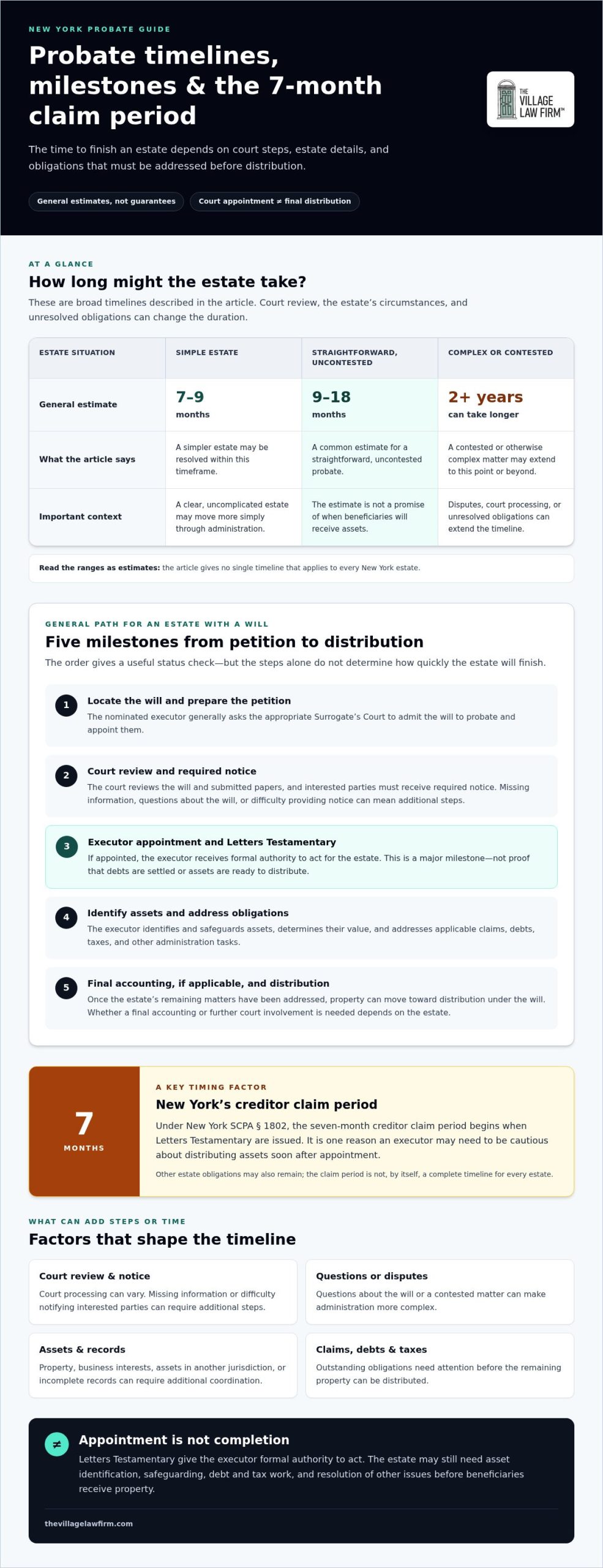
There’s no single timeline for every New York estate. A straightforward, uncontested probate commonly takes 9 to 18 months. A simple estate may finish in 7 to 9 months, while a complex or contested matter can take two years or longer. These are general estimates, not guarantees. The court’s review, the estate’s circumstances, and obligations that must be addressed before distribution all affect how long administration takes.
To understand how long probate may take, distinguish two milestones: the executor receiving authority to act and the estate completing administration. Court appointment lets the executor begin handling estate matters, but it doesn’t mean assets are ready to distribute. The executor may still need to identify and safeguard property, address debts and taxes, and resolve outstanding issues. New York’s seven-month creditor claim period, which begins when Letters Testamentary are issued, is one reason final distribution may come well after appointment.
What does “probate complete” mean in New York?
Probate is the court process for validating a will and authorizing administration of the estate. In a will-based estate, the court’s appointment of an executor is a major step, not necessarily the finish line. The estate generally moves toward completion after assets and obligations have been addressed and the remaining property can be distributed under the will. The required steps depend on the estate and the applicable New York procedures.
Families may also use “probate” to mean settling an estate. Technically, when someone dies without a will, the court process is generally called administration rather than probate. The distinction matters because the court’s role and the person authorized to act can differ, even though both processes involve gathering estate information and resolving obligations. A case-specific review can clarify which process applies.
Who may need to wait for the process to finish?
The executor is responsible for administering the estate. Beneficiaries have a practical interest in knowing the matter’s status and what remains. Receiving court authority lets the executor take important steps, but beneficiaries may still need to wait for outstanding obligations and administration tasks to be resolved before receiving an inheritance.
Two families can face different timelines even when both estates go through court. One estate may have clear records, readily identified beneficiaries, and straightforward assets. Another may involve questions about the will, property in another jurisdiction, or debts that take time to resolve. Court processing can also vary. Beneficiaries can ask the executor for a status update, but they can’t control the court’s schedule or bypass legal requirements. Knowing the current milestone is more useful than relying on a single calendar estimate.
New York probate milestones: from filing the will to estate distribution
Probate involves court and estate-administration steps, but their order alone doesn’t determine how quickly a case will finish. The will, court review, required notice, and the estate’s assets and obligations all affect the process. The outline below describes the general path for a New York estate with a will. Specific filing requirements and terminology depend on the circumstances.
Filing the petition and seeking appointment
The process generally begins with locating the original will and preparing a petition for the appropriate Surrogate’s Court. The person nominated as executor typically asks the court to admit the will to probate and appoint them. The court reviews the will and submitted papers, and interested parties must receive required notice. Missing information, questions about the will, or difficulty providing notice can mean additional steps before the court acts.
If the court appoints the nominated executor, it issues Letters Testamentary. These letters are the executor’s formal authority to act on behalf of the estate, subject to the scope of that authority and applicable law. Appointment is an important milestone, but it doesn’t settle debts, resolve tax matters, or establish that the estate is ready to distribute. The executor should follow the requirements that apply to the specific case.
Administering the estate before final distribution
After appointment, the executor identifies and safeguards estate assets, determines their value, and addresses valid obligations. The work depends on the estate. A bank account may be straightforward to locate, while property, business interests, or assets in another jurisdiction can require additional coordination. Tax questions, creditor claims, or incomplete records may also need attention before the remaining property can be distributed under the will.
New York’s SCPA § 1802 provides a seven-month creditor claim period beginning when Letters Testamentary are issued. This is one reason an executor may need to be cautious about distributing assets soon after appointment. Other estate obligations may also remain. Whether a final accounting or further court involvement is needed depends on the estate and its administration.
A practical sequence to keep in view:
- Locate the will and prepare the probate petition for the appropriate Surrogate’s Court.
- Complete court review and required notice to interested parties.
- Receive Letters Testamentary if appointed, then identify and safeguard estate assets.
- Address applicable claims, debts, tax matters, and other administration tasks.
- Determine when the estate is ready for final accounting, if applicable, and distribution.
In short, the probate timeline begins with court review, followed by the work needed to settle the estate responsibly. The Village Law Firm provides estate administration guidance to help executors understand filings, responsibilities, and next steps, including when assets or administration span more than one jurisdiction. Learn more about estate administration guidance.
What can make New York probate take longer?
Probate can slow down for reasons that are or aren’t within the executor’s control. Court review and scheduling may take time. Family disputes, hard-to-locate interested parties, complicated assets, and unsettled debts can add work or require further proceedings. Incomplete filings or missed communications can create avoidable back-and-forth. Identifying the source of a delay helps set realistic expectations about how long probate may take in New York.
Disputes, missing information, and court requirements
A will contest or an objection to the petition can require additional court steps. Incomplete papers, uncertainty about the will, or difficulty locating someone who must receive notice can also hold up progress. The effect depends on the facts and the court’s directions. Notice requirements, deadlines, and procedural consequences depend on the case and applicable New York rules.
Some delays are largely outside an executor’s control, such as the court’s calendar or a dispute requiring judicial attention. Careful preparation can help reduce avoidable delays: organize requested documents, check filings for missing information, keep contact details current, and respond promptly to court communications. These steps can prevent confusion, but they can’t guarantee a faster decision or override required procedures.
Complex assets, debts, and property outside New York
An estate with a closely held business, assets that are difficult to value, unresolved claims, or uncertain liabilities may need more investigation before the executor knows what is available for distribution. Property in another state can add a separate layer. Ancillary probate or another proceeding may be needed there, depending on the asset and applicable law. For an overview, see this guide to ancillary probate in New York.
The table below pairs common sources of delay with practical responses. These steps support orderly administration, but they don’t promise a court matter or unresolved obligation will be completed sooner.
| Potential delay factor | Practical response |
|---|---|
| Court review, scheduling, or requests for additional information | Keep a dated record of filings and court communications, and address requests carefully. |
| Will objections or disagreement among family members | Preserve relevant documents and avoid treating a dispute as resolved before the court process addresses it. |
| Missing beneficiary or interested-party information | Gather current contact details and share accurate information with the estate’s legal team. |
| Business interests or assets that are difficult to value | Collect ownership, account, and valuation records so the estate’s assets can be assessed methodically. |
| Debts, claims, or out-of-state property | Maintain a clear inventory of obligations and identify property located in other jurisdictions. |
A delay doesn’t automatically mean something has gone wrong. Identify its source, separate required legal process from preventable administrative gaps, and keep a clear record of what remains unresolved.
What can an executor do to keep New York probate organized?
A clear system won’t control the court’s calendar or resolve a dispute, but it can make progress easier to track and prevent avoidable administrative back-and-forth. If you’re trying to understand how long probate may take in New York, keep essential records together and note what is complete, what is pending, and who is responsible for the next step.
Build a clear record from the outset
Create a secure file for the will, death certificate, court filings, asset records, estate expenses, and contact information for beneficiaries and other relevant parties. Protect original documents and store digital copies securely. Estate records contain sensitive personal and financial information, so limit access to people who need them for administration.
A dated log helps everyone follow events without relying on memory. Record when papers are filed or received, summarize court communications, note requests and responses, and document important administrative decisions. Keep receipts and statements for estate expenses, and update the asset inventory as new information becomes available. These records can also help the executor answer questions and prepare for conversations with legal or tax professionals.
- Track deadlines and requests: Record dates and identify items that need a response or follow-up.
- Respond carefully: Provide accurate information promptly when the court or a professional requests it. If a request is unclear, seek guidance rather than guessing.
- Separate routine tasks from legal decisions: Organizing documents and recording expenses are practical steps. Disputed claims, interpreting the will, and the timing of distributions may require tailored legal advice.
Before distributing estate property, confirm that applicable legal requirements and estate obligations have been addressed. A beneficiary’s request or an apparent lack of outstanding bills doesn’t establish that distribution is appropriate. The executor should consider the estate’s specific circumstances before taking that step.
Know when the estate needs tailored guidance
Some situations call for closer analysis: a will dispute, uncertainty about an asset or liability, property in another state, or connections to another country. These circumstances can raise questions about court requirements, coordination, or the executor’s responsibilities. Distinguish general organization tasks from decisions that need legal review.
Planning can also shape how an estate is administered in the future. Thoughtful New York estate planning may help families prepare for how assets will be handled, although it can’t change the requirements for an estate already in probate.
The Village Law Firm helps executors understand filings, responsibilities, and complex estate administration, including matters involving assets outside New York. Learn about New York estate administration.
When New York probate feels complex, get a clear path forward
No universal calendar can tell a family exactly when an estate will close. A clearer picture comes from knowing the estate’s current milestone, what remains unresolved, and which steps depend on the court or other parties. That’s more useful than relying on a single estimate for how long probate takes in New York.
An executor can get help understanding applicable filings and responsibilities, identifying issues that need attention, and distinguishing immediate priorities from tasks that can wait. This can be especially valuable when the estate includes disputed matters, assets outside New York, or connections to more than one country. The process and outcome still depend on the estate’s facts and applicable requirements.
What to prepare before discussing an estate
Preparing a few key details can make an initial conversation more focused. Gather the will, any court notices or filed papers, and a basic inventory of known assets and obligations. Include relevant contact information and note what you know about property held outside New York or in another country. The inventory doesn’t need to be complete. Flag estimates and unanswered questions rather than guessing.
- List questions about the estate, the executor’s role, or the next procedural step.
- Note upcoming dates or deadlines shown on court notices and correspondence.
- Bring available records of assets, debts, expenses, and prior communications about the estate.
These materials help organize the facts, but they don’t determine the court’s schedule or guarantee a particular result. If documents are missing, note that. A clear account of what is known and uncertain is a useful starting point.
Choose a deliberate next step
A tailored review can help an executor understand where the matter stands, which filings or obligations remain, and what needs attention next. When an estate involves international assets or administration across jurisdictions, The Village Law Firm handles cross-border estate administration to help bring the different pieces into focus. The appropriate next step depends on the estate and court requirements, not on a fixed timeline.
Probate carries practical demands and emotional weight. A calm, informed approach can replace some uncertainty with a clearer sense of what is happening and what decisions lie ahead. Discuss the estate’s circumstances, your questions, and the records you have, while keeping in mind that each estate follows its own path.
If you’re an executor or family member seeking clarity, discuss New York estate administration with The Village Law Firm. A focused review can help identify current priorities and a practical path forward.
Take the next step with greater clarity
Waiting without knowing what comes next can make estate administration difficult. Rather than trying to predict an exact end date, focus on the estate’s current position and the decisions or documents that need attention. That’s a practical way to approach the question, “how long does probate take in New York?”
The Village Law Firm provides estate administration guidance to help executors understand their responsibilities and manage complex matters. The firm also handles cross-border estate administration when assets or administration span national borders. A conversation can help identify useful questions and a measured next step, without promising a particular court schedule or outcome.
You don’t have to resolve every uncertainty at once. Discuss your New York estate administration needs with The Village Law Firm.
Frequently Asked Questions
How long does probate take in New York?
A straightforward, uncontested New York estate commonly takes 9 to 18 months. A simple matter may finish sooner, while a contested or complex estate can take two years or more. These are general estimates, not deadlines. The timeline also depends on what you mean by “complete”: the executor may receive authority before the estate is ready to close. Ask which milestone has been reached and what remains outstanding.
Can an executor distribute assets before probate is complete?
An executor should be cautious about distributing estate property before confirming the estate’s obligations and applicable legal requirements. New York’s seven-month creditor claim period starts when Letters Testamentary are issued. Executors are generally advised to wait until it has passed before distributing, to reduce the risk of personal liability for unpaid claims. Whether any earlier or partial distribution is appropriate depends on the estate. Don’t treat a cash balance or beneficiary request as sufficient reason to distribute.
What happens after a New York probate petition is filed?
After filing, the Surrogate’s Court reviews the petition and supporting papers, and required notice is given to interested parties. Depending on the case, the court may issue a citation requiring someone to appear on a specified date. Notice methods and timing matter, so follow the court’s instructions and applicable New York requirements rather than assuming one deadline applies to every recipient. If the court admits the will and appoints the executor, it issues Letters Testamentary.
Does a will contest make probate take longer in New York?
It can. A formal challenge to the will or an objection to the probate petition may require additional court proceedings before the court determines whether the will should be admitted. The effect on timing depends on the issues raised, the evidence, and the court’s process. There’s no reliable fixed extension for every contest. If someone disputes the will, keep relevant documents and communications and get case-specific legal advice before responding or making decisions about estate property.
Can probate be required for property outside New York?
It may be. If a New York resident owned real property in another state, that state may require a separate ancillary probate proceeding to transfer or sell it. The rules depend on the property’s location and ownership, and the additional proceeding can require coordination with the New York estate. For example, an executor handling a New York home and an out-of-state parcel may need to address each jurisdiction’s process before the parcel can be transferred.
Do all estates have to go through probate in New York?
No. Some assets pass outside probate, such as accounts with beneficiary designations, property held in a living trust, and jointly owned property with survivorship rights. New York also has a simplified Voluntary Administration process for estates with $50,000 or less in personal property; real estate isn’t included in that threshold. Which assets require a court process depends on how they’re titled, their value, and the estate’s circumstances.
What can delay probate in New York?
Delays may stem from court review, incomplete papers, difficulty locating interested parties, a will dispute, or assets and obligations that take time to identify or resolve. For example, unclear ownership records for a business interest may require investigation before its value can be addressed. Executors can reduce some administrative back-and-forth by keeping records organized and responding accurately to requests, but they can’t control court scheduling or eliminate required legal steps.