
What if the most important part of later-life planning isn’t deciding what happens after you’re gone, but making sure your choices are understood while you’re here? Estate planning for seniors can help you stay in control of personal and financial decisions while preparing people you trust to step in if needed. It can also give your family clearer direction during uncertain moments.
It’s understandable to feel unsure about which documents matter, how to plan for long-term care, or whether planning could create family tension. A thoughtful plan can bring these concerns into focus. Wills, trusts, financial powers of attorney, and health care directives serve different purposes. The right approach depends on your wishes and family circumstances.
This article explores key planning topics for New York seniors, ways to make your wishes easier for trusted people to understand and follow, and how Medicaid planning relates to long-term care and preserving assets. You’ll also learn when New York legal guidance can help you review your options and bring greater clarity to your family.
Key Takeaways
- Estate planning for seniors can organize decisions around your wishes without automatically giving up control or independence.
- Wills, trusts, healthcare directives, and powers of attorney serve different purposes. Which documents are appropriate depends on your circumstances.
- Gather existing documents, identify trusted decision-makers, and review beneficiary designations and asset ownership alongside your legal plan.
- Thoughtful conversations and coordinated documents can help trusted people understand your wishes and reduce uncertainty for your family.
- New York legal guidance can help you align your plan with your goals, family circumstances, and related long-term care considerations.
Estate Planning for Seniors: How a Plan Can Preserve Your Choices
Planning later in life involves more than writing a will. Estate planning for seniors means organizing legal and financial decisions so they reflect a person’s wishes and give trusted people clear guidance. A plan can address what happens to property, who may help with financial or healthcare decisions, and how those choices should be communicated.
Planning can support independence rather than take it away. Preparing documents does not, by itself, mean handing over authority or inviting someone else to make decisions now. Instead, it gives you a chance to express what matters, consider whom you trust, and prepare for circumstances in which you may want or need assistance. Clear instructions can also ease uncertainty for family members who might otherwise have to guess about your preferences.
Who benefits from planning later in life?
Older adults can benefit whether they live independently, share a home with family, or reside in a care setting. Planning can also help adult children and caregivers understand how best to support a senior. The senior’s preferences should remain central: family involvement can help communicate wishes, but it should not replace the person’s own voice.
Consider organizing your plan before an urgent health or family change makes decisions more difficult. A calm conversation can help you identify priorities and questions to address.
What can an estate plan help organize?
A plan can bring several areas of decision-making into focus:
- Property: How you want your belongings and other assets handled.
- Finances: Who may be authorized to help manage financial matters, as set out in applicable documents.
- Healthcare: How you want your medical preferences communicated and whom you may want involved in healthcare decisions.
- Personal choices: The values, priorities, and practical preferences you want trusted people to understand.
Documents provide formal instructions, while conversations add context. For instance, explaining why a particular person is suited to help may make your intentions easier for relatives to understand. Neither documents nor conversations guarantee a particular outcome, but together they can give your family a clearer picture of your wishes. The Estate planning overview describes common planning tools and purposes. For a New York-focused discussion of planning and legacy considerations, see this New York estate planning guide.
Start by writing down the decisions you most want to make clear: whom you trust, what matters to you, and where family members may need guidance. Gather existing paperwork and note questions for review. A will is one part of a plan, but it does not address every financial, healthcare, or personal decision. Looking at the full picture can help you prepare with greater clarity while keeping your choices at the center.
Which Estate Planning Documents Help Seniors Prepare for the Unexpected?
The right documents depend on your goals, family, assets, and circumstances. Some set out how property should be handled after death; others may authorize someone to help with financial or healthcare decisions during your lifetime. These roles are distinct, so one document may not address every decision you want to plan for.
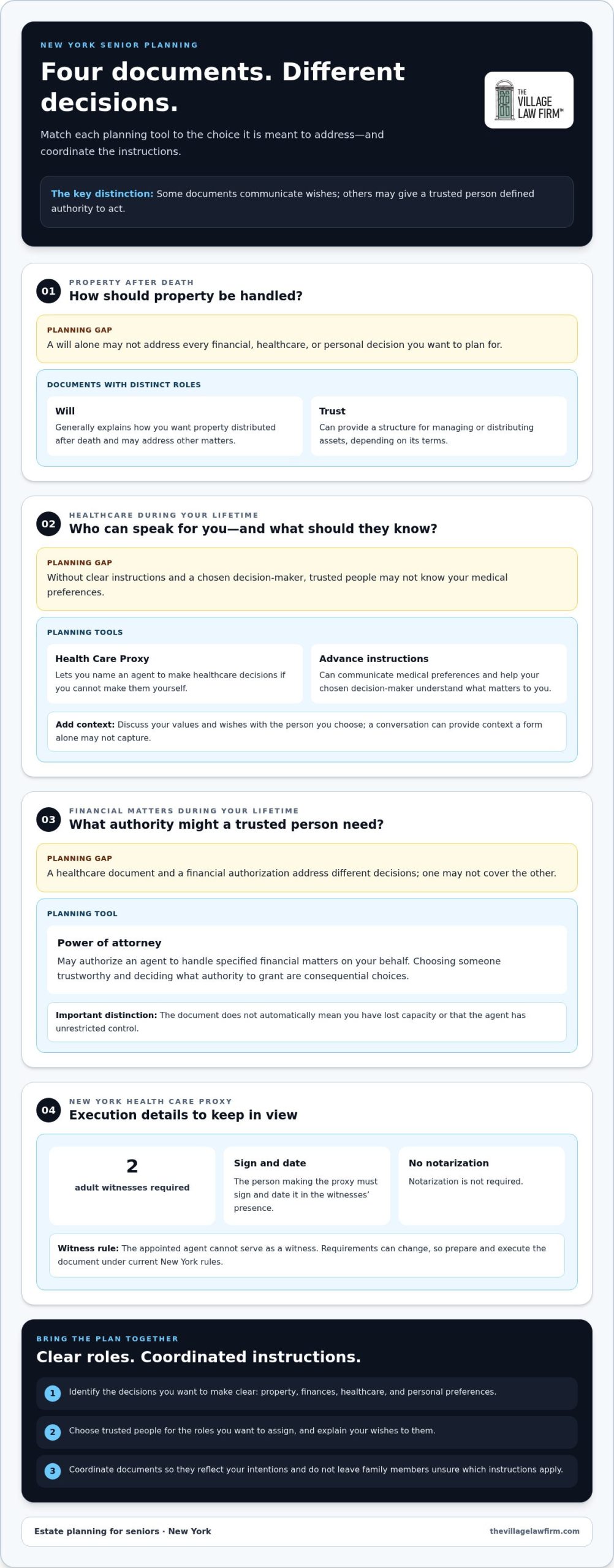
Coordinated estate planning documents address different decisions: some communicate your wishes, while others may give a trusted person defined authority to act. A will generally explains how you want property distributed after death and may address other matters. A trust can provide a structure for managing or distributing assets, depending on its terms. A healthcare directive can record medical preferences or identify someone to speak for you, while a power of attorney can authorize an agent to handle specified financial matters. The AARP Estate Planning Guide for Seniors offers an overview of common documents and considerations.
Consider both timing and purpose. A will or trust primarily concerns property and future planning, while healthcare and financial authority documents may become relevant during your lifetime. The details matter: documents should reflect your intentions and work together, rather than leave family members unsure which instructions apply.
How do healthcare directives express personal wishes?
A New York Health Care Proxy lets you name an agent to make healthcare decisions if you cannot make them yourself. Advance healthcare instructions can communicate your preferences and help your chosen decision-maker understand what matters to you. Discuss your values and wishes with that person before a crisis. A conversation can provide context that a form alone may not capture.
New York’s Health Care Proxy must be signed and dated by the person making it in the presence of two adult witnesses. The appointed agent cannot serve as a witness, and notarization is not required. Requirements can change, so prepare and execute the document under current New York rules.
How can financial authority be planned for incapacity?
A power of attorney may authorize an agent to handle specified financial matters on your behalf. Choosing someone trustworthy and deciding what authority to grant are consequential choices. The document doesn’t automatically mean you’ve lost capacity or that the agent has unrestricted control. In New York, the form must substantially conform to statutory wording, and both the principal and agent must sign. Certain gifting powers require specific authorization.
Before signing, consider which tasks you may want help with and whether the proposed agent understands your priorities. A New York estate planning attorney can tailor wills, trusts, and healthcare directives to your family circumstances and coordinate them with related documents. For guidance shaped around your wishes, speak with New York estate planning counsel.
Does Estate Planning Mean Giving Up Control or Independence?
No. Thoughtful planning can help you state your preferences and choose whom you trust to assist, without automatically transferring decision-making authority. Preparing for the possibility of needing help is not the same as giving someone control now. The effect of any document depends on its terms and the circumstances in which it is used, so understand what you’re signing.
For many people, the concern is personal: “Will I still be able to make my own choices?” Estate planning for seniors gives you a way to express those choices in advance. For example, you may identify someone you would want involved in healthcare decisions if you could not communicate your wishes, while continuing to make decisions yourself when you’re able. Planning does not predict that your health or independence will change.
What is the difference between planning ahead and guardianship?
Advance planning and guardianship are different situations. Documents such as a power of attorney or healthcare proxy are prepared voluntarily to communicate preferences or authorize a person to act in defined circumstances. Guardianship, by contrast, involves a court-supervised process. It is not another name for signing planning documents, and preparing documents does not automatically mean guardianship will occur.
Whether guardianship is relevant depends on the person’s circumstances and applicable New York law. These questions can have significant consequences, so avoid assumptions about what a document does or what a court may decide. New York-specific elder law resources, including the New York State Bar Association’s New York Elder Law and Special Needs Planning section, can help explain the broader context. Individual questions call for careful legal review.
How can seniors choose people they trust?
Choose decision-makers for their judgment and dependability, not just their place in the family. Consider whether a potential agent listens carefully, communicates clearly, can manage the responsibilities, and is willing to serve. You may also want to name an alternate, if appropriate, in case your first choice cannot act.
Have a direct conversation before naming someone. Explain what you’re asking them to do, share the values behind your preferences, and give them room to consider the responsibility. For instance, someone may be comfortable helping with financial matters but not healthcare decisions. Different roles can go to different people when that better fits your wishes and plan.
Where appropriate, discuss the general plan with family members too. A shared understanding of who has which role can reduce avoidable confusion, though it cannot guarantee agreement. Keep the senior’s preferences at the center. If questions arise about authority, guardianship, or how New York rules apply, tailored estate planning guidance can clarify options before decisions become urgent.
How Can Seniors Keep an Estate Plan Coordinated and Current?
A plan is most useful when its documents, account information, and instructions reflect the same intentions. Estate planning for seniors isn’t a one-time paperwork exercise. It’s an organized record that should reflect current wishes and circumstances. A straightforward review can reveal outdated information or unanswered questions before someone needs to rely on the plan.
Work through these steps:
- Gather: Collect existing wills, trusts, powers of attorney, healthcare directives, and relevant account records. Note where originals or copies are kept.
- Identify: List the people named to help or make decisions, along with each person’s role.
- Compare: Review whether the documents and account details appear consistent with your current wishes. Flag differences rather than assuming one instruction overrides another.
- Discuss: Write down open questions and talk them through with the people involved or with legal counsel.
This sequence gives you a practical starting point. It doesn’t replace individualized legal review, particularly when documents were prepared at different times or your circumstances have changed.
How do documents, accounts, and family instructions fit together?
Legal documents are only part of the picture. Ownership arrangements and beneficiary designations on accounts may affect how particular assets transfer, so consider them alongside your will or trust rather than reviewing each in isolation. For example, compare the people named on account records with the intentions expressed in your estate documents. That comparison can surface questions to resolve, but the result depends on the specific asset, document, and applicable law.
Keep a current inventory of important documents, financial institutions, account types, and where records can be found. Protect sensitive details, and avoid putting passwords or private account numbers in a document that may be shared broadly. The goal is to make key information accessible to appropriate trusted people without exposing it unnecessarily. Don’t assume a tax or transfer result from a general checklist; individual facts and current law matter.
When should a senior revisit an existing plan?
Use meaningful life events as prompts to review your plan. Marriage, the loss of a spouse or another named decision-maker, a move, a change in health or finances, or a shift in your wishes may raise questions about whether documents and account records still reflect your intentions. A review can also help identify someone who is no longer able or willing to serve.
There’s no need to rely on an arbitrary timetable. Revisit the plan when circumstances change, and periodically consider whether anything important has shifted. A move to or from New York, or a change in property location, may make jurisdiction-specific review especially relevant.
Medicaid planning is a related but distinct area, with its own rules and individual considerations. Seniors reviewing care-related planning can explore the New York Medicaid planning guide for more on that topic. For help reviewing how your estate documents fit your family’s circumstances, discuss your New York estate plan with an attorney.
When Should a New York Senior Seek Estate Planning Guidance?
Consider legal guidance when creating a plan, reviewing documents prepared years ago, or facing a change that may affect your wishes, family, property, or care needs. The goal is to make sure the plan reflects your actual circumstances, not simply to collect forms. New York residence, property, family relationships, and assets in other locations may raise questions that deserve individual attention.
Estate planning for seniors is personal. A plan that suits one household may not fit another, particularly when family members have different roles or assets cross state or national borders. A legal review can help you understand how your documents work together and identify issues to discuss, without promising a particular outcome.
What should seniors bring to an initial planning conversation?
Bring any existing will, trust, healthcare directive, and power of attorney you can locate. A simple outline is also useful: family members, property, major accounts, and the wishes you most want reflected in your plan. You don’t need to resolve every question beforehand. A list of uncertainties can help focus the discussion.
- Questions about healthcare preferences and whom you trust to help.
- Notes about changes in family, health, residence, or finances.
- Information about property or other assets outside New York or the United States.
How can legal guidance bring clarity to a family plan?
The Village Law Firm drafts wills, trusts, and healthcare directives tailored to individual family needs. Reviewing the documents together can help organize decisions around your priorities and give the people you trust a clearer framework. If family members are involved, consider what they need to understand about their roles and your intentions.
Estate planning and Medicaid planning are related, but address distinct concerns. Medicaid planning focuses on questions connected with care and eligibility, while estate planning organizes decisions about your wishes, documents, and assets. Neither guarantees eligibility or asset protection. If long-term care planning is part of your concern, the New York Medicaid planning guide addresses that separate topic. Estate administration is another distinct matter, involving the handling of an estate after a death.
Bring your questions, even if they’re still taking shape. A thoughtful conversation can clarify what needs attention now and what may warrant further review as circumstances evolve. For guidance tailored to your family and goals, Explore estate planning guidance with The Village Law Firm.
Take the Next Step at Your Own Pace
You don’t need every answer before you begin. Start by gathering the documents you already have and writing down the decisions you want to make clear. Note any changes in your family, health, residence, or priorities, then consider which questions would benefit from individual legal review.
Estate planning for seniors is most meaningful when it reflects the person behind the paperwork: their wishes, relationships, and sense of independence. You can approach the work thoughtfully, one decision at a time. A conversation with a New York estate planning attorney can help turn your questions into a plan shaped around your circumstances, without assuming every family needs the same approach.
The Village Law Firm provides New York estate planning guidance, along with Medicaid planning and estate administration counsel when those distinct concerns are relevant. If you’re ready to explore a plan that reflects your family’s needs, explore estate planning guidance with The Village Law Firm. A clear next step can bring greater confidence to the choices ahead.
Frequently Asked Questions
Is estate planning only for seniors with substantial wealth?
No. Estate planning can help people with different levels of assets make their wishes and priorities clearer. A modest estate may still involve a home, personal belongings, savings, or decisions about who should help if needed. The value of estate planning for seniors isn’t measured only by wealth. It can also give trusted people clearer direction and keep practical matters from being left entirely to guesswork.
Can an older adult make an estate plan after a health diagnosis?
Often, a diagnosis alone doesn’t answer whether someone can make or update an estate plan. The person’s ability to understand the decisions and their significance is a situation-specific question. If a diagnosis prompts new concerns, discuss them with a New York estate planning attorney while the person can share their priorities and ask questions. Avoid assuming either that a diagnosis prevents planning or that every document should be changed.
How often should seniors review an estate plan?
There’s no single review schedule that fits everyone. Revisit the plan after a major change, such as a marriage, loss, move, new health concern, or shift in family relationships. A periodic check can also help confirm that named people are still appropriate and that copies can be found. If nothing has changed, a review can still surface questions without requiring unnecessary revisions.
What happens if a senior becomes unable to manage financial decisions without planning documents?
If someone can no longer manage financial decisions and has not prepared relevant authority documents, relatives may need legal guidance about available options. Depending on the circumstances, a court-supervised process may be considered. The steps and outcome depend on the facts and applicable law, so don’t assume a family member can automatically take over. Planning ahead can clarify preferences, but cannot guarantee that no court process will be needed.
Should adult children be involved in a senior’s estate planning?
They can be involved if the senior wants their support, but the senior’s preferences should guide the process. An adult child might help gather paperwork, take notes, or join a conversation with permission. It can also help to discuss expectations with anyone being considered for a role. If family members disagree, a focused conversation can surface questions, though it cannot guarantee consensus or replace the senior’s own decisions.
Does estate planning for seniors include Medicaid planning in New York?
Medicaid planning can be considered alongside estate planning, but it serves a distinct purpose. It addresses questions related to Medicaid and potential care needs, while an estate plan focuses on organizing personal, financial, and legacy decisions. New York requirements can change, and eligibility depends on individual circumstances. A plan should not assume a particular result; individualized legal guidance can clarify how these separate areas may relate to your family.
Can a senior’s estate plan address property outside New York?
Yes, property in another state or country can be an important part of the planning discussion. Its location, ownership, and applicable rules may affect how it should be addressed alongside New York documents. Gather available records and identify where each asset is held. If you have international property or accounts, cross-border estate planning guidance can help assess the issues without assuming that one document will govern every asset. For individuals managing cross-border assets or family interests in jurisdictions like Brazil, consulting established counsel such as Di Pace Carvalho Advogados can help navigate local legal requirements.