What if the most taxing part of settling an estate isn’t the primary probate in your home state, but a single property located across state lines? It’s a jarring realization for many executors who find that a standard court order from another jurisdiction lacks the authority to move assets within the Empire State. This secondary process, known as ancillary probate New York, often feels like a redundant hurdle designed to drain your time and emotional energy. You’ve already done the work once; it’s only natural to feel that a second round of filings is an unnecessary burden.
We understand the weight of this responsibility and the anxiety that comes with navigating unfamiliar court rules from a distance. You deserve a clear, reassuring path that protects your family’s legacy without requiring constant travel to the city. This 2026 guide offers a meticulous roadmap to help you unlock assets efficiently and ensure every filing meets the strict standards of the Surrogate’s Court. We’ll examine the updated 2026 fee schedules, the necessity of exemplified records, and how to transition from legal chaos to a sense of lasting security.
Key Takeaways
- Understand the critical distinction between domiciliary and ancillary proceedings to determine exactly when New York court intervention is required for out-of-state executors.
- Master the 2026 procedural requirements for ancillary probate New York, including the specific steps for obtaining the “exemplified” records necessary to satisfy local Surrogate’s Courts.
- Identify which assets, such as Manhattan condominiums and co-ops, require a secondary probate and which can bypass the process through alternative legal structures.
- Navigate the complexities of international estates by learning how the Apostille process validates foreign legal documents for use within the New York judicial system.
- Discover how to fulfill your fiduciary duties without the need for travel by leveraging a local legal partner to manage filings and court interactions on your behalf.
What is Ancillary Probate in New York and When is it Required?
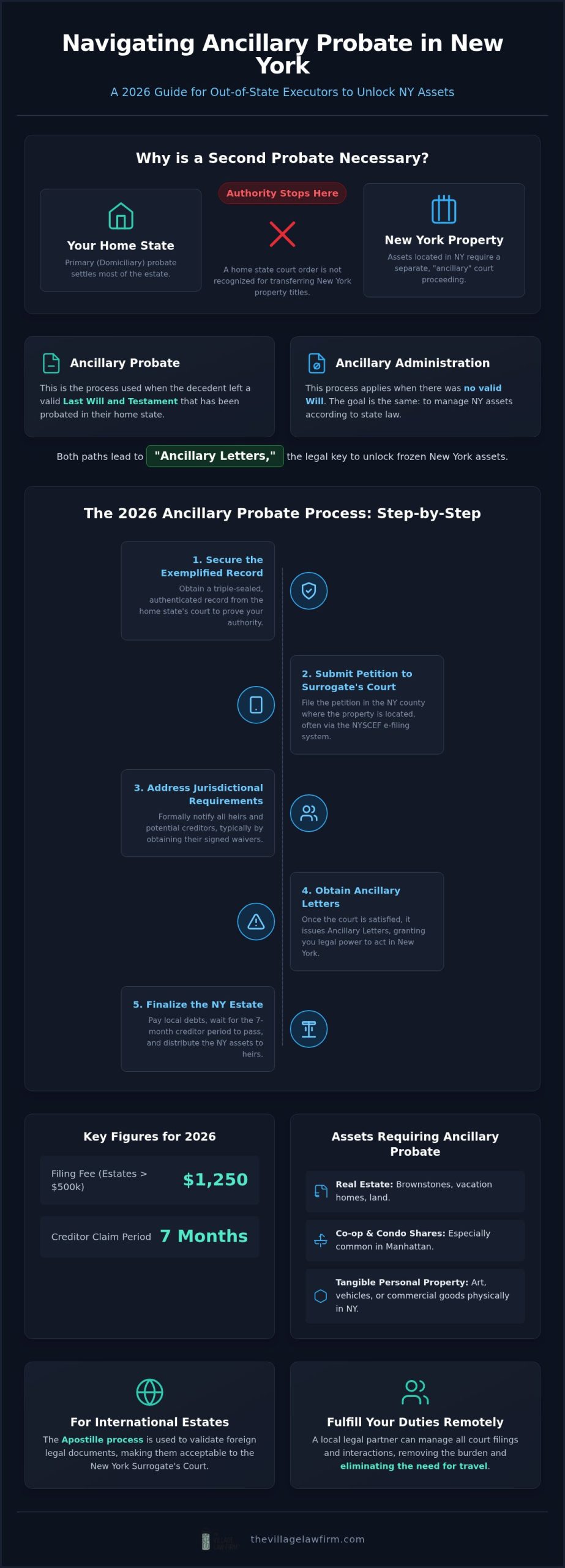
When a loved one passes away while residing in Florida, California, or even London, the primary legal process to settle their affairs occurs in their home jurisdiction. This is known as the domiciliary proceeding. However, if that individual owned a brownstone in Brooklyn, a vacation home in the Hamptons, or a commercial warehouse in Queens, the home state court has no authority over those physical New York assets. This jurisdictional gap is where What is Ancillary Probate becomes a critical necessity. New York courts maintain exclusive control over “situs” assets. If the property is physically anchored to New York soil, it must pass through a New York court to reach its rightful heirs.
The term ancillary probate New York refers to this secondary legal proceeding. It is specifically designed for non-residents who left behind real estate or tangible personal property within the state. It is vital to recognize that New York isn’t a legal monolith. Each county’s Surrogate’s Court, from the high-volume chambers of Manhattan to the meticulous clerks in Richmond County, operates with its own nuanced culture and procedural preferences. Successfully managing these assets requires more than just filling out forms. It requires an understanding of how local clerks interpret state statutes to ensure your filings aren’t rejected for minor technicalities.
The Legal Necessity of a Secondary Proceeding
You may already hold “Letters Testamentary” from your home state. While those documents grant you authority elsewhere, a Manhattan co-op board or a New York title company cannot legally recognize them. They require a New York judge to validate the out-of-state order. Ancillary probate acts as the essential legal bridge between jurisdictions. It ensures that the title to the property is clear and that the executor has the specific local authority to sign a deed or transfer shares. Without this validation, the New York asset remains frozen. This delay can stall the entire estate settlement for months.
Ancillary Probate vs. Ancillary Administration
The specific path you take depends entirely on whether the decedent left a valid Last Will and Testament. If a Will exists and has been admitted to probate in the home jurisdiction, you’ll file for ancillary probate New York. If there was no Will, the process is called ancillary administration. In either case, the court issues “Ancillary Letters.” These are the specialized keys needed to unlock New York assets. Gaining a foundational understanding of the New York probate process is the first step in moving from the chaos of a frozen asset to a structured, orderly resolution.
The Step-by-Step Process for NY Ancillary Probate in 2026
Transitioning from a primary probate in your home state to the New York court system requires a shift in both strategy and documentation. It’s a methodical progression that demands precision. If you’re managing a high-value estate, such as one with assets exceeding $500,000, you’ll encounter a filing fee of $1,250. This is a fixed cost based on the 2026 fee schedule. The process typically follows five essential steps:
- Secure the Exemplified Record: This is the foundation of your filing. You must obtain a triple-sealed record from your home state court to prove your existing authority.
- Submit the Petition: Your petition is filed in the Surrogate’s Court of the county where the property is located. In 2026, most NYC filings are processed digitally through the NYSCEF system.
- Address Jurisdictional Requirements: You must notify all necessary parties, including heirs and potential creditors. This is often done through waivers or citations.
- Obtain Ancillary Letters: Once the Surrogate is satisfied, they will issue Ancillary Letters. These documents grant you the legal power to act within New York.
- Finalize the New York Estate: You’ll marshal the assets, pay local debts, and wait out the mandatory 7-month creditor claim period before final distribution.
Each phase represents a transition from legal complexity toward resolution. While the steps are clear, the execution requires a steady hand. Partnering with a firm that understands cross-border estate administration can replace confusion with clarity, ensuring you don’t have to manage these logistics alone.
The Exemplified Record: The Gold Standard for Filing
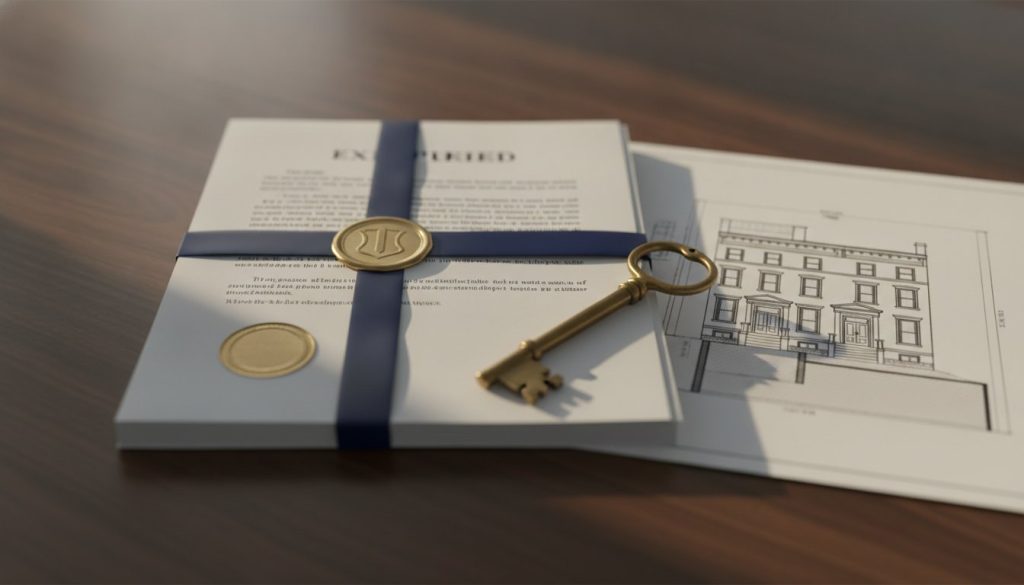
Many executors mistakenly believe a standard certified copy of a Will is enough to trigger ancillary probate New York. It isn’t. New York courts require an “Exemplified Record,” also known as a triple-seal. This document includes signatures from the court clerk and a judge, certifying that the clerk is indeed the clerk and the judge is indeed the judge. An Exemplified Record is the primary document needed to trigger NY jurisdiction. Without it, your petition will likely face immediate rejection.
Navigating NYC Surrogate’s Court Logistics
There’s a distinct cultural divide between the boroughs. Manhattan (New York County) is a high-volume environment where efficiency is prized, but the sheer number of cases can lead to longer wait times. Brooklyn (Kings County) often operates with a more meticulous, traditional pace. In 2026, local NYC expertise is your best defense against common filing rejections. A “white-glove” approach involves more than just submitting paperwork. It’s about knowing how local clerks interpret specific rules and ensuring your application is perfect before it reaches their desk. This level of care prevents the redundant legal fees and travel anxiety that so often plague out-of-state executors.
Assets That Require (and Those That Bypass) Ancillary Probate
Determining which assets fall under the jurisdiction of the Surrogate’s Court is the first step in creating an efficient settlement plan. In New York, the distinction between probate and non-probate assets is often dictated by how the title is held rather than the value of the asset itself. While a bank account with a named beneficiary might bypass the court entirely, a single deeded property can trigger the full ancillary probate New York process. Understanding these categories allows you to separate the assets that are ready for distribution from those that remain legally locked.
Tangible personal property physically located within the state also requires attention. This includes high-value art collections stored in Manhattan vaults, jewelry, or even vintage vehicles kept in a Hamptons garage. If these items were owned solely by the decedent, they typically require court authorization to move or sell. For families looking to shield future generations from these complexities, consulting an irrevocable trust attorney NYC can provide sophisticated strategies to remove assets from the probate estate altogether.
New York Real Estate: Condos, Co-ops, and Brownstones
New York City real estate presents a unique legal landscape. A condominium is considered real property. Because it’s deeded, it always triggers an ancillary proceeding to clear the title for heirs. A co-operative apartment, however, is technically personal property; it consists of shares in a corporation and a proprietary lease. While some co-op boards may accept out-of-state letters, many in 2026 still require New York court authorization to approve a transfer. This “quasi-real property” status often surprises out-of-state executors who expect a simpler transition. Brownstones and upstate vacation homes are straightforward real property and will always necessitate a secondary proceeding to ensure the New York real property law is satisfied.
Strategies to Avoid Ancillary Probate in the Future
Preparation is the most effective shield against legal complexity. One of the most reliable methods to bypass the Surrogate’s Court is placing New York property into a Revocable Living Trust. Because the trust owns the property, the individual’s death doesn’t trigger a change in title that requires court intervention. It’s also important to note that New York does not currently recognize “Transfer on Death” (TOD) deeds for real estate, a tool common in many other states. For couples, holding property as “joint tenants with rights of survivorship” or “tenants by the entirety” allows the asset to pass automatically to the survivor, effectively removing the need for ancillary probate New York for the first death. These meticulous choices today prevent the chaos of redundant filings tomorrow.
For estates where California property was accidentally left out of a trust, you can learn more about HEGGSTAD HELP to see how a Heggstad petition can transfer the asset without a full probate proceeding.
International Ancillary Probate: Managing Cross-Border Estates
For a non-US resident owning a pied-à-terre in Manhattan or a commercial interest in Brooklyn, the legal path to distribution is significantly more complex than a standard state-to-state transfer. It is a matter of international treaties and sovereign laws. The process of ancillary probate New York takes on a global dimension when the primary estate is located in a foreign country. You aren’t just bridging two court systems; you’re harmonizing two different cultures of law. This scenario requires a meticulous approach to ensure that New York assets are protected while respecting the rules of the home jurisdiction.
The primary tool for validating foreign documents in a New York Surrogate’s Court is the Apostille. While domestic cases require an exemplified record, international cases often rely on this specialized certification under the Hague Convention. It serves as a universal seal of authenticity. Without this high-level validation, a foreign will is essentially invisible to a New York judge. Gaining this recognition is the first step in replacing global uncertainty with a structured, local resolution. Our firm’s deep expertise in international estate planning ensures that these cross-border complexities are managed with the precision your family’s legacy requires.
Foreign Wills in the New York Surrogate’s Court
New York courts are generally welcoming to foreign wills, but they demand absolute clarity. If the original will is written in a foreign language, you must provide an official translation accompanied by an affidavit from a qualified translator. Often, the court also requires an affidavit from a legal expert in the home country. This expert must testify that the will was executed according to the laws of that jurisdiction. This process transforms what could be a chaotic multinational dispute into an orderly legal transition. It provides a sanctuary of calm for executors who are already managing the emotional weight of a loss across oceans.
Tax Implications for Multinational Ancillary Estates
The financial stakes for international estates are particularly high in 2026. For individuals passing away this year, the New York State basic estate tax exclusion amount is $7,350,000. However, the “estate tax cliff” remains a critical risk. If the taxable estate exceeds 105% of that exemption ($7,717,500), the entire exemption is lost. For non-residents, New York taxes the real and tangible property physically located within its borders. Meticulous coordination with home-country tax advisors is essential to avoid the trap of double taxation. Understanding how the New York estate tax exemption and the cliff rule applies to your specific situation is critical to ensuring you aren’t overpaying or triggering unnecessary audits. Every filing must be perfect to ensure you aren’t overpaying or triggering unnecessary audits. If you are managing a global estate with New York interests, contact us today to ensure your cross-border administration is handled with white-glove care.
The Executor’s Partnership: Removing the Burden of NY Probate
Serving as an executor is a profound responsibility that often arrives during a season of grief. It’s a role that requires a balance of emotional resilience and meticulous attention to legal detail. When the estate involves ancillary probate New York, the physical distance between your home and the Surrogate’s Court can amplify the inherent stress. You shouldn’t have to spend your time on flights to JFK or LaGuardia just to hand-deliver documents or check on the status of a filing. This is where a sophisticated legal partnership becomes your most valuable asset.
A white-glove partnership changes the entire dynamic of estate administration. We act as your “boots on the ground,” providing a steady presence in the city while you remain focused on your family and your own life. Choosing a professional partner eliminates the “DIY” risks that often lead to court rejections and unnecessary delays. For a deeper look at the specific responsibilities you hold in this role, our executor of estate attorney New York guide offers a comprehensive breakdown of your fiduciary duties.
Fiduciary Liability in Ancillary Proceedings
In New York, an executor’s liability isn’t a theoretical concept; it’s a serious legal reality. You are responsible for satisfying local creditors and tax authorities before any assets can be distributed to heirs. New York law requires a mandatory 7-month waiting period from the time Letters are issued to allow creditors to file claims. If you distribute assets prematurely and a valid claim arises, you could be held personally liable for the shortfall. Professional counsel acts as a shield against this personal liability, ensuring that every statutory requirement is met with precision. Ignoring these local rules can lead to the “real cost” of delays, which we detail in our guide on the cost of probate in New York.
Your Roadmap to Peace of Mind
Our commitment to you is rooted in transparency and the total removal of legal complexity. We believe that an executor should feel empowered, not overwhelmed. The first step in our partnership is a meticulous consultation where we review your home-state filings and identify the specific New York assets requiring attention. From there, we build a clear roadmap that guides you through the petition process, the issuance of Ancillary Letters, and the final distribution. Our goal is to replace the unpredictability of ancillary probate New York with a methodical, calm process. We help you transition from the chaos of a frozen estate to the security of a protected family legacy, walking alongside you with compassion and expertise every step of the way.
Securing a Seamless Transition for Your Family’s Legacy
Managing an estate across state or international lines doesn’t have to be a source of constant anxiety. By securing the correct exemplified records and identifying which assets require court intervention, you can move through the ancillary probate New York process with confidence. You’ve already done the hard work of starting the primary probate in your home jurisdiction. These final steps in New York should represent a transition toward order, not a descent into legal chaos or redundant fees.
Our firm provides the deep local knowledge of all five NYC Surrogate’s Courts and the cross-border expertise needed to handle these filings with meticulous care. We offer a premium, white-glove service that removes the logistical burden from your shoulders. This allows you to settle the estate without the stress of constant travel or the fear of procedural rejections. We act as your steady urban guide, replacing uncertainty with a sense of lasting security for your family.
Secure your family’s New York legacy with a complimentary ancillary probate consultation.
Your family’s future deserves a steady, protective partner. We are here to walk alongside you with compassion and excellence.
Frequently Asked Questions
What is the difference between probate and ancillary probate in New York?
Probate is the primary legal proceeding held in the state where the decedent lived at the time of their death. In contrast, ancillary probate New York is a secondary proceeding required when a non-resident owned real estate or tangible property physically located within New York borders. While the home state court handles the majority of the estate, it lacks the jurisdiction to transfer title to New York soil; only a New York Surrogate’s Court can do that.
How long does the ancillary probate process typically take in NY in 2026?
The timeline depends heavily on the county and the complexity of the assets. While some upstate counties may process petitions in a few weeks, the high-volume courts in Manhattan and Brooklyn typically take several months to issue Ancillary Letters. For a full distribution of assets, a typical uncontested case in New York can take between 9 and 18 months from the initial filing to completion.
Do I need to travel to New York to complete the ancillary probate process?
You don’t need to visit New York City or travel to the local Surrogate’s Court to settle the estate. Most filings in 2026 are handled through the NYSCEF digital system, allowing for electronic document submission. By partnering with a local firm to act as your “boots on the ground,” you can manage all fiduciary responsibilities from the comfort of your home state while your legal representative handles court interactions and clerk follow-ups.
What are the New York Surrogate’s Court filing fees for ancillary probate?
Filing fees for ancillary probate New York are calculated based on the value of the assets located specifically within the state. According to the 2026 fee schedule, costs range from $45 for assets under $10,000 to $1,250 for assets valued at $500,000 or more. These fees are set by statute under SCPA 2402 and must be paid at the time the petition is filed with the court.
Can I sell a New York property before ancillary probate is finished?
You cannot legally sign a deed or transfer shares in a co-op until the court issues Ancillary Letters. These letters serve as your official authorization to act on behalf of the estate within New York. While you might be able to list the property or enter into a contract, the closing cannot occur until the Surrogate’s Court validates your authority to transfer the title to a buyer.
What happens if the decedent died without a Will but owned NY property?
The process is called “ancillary administration” rather than ancillary probate. When a non-resident dies intestate, New York’s specific intestacy laws govern how the real property located within the state is distributed. This often adds a layer of complexity, as the court must determine the rightful heirs based on New York statutes regardless of the laws in the decedent’s home state.
Does New York tax the estate of a non-resident?
New York does tax the real and tangible personal property of non-residents if the value of the taxable estate exceeds the state’s exemption. For 2026, the basic estate tax exclusion amount is $7,350,000. It’s vital to watch the “tax cliff,” because if the estate exceeds 105% of that amount, the entire exemption is lost and the entire estate becomes subject to New York tax. Our detailed guide on the New York estate tax exemption 2026 and the cliff rule explains how to navigate this risk with confidence.
Is an exemplified record the same as a certified copy?
No, an exemplified record is a much higher level of certification than a standard certified copy. Also known as a “triple-seal,” it requires the court clerk to certify the document, a judge to certify the clerk’s authority, and the clerk to then certify the judge’s signature. New York courts require this specific format to prove that the out-of-state probate and your authority as executor are valid and beyond reproach.