
A family disagreement can make a will seem invalid, even when the key question is whether New York’s legal requirements were followed. It’s understandable to worry about a relative challenging a loved one’s wishes, but a challenge doesn’t automatically invalidate a will. Understanding what makes a will invalid in New York starts with separating execution problems from allegations about the person who signed it or the circumstances surrounding the signing.
New York generally requires a will to be in writing, signed by the person making it at the end, and witnessed by at least two people who sign within 30 days. The person making the will must also be at least 18 and of sound mind and memory. This guide explains those requirements and common grounds for a challenge, including lack of capacity, undue influence, and fraud. You’ll learn what Surrogate’s Court may consider during probate, how to preserve relevant documents and evidence, and when estate-planning counsel can help assess a will and its execution together. Careful preparation can reduce uncertainty and help protect your family’s intentions.
Key Takeaways
- Understand what makes a will invalid in New York, and why a family dispute alone doesn’t prove that a will fails legal requirements.
- Use the signing checklist to spot potential execution issues, including problems with how the testator and witnesses signed.
- Learn how courts may assess claims involving capacity, undue influence, fraud, or revocation using evidence about the will and the circumstances around it.
- If you have concerns, preserve the original will and relevant records, then seek a review of the document, signing circumstances, and probate context.
What Makes a Will Invalid in New York, and What Does Not?
It’s unsettling to wonder whether a signed will will carry out the wishes it records. But a signature alone doesn’t answer the legal question. In New York, what makes a will invalid depends on whether it meets the law’s requirements or whether evidence supports a legally recognized challenge. A relative’s disappointment or disagreement, by itself, doesn’t undo a will.
It helps to distinguish a legally defective will from one whose validity is being questioned. A probate objection raises an issue for the court to consider; it isn’t proof that the will is invalid. The court evaluates the document, evidence, and circumstances before deciding how the estate should proceed.
Invalid, revoked, and contested: three different situations
Invalidity concerns a failure to meet a legal requirement or a challenge supported by sufficient evidence. Revocation is different: a later will or another legally recognized act may revoke an earlier one. Contestation means someone has formally disputed the will. The dispute itself doesn’t establish that the will is invalid or revoked.
Which New York rules govern a will?
New York’s Estates, Powers and Trusts Law (EPTL) sets out rules for making a will. Under EPTL § 3-2.1, a will generally must be in writing, signed at the end by the person making it, and attested by at least two witnesses. The testator may sign in front of the witnesses or acknowledge an existing signature. The testator must also make clear that the document is their will and ask the witnesses to attest to it. Witnesses must sign and provide their addresses within 30 days.
These formalities give the court a framework for assessing whether the document reflects the testator’s act and intent. For broader background on requirements for a valid will, see the general overview. New York law controls a New York probate analysis.
The applicable rules may depend on more than where probate takes place. The testator’s circumstances, where and how the will was signed, and connections to another state or country can affect the analysis. A will executed outside New York, a different domicile, or foreign assets and documents may call for a case-specific review rather than a quick conclusion based on New York’s usual signing process.
Did the Will Meet New York’s Signing and Witness Requirements?
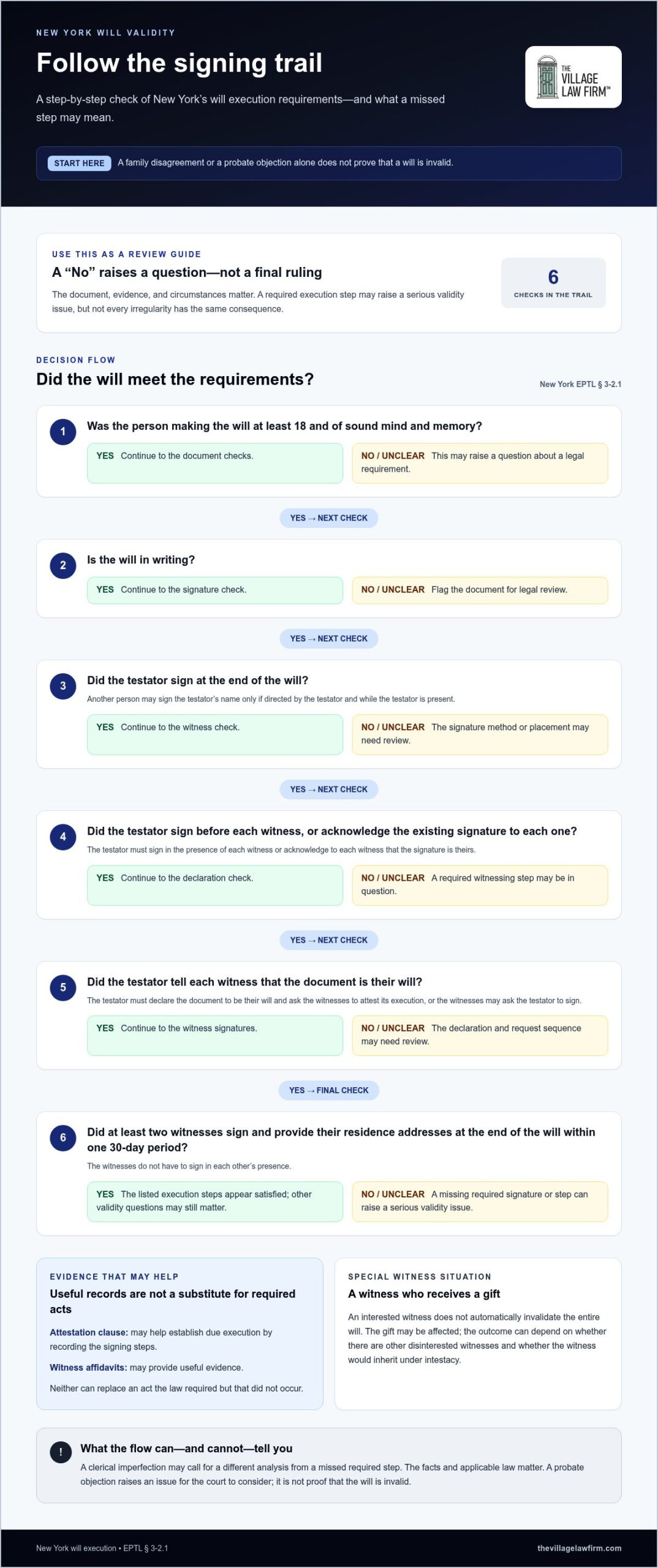
A careful review starts with how the will was signed, not just whether the document looks complete. New York’s Estates, Powers and Trusts Law (EPTL) sets out execution formalities. Use this checklist to identify questions for legal review, not to make a final ruling about validity.
- Written document: The will must be in writing.
- Signature at the end: The testator, the person making the will, must sign at the end. Another person may sign the testator’s name only if the testator directs that person to do so and the signing occurs in the testator’s presence.
- Signing or acknowledgment before witnesses: The testator must sign in the presence of each witness or acknowledge to each witness that an existing signature is theirs.
- Declaration and request: The testator must declare to each witness that the document is their will. The testator must then ask the witnesses to attest its execution, or the witnesses may ask the testator to sign the will.
- Two attesting witnesses: At least two witnesses must sign their names and provide their residence addresses at the end of the will within one 30-day period.
The witnesses don’t have to sign in each other’s presence. The sequence still matters: the testator’s declaration must be made to each witness, and the statutory signing and acknowledgment requirements must be followed. A general Last will and testament overview can explain the document’s purpose, but New York’s statute governs these local execution details.
Do witness mistakes automatically void a New York will?
Not every irregularity has the same consequence. A missing required signature or failure to follow a required execution step can raise a serious validity issue. A clerical imperfection may call for a different analysis. The facts and applicable law matter.
A witness who receives a gift under the will doesn’t automatically invalidate the entire document. Under EPTL § 3-3.2, an interested witness can affect the gift. The outcome may depend on whether there are other disinterested witnesses and whether the witness would inherit under intestacy. Have the will reviewed before assuming the whole document, or the entire gift, fails.
An attestation clause that records the signing steps can help establish due execution, and witness affidavits may provide useful evidence. Neither can replace an act the law required but that did not occur. If you’re preparing or reviewing a will, New York estate-planning guidance can help assess the document and the circumstances of its execution together.
Can Capacity, Undue Influence, or Fraud Make a Will Invalid?
Yes, but suspicion alone isn’t enough. A challenge based on capacity, undue influence, or fraud turns on what the evidence shows about the testator and the circumstances in which the will was made. Age, illness, an unexpected gift, or a strained family relationship may prompt questions, but none automatically proves a legal defect.
How does New York assess testamentary capacity?
New York applies a relatively low threshold for testamentary capacity. In general, the person making the will must understand that they’re making a will and what it does, have a general understanding of the property they own, and recognize the people who may naturally be affected by the plan, including beneficiaries and close relatives. The question is what the person understood when the will was executed, not simply their age or medical history.
A diagnosis or advanced age, standing alone, doesn’t establish incapacity. Records from around the signing date, communications, and observations from people who interacted with the testator may help show their understanding. These are evidence to assess in context, not automatic proof either way. New York generally presumes capacity, and the person challenging the will must prove otherwise.
What evidence may support an undue-influence or fraud claim?
Undue influence means more than persuasion, close caregiving, or a family member’s involvement in planning. The issue is whether pressure or coercion overcame the testator’s free will. A court may consider the relationship between the testator and a beneficiary, whether that person participated in arranging or drafting the will, and whether the surrounding circumstances suggest the testator acted freely. No single fact necessarily decides the question.
Fraud involves deception about a material fact that affects the will. For example, evidence that someone knowingly misrepresented an important fact to the testator could be relevant if the alleged deception influenced the testamentary decision. Threats or force may also raise duress concerns, depending on the facts and applicable law.
Drafting history, messages, medical or other contemporaneous records, and witness accounts can help establish what happened before and during execution. Preserve original documents and communications rather than relying on recollections alone. The legal burden and standards differ by claim and should be assessed under current New York law.
A will challenge must be measured against the evidence and New York law, not family suspicion or disagreement alone. A lawyer’s review can bring the document, available records, and circumstances together without assuming in advance what a court will decide.
When Is a Will Defect Serious Enough to Affect New York Probate?
A concern about a will can raise a real question, but it doesn’t decide the probate case. In New York, Surrogate’s Court considers objections under applicable law and evaluates evidence related to the particular issue. The effect may depend on the defect and the provisions involved. Don’t assume that one alleged problem voids the entire document.
Will defect or probate objection: how are they different?
An objection asks the court to examine a claim. It is not a finding that the will is invalid. To assess what makes a will invalid in New York, the court may consider the type of challenge, the supporting evidence, and the relevant legal standard. The table gives examples of issues and evidence that may matter, not predictions about a case’s outcome.
| Alleged issue | What it may affect | Evidence a court may examine |
|---|---|---|
| Execution defect | Whether the will, or a disputed provision, can be admitted to probate | The original document, signatures, attestation clause, and witness testimony |
| Capacity objection | Whether the testator had the required understanding when signing | Records from around the signing date, communications, and observations from people present or familiar with the testator |
| Undue influence | Whether the will reflects the testator’s free choice | Drafting history, the beneficiary’s role, communications, and witness accounts |
| Fraud claim | Whether alleged deception affected the testator’s decision | Relevant statements, correspondence, and evidence about what the testator knew |
| Revocation claim | Whether a later will or legally recognized act displaced the document | Later testamentary documents and evidence concerning their execution or revocation |
What should beneficiaries and executors preserve?
Keep the original will safe and unaltered. Preserve related drafts, letters, emails, text messages, and other communications. Keep names and contact details for people who witnessed the signing or may know relevant circumstances. Make a dated note of the timeline and where documents came from. Don’t write on, staple, or mark up the original.
Organizing these materials can help counsel assess the will, execution evidence, and probate context together. For an overview of procedure, read the New York probate process guide. The Village Law Firm also advises on New York estate administration and probate concerns through its estate-planning and administration practice.
What Should You Do If You Suspect a New York Will Is Invalid?
Start by identifying the concern, then preserve the documents and facts that may help explain it. A suspected problem doesn’t settle whether a will is valid. The right next steps differ depending on whether you’re preparing your own will or responding to a loved one’s death.
If you are making or updating your own will
Before signing, review the document and execution arrangements together. Confirm that the final version reflects your wishes, that names and provisions are consistent, and that the signing can follow New York’s required formalities. Don’t rely on a draft, informal notes, or an earlier will to communicate a change without considering how the documents fit together.
Tailored estate-planning advice can account for family circumstances and foreseeable sources of confusion, such as blended-family relationships or assets in more than one country. Explore New York estate-planning guidance for help thinking through the plan before signing, while there’s still an opportunity to address questions.
If you are concerned about a loved one’s will
Keep the original will and gather relevant records, such as earlier drafts, communications, and information about who was present during signing. Make a factual timeline while events are fresh. Don’t write on or alter original documents, and avoid pressuring potential witnesses; their independent recollections may matter.
Ask a New York estate-planning or estate-administration lawyer to assess the will, execution evidence, and probate context together. What makes a will invalid in New York depends on the specific facts and applicable law, not suspicion alone.
Act promptly. Probate procedures and deadlines can affect what steps are available, and the right timing may depend on the claim and circumstances. Get case-specific advice as soon as you can, especially if a proceeding has begun or you’ve received court papers.
The Village Law Firm advises on New York wills, estate planning, and estate administration, including complex probate matters. A review can clarify the issues and help you understand possible next steps without guaranteeing a particular court outcome. Speak with The Village Law Firm about your New York will.
Protect Your Family’s Intentions With a Clear Next Step
Understanding what makes a will invalid in New York means looking beyond family disagreement to the legal requirements, the circumstances of signing, and the evidence supporting any challenge. A will objection is not a decision: Surrogate’s Court assesses the specific issues under applicable law. If you’re reviewing your own plan, careful preparation before signing can help reduce uncertainty. If you’re concerned about a loved one’s will, preserve the original document and relevant records, and seek advice promptly because deadlines and court procedures may matter.
The Village Law Firm provides New York estate-planning and estate-administration counsel, including support with complex probate matters. If an estate involves foreign assets, documents, or family connections, the firm also has experience with cross-border estate administration. A lawyer can review the will, execution evidence, and probate context together without presuming the outcome.
Discuss your New York will with The Village Law Firm. A thoughtful review can help you move forward with greater clarity and care for the intentions your family wants to preserve.
Frequently Asked Questions
What makes a will invalid in New York?
A New York will may be invalid if it fails required execution formalities or if a legally sufficient challenge, supported by evidence, establishes a problem such as lack of testamentary capacity, undue influence, or fraud. Generally, the will must be written, signed at the end by the testator, and attested by at least two witnesses. A family disagreement or an unusual inheritance decision, by itself, doesn’t make a will invalid.
Does a New York will need two witnesses?
Yes. For most New York wills, at least two attesting witnesses are required. The testator must sign in each witness’s presence or acknowledge an existing signature to each, declare that the document is their will, and request that the witnesses attest to it, or the witnesses may ask the testator to sign. Each witness must sign and provide an address within a 30-day period.
Can a will be valid if a witness is also a beneficiary?
Yes, an interested witness doesn’t automatically invalidate the entire will. New York law may affect the gift made to that witness, depending on the circumstances, including whether there are other disinterested witnesses and what the witness would receive if there were no will. The specific result requires review of the will and relevant facts. Don’t assume either that the whole document fails or that the witness’s gift is unaffected.
Can dementia or a medical diagnosis make a will invalid in New York?
A diagnosis, including dementia, doesn’t by itself establish that a will is invalid in New York. The key question is whether the person had testamentary capacity when signing. Generally, they must understand that they’re making a will, have a general understanding of their property, and recognize the people affected by their plan. Records and observations from around the signing may be relevant, but must be considered in context.
Can a family member challenge a will in New York?
A family member may be able to object in Surrogate’s Court if they have a legally recognized interest in the estate and an appropriate basis for challenging the will. Being upset about an inheritance or disagreeing with the testator’s choices isn’t enough on its own. Standing, deadlines, court procedures, and the evidence required depend on the situation, so seek case-specific New York legal advice promptly if probate is underway.
Does a handwritten will count as valid in New York?
A handwritten will generally isn’t valid in New York just because the testator wrote and signed it. Most wills must meet the state’s execution rules, including attestation by two witnesses. New York law recognizes narrow exceptions for certain members of the armed forces and mariners at sea. Whether an exception applies depends on the specific circumstances, so have the document and the testator’s situation reviewed before relying on it.
What happens if a will is found invalid in New York?
If a court determines that a will is invalid, the estate may be distributed under an earlier valid will, if one exists, or under New York’s intestacy rules if no valid will controls. The effect can depend on the court’s findings and the particular defect; don’t assume every issue invalidates every provision. Preserve the original will and related records, and get advice about the estate and any active probate proceeding.