
What if the first step in settling an estate is determining which court process applies? After a loss, uncertainty about filings, family concerns, creditor claims, and your responsibilities can make each decision feel heavier. A probate administration lawyer NYC families work with can help clarify the path ahead and bring more order to the process. The terms matter: probate generally applies when there’s a will, while administration is generally required when there isn’t one.
You may be wondering what belongs to you as executor or administrator, whether the estate needs court proceedings, and when legal guidance could help prevent avoidable complications. This article explains how those roles differ, what information and documents to gather, and how estate tasks may unfold in New York City. It also covers disputes, creditor claims, and assets across borders that may call for careful coordination. With a clearer picture of the process, you can prepare for a focused conversation and take the next steps with greater confidence.
Key Takeaways
- Learn how a will, the estate’s assets, and family circumstances can shape whether probate or administration is appropriate.
- See how a probate administration lawyer NYC can help clarify fiduciary responsibilities and New York court requirements for an estate.
- Understand why disputes, incomplete records, or assets in more than one country may require additional coordination.
- Prepare for a more productive legal conversation by organizing available documents and noting what remains unknown.
- Get a high-level view of the steps from court appointment to estate distribution, and where legal guidance can help.
When a Probate Administration Lawyer in NYC Can Help Your Family
Estate responsibilities often arrive while a family is grieving and managing immediate practical concerns. Questions about the will, the court, assets, and your role soon follow. A probate administration lawyer NYC families work with can provide legal guidance on the estate process and a fiduciary’s responsibilities. The goal is to clarify the work ahead, not add another layer of uncertainty.
Probate or administration: which term applies?
Probate generally means submitting a will to Surrogate’s Court for review so the named executor can seek appointment. If no valid will governs the estate, the court process is generally called administration, and the court appoints an administrator instead. A probate court handles estate matters, though not every asset necessarily passes through a court proceeding.
Some assets may pass outside probate based on how they’re owned or whether a beneficiary is designated. So the presence of a will doesn’t, by itself, determine which assets require court involvement. The estate’s documents, ownership records, and circumstances all matter.
Who may benefit from legal guidance?
Executors, court-appointed administrators, and family members seeking clarity may all benefit from understanding the fiduciary’s role. Legal guidance can be especially useful when records are incomplete, beneficiaries have questions, assets are difficult to identify, or obligations need to be coordinated. A lawyer advises and represents the fiduciary; the fiduciary remains responsible for carrying out the duties of the role.
A probate administration lawyer helps a fiduciary understand and address legal responsibilities, while the fiduciary remains accountable for decisions made on the estate’s behalf.
An executor is named in a will, but must obtain the court’s appointment before acting in that capacity. When no valid will governs, the court appoints an administrator. In either role, the fiduciary may need to keep clear records, communicate with interested parties, identify estate property, and address obligations before distributing assets. Legal counsel can explain how those duties apply to the facts, but doesn’t take them over.
Consider seeking guidance when you encounter questions such as:
- Whether a document is the final will or whether its terms raise concerns.
- How to make sense of accounts, property, or financial records that are incomplete or spread across institutions.
- How to respond when beneficiaries disagree or a creditor makes a claim.
- How to coordinate assets or records connected to another country.
These circumstances don’t automatically mean an estate will become contentious or unusually complex. They do signal that careful, fact-specific advice may help you understand your options before taking consequential steps. If you’re unsure what belongs to you as fiduciary, start by identifying the questions and documents you already have. You don’t need every answer before seeking clarity.
How NYC Surrogate’s Court Administration Moves from Appointment to Distribution
Estate administration is a sequence of decisions, not a single filing. This outline offers general orientation, not advice about a particular estate. The appropriate Surrogate’s Court and filing requirements depend on the estate’s facts, including where the person lived and which proceeding is needed. In New York City, county-specific details matter, so one family’s filing steps may not apply to another.
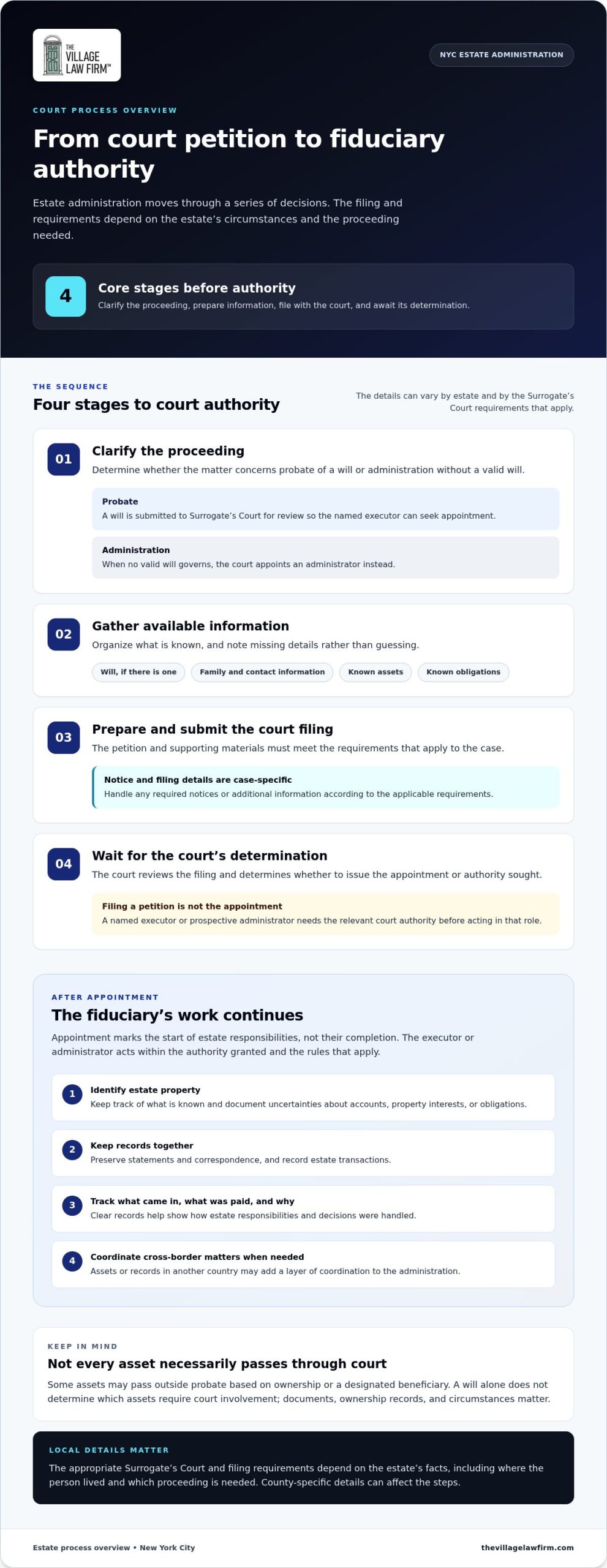
From court petition to fiduciary authority
The first stage is identifying the appropriate proceeding and assembling the information the court needs. A will, family details, and information about the estate may all be relevant. The court reviews the filing and determines whether to issue the appointment or authority sought. Forms, notice procedures, and filing details depend on the circumstances and should be addressed for the specific estate.
- Clarify the proceeding. Determine whether the matter concerns probate of a will or administration without a valid will. The estate’s circumstances shape this decision.
- Gather available information. Organize the will, if there is one, basic family and contact information, and an initial picture of known assets and obligations. Identify missing details rather than guessing.
- Prepare and submit the court filing. The petition and supporting materials must meet the requirements that apply to the case. Handle any required notices or additional information according to those requirements.
- Wait for the court’s determination. A person named as executor and a person seeking appointment as administrator both need the relevant court authority before acting in that role. Filing a petition alone doesn’t make someone the appointed fiduciary.
Managing estate responsibilities after appointment
Appointment marks the start of the fiduciary’s work, not its completion. The executor or administrator manages estate responsibilities within the authority granted and the rules that apply. Careful records show what came in, what was paid, and why decisions were made.
Practical early steps include identifying estate property, keeping statements and correspondence together, and recording estate transactions. If an account, property interest, or obligation is uncertain, document what is known and what remains unresolved. Assets or records in another country may require cross-border coordination, adding another layer to the administration.
Before distributing property, the fiduciary may need to consider obligations, beneficiary interests, the will’s terms or applicable law, and court requirements. The order and details depend on the estate. Appointment alone doesn’t resolve every question or mean distribution should happen immediately. A fiduciary may consult a probate administration lawyer NYC for help interpreting the process and organizing legal questions, while remaining responsible for estate decisions and records.
If the next step feels unclear, gather the court papers and make a simple record of known assets and transactions. That can make the situation easier to assess. The Village Law Firm provides estate administration counsel in New York City, including support with complex cross-border matters. A conversation with The Village Law Firm can help you consider the estate’s circumstances and the legal questions they raise.
When an NYC Estate Needs More Than Basic Probate Guidance
Not every estate requires the same level of legal involvement. If the will is clear, records are organized, assets are easy to identify, and beneficiaries understand the plan, administration may present fewer questions. Even then, the fiduciary must understand the responsibilities attached to the role. A more complicated fact pattern may call for closer legal attention, but complexity alone doesn’t mean a dispute is inevitable.
Think of complexity as a reason to pause and assess, not a prediction of conflict. A probate administration lawyer NYC families consult can help identify which questions need answers and how they relate to the estate. Early clarity may help a fiduciary avoid acting on assumptions, especially when a document, account, or family relationship isn’t straightforward.
Signs the administration may need closer legal attention
Questions can be easy to miss when records are scattered or family members have different understandings of the estate. Take note if the will’s terms or status are uncertain, beneficiary information is incomplete, asset ownership is unclear, or the fiduciary’s authority is being questioned. These issues don’t establish that anyone has acted improperly. They do make it important to understand the facts before taking consequential steps.
Other circumstances may also warrant careful review:
- Financial records are missing, inconsistent, or difficult to reconcile.
- A creditor has made a claim, or the fiduciary is unsure how to address an obligation.
- Beneficiaries disagree about what the will means, what property belongs to the estate, or how information should be shared.
- Property may be jointly owned, held through a trust, or connected to beneficiary designations, making ownership and transfer questions less obvious.
- There are concerns about whether a proposed action falls within the fiduciary’s authority.
Disagreement doesn’t automatically require litigation. Sometimes people need a clearer explanation of documents, records, or responsibilities. A lawyer can help the fiduciary understand the legal issues and consider appropriate next steps without assuming that a family disagreement will escalate or predicting how a court would resolve it.
When assets cross state or national borders
Property outside New York can add another layer. For instance, real estate in another state may raise ancillary probate questions because it is located beyond New York. The steps depend on the asset and circumstances, so identify the property early and keep its ownership records with the estate’s other documents. The firm’s ancillary probate guide for out-of-state assets provides more detail.
International assets may require coordination across different legal systems, records, and institutions. That doesn’t necessarily make the estate contentious, but it can make the work less linear. If property, accounts, or essential documents are in another country, note where they are and what information is available. This gives counsel a useful starting point for assessing the administration and any cross-border coordination it may involve.
How to Prepare for a Probate Administration Lawyer Consultation
Preparing for a legal discussion doesn’t mean assembling a perfect file first. A few available records and a clear account of what you know can help a probate administration lawyer NYC understand the estate’s immediate questions. If key documents or details are missing, make a note. Don’t delay seeking guidance just because you haven’t located everything.
Records and information to gather
Start with what’s already within reach. A paper or digital folder can keep documents together and help distinguish confirmed information from open questions. Useful materials may include:
- A will, trust documents, and any related amendments or instructions you’ve found.
- A death certificate, Surrogate’s Court correspondence, petitions, or other court papers.
- Available records for bank or investment accounts, real estate, insurance, business interests, debts, and other known assets.
- Names and contact information for known beneficiaries, heirs, financial institutions, and other relevant organizations.
This isn’t a required complete checklist. If you can’t locate a will, account statement, or contact detail, write down what’s missing and where you last saw or heard about it. That helps prevent an unknown fact from being mistaken for a confirmed one.
Questions to bring to the first discussion
A focused conversation can clarify immediate priorities and how you’ll work together. Consider noting questions such as:
- What authority do I currently have, and what should I avoid doing until my role is clear?
- Which responsibilities need attention first, based on the estate’s circumstances?
- What records or information would help address the main open questions?
- How will we communicate about filings, records, and important developments?
- How should I raise concerns about debts, beneficiary disagreements, foreign assets, or earlier court activity?
A short chronology can be as useful as a thick stack of papers. Write down the date of death, when you found the will or other estate documents, any court filings or notices received, and significant conversations or concerns. Keep it factual. For example, note that a beneficiary asked about an account, then record separately what you know about the account and what still needs to be established.
Preparation helps make the discussion more productive, but it isn’t a substitute for legal advice tailored to the estate. Share uncertainties plainly, including disagreements, creditor concerns, missing records, and assets outside the United States. Clear communication gives counsel a fuller picture and helps focus attention on the questions that matter to your role.
Bring what you have, along with notes on what remains unknown. To discuss estate administration guidance for your circumstances, contact The Village Law Firm.
How The Village Law Firm Supports NYC Estate Administration
Even with a general understanding of the process, serving as an executor or administrator can leave you facing unfamiliar decisions. The Village Law Firm provides estate administration counsel in New York City, helping families and fiduciaries organize estate responsibilities. Legal guidance can clarify which questions need attention and how the estate’s circumstances shape the work ahead.
A steady partner for complex estate responsibilities
Estate administration can involve reviewing documents, understanding fiduciary duties, coordinating information, and addressing questions as they arise. The Village Law Firm supports executors and administrators through these responsibilities, with advice grounded in the estate’s specific facts. The fiduciary retains responsibility for the role, while counsel provides legal guidance and representation.
Some matters involve incomplete records, questions about asset ownership, or concerns raised by beneficiaries. Others may include property, accounts, or important documents connected to more than one country. These circumstances don’t predict conflict or a particular result, but they can make coordination and careful legal analysis especially important.
The firm provides international estate planning and cross-border estate administration. For a family dealing with assets abroad, administration may involve coordinating information across jurisdictions and legal systems. Knowing where assets are held, what records are available, and which questions remain unresolved can help frame the work. A probate administration lawyer NYC families consult can assess those issues in context rather than treating every estate as if it follows the same path.
Take the next step with clarity
You don’t need every document or answer in hand before discussing the estate. Start with what you know: whether a will has been located, what court papers or notices have arrived, who may be involved, and which concerns feel most pressing. If details are uncertain, say so. Separating confirmed facts from open questions gives the conversation a practical starting point.
It can also help to explain your role, such as whether you’re named as executor or have been appointed administrator, and to mention known debts, beneficiary concerns, or assets outside the United States. An initial discussion can help identify the legal questions that may need attention. You don’t need to predict how every issue will resolve before seeking guidance.
For families in New York City, working with counsel can provide a steadier framework for handling estate responsibilities. The Village Law Firm offers estate administration guidance, including for matters with cross-border considerations. If you’re ready to discuss what you know and where you need clarity, Speak with The Village Law Firm.
Move Forward with a Clearer Plan
The next step doesn’t have to answer every question at once. Identify the decision or uncertainty that weighs most heavily on you, then bring forward what you know and what still needs clarification. That gives your conversation a practical focus and helps you consider how to proceed with care.
If you’re weighing whether a probate administration lawyer NYC can help with your family’s situation, a focused discussion can clarify your role and the estate’s immediate needs. You don’t need a perfect record or complete plan before beginning. Take the step that feels manageable now, and address the remaining questions in turn.
Discuss your estate administration needs with The Village Law Firm. Start with a conversation about your estate’s circumstances and the guidance you need.
Frequently Asked Questions
Does every estate in New York City have to go through probate?
No. A New York City estate may include assets handled through a court proceeding and others that transfer under ownership or beneficiary arrangements. For example, an account with a named beneficiary may be treated differently from an account owned solely by the deceased person. Review each asset’s title and governing paperwork. Don’t infer the estate’s court needs from one account or property alone.
Can an executor administer an estate without a lawyer in New York?
Yes, an executor may be able to handle some estate tasks without a lawyer, but the decision depends on the work and the executor’s comfort with fiduciary duties. A probate administration lawyer NYC executors consult can help interpret court correspondence, address uncertainty about records, and identify issues that need attention. Before acting on a distribution, creditor demand, or disputed document, understand the authority and responsibilities that apply to the estate.
What is the difference between an executor and an administrator in NYC?
An executor is designated in a will; an administrator is appointed by the court when no will governs the appointment. Being named executor is different from having court authority to act for the estate. For instance, a financial institution may request proof of appointment before discussing or transferring estate funds. Procedures and authority depend on the circumstances, so clarify your role before signing documents or representing the estate.
Which New York City Surrogate’s Court handles an estate?
Generally, venue is connected to where the deceased person was domiciled, not simply where an asset is located. For someone domiciled in New York City, the borough-level county connection may help identify the relevant Surrogate’s Court. A Manhattan apartment, for example, doesn’t by itself establish venue if the person’s domicile was elsewhere. Review the residence facts and court directions before filing, particularly if records show more than one address.
Can a New York probate administration involve property in another state?
Yes. A New York proceeding may not by itself address the transfer of real property located in another state, and ancillary steps may be needed under the rules where the property sits. The deed, ownership form, and any existing proceeding can affect the coordination involved. Keep property and court records together. The firm’s ancillary probate guide explains how out-of-state assets can affect an estate with a New York connection.
What should I bring to a probate administration lawyer consultation?
Bring what’s readily available, such as a will, trust papers, death certificate, court notices, and recent account or property records. A brief note naming possible beneficiaries, known debts, and your most urgent question can focus the discussion. If you have several court notices, record when each arrived and any response date shown. Missing records are useful to identify, not a reason to postpone seeking guidance.
What happens if a beneficiary disagrees with the executor?
The executor should acknowledge the concern, preserve relevant messages and records, and avoid making promises before understanding the issue. If a beneficiary questions an expense, for example, note the concern and locate any related invoice or account entry. A disagreement alone doesn’t establish misconduct. A lawyer can help assess the fiduciary’s authority and available documentation, then consider a measured response without assuming court action is necessary.