
What if the most important part of trust administration isn’t making a quick decision, but creating a clear, well-documented process for each one? As a New York trustee, you may be balancing unfamiliar trust terms, beneficiary questions, asset records, and tax matters, while knowing that a mistaken distribution or missed task can have serious consequences. A trust administration attorney NY trustees consult can clarify the legal steps while leaving fiduciary decisions in the trustee’s hands.
It’s understandable to want clarity before acting. Your responsibilities depend on the trust document and the circumstances, and careful administration takes more than distributing assets. This guide explains the trustee’s role, where legal guidance can help, and how an attorney can bring order to a complex process.
You’ll learn what to consider when interpreting trust terms, managing assets and records, communicating with beneficiaries, and addressing tax-related questions. You’ll also find out what information to gather before seeking counsel, so you can make the conversation focused and productive.
Key Takeaways
- Understand how a trustee’s responsibilities differ from an attorney’s role, while keeping fiduciary decisions with the trustee.
- Approach administration as a sequence: review trust terms, identify assets, manage records, address reporting, and make distributions.
- Consider guidance from a trust administration attorney NY when the trust, assets, family circumstances, or administration questions become complex.
- Gather relevant trust documents, asset information, correspondence, and records to make a legal discussion more focused.
- Tailor legal support to the trust’s circumstances, including matters involving assets or administration across borders.
What a Trust Administration Attorney in New York Does for a Trustee
Becoming a trustee can bring unfamiliar legal and administrative responsibilities at a time when you may also be supporting family members. Trust administration means carrying out the trust’s terms under applicable law. That can involve determining who may receive trust assets, what conditions apply, and which records or communications are needed. The steps depend on the trust document, the assets involved, and the circumstances.
A trust administration attorney NY trustees consult provides legal guidance and document support. An attorney can help interpret trust language, identify questions that need careful consideration, and explain how applicable law may affect a proposed action. The trustee remains responsible for administering the trust and making fiduciary decisions. Legal counsel supports that work; hiring an attorney does not transfer the trustee’s responsibilities.
Trustee duties and legal counsel are separate roles
The trustee acts under the trust document and applicable fiduciary standards. In New York, core fiduciary responsibilities include managing investments prudently, acting loyally rather than for personal benefit, and keeping accurate records and accounting to beneficiaries. These duties call for careful judgment, particularly when a trust has detailed distribution terms or beneficiaries have different needs.
Counsel helps the trustee understand the legal framework for those decisions. For example, if a trust allows distributions for a beneficiary’s needs, an attorney can help interpret the wording and explain relevant legal considerations. The trustee still evaluates the facts and makes the decision. Counsel can also prepare or review administration documents and explain how to document the trustee’s actions.
Not every trust calls for the same level of attorney involvement. A straightforward trust with clearly described assets and terms may raise different questions from one involving complex distribution provisions, disagreements, or assets in multiple jurisdictions. The goal is guidance tailored to the trust, not unnecessary complexity.
When New York law and the trust document intersect
The trust instrument sets out the creator’s instructions, but it operates within applicable law. General background on United States trust law explains the roles of the person creating a trust, the trustee, and the beneficiaries. State rules differ, so a broad overview cannot determine how a particular New York trust should be administered. New York’s trust framework primarily draws on its Estates, Powers and Trusts Law and Surrogate’s Court Procedure Act.
The Surrogate’s Court is relevant to certain estate-related matters, including proceedings involving a decedent’s estate. Whether a court process applies to trust administration depends on the facts and the issue. A trustee should not assume that every trust requires court involvement or that a question about trust terms automatically belongs in court.
Legal guidance can be especially useful when trust language is unclear, an asset’s ownership or location complicates administration, or a proposed distribution raises questions. An attorney can help identify what the document says, which legal rules may apply, and what information to consider before acting. This structure helps you proceed deliberately while keeping decision-making responsibility in the right place.
How Trust Administration Moves from Review to Distribution
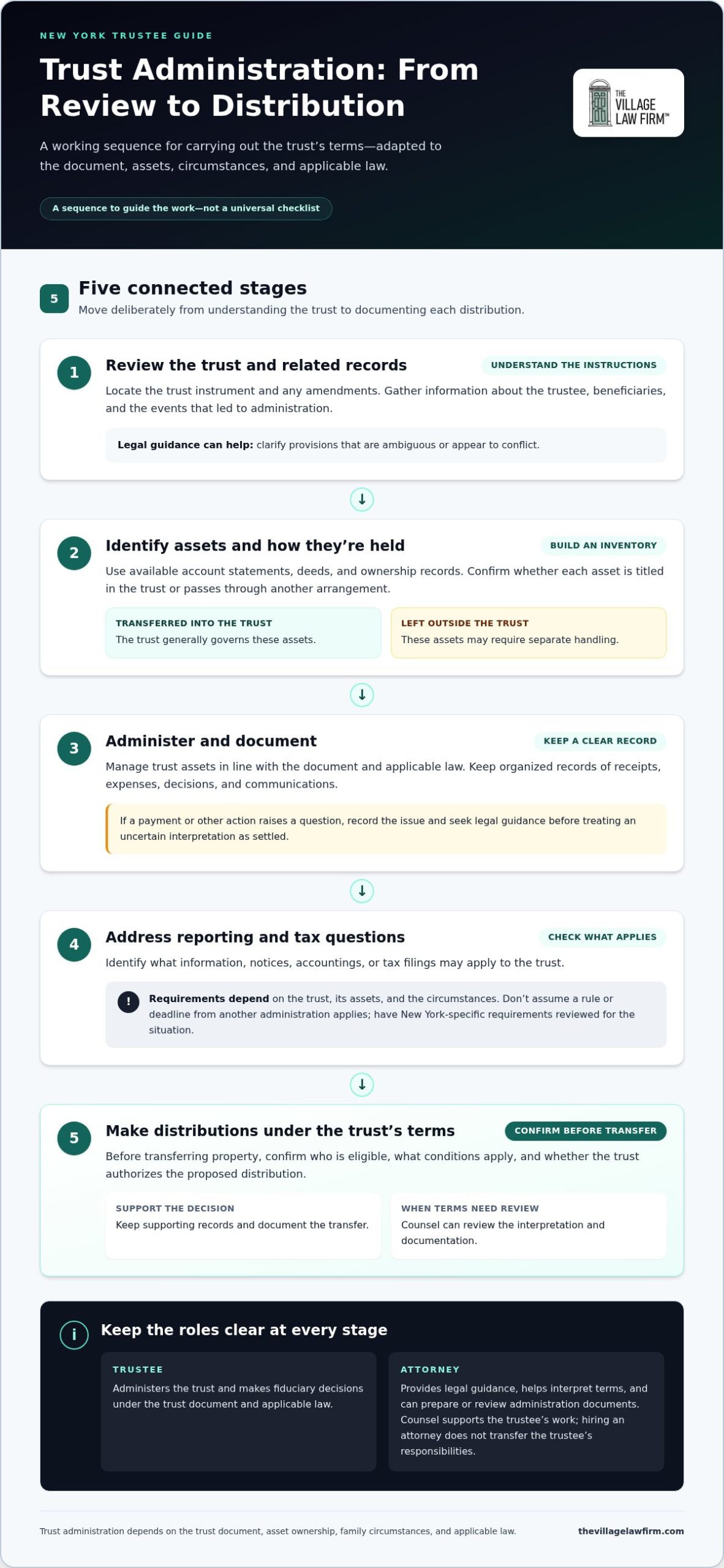
A clear sequence can make trust administration easier to manage. Treat it as a working plan, not a universal checklist: the trust document, asset ownership, family circumstances, and applicable law all affect what the trustee needs to do. A trust administration attorney NY trustees work with can interpret terms, prepare or review documents, and identify legal questions at each stage. The trustee remains responsible for carrying out the trust.
- Review the trust and related records. Locate the trust instrument and any amendments, along with information about the trustee, beneficiaries, and the events that led to administration. Counsel can help clarify provisions that are ambiguous or appear to conflict.
- Identify the assets and how they’re held. Build an inventory using available account statements, deeds, and ownership records. Confirm whether each asset is titled in the trust or passes through another arrangement. A trust generally governs assets transferred into it; assets left outside it may require separate handling.
- Administer and document. Manage trust assets in line with the document and applicable law. Keep organized records of receipts, expenses, decisions, and communications. If a question arises about a payment or other action, record the issue and seek legal guidance before treating an uncertain interpretation as settled.
- Address reporting and tax questions. Identify what information, notices, accountings, or tax filings may apply to the trust. Requirements depend on the trust, its assets, and the circumstances. Don’t assume a rule or deadline from another administration applies; have New York-specific requirements reviewed for the situation.
- Make distributions under the trust’s terms. Before transferring property, confirm who is eligible, what conditions apply, and whether the trust authorizes the proposed distribution. Keep supporting records and document the transfer. Counsel can review the interpretation and documentation when the terms or facts raise legal questions.
Start with the trust document and asset picture
Gather the trust instrument, amendments, prior administration records, a current list of known assets, and relevant correspondence. You may not have every record at the outset, and the list can grow as you gather information. Beneficiary designations and account or property ownership can affect whether an asset is part of the trust administration, so don’t rely on an informal list alone.
Keep New York property and accounts distinct from assets located elsewhere. Out-of-state property or an international account may raise separate ownership, legal, or administrative questions. The Village Law Firm provides estate administration counsel to help trustees organize these issues, including matters involving cross-border considerations.
Track administration, reporting, and distributions
Use a consistent recordkeeping system from the outset. Save statements, receipts, correspondence, notes explaining decisions, and copies of documents sent or received. Good records make later review more orderly, but they don’t replace advice tailored to notice, accounting, filing, or tax obligations.
New York-specific requirements can depend on the trust and its circumstances, so avoid applying a general deadline or filing rule without legal review. If you’re preparing to administer a trust, estate administration guidance can help you identify the questions to address before making a report or distribution.
When a Trustee in New York Should Consider Legal Guidance
You don’t have to wait for a beneficiary to object or a dispute to begin before seeking legal advice. Counsel can help early, while you’re interpreting a trust provision, weighing a consequential decision, or deciding what records to keep. Guidance at a decision point can help you understand the legal questions before acting, while fiduciary decisions remain your responsibility as trustee.
Complexity doesn’t automatically mean a trustee must hire an attorney. It is a practical signal to consider whether tailored advice could help you administer the trust with greater clarity. Ask yourself:
- Are any terms unclear, inconsistent, or difficult to apply to current circumstances?
- Are there multiple beneficiaries whose interests or needs differ?
- Does the trust hold real estate, an interest in a closely held business, or assets outside New York?
- Are you uncertain about a proposed distribution, beneficiary communication, or how to document a decision?
- Do tax, reporting, or ownership questions require legal interpretation?
Trust terms, beneficiaries, or assets create added complexity
A provision that seems straightforward at first may become harder to apply when circumstances change. For example, a trustee may need to consider how a distribution term applies when a beneficiary’s needs shift, or how to interpret language that could support more than one reading. Multiple beneficiaries can add another layer, particularly when a decision affects them differently.
Asset type and location matter, too. Real estate, closely held business interests, and international assets can raise distinct ownership and administration questions. A trust with assets in another country may require coordination across legal systems, not just a review of the New York trust document. If global property or family connections are relevant, the firm’s international estate planning guidance provides context on cross-border considerations.
Disagreement, uncertainty, or significant decisions arise
Seeking advice can make sense even when everyone is communicating calmly. You may want legal input before interpreting a disputed term, responding to competing beneficiary requests, documenting a sensitive decision, or making a distribution that may be difficult to reverse. Counsel can clarify the legal issues and review relevant documents, but that guidance does not guarantee agreement or a particular result.
Keep the question specific. Note the trust provision involved, the decision under consideration, the facts you’re relying on, and any related correspondence or records. This gives counsel a useful starting point without requiring you to resolve the legal issue alone. To discuss a trust administration matter, you can speak with the firm about trust administration.
What to Organize Before Discussing Trust Administration
You don’t need to arrive with every issue solved. A clear set of records and a short list of questions can help a trust administration attorney NY focus on the decisions that matter now, rather than reconstructing basic facts. The trust and its assets determine which documents are relevant, so use this as a starting point, not a requirement to produce a perfect file.
Documents and records to gather
Start with what you have. Gather the trust instrument and amendments, information identifying the trustee and beneficiaries, available asset records, and correspondence about the trust. A recent account statement, property record, or business document may help show what the trust owns, but missing information shouldn’t prevent you from seeking advice.
A simple timeline can provide useful context. Note when you began serving as trustee, actions already taken, known obligations, and decisions approaching. Keep financial and personal information organized, and share sensitive records through appropriate secure channels.
- The trust document and any amendments or related records
- Available account, property, business, or other asset information
- Relevant beneficiary correspondence and prior administration records
- A brief timeline of actions, obligations, and pending decisions
Estate planning documents provide instructions that may shape later administration. For broader context on how planning fits together, the firm’s New York estate planning overview discusses considerations related to protecting a legacy.
Questions to clarify before seeking advice
Before a discussion, identify the point where you need clarity. Is a particular trust term difficult to interpret? Are you deciding whether a beneficiary may receive a distribution or how to respond to a request? Is there a recordkeeping, property, or tax concern you need to understand? State the question plainly and describe the decision you’re facing. You don’t need to arrive with a legal conclusion.
If relevant, note whether beneficiaries have raised different concerns, whether an asset is outside New York, or whether international property or administration issues are involved. These details help counsel understand the context and tailor the discussion to the trust, its assets, and your responsibilities as trustee.
- Which trust provision or responsibility is unclear?
- What decision is approaching, and what information informs it?
- Are there beneficiary, tax, property, or international-asset questions?
- What documents or communications relate directly to the issue?
Bring accurate records, even if they’re incomplete. You can contact The Village Law Firm about trust administration to discuss your questions with counsel.
Choosing Trust Administration Counsel in New York and Taking the Next Step
The right legal support depends on the trust’s actual demands, not on a one-size-fits-all checklist. A trustee handling a narrow question about a provision may need focused advice on that decision. A trust involving several asset types, multiple beneficiaries, or ongoing administration questions may call for guidance across more than one stage. In either case, the purpose is to clarify your legal responsibilities and options, not to transfer your fiduciary role to the attorney.
As you consider a trust administration attorney NY, think about what makes this trust distinct. Where are its assets located? Are there family circumstances that affect how the terms apply? Is your immediate concern a distribution, a document, an accounting question, or the overall administration process? These details help shape a useful discussion about the scope of legal support.
Match legal support to the trust’s actual needs
Some trustees seek advice on one issue, such as interpreting a specific clause before making a decision. Others need support reviewing documents and legal questions that arise at several points in administration. The scope can be tailored to the trust’s terms, asset structure, family circumstances, and the trustee’s questions. Clarity about the decisions ahead helps counsel focus the work.
Asset location can also influence the questions involved. A trust holding property or accounts outside New York may require additional coordination, and international assets can raise cross-border administration considerations. The Village Law Firm provides estate administration counsel in New York, including support with complex cross-border estate administration. If the structure of the trust itself is central to your question, its irrevocable trust guidance in NYC offers related planning context.
Before discussing the engagement, identify the legal issue you want help understanding and whether it is a single decision or part of a broader administration concern. Note which assets or beneficiaries are involved and what records relate to the question. That preparation helps establish a practical scope without assuming every trust needs the same level of support.
Move forward with a clear, tailored discussion
A focused conversation can begin with three points: your role as trustee, the trust’s general circumstances, and the decision or legal question that needs attention. Share relevant documents and explain what you have already done. If you’re unsure which details matter, describe the issue plainly. Counsel can identify the legal questions and discuss an appropriate scope of work.
The discussion helps bring structure to the next step, without promising a particular result or timeline. The Village Law Firm’s estate planning and administration work provides guidance tailored to family and trust circumstances. For a considered discussion of your matter, Discuss your New York trust administration needs.
Take the Next Step with Clarity
Your next step doesn’t need to be a final decision about every aspect of administration. Start by identifying the question you need answered and the outcome you’re responsible for deciding. A focused conversation can help you understand what legal support may be useful while keeping your role as trustee clear.
If the trust connects to broader planning or involves assets across borders, counsel familiar with New York estate planning and administration, as well as cross-border matters, can help frame the relevant questions. A trust administration attorney NY can offer guidance suited to your circumstances without promising a particular result.
Bring the facts and questions you have, even if some details remain unresolved. Discuss your New York trust administration needs with The Village Law Firm to take the next step with greater clarity.
Frequently Asked Questions
How long does trust administration take in New York?
There’s no single timeline for every New York trust. Administration may take longer if assets need to be identified or managed in different places, tax or reporting questions need attention, or beneficiary concerns require discussion. For example, property that must be valued or sold can affect when it’s practical to distribute proceeds. Counsel can identify which steps may shape this trust’s schedule. Don’t treat a general estimate as a deadline.
Does a trustee need court approval to distribute trust assets in New York?
Not every trust distribution follows the same court process. The trust terms, the asset involved, applicable law, and any existing dispute or proceeding can affect which steps are appropriate. A trustee shouldn’t assume court approval is always required or never required. Before transferring an asset, a trust administration attorney NY can review the circumstances and help identify whether a New York court procedure is relevant.
What happens if a named trustee does not want to serve?
A named trustee may have a process to decline or resign, but the trust document and applicable law determine the appropriate steps. Check whether the document names a successor or describes how another trustee may be appointed. Before communicating a decision or stepping away, get advice about any notices or records that may be needed and how administration can continue without confusion about who is responsible.
Can a trustee make distributions before every trust issue is resolved?
Whether a distribution is appropriate depends on the trust terms, known obligations, available information, and applicable legal requirements. For instance, a trustee considering one beneficiary’s request should assess whether the trust authorizes it and whether other unresolved matters may affect the decision. Don’t treat a distribution as routine if its basis is uncertain. Legal advice can help assess the specific proposal before you act.
Can a New York trust own property in another country?
A trust may involve assets outside the United States, but a New York trustee shouldn’t assume domestic procedures answer every question. Foreign property or an account may raise issues involving local law, ownership records, tax treatment, or coordination across jurisdictions. Keep the asset’s location and available records clear, then seek advice on the relevant questions. Counsel experienced with cross-border estate matters can help assess the legal and administrative considerations.
What should a trustee do if beneficiaries disagree about trust administration?
Keep clear records, communicate carefully, and continue to follow the trust terms rather than treating disagreement as permission to change course. First, identify the specific concern, the trust provision involved, and any decision that needs attention. Avoid making promises or acting based only on pressure from one beneficiary. A trustee can seek legal advice early to understand responsibilities and consider appropriate options without assuming a dispute will escalate.