
What if the greatest threat to your family home isn’t the New York real estate market, but the staggering cost of the long-term care you might one day need? It’s a heavy thought to carry. Many New Yorkers feel a deep sense of anxiety when they realize that nursing home costs in the city now exceed $15,282 per month. Partnering with a sophisticated Medicaid planning attorney New York is about more than just paperwork. It’s about building a sanctuary of financial order in an unpredictable world.
You likely feel that protecting your legacy shouldn’t mean sacrificing your quality of life, and we couldn’t agree more. You’ve worked too hard to see your life savings consumed by healthcare costs or complex eligibility rules. This guide explains how a meticulous strategy can shield your home and assets while ensuring you receive the high-quality care you deserve. We’ll explore the 2026 individual asset limit of $33,038, the current status of the 30-month community look-back period, and the clear roadmap needed to secure your spouse’s financial future and your children’s inheritance.
Key Takeaways
- Learn how to transform the stress of a potential medical crisis into a structured legal roadmap that preserves your dignity and financial independence.
- Understand the mechanics of the 5-year look-back period and how New York’s regional penalty rates directly impact your eligibility timing.
- Discover how a Medicaid planning attorney New York utilizes specialized tools like the Medicaid Asset Protection Trust to shield your home from estate recovery.
- Identify the critical advantages of proactive planning over crisis intervention to ensure you maintain the highest degree of control over your assets.
- Explore how sophisticated planning integrates cross-border assets and specific family needs to create a lasting sanctuary of order for your heirs.
Navigating Medicaid Planning in New York: Moving from Chaos to Order
Planning for your future shouldn’t feel like a desperate scramble. For many successful New Yorkers, the phrase “Medicaid planning” often conjures images of poverty or total asset depletion. This is a misconception. In reality, sophisticated Medicaid planning is a proactive legal strategy designed specifically for middle-class and wealthy families who want to preserve what they’ve built. It is the bridge between the chaos of a sudden medical crisis and the quiet order of a protected legacy.
The High Cost of Waiting: Why NY Seniors Need a Strategy Now
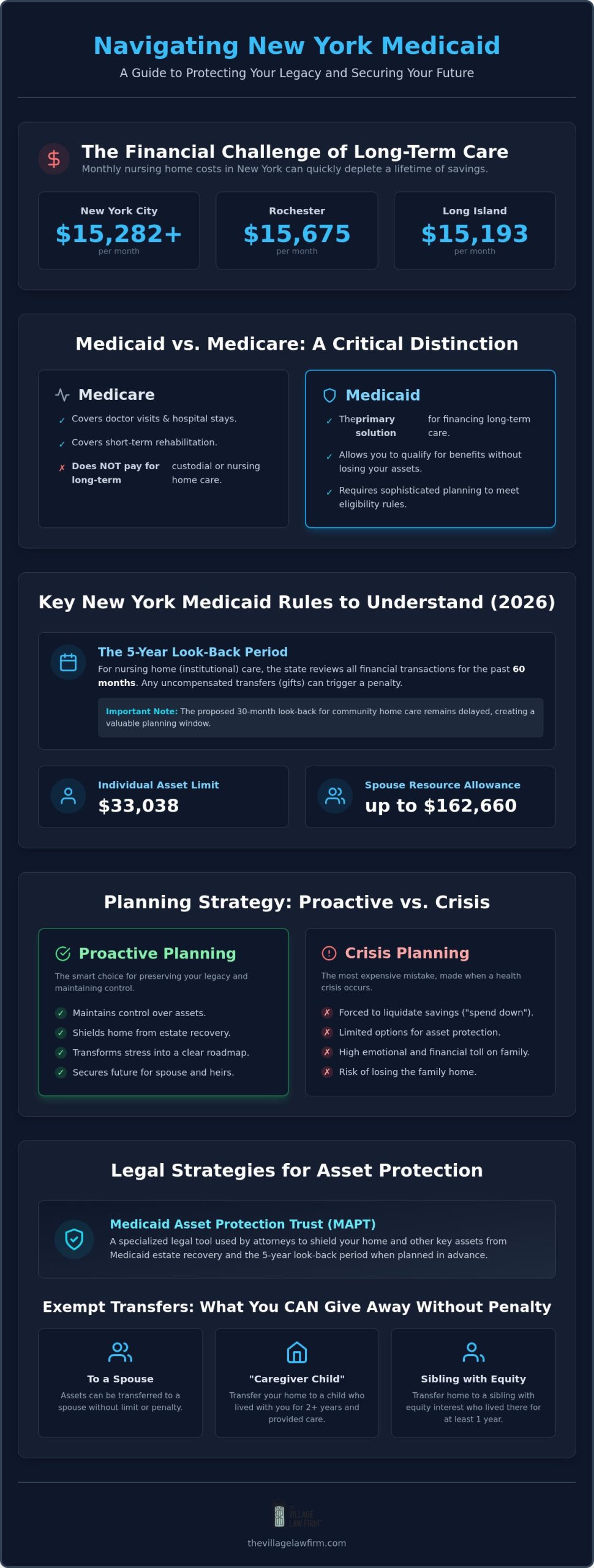
Waiting until a health crisis occurs is the most expensive mistake a senior can make. In 2026, the cost of nursing home care in the New York City region has reached a staggering $15,282 per month. Other regions aren’t far behind, with Rochester at $15,675 and Long Island at $15,193. Without a plan, you are forced into a private pay scenario. This often results in a lifetime of savings being exhausted in just a few years. The emotional toll on a spouse or children who must watch a family’s financial foundation crumble is immense. Proactive planning ensures that care is funded without liquidating the family home. A comprehensive overview of Medicaid planning for seniors in New York can help you understand the full scope of strategies available before a crisis strikes.
Medicaid vs. Medicare: Clearing the Confusion
Many people assume their health insurance will cover them as they age, but this is a dangerous assumption. The Medicaid program is fundamentally different from Medicare. While Medicare covers doctor visits and short-term rehabilitation, it does not pay for long-term custodial care or permanent nursing home stays. Relying on Medicare for long-term needs is a costly error that leaves families vulnerable. Medicaid remains the primary solution for financing long-term care while keeping your assets intact. Partnering with a Medicaid planning attorney New York allows you to qualify for these benefits without spending down to the point of financial ruin.
Understanding the New York Medicaid 5-Year Look-Back Rule
The look-back rule is often the source of the most significant anxiety for New York families. It is a simple concept with complex consequences. When you apply for institutional Medicaid, the state reviews every financial transaction you’ve made over the past 60 months. Any uncompensated transfer of assets, essentially a gift, triggers a penalty period during which you must pay for care out of pocket. As of mid-2026, it is vital to recognize that while the 5-year look-back is strictly enforced for nursing homes, the proposed 30-month look-back for community home care remains delayed. This creates a narrow but valuable window for those needing help at home to secure their assets without immediate penalty.
New York calculates your penalty by dividing the total amount transferred by a regional divisor. These rates reflect the average cost of care in your specific area. For 2026, the NYC divisor is $15,282, while Long Island sits at $15,193 and the Northern Metropolitan region is $15,024. If you gifted $150,000 in Brooklyn, you would face nearly ten months of ineligibility. This is why meticulous record-keeping is non-negotiable. Every check and transfer must be documented to ensure New York’s Medicaid program doesn’t misinterpret a legitimate expense as a gift. Precision in your financial history is the only way to maintain order during the application process.
Exempt Transfers: What You CAN Give Away
Not every transfer triggers a penalty. You can move assets to a spouse without limit, utilizing the Community Spouse Resource Allowance, which is up to $162,660 in 2026. The “Caregiver Child” exemption is another powerful tool. It allows you to transfer your home to a child who lived with you for at least two years and provided care that kept you out of a facility. Siblings with an equity interest who have lived in the home for a year also qualify for certain exemptions. These rules are highly specific. They require the steady hand of a Medicaid planning attorney New York to execute correctly and avoid unintended consequences.
The Danger of Unplanned Gifting
A common trap is the annual IRS gift tax exclusion. You might think gifting $18,000 to a grandchild is safe because it’s tax-free. For Medicaid, it’s not. Any gift, no matter how small, is presumed to be made for the purpose of qualifying for benefits. You must rebut this presumption with clear evidence, which is often difficult without professional guidance. If you’ve made mistakes in the past, don’t panic. Legal counsel can often correct these through “cure” strategies or partial returns, restoring your path to eligibility and replacing fear with a concrete plan.
Proactive vs. Crisis Planning: Choosing the Right Strategy
The difference between proactive and crisis planning is the difference between writing your own story and having it written for you. Proactive planning occurs when you are healthy and have the luxury of time. It allows for the highest level of asset control and the broadest range of legal options. Conversely, crisis planning happens at the hospital door. It often begins when a loved one is being discharged to a nursing home and the family realizes the monthly cost will exceed $15,000. While the pressure is higher in a crisis, a sophisticated Medicaid planning attorney New York can still find paths to security even in the eleventh hour.
Your attorney serves as a steady partner in both scenarios. In calm times, we act as architects building a fortress. In a crisis, we are the guides leading you through a storm toward a sanctuary of order. The goal remains the same: ensuring you receive the care you need without surrendering everything you’ve spent a lifetime building. No matter where you are in the journey, there is always a methodical way forward.
Proactive Planning: The Medicaid Asset Protection Trust (MAPT)
The gold standard for long-term security is the Medicaid Asset Protection Trust. By transferring your home or other assets into this trust, you effectively start the five-year look-back clock. The beauty of the MAPT lies in its balance. You can continue to live in your home and maintain a sense of normalcy while the legal shield hardens around your property. Unlike outright gifting, which can trigger immediate tax liabilities and loss of control, a trust preserves the “step-up in basis” for your heirs. This means your children won’t be burdened by heavy capital gains taxes when they eventually inherit the property. Working with a qualified irrevocable trust attorney NYC ensures that every detail of your trust aligns with both New York law and your specific family dynamics, creating a permanent and sophisticated shield around your most valuable assets. The Village Law Firm’s meticulous approach to trust drafting ensures that every detail aligns with both New York law and your specific family dynamics.
Crisis Planning: Protecting Assets at the Hospital Door
Many families believe that if they haven’t planned five years in advance, all is lost. This is simply not true. Even if a nursing home stay is imminent, we can often employ the “Rule of Halves” to protect a significant portion of the estate. This involves a “Gift and Note” strategy. We gift roughly half the assets and use the other half to purchase a private annuity or promissory note to pay for care during the resulting penalty period. In New York, we also have the powerful tool of Spousal Refusal. This allows a healthy spouse to legally refuse to contribute their assets toward the ill spouse’s care, forcing Medicaid to step in. These maneuvers are complex and require the precision of a Medicaid planning attorney New York, but they prove that it’s almost never too late to save your family’s financial foundation.
Key Legal Tools for Medicaid Asset Protection in New York
While general legal advice focuses on what you cannot do, a sophisticated Medicaid planning attorney New York focuses on the specific tools that make protection possible. These legal instruments are not just documents; they are the structural supports of your future financial security. In New York, we utilize a specific set of instruments to ensure your assets remain within the family while you access the benefits you have earned. By moving from the complexity of state regulations to a methodical legal plan, you create a sanctuary of order for yourself and your heirs.
Your plan must be as dynamic as your life. We often combine several tools to address both your current income needs and your long-term legacy goals. These include:
- Promissory Notes: These are used to bridge the gap during penalty periods by turning excess assets into a structured stream of income to pay for care.
- Caregiver Agreements: These formalize the care provided by family members. This allows you to transfer funds to children as legitimate compensation for their time rather than as penalized gifts.
- Power of Attorney: A standard document is rarely sufficient. You need a Power of Attorney with robust “Gifting Authority” that allows your agent to execute Medicaid planning strategies even if you become incapacitated.
The MAPT: Shielding the New York Home
The Medicaid Asset Protection Trust (MAPT) is an irrevocable trust designed to exclude your assets from being counted for Medicaid eligibility once the 60-month look-back period has passed. Within this structure, you retain a “Life Estate.” This means you have the absolute legal right to live in your home for the rest of your life and maintain your property tax exemptions. Because the home is held by the trust, it avoids the probate process entirely. Since New York’s recovery program currently targets only probate estates, a meticulously drafted MAPT effectively shields your home from state recovery after you pass away. Understanding how to protect your home from Medicaid recovery in NY is essential, as New York pursues approximately 30,000 estates for reimbursement every year, making this trust a critical component of any comprehensive plan.
Sophisticated Income Planning: Pooled Income Trusts
New York offers a unique advantage for those seeking home care through Community Medicaid. In 2026, the individual income limit is $1,836 per month. If your monthly income from Social Security or pensions exceeds this amount, you do not have to lose that surplus to a “spend-down.” By depositing your “excess” income into a Pooled Income Trust, you can qualify for Medicaid while still using that money to pay for your own personal expenses. This trust can cover your utilities, groceries, or even clothing. It is a vital tool for maintaining your independence and staying in the comfort of your own home. To see how these tools can protect your specific assets, consult with a specialist at The Village Law Firm.
The Village Law Firm Approach: White-Glove Medicaid Planning
In a city that never stops, the weight of legal complexity can feel like a constant storm. We believe your experience with a Medicaid planning attorney New York should be the exact opposite. It should be a sanctuary of order. Our firm doesn’t view asset protection as a series of isolated transactions. Instead, we approach it as a comprehensive partnership. We look at the entirety of your life, from your local real estate to your cross-border investments. This white-glove service means every detail is handled with the meticulous care you expect from a premium partner who values your time and your peace of mind.
Many of our clients have lives that span borders. We specialize in international estate planning, ensuring that assets held outside the United States are disclosed and protected with the same precision as your New York home. For those with specific connections to Israel, the Salior Ben Hamou Law Office offers the specialized legal representation needed to navigate life and assets in that region. We also place a deep emphasis on planning for families with children. Whether you’re protecting an inheritance for adult children or ensuring a minor’s future is secure, our strategies are designed to endure for generations. We replace the uncertainty of the future with a steady, high-end legal framework that reflects your values and your hard work.
Meticulous Attention to Detail in a Fast-Paced City
The Medicaid application process is notorious for what we call “paperwork chaos.” A single missing bank statement from four years ago can derail an entire strategy. We take that burden off your shoulders. Our team manages the exhaustive documentation requirements with unwavering integrity and transparency. For clients with global interests, precision in cross-border asset disclosure is paramount. We navigate these international nuances to prevent delays or penalties. You aren’t just another file in our office. You’re a partner who deserves clear communication and the total removal of unnecessary complexity.
Securing Your Legacy: Next Steps with The Village Law Firm
Starting this journey shouldn’t feel like another source of stress. Your initial consultation is designed to be a calming, informative experience where we listen first and plan second. We don’t work in a vacuum. We actively coordinate with your financial advisors and family members to ensure your legal strategy aligns with your broader financial goals. This collaborative approach creates a unified front against future uncertainty. It’s time to move from the anxiety of the unknown to the clarity of a defined plan. Contact us today to begin building your sanctuary of order and ensure your legacy remains exactly where it belongs: with your family.
Securing Your Peace of Mind for the Years Ahead
Your legacy is far more than a collection of assets; it’s the story of your hard work and the foundation for your family’s future. We’ve explored how proactive measures, like the Medicaid Asset Protection Trust, can start the five-year clock and protect your home from estate recovery. We’ve also seen that even in a crisis, sophisticated tools can provide a sanctuary of order when you need it most. By organizing your affairs today, you ensure that your quality of care is never compromised by financial uncertainty.
Navigating these regulations requires a partner who understands both the technical precision of New York law and the emotional weight of these decisions. As a dedicated Medicaid planning attorney New York, we provide a premium white-glove service tailored to busy professionals. Whether you are managing complex cross-border estate administration or creating dedicated strategies for families with minor children, our goal is to replace anxiety with a clear, methodical roadmap. Our detailed 2026 resource on Medicaid planning for seniors in New York provides an in-depth look at the eligibility requirements, income limits, and asset protection strategies available to you this year.
You don’t have to face the future alone. Schedule a calming, comprehensive consultation with our New York Medicaid planning team. Taking this first step ensures that your care and your legacy are handled with the unwavering integrity they deserve. You’ve built a remarkable life; let’s work together to protect it.
Frequently Asked Questions
Is it too late to start Medicaid planning if my spouse is already in a nursing home?
It is almost never too late to protect your family’s financial foundation. Even if a spouse is already receiving care, a Medicaid planning attorney New York can employ crisis planning techniques like the Rule of Halves or Spousal Refusal. These methods allow you to safeguard a substantial portion of your estate while securing immediate eligibility. Don’t assume all is lost just because you didn’t plan years in advance; there are always options to restore order.
Can Medicaid take my home in New York if I have a spouse living there?
Your home is generally safe from being counted as an asset as long as your spouse resides there. New York law considers the primary residence an exempt asset in this specific scenario. However, the risk arises later through the Medicaid Estate Recovery Program. If the home is not shielded within a trust, the state may seek reimbursement from your estate after both you and your spouse have passed away. Protecting the property now ensures it stays in the family.
What is the “Rule of Halves” in New York Medicaid planning?
The Rule of Halves is a strategic crisis maneuver used when someone needs immediate nursing home care. We gift approximately half of the applicant’s excess assets to their heirs and use the remaining half to purchase a private annuity or promissory note. This note generates the income needed to pay for care during the penalty period created by the gift. It is a precise calculation that effectively saves roughly 50% of an estate that would otherwise be lost to private pay costs.
How much can I keep in assets and still qualify for Medicaid in NY in 2026?
In 2026, the asset and income limits in New York have increased to reflect rising costs. An individual applicant can keep up to $33,038 in non-exempt assets and a monthly income of $1,836. If you’re married and only one spouse is applying, the community spouse staying at home can keep up to $162,660 in resources. These figures are indexed annually. Meticulous planning ensures you meet these requirements without losing the lifestyle you’ve worked hard to build.
What is the difference between Community Medicaid and Chronic Care Medicaid?
The primary difference lies in the setting of care and the look-back rules. Community Medicaid provides for home care services and, as of mid-2026, still does not have an enforced look-back period in New York. Chronic Care Medicaid covers nursing home stays and is subject to a strict 60-month financial review. Choosing the right path depends on your health needs and how much time we have to protect your assets before institutional care becomes a necessity.
Does a revocable living trust protect my assets from Medicaid?
A revocable living trust offers no protection against long-term care costs. Because you retain total control and can revoke the trust at any time, Medicaid views those assets as fully available to pay for your care. To shield your legacy, you must use an irrevocable Medicaid Asset Protection Trust. This specific legal tool removes the assets from your name for eligibility purposes while still allowing you to benefit from the property, such as the right to live in your home.
What happens to my Social Security income if I go on Medicaid in New York?
If you enter a nursing home, your Social Security income is generally applied toward the cost of your care. You’re permitted to keep a small Personal Needs Allowance of only $50 per month. However, if you’re receiving Community Medicaid for home care, the rules are more flexible. You can utilize a Pooled Income Trust to protect your excess income, allowing you to use your Social Security checks to pay for your own rent, food, and utilities instead of care providers.
How does international property affect my New York Medicaid eligibility?
Medicaid is a needs-based program that considers your global financial picture. International property is not invisible to the state and must be disclosed during the application process. If not properly structured, foreign real estate can disqualify you from receiving benefits. A Medicaid planning attorney New York with expertise in cross-border assets can help you integrate these properties into your overall protection strategy, ensuring your global legacy remains intact while you receive the local care you deserve.