
What if the person named to settle an estate also has a separate duty to manage a trust? In New York, those roles don’t create one all-purpose authority. The difference in executor duties vs trustee duties NY often comes down to which assets you’re responsible for: an executor handles the probate estate through the Surrogate’s Court process, while a trustee administers trust property according to the trust’s terms.
If you’ve been named to either role, you may be wondering when your authority begins, what decisions you can make, and how to avoid mistakes that could expose you to personal liability. The roles have different responsibilities and procedures, but both require careful, loyal management for the benefit of others.
This guide explains when an executor’s or trustee’s authority takes effect, which assets and decisions fall within each role, and where their fiduciary duties overlap. You’ll also learn what records to keep, how beneficiary communication fits into the work, and practical steps to take before acting. When the governing documents or estate process feel unfamiliar, legal guidance can help clarify your responsibilities and organize the next steps.
Key Takeaways
- Use the will and trust documents to identify whether you’re acting as executor, trustee, or both, and which assets each role covers.
- As executor, follow the New York Surrogate’s Court process and confirm your appointment before taking actions that require authority.
- A trustee’s responsibilities are guided by the trust terms and may continue after the executor has distributed probate assets.
- The key distinction in executor duties vs trustee duties NY is each role’s separate authority and purpose, even when one person holds both positions.
- Keep clear records, preserve estate and trust assets, and pause before making distributions or decisions beyond your current authority.
Executor Duties vs. Trustee Duties in New York: The Core Difference
Being named to manage another person’s affairs can feel weighty, especially when it’s unclear which assets you may handle or when your authority begins. The central distinction in executor duties vs trustee duties NY is the property involved: an executor administers a deceased person’s probate estate, while a trustee manages property held in a trust.
A will nominates an executor to carry out its instructions through the estate administration process. A trustee manages assets transferred to a trust for the beneficiaries identified in the trust document. For a general overview of the executor’s role, see Executor (Wikipedia). The same person may hold both roles, but the powers and records for each remain separate.
An executor settles the probate estate under court authority; a trustee manages trust property under the trust’s terms and applicable law.
| Point of comparison | Executor | Trustee |
|---|---|---|
| Source of authority | Will and Surrogate’s Court appointment | Trust instrument and applicable law |
| Property handled | Probate assets subject to estate administration | Assets held in the trust |
| Primary purpose | Administer the estate and distribute property as required | Manage and distribute trust property for beneficiaries |
| Typical duration | Usually ends when estate administration is completed | May continue as long as the trust remains active |
Where does an executor’s or trustee’s authority come from?
A will nominates an executor, but nomination alone generally doesn’t give that person authority to act for the estate. The nominated executor typically petitions the New York Surrogate’s Court, and authority follows the court’s appointment. The trust instrument, by contrast, sets out the trustee’s role and powers, subject to applicable law. Whether a person accepts a role and when authority takes effect depend on the documents and circumstances.
What does New York’s fiduciary framework mean?
A fiduciary is someone entrusted to act for others within defined legal duties. Both roles carry that responsibility, but they follow different processes. Estate administration proceeds through the Surrogate’s Court, while trust administration is governed by the trust terms and applicable law. For example, a will may direct that estate assets be transferred into a testamentary trust. The executor handles the estate process; the trustee then manages the assets transferred into the trust, potentially after estate administration ends. That handoff doesn’t make their authority interchangeable. Start by identifying the governing document and confirming the appointment that applies to each role.
What an Executor Must Do During New York Estate Administration
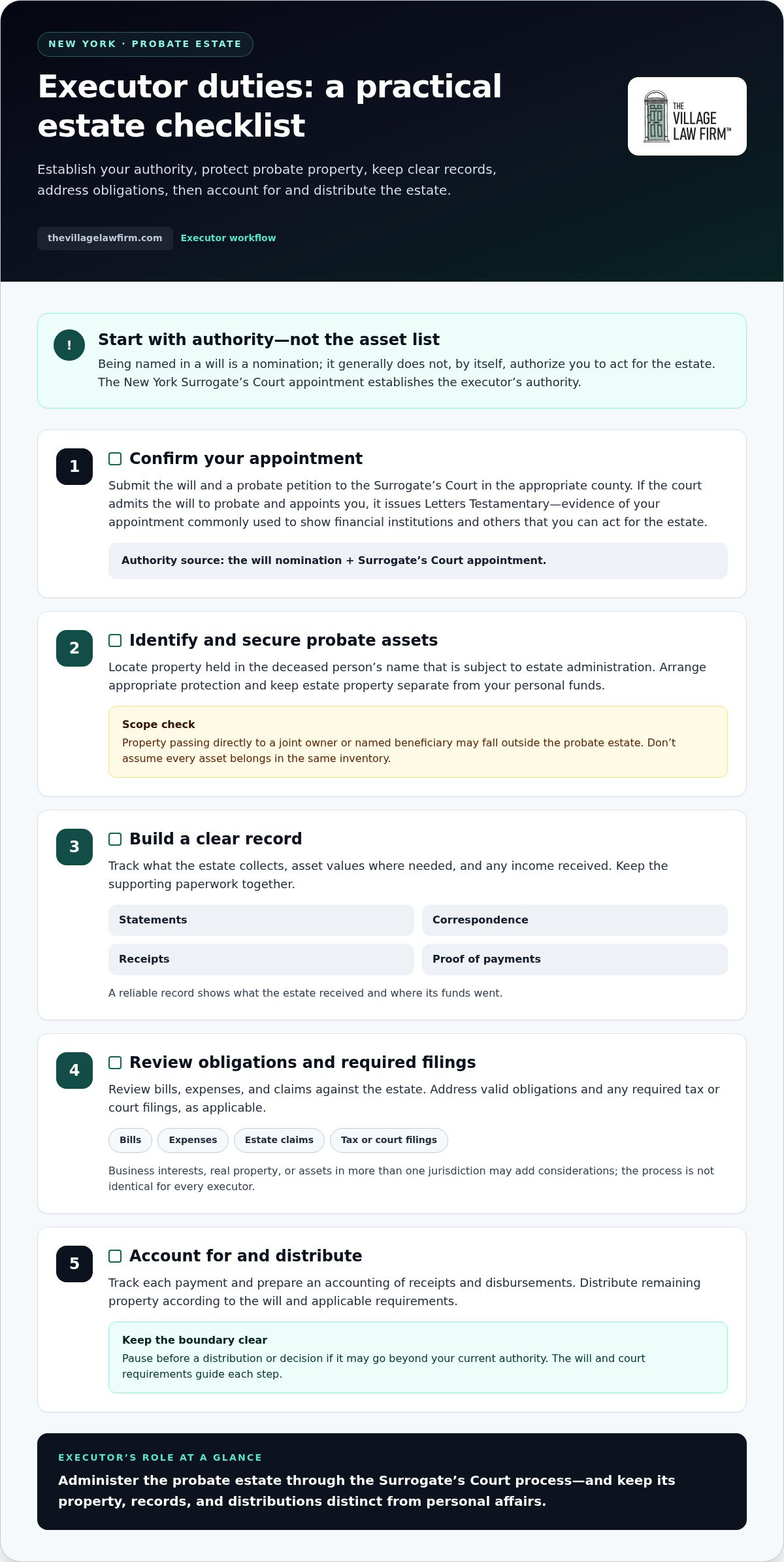
An executor’s work follows a sequence, but the details depend on the will, the assets involved, and the estate’s obligations. The central task is to administer the probate estate and carry out the will’s directions, subject to New York law and court requirements. That means establishing authority before acting, protecting estate property, addressing obligations, and documenting how assets are ultimately distributed.
How does probate establish an executor’s authority in New York?
The nominated executor generally submits the will and a probate petition to the Surrogate’s Court in the appropriate county. The court reviews the filing and, if it admits the will to probate and appoints the nominated person, issues Letters Testamentary. These court-issued letters are evidence of the executor’s appointment and are commonly used to show financial institutions and others that the executor can act for the estate. The will is a key planning document. A New York estate planning guide offers further context on how planning documents shape estate administration.
Which tasks typically fall to the executor?
Once appointed, an executor can work through the estate in a deliberate order. The will and court requirements should guide each step, since filings and timing vary by matter.
- Identify and secure probate assets. Locate property held in the deceased person’s name that is subject to the estate process. Arrange appropriate protection and keep estate property separate from personal funds. Assets that pass directly to a joint owner or named beneficiary may fall outside the probate estate, so don’t assume every asset belongs in the same inventory.
- Establish a clear record. Document the assets collected, their values where needed, and any income received. Keep statements, correspondence, receipts, and proof of payments together. A reliable record shows what the estate received and where its funds went.
- Identify obligations and required filings. Review bills, expenses, and claims against the estate. Address valid obligations and any required tax or court filings as applicable. An estate with business interests, real property, or assets in more than one jurisdiction may involve additional considerations, so the process won’t be identical for every executor.
- Account and distribute. Track each payment and prepare an accounting of receipts and disbursements. Distribute remaining property in accordance with the will and applicable requirements. Avoid early payments that could leave insufficient assets for obligations.
These steps show why executor duties and trustee duties are distinct: the executor’s work centers on the probate estate and the will, not every asset associated with the deceased person. If the documents, court process, or estate obligations are difficult to interpret, New York estate administration guidance can help clarify your responsibilities before you make important decisions.
What a Trustee Must Do Under a New York Trust
A trustee’s responsibilities begin with the trust document, which sets the framework for managing and distributing property alongside applicable law. The document may identify who can benefit, when distributions should occur, and whether the trustee has discretion over certain decisions. The role is not simply to hold assets. It requires administering them for the trust’s beneficiaries within the authority the trust provides.
A trustee administers trust property for beneficiaries under the trust’s terms, while an executor settles the probate estate under the will. That distinction matters even when the same person holds both roles: completing estate distributions doesn’t necessarily end the trustee’s work.
How does a trustee manage and distribute trust property?
The trustee first identifies the property held in the trust and reviews the governing instrument to understand its purpose, beneficiaries, and distribution provisions. The trustee then manages trust property prudently in light of the trust’s terms and applicable law. There’s no universal investment formula. Appropriate administration depends on the trust, its assets, and its circumstances.
Distribution language matters. A trust may direct a payment when a stated condition is met, or it may give the trustee discretion to decide whether and when a distribution is appropriate. Discretion doesn’t mean personal preference: decisions should stay within the authority granted by the document and account for the beneficiaries’ interests. If a trust directs income to a beneficiary but leaves principal distributions to the trustee’s discretion, those provisions call for different kinds of judgment.
What ongoing responsibilities may a trustee have?
Trust administration can continue long after an executor has completed the estate process, particularly if the trust holds assets for ongoing management or future distributions. The trust’s duration and provisions shape how long the trustee serves. For related planning context, the firm’s New York irrevocable trust guide discusses a trust structure that may involve continuing administration.
Careful records make ongoing administration easier to explain. A trustee should track assets, income, expenses, decisions, and distributions, and provide information or an accounting when required by the trust terms or applicable law. The precise obligations depend on the trust and circumstances, so don’t assume every beneficiary is entitled to identical reports on the same schedule.
- Keep trust activity distinct. Record receipts and payments clearly so trust transactions can be explained and reviewed.
- Consider beneficiaries fairly. Follow the trust’s provisions and take relevant interests into account, especially where beneficiaries may have different rights or needs.
- Address conflicts with care. If a decision could benefit the trustee personally or favor one beneficiary over another, review the governing terms and applicable duties before acting.
For executor duties vs trustee duties NY, the trustee’s work is defined by trust administration rather than settling a probate estate. If the trust language is unclear or a decision involves competing beneficiary interests, legal guidance can help clarify your authority before you act.
Executor vs. Trustee in New York: Compare Authority, Duties, and Risk
The practical distinction in executor duties vs trustee duties NY is not just what each person does. It’s which legal capacity authorizes the action. A court appointment for an estate doesn’t, by itself, authorize someone to manage a separate trust, and being named trustee doesn’t make that person the estate’s executor.
| Issue | Executor | Trustee |
|---|---|---|
| Authority | Acts under the will and the authority granted through Surrogate’s Court. | Acts under the trust instrument and applicable law. |
| Assets handled | Probate property administered through the estate. | Property held by the trust. |
| Primary purpose | Administers the estate and carries out the will’s directions. | Manages trust property and follows its terms for beneficiaries. |
| Reporting | Keeps estate records and provides accountings or court filings as required in the matter. | Keeps trust records and provides information or accountings as required by the trust and applicable law. |
| Likely endpoint | Typically ends when estate administration is complete. | May continue while the trust remains active. |
Can one person serve as both executor and trustee?
Yes. A will may nominate someone as executor and name that same person, or another person, as trustee of a testamentary trust created under the will. But each role has a separate source of authority, set of assets, and recordkeeping trail. The will, trust terms, court requirements, and any potential conflict can affect how the person should proceed in each capacity.
Consider a will that directs part of the probate estate to a trust for a child. The handoff has two distinct stages:
- Executor capacity: The executor administers the probate estate and transfers the designated assets to the trust as directed, subject to applicable requirements.
- Trustee capacity: The trustee receives and manages those trust assets under the trust’s terms, including any conditions for distributions.
Even if one individual performs both steps, they should document the transfer and identify which role is responsible for each transaction. Authority over one pool of assets doesn’t automatically extend to the other.
What shared fiduciary responsibilities should both roles take seriously?
Both roles require careful stewardship, decisions within granted authority, and attention to the interests of others. Neither role permits the use of estate or trust property for improper personal benefit. Accurate records help show what was received, how decisions were made, and where funds went. They also support accountability to beneficiaries and, where relevant, the court. Errors or conflicts can have consequences, but not every concern leads to litigation. Clear documentation and legal guidance can help address uncertainty responsibly.
If you’re handling both roles or aren’t sure which authority applies to a decision, get guidance on estate and trust responsibilities before taking action.
Named as an Executor or Trustee? Practical Next Steps in New York
Being named as an executor or trustee can bring immediate questions, but you don’t need to solve everything at once. Start by confirming which role you’ve been asked to take on, what documents govern it, and whether your authority has begun. The distinction in executor duties vs trustee duties NY matters from the outset: acting in the wrong capacity can create confusion about which assets you may handle and how decisions should be recorded.
What should you do before taking action?
Gather the documents and information that define your role before making distributions or major decisions. A clear file helps you understand what needs attention and creates a reliable record of your actions.
- Identify the role and authority. Review the will, trust instrument, and any court papers. If you’re nominated as executor, distinguish that nomination from court appointment. If you’re named trustee, read the trust provisions that describe your powers and responsibilities.
- Collect relevant records. Locate asset statements, property information, insurance details, account records, and correspondence about the estate or trust. Keep estate and trust materials organized separately, especially if you’re serving in both roles.
- Make a short action list. Note known deadlines, urgent property-preservation concerns, pending bills, and questions about your authority. Prioritize protecting assets from loss or damage while clarifying which steps are permitted.
- Pause before moving money. Don’t commingle funds, make distributions, or take significant action until you understand the governing documents and applicable process. Record receipts, payments, and communications as they occur.
This is a practical starting point, not a substitute for reviewing the documents and circumstances that apply to your situation. A will may direct that estate property move into a trust, for example, creating a handoff that requires careful records and clear authority in each role.
When can New York estate administration counsel help?
Legal guidance can help you interpret a will or trust, distinguish executor authority from trustee authority, and identify questions to resolve before acting. It can be especially useful when the estate includes complex assets, beneficiaries have competing interests, or property is located across borders. A trust receiving estate property may also require coordination between the estate process and the trust’s terms. The appropriate next steps depend on the documents and facts involved.
The Village Law Firm provides New York estate administration counsel to help clarify fiduciary roles and navigate complex estate matters. Speak with The Village Law Firm about your New York estate administration questions.
Take the Next Step With Confidence
Before making a consequential decision, give yourself time to match the action to your authority. Gather the governing documents, note what remains unclear, and identify decisions that could affect a beneficiary or another set of assets. This pause can help turn a demanding responsibility into a more considered process.
Understanding executor duties vs trustee duties NY is a useful starting point, but the right next step depends on the specific documents and circumstances. The Village Law Firm provides estate planning and administration counsel, including guidance with complex cross-border estate administration, to help clarify responsibilities and address questions as they arise.
To discuss your situation, contact The Village Law Firm about your New York estate administration questions. With clear guidance, you can move forward thoughtfully and carry out your role with greater confidence.
Frequently Asked Questions
Can an executor and trustee be the same person?
Yes. A will and trust may name the same individual, but the documents give that person separate responsibilities in each capacity. For example, someone managing a bank account as executor should identify the estate transaction as such, then separately record any later transfer into a trust. The distinction in executor duties vs trustee duties NY depends on the governing documents and New York law, not simply on the individual’s identity.
How long does an executor’s role last compared with a trustee’s?
There’s no fixed end date that applies to every executor or trustee. An executor’s role generally concerns settling the estate, but court proceedings, asset issues, and required filings can affect the timeline. A trustee’s duties may continue under the trust’s terms after estate administration ends. To understand your responsibilities, review the documents for conditions that may end or extend each role.
Does a New York executor need court appointment before acting?
Generally, being named in a will isn’t the same as having authority to act as executor. The Surrogate’s Court process and documents issued in the particular estate determine that authority. Before transferring or distributing estate property, confirm what the court has authorized. If an asset needs prompt protection, distinguish safeguarding it from taking actions that may require formal appointment, and get guidance on the appropriate step.
What happens if a named executor cannot or does not serve?
The will may name a successor executor, but the next steps depend on its terms and the estate’s status. A relative doesn’t automatically gain authority just because the first nominee declines or can’t serve. Locate the will and any existing court papers, then clarify who may seek appointment under the applicable New York process. Avoid signing documents or moving estate assets as though you already hold the role.
Can beneficiaries remove an executor or trustee in New York?
Beneficiaries may be able to raise concerns, but removal isn’t automatic. A disagreement about timing or a distribution alone doesn’t establish that removal is appropriate; the role, governing documents, facts, and applicable law matter. If there’s concern about missing records, a conflict, or inability to serve, preserve relevant communications and account information. The Village Law Firm can assess the issue and explain possible steps without assuming litigation is necessary.
Does an executor automatically become trustee of a testamentary trust?
No. An executor doesn’t become trustee solely by serving as executor. A will may create a testamentary trust and name a trustee, and the executor may later transfer designated estate property into it. Check the will for the trustee’s identity and the trust’s terms, then review court papers for the executor’s authority over the transfer. This helps prevent confusion about who should manage the assets after they enter the trust.