
What if an equal split doesn’t feel fair? When siblings inherit, a will may set clear shares, but questions about a home’s value, personal belongings, or years of caregiving can make the practical division more complicated. Fairly dividing assets between siblings NY families inherit starts with understanding what the estate documents and New York law require.
It’s understandable to want an outcome that recognizes each person’s circumstances while preserving family relationships. But legal entitlement and a family’s preferred way to share value aren’t always the same. If there’s no valid will, New York’s intestacy rules determine who inherits, and the result may differ from what siblings expected.
This guide explains how to identify the rules that apply, clarify ownership and value, and create a transparent process for discussing possible divisions. It also considers how caregiving and estate responsibilities may inform family conversations, and when an estate administration attorney can help clarify documents, responsibilities, and options. A careful process makes the choices clearer, even when agreement takes time.
Key Takeaways
- Fairness can mean different things to each sibling. Begin with a transparent process that respects legal rights and the deceased person’s instructions.
- Before discussing shares, clarify which estate documents govern distribution and who has authority to manage the assets.
- Use a shared inventory to compare ownership, estimated value, liquidity, and possible recipients. Treat sentimental meaning separately from market value.
- For fairly dividing assets between siblings NY families can follow a step-by-step approach: confirm authority, list assets and obligations, assess values, and prepare options using the same verified information.
- Consider estate administration counsel when instructions or valuations are disputed, fiduciary responsibilities are unclear, or siblings reach an impasse.
What Does Fairly Dividing Assets Between Siblings in NY Really Mean?
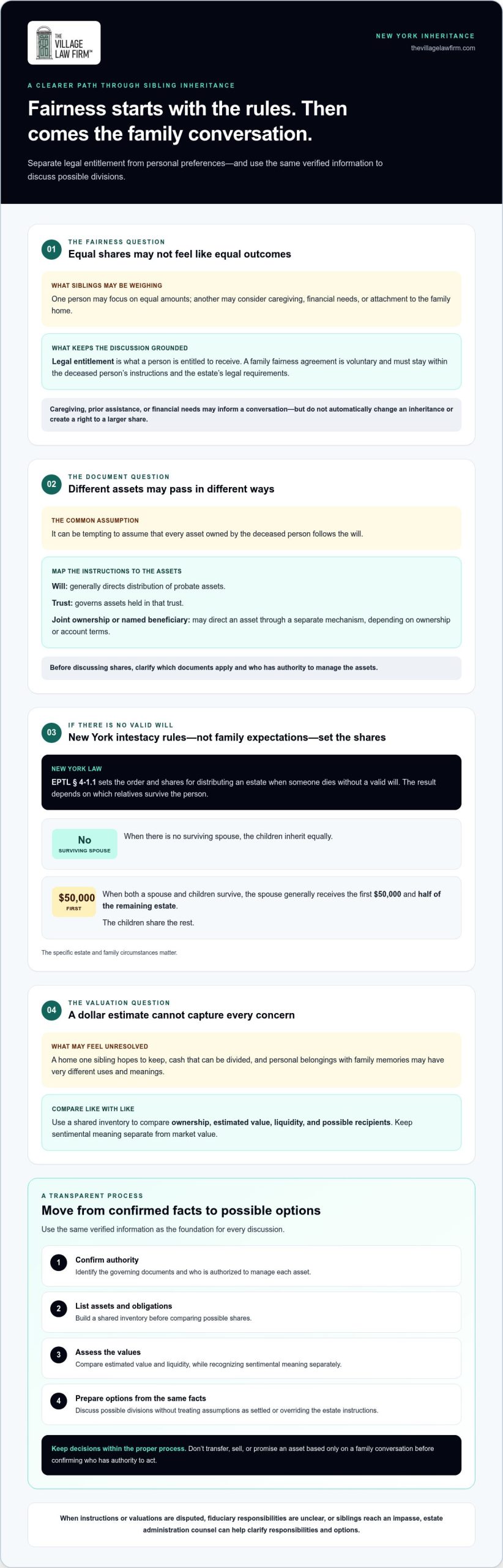
One sibling may define fairness as everyone receiving the same amount. Another may focus on who provided care, who needs financial support, or who feels deeply attached to the family home. Those perspectives can all be sincere, but they may point to different outcomes. Grief can make those differences harder to navigate.
For an inheritance, fair division begins with a transparent process that respects legal rights and the deceased person’s valid instructions. The idea of Fair Division Principles offers a useful general lens: dividing shared resources involves deciding what counts as a fair allocation. A family’s sense of fairness, however, doesn’t replace the legal rules governing an estate.
Legal entitlement determines what a person is entitled to receive; a family fairness agreement is a voluntary way to share value within the limits of those rights and the estate documents. Siblings can discuss options, but they shouldn’t assume that a preferred arrangement allows them to disregard a will or other controlling instructions. If the documents are unclear, understanding them comes before negotiating an alternative.
Equal shares and fair outcomes are not always identical
Equal monetary shares can still feel unequal when assets differ in use or meaning. For example, an estate might include a home one sibling hopes to keep, cash that can be divided, and personal belongings with strong family memories but uncertain market value. Assigning each person assets with the same estimated dollar value may not resolve concerns about access, attachment, or practicality. Discuss those concerns calmly instead of treating them as an automatic reason to allocate an asset a particular way.
Equal division is one possible measure of fairness, not a complete definition. Siblings may consider different ways to address an asset’s value or practical use, but any arrangement must remain consistent with the deceased person’s instructions and the estate’s legal requirements. Don’t transfer, sell, or promise an asset based only on a family conversation before confirming who has authority to act.
Start with the deceased person’s wishes and the family’s circumstances
Separate what the deceased person put in writing from what relatives remember, expect, or would prefer now. A will or other relevant estate document may provide instructions; a family assumption, even if sincerely held, isn’t the same thing. If a document’s meaning or effect is uncertain, don’t treat one sibling’s interpretation as settled fact.
Caregiving, prior assistance, and financial needs may inform a voluntary conversation about what feels fair. They don’t automatically change an inheritance or create a right to a larger share. That’s why fairly dividing assets between siblings NY families inherit should begin with the documents and legal framework, then make room for personal circumstances.
Choose a steady moment to talk. Give each person time to explain what they value and what worries them, and ask questions before assigning blame. Avoid rushed decisions, especially when emotions are raw or ownership and instructions are still unclear. A respectful conversation won’t guarantee agreement, but it can help distinguish confirmed facts from assumptions and identify thoughtful next steps.
How New York Law and Estate Documents Shape a Sibling Inheritance
Before comparing possible shares, establish which rules apply to each asset. A valid will generally directs how probate assets are distributed, but administration, applicable law, and certain rights, including a surviving spouse’s rights, can affect the result. Not everything a person owned necessarily passes under the will: jointly owned property or accounts with named beneficiaries may transfer through a separate mechanism, depending on the ownership or account terms.
New York’s intestate succession provision, EPTL § 4-1.1, sets the order and shares for distributing an estate when someone dies without a valid will. The result depends on which relatives survive the person. For example, under New York’s intestacy rules, children inherit equally when there is no surviving spouse; when both a spouse and children survive, the spouse generally receives the first $50,000 and half the remaining estate, with the children sharing the rest. The specific estate and family circumstances matter.
What if there is a will, trust, or no valid will?
Start by locating the will and any trust documents, then identify which assets each document covers. A will generally addresses property that is part of the probate estate. A trust governs assets held in that trust, while beneficiary designations and joint ownership can direct other assets separately. Don’t assume every asset follows the will or that the existence of a document alone answers how a particular asset passes.
If there’s no valid will, intestacy supplies the rules rather than family preference. The statutory shares depend on surviving relatives, so a sibling’s expectation may differ from the legal result. Before discussing a different arrangement, confirm the applicable shares and whether the relevant beneficiaries have authority to agree to it.
Who has authority to handle estate property?
An executor is named in a will and, through the estate process, is authorized to administer the probate estate. If there is no will, an administrator may be appointed to handle estate administration. These roles involve managing estate property and carrying out the applicable legal process, not simply choosing a preferred division. A beneficiary’s status or preference by itself doesn’t authorize that person to distribute estate assets.
In New York, the Surrogate’s Court oversees matters such as probate and the appointment of an estate representative. Until the person with authority is established, siblings should be cautious about selling, transferring, or dividing property that may belong to the estate. Clear administration can protect everyone’s interests and reduce misunderstandings about who may take the next step.
For families working on fairly dividing assets between siblings NY law and estate documents should be the starting point, not an afterthought. Reviewing the will, trust, ownership records, and beneficiary designations can clarify which rules apply before siblings compare options. Estate administration guidance from The Village Law Firm can help clarify documents and responsibilities when the picture is complicated.
How to Compare Assets When Siblings Disagree About What Is Fair
Once the family knows which assets are part of the estate, put the same information in front of everyone. A shared inventory separates facts from assumptions and helps siblings compare unlike property without treating every item as interchangeable. For each asset, record its type, legal owner, estimated value, liquidity, and proposed recipient. Note unresolved questions too, such as whether an account has a beneficiary or whether a valuation is preliminary.
Keep market value and personal meaning in separate columns or notes. A family photograph may matter deeply to several siblings but have little or no reliable resale value. Acknowledge that emotional importance without disguising it as an objective dollar amount. Likewise, don’t treat a preliminary estimate as a final answer.
Value property without treating estimates as automatic answers
For a substantial or disputed asset, an independent appraisal or other appropriate valuation can give the conversation a firmer starting point. A home’s estimated market value isn’t necessarily its net distributable value: a mortgage, liens, sale costs, or other relevant obligations may affect what remains. Before settling on allocations, understand estate debts and administration expenses, as well as any ownership claims or restrictions that could change what is available to distribute.
Property outside New York deserves particular care. Real estate in another state may involve a separate or ancillary administration process, depending on the circumstances. That can affect timing and practical options, so don’t assume New York estate administration alone resolves every question about out-of-state property.
Compare practical options for dividing unlike assets
Consider options as proposals, not automatic solutions. The right approach depends on the governing documents, who has authority, the asset’s ownership, and whether the people involved can reach and properly document an agreement.
| Discussion option | Potential benefit | Trade-off to consider |
|---|---|---|
| One sibling keeps an asset and offsets its value | May let a sibling retain a home or meaningful item while others receive other estate assets. | Requires an agreed valuation and enough other assets or an acceptable way to account for the difference. |
| Sell the asset and divide proceeds | Can turn a hard-to-share asset into cash that is easier to allocate. | A sale may involve expense, delay, or the loss of a property someone hoped to keep. |
| Shared ownership | May preserve access to property for more than one sibling. | Requires agreement about costs, use, maintenance, and future decisions. |
Hypothetical example: An estate includes a home, cash, and personal belongings. One sibling wants the home, another prefers a sale, and both value particular keepsakes. The family could use a shared inventory and reliable valuation to compare a keep-and-offset proposal with a sale, while discussing personal items separately. This illustrates a conversation, not a legal formula or a recommendation for a particular outcome.
For families fairly dividing assets between siblings NY, the aim of this comparison is clarity: document what is known, flag what needs review, and record each option’s benefits and trade-offs before treating any proposal as final.
A Step-by-Step Process for Dividing an Inheritance Between Siblings
A clear sequence gives siblings reliable information to work from, especially when memories, expectations, and assumptions differ. Take the steps in order, and pause if authority or a key fact remains uncertain. Build a proposal on verified information, not pressure to settle quickly.
- Confirm who has authority. Identify the executor or administrator and clarify which assets they’re authorized to handle before anyone promises or transfers estate property.
- Build a complete inventory. List assets and note ownership, relevant documents, available valuations, and questions that still need answers.
- Identify obligations. Account for known debts, taxes, and administration expenses before estimating what may be available for distribution.
- Assess asset values. Separate documented figures from estimates. Arrange an appropriate valuation for significant or disputed property when needed.
- Prepare more than one option. Compare possible allocations, including any proposed asset offsets, and state the assumptions behind each choice.
- Share the same information. Give each sibling the same inventory and proposal so everyone can respond to a common set of facts.
Prepare a transparent inventory and proposal
For each asset, record what it is, who owns it, the supporting document, and how its value was established. Mark estimates clearly, and list unresolved questions separately rather than presenting them as settled facts. A proposal should identify requested assets, explain the reasoning, and describe any proposed adjustment if one sibling would receive more value in a particular form.
Invite each sibling to respond to the same proposal and explain their priorities respectfully. A written format gives everyone time to review the details and helps prevent different versions of the conversation from taking hold.
Keep the agreement and administration process clear
Before acting on a proposed division, put agreed terms in an appropriate written form. What that requires depends on the estate, the assets, and each participant’s legal role. A family understanding may not, by itself, authorize a transfer or satisfy requirements that apply to the estate. Clarify those requirements before implementing the plan, particularly if the proposal differs from the governing documents.
If direct conversations stall, mediation may provide a structured setting to hear concerns and explore options. It can support communication, but it doesn’t replace required estate administration steps or court procedures. Keep the decision-making process separate from the formal authority to distribute property.
The Village Law Firm helps clarify estate documents, administration responsibilities, and the steps involved in a distribution. For tailored support with New York estate administration, discuss your estate administration questions with the firm.
When New York Estate Counsel Can Help Siblings Move Toward Resolution
Not every disagreement calls for a courtroom. Sometimes siblings simply have different preferences about who should keep a family home or how to handle personal belongings. Legal guidance can clarify the estate documents, each person’s role, and the available steps before a difference of opinion becomes a larger conflict.
A legal question may arise if siblings disagree about what a will or trust means, who has authority to act, or whether an asset belongs to the estate. Concerns about unexplained transactions, possible undue influence, or the deceased person’s capacity when documents were signed deserve careful assessment. These issues call for facts and document review, not assumptions about what happened or what a court might decide.
Recognize when a family disagreement raises a legal question
Distinguish a personal preference from a question of legal authority. “I think I should receive the house” expresses a preference; “the will gives me the house” raises a question about what the document says and how it applies. Disputed valuations may also need professional review, especially if an estimate affects a proposed distribution. Keep a record of questions and relevant communications so they can be reviewed clearly.
If an asset or transaction is disputed, don’t withhold, transfer, sell, or distribute property without first understanding the duties that apply to the person managing it. The right course may depend on the estate documents, the asset’s ownership, the representative’s role, and any deadlines or court process involved. Getting clarity early can help siblings avoid steps that complicate administration.
Choose a constructive next step
Estate administration counsel can review the governing documents, explain the executor’s or administrator’s responsibilities, and outline the process relevant to the estate. That guidance can be useful even when no one is threatening litigation. It helps separate what the documents require from what family members are proposing voluntarily, giving everyone a clearer basis for discussion.
Before seeking help, gather the will or trust, relevant ownership or beneficiary records, the current asset inventory, valuation information, and a concise list of unresolved questions. Note what is confirmed and what remains uncertain. This preparation helps focus the conversation on decisions that need attention rather than every past family grievance.
If siblings can participate constructively but struggle to communicate, mediation may offer a structured setting to discuss concerns and consider options. It’s a communication tool, not a substitute for required legal or court procedures, and it can’t guarantee agreement. Whether it is suitable depends on the circumstances and the participants’ roles.
For fairly dividing assets between siblings NY families may need both a respectful conversation and a clear understanding of the law. The Village Law Firm helps clients review estate documents and understand administration responsibilities. Discuss New York estate planning and administration guidance with the firm.
Take the Next Step With Clarity
Fairness doesn’t always mean every sibling feels exactly the same about the outcome. It does mean the next steps are grounded in the estate’s instructions, clear information, and a process that gives concerns room to be heard. If questions remain about authority, a document, or how to proceed, guidance can help you make decisions with greater confidence and care.
For families fairly dividing assets between siblings NY, the way forward may begin with one practical step: clarify what the estate requires before making commitments to one another. The Village Law Firm provides New York estate planning and administration guidance, including support with complex and cross-border estate administration matters.
Discuss your New York estate administration questions with The Village Law Firm. A clear, thoughtful next step can help your family move forward with greater confidence.
Frequently Asked Questions
Are siblings legally entitled to equal shares of an inheritance in New York?
Not in every situation. A valid will or trust may direct a particular distribution, and property with a joint owner or named beneficiary may pass separately from the probate estate. If there’s no valid will, New York intestacy rules determine inheritance based on surviving family members. Before assuming siblings receive equal shares, identify which documents apply and how each asset is owned. A New York estate attorney can help assess the rules for the specific estate.
Can siblings agree to divide an inheritance unequally in New York?
They may discuss a voluntary arrangement, but agreement alone doesn’t necessarily authorize anyone to distribute estate property. The executor or administrator has responsibilities, and the appropriate documentation or approvals depend on the estate and the participants’ legal roles. Before relying on a compromise, clarify what the will or trust requires, who has authority to act, and whether a court process is involved. Put any agreed terms in an appropriate written form before taking action.
Can an executor decide which sibling gets each asset in New York?
An executor administers the estate under the will and applicable law, but that doesn’t give them permission to disregard instructions or choose recipients based only on personal preference. The executor’s authority depends on the documents, the assets, and the administration circumstances. If you’re concerned about a decision, keep copies of relevant notices, accountings, and communications, and seek advice about the proper New York process before taking steps that could affect estate property.
What happens if siblings cannot agree on inherited property in New York?
The next step depends on the property, estate documents, administration status, and nature of the disagreement. A family may consider options such as a sale or another proposed allocation, but shouldn’t act on disputed property without understanding authority and applicable duties. A search for “fairly dividing assets between siblings NY” often begins with a practical concern: who can make the next decision? A neutral facilitated conversation may help, while questions about rights or fiduciary conduct call for legal guidance.
How should siblings divide sentimental belongings fairly?
Start by giving each sibling a chance to identify items with personal meaning and note any family stories or preferences connected to them. Then choose a process together, such as taking turns selecting items or creating a rotation, if everyone finds that acceptable. For example, siblings might agree that each person selects one keepsake per round. Record the arrangement and check it against the estate instructions; these methods are discussion options, not legal requirements.
Can one sibling keep the family home and compensate the others?
It may be possible, but feasibility depends on ownership, the estate representative’s authority, valuation, financing, and relevant legal or tax considerations. A current valuation can help the family discuss whether an offset is workable, while a sale may also be considered. Don’t assume the executor has authority to approve every proposed arrangement. Before transferring the home or distributing other property to balance shares, review the documents and get advice about the estate’s requirements.
Do gifts made before death count as part of a sibling’s inheritance in New York?
Don’t assume a lifetime gift automatically reduces a beneficiary’s inheritance. Its significance may depend on the estate documents, the circumstances and records surrounding the transfer, and applicable law. If siblings recall a gift differently, look for dated letters, transfer records, or other documentation rather than relying only on memory. Avoid treating an unverified recollection as proof that a sibling’s share should change. A New York estate attorney can assess the gift in the context of the estate.
Does inherited property outside New York require a separate process?
It can. Real estate located in another state may require an additional administration process, depending on how the property is owned and how the estate is structured. This may affect the steps and timing involved in handling the property. Gather the deed, estate documents, and information about any co-owners or liens, then seek advice that considers the relevant jurisdictions. An ancillary probate guide can offer background when out-of-state real estate is part of the estate.