
What if the lowest will-drafting fee leaves out work that matters to your family? If you’re asking how much does a will cost in NY, the answer depends on more than the document itself. The legal guidance, your family circumstances, and the decisions your will needs to address can all affect the fee.
It’s reasonable to want a clear comparison before you commit. But an online document price, an attorney’s fee, court filing costs, and expenses that may arise during estate administration are different things. Treating them as one cost can make your options harder to evaluate.
This 2026 guide explains what can affect the cost of a New York will, what a drafting fee may cover, and how DIY, online, and attorney-prepared options differ in scope. You’ll also learn why circumstances such as minor children, blended families, business interests, or assets in more than one country may call for planning beyond a basic document. By the end, you’ll have a practical list of details to gather before seeking tailored legal guidance.
Key Takeaways
- There’s no single answer to how much does a will cost in NY. The fee depends on the work needed to prepare, tailor, review, and finalize your will.
- Family circumstances, assets, and coordination needs can shape the planning involved, especially when a basic beneficiary plan doesn’t address the full picture.
- Compare DIY, online, and attorney-prepared wills by customization, legal guidance, revision options, and support, not just by upfront cost.
- Prepare for a fee discussion by outlining your goals, assets, family needs, and questions about signing, revisions, and related planning documents.
- The Village Law Firm provides New York estate-planning counsel tailored to individual and family needs, helping place a will within a broader plan where appropriate.
How much does a will cost in NY, and why is there no single answer?
There’s no single statewide fee for drafting a will in New York. The answer to “how much does a will cost in NY” depends on the legal work involved: preparing the document, tailoring it to your circumstances, reviewing your choices, and finalizing the language. A straightforward plan may require different work from one involving several beneficiaries, a business, or assets in more than one country.
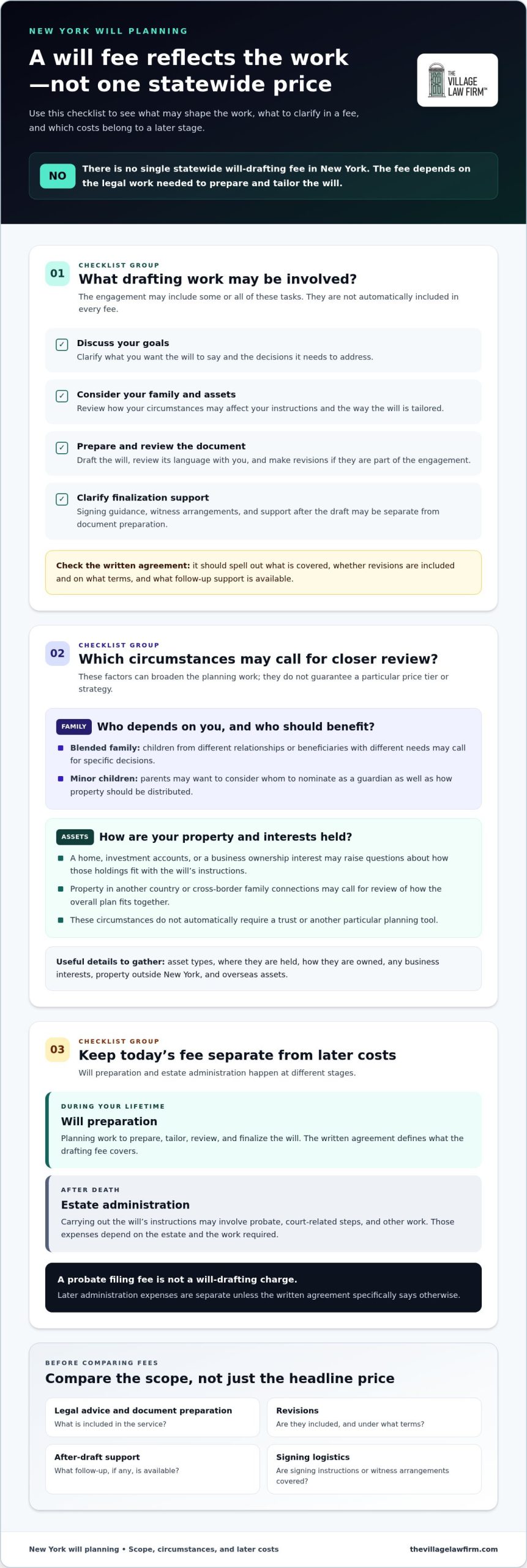
No single statewide will-drafting fee applies because each fee reflects the legal work needed to prepare and tailor a will to the person making it. A headline price alone doesn’t tell you whether the service includes legal advice, revisions, or help completing the next steps. Compare the stated scope, not just the fee.
A will sets out instructions for distributing property after death. For a general overview of its purpose and legal nature, see Will and testament. Preparing a will is a planning expense, separate from later costs of probate, estate administration, or court filings.
What does a will-drafting fee generally cover?
Depending on the engagement, the work may include discussing your goals, considering how your assets and family circumstances affect your instructions, drafting the document, reviewing it with you, and making revisions. These tasks aren’t automatically included in every fee. The written agreement should specify what’s covered and what follow-up, if any, is available.
Legal advice and document preparation are also distinct from signing logistics. Guidance about the will’s language doesn’t necessarily include arranging witnesses or overseeing execution. Before comparing fees, look for clarity on:
- What legal advice and document preparation are included
- Whether revisions are included, and under what terms
- What support is available after the draft is prepared
- Whether signing instructions or witness arrangements are covered
This makes it easier to compare like with like. Two fees can describe different levels of work, even when both are advertised as will preparation.
Is making a will the same cost as settling an estate?
No. Will preparation happens during a person’s lifetime as part of planning. Estate administration follows death and may involve carrying out the will’s instructions, addressing probate, and handling court-related steps. Those later expenses depend on the estate and the work required. They aren’t part of the will-drafting fee unless the written agreement specifically says otherwise.
Keep these cost categories separate. A probate filing fee, for example, is not a charge for drafting a will. If you’re researching the process and expenses of settling an estate, a New York probate guide can help you explore that separate stage. Knowing what each fee covers makes it easier to understand what you’re paying for now and what costs may arise later.
Which New York circumstances can make will planning more involved?
A will that leaves defined assets to a small number of beneficiaries may involve relatively direct decisions. The work can broaden when family relationships, ownership arrangements, or assets in different places raise questions about how your instructions fit together. That doesn’t automatically mean you need a particular document or strategy. It means the legal analysis should reflect your circumstances.
The more a will must account for intersecting family, asset, or cross-border concerns, the more legal analysis may be needed to express your intentions clearly. These factors can affect the work involved, but they don’t translate into a guaranteed price tier. The key question is what your plan needs to address.
How can family circumstances affect the work involved?
Family details can change the decisions a will needs to capture. A blended family, for example, may include children from different relationships and beneficiaries with different needs. Parents of minor children may also want to consider whom they would nominate as a guardian, alongside how they want their property distributed. Discussing these choices can help ensure the document reflects your intentions rather than assumptions.
Consider who depends on you, whom you want to benefit, and whether any family relationships call for specific instructions. A New York parents’ estate-planning guide can offer context on planning for children and guardianship. The Village Law Firm drafts estate-planning documents tailored to individual and family needs, including circumstances involving children.
When can assets or international ties require broader planning?
The range and ownership of your assets can raise coordination questions. Someone with a home, investment accounts, and an ownership interest in a business may need to consider how those holdings relate to the will’s instructions. Similar questions can arise when assets are located in another country or family members have cross-border connections. These circumstances don’t automatically require a trust or another particular tool, but they may call for a closer review of the overall plan.
Before discussing your situation, make an inventory of asset types, where they’re held, and how they’re owned. Note any business interests, property outside New York, or overseas assets. For cross-border concerns, an international estate-planning guide can help frame the questions to consider. Coordinating a will with broader estate planning may be useful when different parts of your situation interact.
Signing also deserves attention. The applicable execution requirements should be confirmed for your circumstances, and planning the signing is distinct from deciding what the document should say. When reviewing the work involved, separate two questions: how the will will be tailored and what guidance is provided to complete it properly.
If your family, assets, or international ties make the planning questions feel interconnected, consider discussing them with The Village Law Firm’s New York estate-planning counsel. A clear picture of your circumstances can help focus the conversation on the legal work your plan may require.
DIY, online, or attorney-prepared will: how should New Yorkers compare options?
Choosing how to prepare a will is a question of fit, not just price. DIY documents, online tools, and attorney-prepared wills can differ in how closely they account for your circumstances, what guidance they provide, and what happens if you need changes. Start by comparing the work included with the decisions you need help making.
The lowest initial fee may not include work equivalent to a more comprehensive preparation process. A generic form may suit someone with straightforward instructions, while a person with more involved family or asset considerations may value individualized legal advice. Neither route is automatically right for everyone.
| Option | Customization and legal guidance | Complexity, revisions, and support |
|---|---|---|
| DIY document | You prepare the document yourself, often using a template or general instructions. | You are responsible for deciding whether the document reflects your circumstances and for addressing questions or changes. |
| Online will tool | A guided process may use your answers to generate a document, but the degree of customization and access to legal advice varies. | Review the tool’s stated scope, revision options, and support. Document generation alone may not address issues beyond the questions it asks. |
| Attorney-prepared will | An attorney can discuss your facts and tailor legal advice and document preparation to your needs. | The engagement may define review, revisions, signing guidance, and any broader planning work. Confirm the scope in writing. |
What should a reader compare beyond the quoted fee?
Look beyond the headline and compare specific deliverables. Does the scope cover only a will, or does it include other planning documents? Does the process include a discussion of your circumstances, or does it primarily generate a document from your answers? Review how revisions are handled, what follow-up is available, and whether signing guidance is included or separate.
Keep optional services distinct from the will itself. A proposal that includes additional documents or broader planning isn’t directly comparable to one covering only document preparation. Write down what each option covers so you can compare the work, not just the label or quoted fee.
When might individualized legal advice matter most?
Personalized advice may be especially relevant if you have minor children, a blended family, a business interest, or assets outside the United States. These details can raise questions about how the will relates to your broader estate plan. An attorney can assess those connections and discuss planning considerations without promising a particular outcome. Someone with simple instructions may have different needs.
If you want advice tailored to your circumstances, The Village Law Firm’s New York estate-planning counsel can help you consider a will alongside your wider planning needs.
How can you prepare to evaluate a New York will fee?
A focused conversation starts with a clear sense of what you want your will to accomplish. You don’t need every answer in advance. An organized summary of your goals, family, and assets can clarify the legal work involved and make written proposals easier to compare. It can also help separate questions about the will from requests for broader estate planning.
Use this five-step checklist to prepare:
- Identify your goals. Note who you want to benefit and any instructions you want the will to address.
- Gather relevant facts. Collect basic details about family relationships and existing planning documents.
- Describe your assets. List the kinds of property you own and where they are located, including assets outside New York.
- Note family needs. Record considerations involving children, guardianship preferences, or beneficiaries who may need particular attention.
- Compare the scope. Review what each written proposal covers, what it leaves out, and what may be addressed separately.
What information should you gather before discussing a will?
Bring a working list of intended beneficiaries and the family relationships that matter to your decisions. If you have minor children, note any guardianship preferences you want to discuss. You can also summarize asset categories, such as real estate, financial accounts, or a business interest, without trying to calculate every value. Flag property or accounts outside New York, since location and ownership may affect planning questions.
Gather any existing will, trust, power of attorney, or healthcare directive, if you have one. These documents provide context and can help identify whether new instructions should be coordinated with existing plans. If you don’t have a complete inventory, bring what you know and note what remains uncertain.
How can you compare two written proposals fairly?
Set the proposals side by side. Compare the documents included, how your circumstances will be reviewed, whether revisions are covered, and what support is described through signing. Note any exclusions, such as witness logistics or related planning documents, and identify services scoped separately. This keeps the headline fee from obscuring meaningful differences in the work.
Write down questions before you decide: How are changes handled? What signing guidance is provided? Are related documents part of the proposal or separate? A clear written scope helps you understand what you’re choosing and compare options on consistent terms. It’s a practical way to assess “how much does a will cost in NY” for your situation without assuming every proposal covers the same work.
For guidance tailored to your family and planning needs, explore New York estate-planning counsel at The Village Law Firm.
How The Village Law Firm can help you plan a New York will
A will should reflect the people and priorities that matter to you, not just fill in standard blanks. The Village Law Firm provides New York estate-planning counsel and drafts wills tailored to individual and family needs. If you’re weighing “how much does a will cost in NY,” a useful next step is to discuss what your plan needs to address and clarify the proposed scope of legal work.
The conversation can cover what you want your will to accomplish, the family and assets it needs to account for, and whether related planning questions deserve attention. The aim is to understand your options and the work involved, not to promise a particular outcome or apply a one-size-fits-all plan.
What can tailored estate-planning guidance address?
Depending on your circumstances, estate planning may involve a will, a trust, or healthcare directives. These documents serve different planning purposes, so related needs can be considered within the context of your broader plan. That doesn’t mean every document is part of a will-drafting engagement. It means you can discuss how the pieces relate and identify which questions matter to your goals.
For instance, you may want to clarify who should inherit particular property while also considering decisions concerning incapacity. Reviewing your priorities can help distinguish instructions for your will from other planning matters. It can also clarify what the proposed work addresses and what, if anything, would be handled separately.
When could the firm’s broader planning experience be relevant?
If you’re a parent, guardianship preferences and providing for children may be important parts of the discussion. Families with children can have planning needs that reach beyond naming beneficiaries, and tailored guidance can help bring those concerns into focus.
International connections may also call for a coordinated conversation. If you own assets abroad or have close family ties across borders, the location and context of those interests may affect the questions to consider. The Village Law Firm advises on international estate planning and cross-border estate administration, bringing that experience to bear when it fits a client’s circumstances.
Before a discussion, gather your goals, a brief picture of your family and assets, and questions about documents, revisions, and signing. You don’t need a perfect inventory to begin. A clear starting point can make it easier to explain what matters and understand the proposed scope.
Explore the firm’s New York estate-planning services and discuss your goals and the scope of a will plan with its estate-planning team. A considered conversation can help clarify the decisions ahead.
Take the next step toward a plan that reflects your priorities
The question of how much does a will cost in NY is a starting point, not the whole decision. Turn your priorities into a clear planning conversation: what you want your will to address, what matters most to your family, and which questions remain unresolved. You don’t need every detail settled before you begin. A thoughtful discussion can clarify the decisions ahead and how they relate to your circumstances.
Keep your notes and questions close. Ask about the proposed scope and how the work connects to your goals. Understanding the process can make a consequential decision feel more manageable, without judging an option by a headline fee alone. You can also revisit your plan as life changes to keep your intentions and documents aligned over time.
Discuss your New York will and estate-planning goals with The Village Law Firm. A considered first step can bring greater clarity to the decisions ahead.
Frequently Asked Questions
How much does it cost to make a will in New York?
There’s no single price for every New York will. The answer to “how much does a will cost in NY” depends on the document’s scope and whether you’re paying for a template, an online drafting process, or legal advice tailored to your circumstances. To understand a quote, compare what it covers, such as attorney review, revisions, and signing support. The written scope should make the fee and included work clear.
Is a handwritten will valid in New York?
A handwritten will may be valid only in limited circumstances, so don’t assume that writing your wishes by hand is enough. New York law sets requirements for wills, and narrow exceptions may apply to particular situations. The details can affect whether a document is accepted, so a handwritten note should not be treated as a reliable substitute for a properly prepared will. If you have one, seek legal guidance about its status and next steps.
Can I write my own will in New York?
Yes, you can write your own will, but preparing the document yourself doesn’t ensure it will meet New York’s legal requirements or clearly carry out your intentions. A practical first step is to list beneficiaries, describe what you want each to receive, and identify any instructions that may need explanation. If your circumstances involve children, a business, or assets in different countries, individualized legal guidance can help you assess questions a basic template may not address.
What makes a New York will more expensive to prepare?
More involved family or asset arrangements can require additional discussion and legal analysis. For example, a blended family may have competing considerations about how property is distributed, while a business owner may need to explain ownership interests and succession wishes. Assets outside the United States can raise coordination questions, too. These factors don’t automatically require a particular strategy, but they can affect the work needed to understand your goals and prepare a will that reflects them.
Does the cost of a will include probate in New York?
Usually, will preparation and probate are separate matters. Preparing a will is part of lifetime planning; probate is a court process that may follow a person’s death. Court filing expenses and legal work involved in administering an estate aren’t automatically covered by a will-drafting fee. Review the written agreement for its scope, and treat future administration costs as a separate planning question rather than assuming they’re included.
Do I need a lawyer to make a will in New York?
You aren’t generally required to hire a lawyer simply to make a will, but you are responsible for ensuring the document meets applicable New York requirements. Legal advice can be useful if you’re unsure how to express instructions, your family situation is complicated, or you want to consider the will alongside trusts or healthcare directives. The Village Law Firm provides New York estate-planning counsel for wills and related planning needs.
Should I update my will after moving to New York?
Review your will after moving to New York, but don’t assume the move automatically cancels it or that an older document still addresses your needs. Consider whether your new residence, property, family circumstances, or other planning documents change the questions your will should answer. A review can also help identify whether the document’s execution and language are suitable for your current situation. Keep a copy of the existing will and related documents for that discussion.