
What if the inheritance plan meant to provide for your family instead leaves them uncertain about your wishes or responsibilities? Preventing family fights over inheritance NYC families may face starts with more than deciding who receives what. Clear, coordinated planning can reduce confusion before it becomes a source of conflict.
If you’re concerned that unequal gifts could cause hurt feelings, or unsure how to discuss inheritance plans without creating tension, you’re not alone. These decisions are personal. Avoiding the conversation can leave loved ones to interpret your intentions later and make estate administration in New York more difficult.
This guide explains how to make your wishes clear across planning documents, assign key responsibilities, and approach family conversations thoughtfully. You’ll also learn how estate planning and administration counsel can connect your intentions with practical next steps. Planning can’t promise that disagreements will never arise, but it can give your family a clearer path forward.
Key Takeaways
- Identify where ambiguity, perceived unfairness, surprises, or unclear responsibilities could create tension among loved ones.
- Pair thoughtful conversations with clear documentation. Explain the purpose behind major decisions without turning every choice into a negotiation.
- Understand how wills, trusts, beneficiary designations, and decision-maker appointments serve different purposes, then review them for consistency.
- Use a practical review process to clarify your goals, check your documents, communicate your intentions, and revisit your plan as family circumstances change.
- Preventing family fights over inheritance NYC families may face can begin with planning counsel that aligns personal priorities with practical estate administration.
Why inheritance disputes happen, and what NYC families can prevent
Planning for loved ones with different needs, histories, and expectations can carry real emotional weight. One person may see an inheritance decision as practical; another may experience it as a judgment about their place in the family. For families focused on preventing family fights over inheritance, NYC estate planning can help address avoidable uncertainty, but it can’t dictate how each relative will feel.
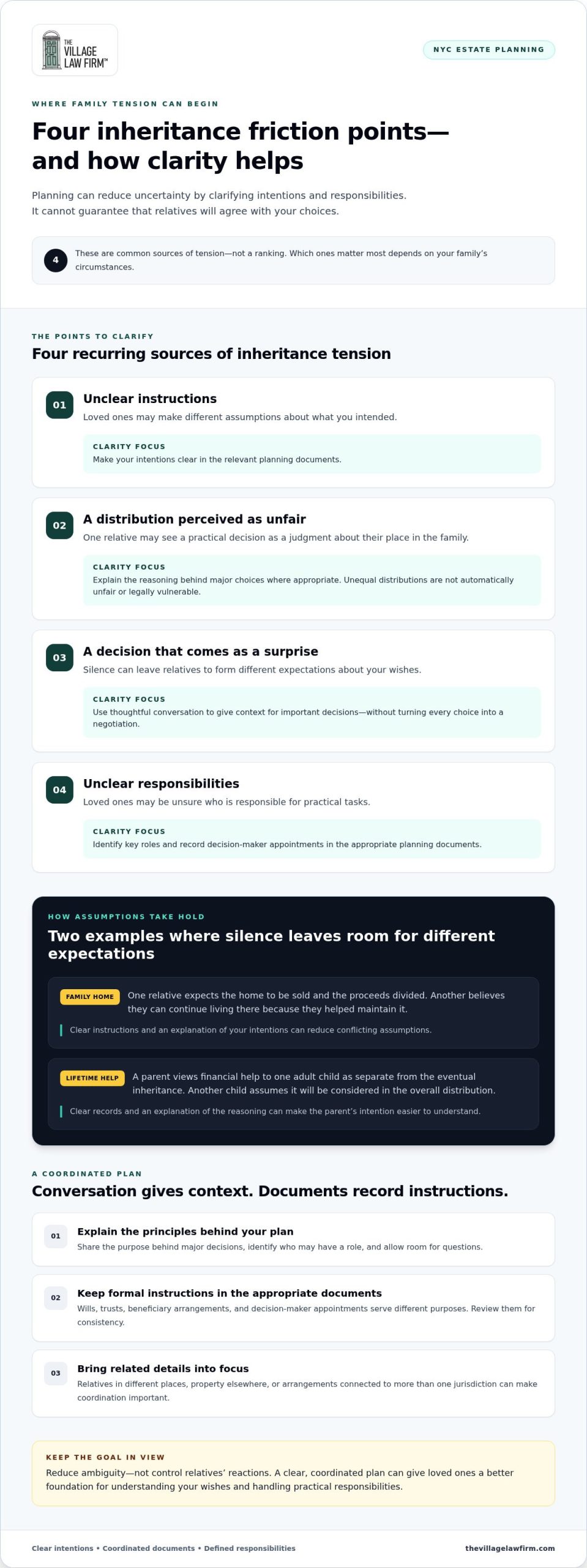
Tension often grows around four issues: unclear instructions, a distribution someone perceives as unfair, a decision that comes as a surprise, or uncertainty about who is responsible for practical tasks. A plan can clarify your intentions and assign roles. It can’t guarantee that relatives will agree with your choices.
Inheritance conflict prevention means reducing ambiguity, not controlling relatives’ reactions.
Which inheritance misunderstandings can planning address?
Consider a family home. One relative assumes it will be sold and the proceeds divided, while another believes they can continue living there because they helped maintain it. If the owner hasn’t explained their intentions, each person may interpret the same family conversations as confirmation.
Or imagine a parent who gives one adult child financial help during their lifetime. The parent may view it as separate from the eventual inheritance, while another child assumes the gift will be considered in the overall distribution. Neither assumption necessarily reflects the parent’s actual plan. Clear records and an explanation of the reasoning can make the intention easier to understand.
Silence leaves room for relatives to form different expectations, especially when a decision feels personal. An unequal distribution isn’t automatically unfair or legally vulnerable. Families have individual circumstances and goals. The practical aim is to make the reasoning and instructions as clear as appropriate while recognizing that relatives may still disagree.
Why NYC families may need a coordinated plan
Family life and assets don’t always fit within one neighborhood or even one state. A New York household may include relatives living elsewhere, property in another location, or financial arrangements connected to more than one jurisdiction. When details sit in separate places, loved ones may be unsure which documents reflect current intentions or how different parts of the plan fit together.
New York legal details depend on the family’s circumstances and the documents involved. Consider a will, trust, or other planning record in context, rather than treating it as an isolated instruction. Coordinating the plan can connect intended distributions with the practical steps loved ones may face during administration.
Families with assets or relatives across borders may also need to consider how multiple jurisdictions intersect. Individualized New York estate planning guidance can help clarify which questions matter for your family and bring relevant documents and responsibilities into focus. The goal isn’t to eliminate every difficult conversation, but to give those conversations a clearer foundation.
How clear intentions and honest conversations reduce inheritance tension
A thoughtful conversation can help relatives understand the values behind your decisions. It can’t replace a properly prepared estate plan, and a document alone may not explain the personal reasoning that matters to your family. Use both: conversation offers context, while current planning documents record instructions in the appropriate form.
You don’t have to turn a family discussion into a negotiation over every choice. Focus on the purpose behind major decisions, such as providing for a dependent, recognizing different needs, or assigning practical responsibilities. Listening to concerns can build understanding, but it doesn’t require promising changes or giving relatives control over decisions that are yours to make.
How to raise inheritance planning without escalating tension
Choose a calm setting and explain why you’re bringing it up: you want to make your intentions clear and support continuity for the family. Disclosure is personal, so there’s no single meeting format that suits every household. You might speak with relatives individually, involve only those affected by a particular decision, or get professional guidance on how to frame a sensitive subject.
If you meet as a family, listen without treating questions as demands. A neutral professional can help structure a difficult discussion when old disagreements, blended-family dynamics, or strong differences in expectations make it hard to stay focused. The aim is understanding, not securing everyone’s agreement.
What to communicate, and what belongs in legal documents
Use conversation to explain the principles behind your plan, identify who may have a role, and give relatives a chance to ask what your decisions mean. Use formal planning documents for instructions that need to be recorded. Verbal assurances or informal notes may offer context, but relatives shouldn’t assume they change or replace the relevant legal documents.
Before sharing details, make sure what you intend to say matches your current plan. For example, telling a relative they’ll receive a particular asset could create confusion if your documents or beneficiary arrangements say something different. An estate-planning attorney can help identify which intentions belong in a will, trust, healthcare directive, or another appropriate document. For additional perspective on estate planning to avoid family conflict in New York, consider how communication and formal planning work together rather than relying on either alone.
A measured sequence can keep the discussion focused:
- Purpose: Say why clarity and continuity matter to you.
- Principles: Explain the broad goals behind major decisions.
- Questions: Invite relatives to share concerns and ask for clarification.
- Follow-through: Review the appropriate planning documents and update them through the proper process if your intentions have changed.
For some families, this may take one conversation. For others, a private discussion followed by a document review may feel more comfortable. The right approach depends on your relationships and circumstances. If you’d like support aligning family priorities with formal planning, estate planning counsel can help you consider a clear, coordinated path forward.
Which planning tools can help prevent inheritance disputes?
Planning documents work best as a coordinated set, with each one addressing a different question: what should happen to your property, how should certain assets pass, and who may make decisions if you can’t make them yourself? For families focused on preventing family fights over inheritance, NYC planning isn’t about finding one document that answers everything. It’s about reducing gaps and conflicting expectations.
Each planning tool addresses different questions, so the pieces should be coordinated rather than treated as interchangeable.
- A will can state how you intend property covered by it to be distributed and name a person to handle the estate.
- A trust can organize assets and provide instructions for managing or distributing property placed in it.
- Beneficiary designations record who is named to receive assets such as certain financial accounts or insurance benefits.
- Decision-maker appointments can identify who may act in specified situations, such as when healthcare decisions are needed.
A will or trust can make your intentions clearer, but neither guarantees that relatives will agree. A family member may understand the instructions and still feel disappointed by the outcome. Clarity gives relatives and the people responsible for carrying out the plan a better chance of understanding what you intended and where to look for guidance.
How wills and trusts can clarify different parts of a plan
A will generally communicates instructions for property addressed through the will, while a trust can set out instructions for property held in the trust. Their roles depend on the plan and the assets involved. Identify which document addresses which property, and don’t assume one covers every asset or purpose. For parents, NYC estate planning for families with children can also address needs beyond distributing property, including naming decision-makers for a child’s care.
How beneficiary choices and fiduciary roles affect expectations
Review account designations and estate documents together. For example, a person may update a will but overlook a beneficiary record made years earlier. That mismatch can leave relatives unsure whether the records reflect current intentions. Don’t assume one document automatically updates another. Review relevant records as a set, and get legal guidance if their interaction is unclear.
Think carefully about whom you name for responsibilities. A trusted person should be willing and able to manage the practical demands of the role, communicate carefully, and follow applicable instructions. The right choice depends on family dynamics, the responsibility, and your circumstances. For parents, that may mean choosing a separate person for a particular decision rather than assuming one relative should handle every role.
Records can become outdated as relationships, assets, or priorities change. Review them after a major life event or a change in your wishes. Tailored estate planning counsel can help connect your intentions with wills, trusts, healthcare directives, beneficiary records, and the practical work of future administration. No single tool can control family reactions, but a coordinated plan can give loved ones a clearer framework to follow.
A practical step-by-step plan for preventing inheritance fights
A manageable review can turn a complicated family subject into a series of clear decisions. To help prevent family fights over inheritance, NYC families can use a process that connects their priorities with the records and responsibilities loved ones may need later. Work through these steps and note questions that require legal guidance rather than guessing at the answers.
- Inventory relevant assets. Make a general list of property, financial accounts, insurance, business interests, and assets connected to another state or country. Note where you believe each is held and whether a beneficiary is named. The purpose is to see the overall picture, not to create a public accounting for relatives.
- Clarify your goals. Write down whom you want to provide for, any responsibilities you want someone to take on, and the reasons behind decisions that could prompt questions. Include unresolved issues, such as how to address a family home or support a dependent.
- Review documents and account records. Gather wills, trusts, healthcare directives, and relevant beneficiary information. Compare them with your current goals and flag records that appear outdated or inconsistent. Don’t make assumptions about legal effect. Mark questions for review.
- Communicate thoughtfully. Decide what to share, with whom, and when. Explain the broader purpose of your plan, keep formal instructions in the appropriate documents, and avoid promises that don’t reflect the current plan.
- Revisit after meaningful changes. Marriage, the arrival of a child, relocation, a change in assets, or a shift in family responsibilities may affect what you want your plan to accomplish. Reassess when circumstances change rather than treating a fixed schedule as a universal rule.
What to prepare before reviewing an estate plan
Bring the current versions of your planning documents, a general asset inventory, and available beneficiary information. You don’t need to resolve every question in advance. Write down the outcomes you hope to achieve and the points that feel uncertain. Note circumstances that could affect coordination, such as a family business, blended-family relationships, or property and relatives in more than one country.
A checklist can help organize your preparation. The 2026 New York estate planning checklist offers a starting point for identifying topics to review. Treat it as a guide for discussion, not a substitute for advice tailored to your situation.
When to revisit the plan and seek legal guidance
Return to your plan when family relationships, assets, or your place of residence change in a meaningful way. If your circumstances involve New York execution requirements, tax considerations, or future administration questions, have those details reviewed under current law. The right analysis depends on the documents and facts involved; a general checklist can’t determine how a rule applies to your family.
For a coordinated review of your estate plan and family priorities, schedule estate planning guidance with counsel who can help identify questions, assess the documents together, and consider how the plan may work in practice.
How New York estate-planning counsel can bring clarity to family decisions
Family priorities don’t always translate neatly into legal documents. You may want to provide for a loved one, recognize that family members have different needs, or choose someone to handle practical responsibilities. Estate-planning counsel can help you examine those priorities, discuss suitable approaches, and coordinate documents such as wills, trusts, and healthcare directives with the plan you intend to put in place.
That work involves more than recording who receives what. A useful review also considers how the plan may function during future estate administration. Are the relevant records easy to locate? Do your chosen decision-makers understand the responsibilities you have in mind? Do the documents and account information appear consistent with your goals? These questions can surface uncertainties while there’s time to address them.
What a tailored planning conversation should clarify
A focused conversation can explore your goals, important family relationships, where relevant assets are located, and which parts of the plan feel unresolved. Bring questions about family circumstances that may call for special consideration rather than assuming a familiar approach fits every household. Counsel can explain planning options in light of those details, while helping you understand that no document or strategy can promise a particular family response or outcome.
For example, parents may have different concerns from a couple with adult children, and a family with a business or property in another country may need to consider additional coordination. A tailored discussion helps separate the family’s underlying objectives from decisions about how to document them. That distinction can make the planning process more deliberate and keep important questions from getting lost in the paperwork.
Taking a measured next step in NYC
You don’t need to arrive with every answer. Gather current planning documents and relevant information about assets or beneficiaries, then write down your main questions. Note changes in family relationships, residence, or finances, along with concerns about how loved ones might carry out the plan. A concise preparation list gives counsel a clear starting point and keeps the conversation grounded in what matters to you.
For families with international assets or connections, estate planning may need to account for the practical realities of cross-border administration. Relevant considerations depend on where assets are held, where family members live, and which documents are in place. Coordinated legal planning can help identify questions that deserve attention across jurisdictions without assuming one solution will apply everywhere.
Preventing family fights over inheritance NYC families may encounter isn’t about eliminating every disagreement. It’s about making intentions clearer and considering whether the plan can be administered in a way that reflects those intentions. The Village Law Firm provides tailored estate-planning and estate-administration counsel to help families bring those pieces into focus. If you’re ready to discuss your priorities and questions, discuss your estate-planning goals.
Give your family a clearer path forward
A thoughtful estate plan is an act of care, but it doesn’t have to be perfected all at once. Start by identifying one uncertainty you’d like to resolve, then take the next step with intention. That small beginning can make a sensitive subject more manageable and help turn your priorities into a plan your loved ones can better understand.
Preventing family fights over inheritance NYC families may face isn’t about controlling every reaction. It’s about creating clarity where you can and giving those who may handle your affairs a considered foundation. The Village Law Firm advises on estate planning and administration, including wills and trusts tailored to family needs, as well as international and cross-border matters.
Bring your questions, current documents, and the family circumstances you want your plan to reflect. A conversation can help identify what deserves attention and consider a path that fits your priorities. Discuss your estate-planning goals with The Village Law Firm and take a calm, purposeful step toward greater clarity for the people you care about.
Frequently Asked Questions
Can a family meeting prevent fights over an inheritance?
A family meeting can reduce surprises and help relatives understand the thinking behind your plan, but it can’t guarantee agreement. Choose a calm setting, decide what information you’re comfortable sharing, and make clear that an explanation isn’t necessarily an invitation to renegotiate. Keep formal instructions in the appropriate documents. If the conversation feels especially sensitive, New York estate-planning counsel can help you prepare and identify which decisions need formal documentation.
Does having a will prevent family members from contesting an inheritance in New York?
No. A will communicates a person’s stated wishes, but it can’t ensure that relatives agree or prevent every challenge. Whether a particular challenge may proceed depends on the circumstances and applicable law. Avoid relying on an online template or assuming a signed document resolves every concern. A New York attorney can review the will and the circumstances surrounding its preparation, then explain issues that may matter to your situation.
Can a family agreement override a will in New York?
Don’t assume an informal agreement changes a will or determines how an estate will be administered. Its legal effect can depend on the agreement’s wording, the people involved, and the surrounding circumstances. For example, a relative’s recollection of a conversation may not match the current documents. Avoid relying on verbal assurances if formal changes may be needed. New York estate-planning counsel can review the documents and explain appropriate next steps.
Is it better to tell family members how an inheritance will be divided before death?
There’s no single disclosure approach that works for every family. Sharing the principles behind your decisions may help relatives understand your intentions, while disclosing every detail could create pressure or unwanted conflict. Consider your relationships, privacy, and purpose before deciding what to discuss. For instance, you might explain why your plan accounts for different needs without sharing account balances. Keep binding instructions in properly prepared documents and seek individualized guidance if disclosure feels delicate.
Can an executor change who receives an inheritance?
An executor’s role is generally to administer an estate under the applicable documents and law, not to substitute personal preferences for the deceased person’s wishes. The executor’s authority and responsibilities depend on the estate’s circumstances and New York law. Clear records can help the person handling the estate understand what to review, but they don’t resolve every question. If you’re concerned about a particular estate, have its documents assessed before making assumptions about the executor’s authority.
What should I do if relatives are already arguing about an inheritance?
Preserve relevant documents and communications, and avoid making rushed promises or signing something you don’t understand. Keep discussions centered on specific questions, such as which document addresses an asset, rather than accusations about motives. If administration is underway, the right next step depends on the documents, the stage of the process, and the disagreement. Seek New York legal guidance promptly to understand the options and responsibilities that may apply. When conflicts threaten to escalate into formal civil litigation or complex family disputes, experienced legal practices such as weemsland.com can provide perspective on navigating civil claims and family law matters.