
The right Manhattan Surrogate’s Court help starts with the estate’s facts, not a stack of forms. If you’re handling an estate matter in Manhattan, you may be trying to understand which court process applies, what needs to be filed, and who is authorized to act.
Not every estate follows the same path. Whether a proceeding is needed, what information the court requires, and who can serve as executor or administrator depend on the circumstances. Organizing those details is a practical first step toward managing the process.
This guide explains the Manhattan Surrogate’s Court’s role and the common stages of an estate matter. You’ll learn what records to gather, how an executor’s or administrator’s responsibilities fit into the process, and where legal guidance can help with complex questions. The Village Law Firm provides estate-administration counsel for New York families, including guidance on cross-border matters.
Key Takeaways
- Learn which estate matters the Manhattan Surrogate’s Court handles and why the appropriate process depends on the estate’s circumstances.
- Understand the typical sequence of an estate proceeding, from gathering information to preparing a filing.
- See how unclear documents, family disagreements, or incomplete asset details can complicate administration.
- Use a simple preparation approach to organize known facts and distinguish them from questions that need legal or court-procedure review.
- Learn how Manhattan Surrogate’s Court help and individualized estate-administration guidance can bring structure to New York and cross-border matters.
What Manhattan Surrogate’s Court handles in an estate matter
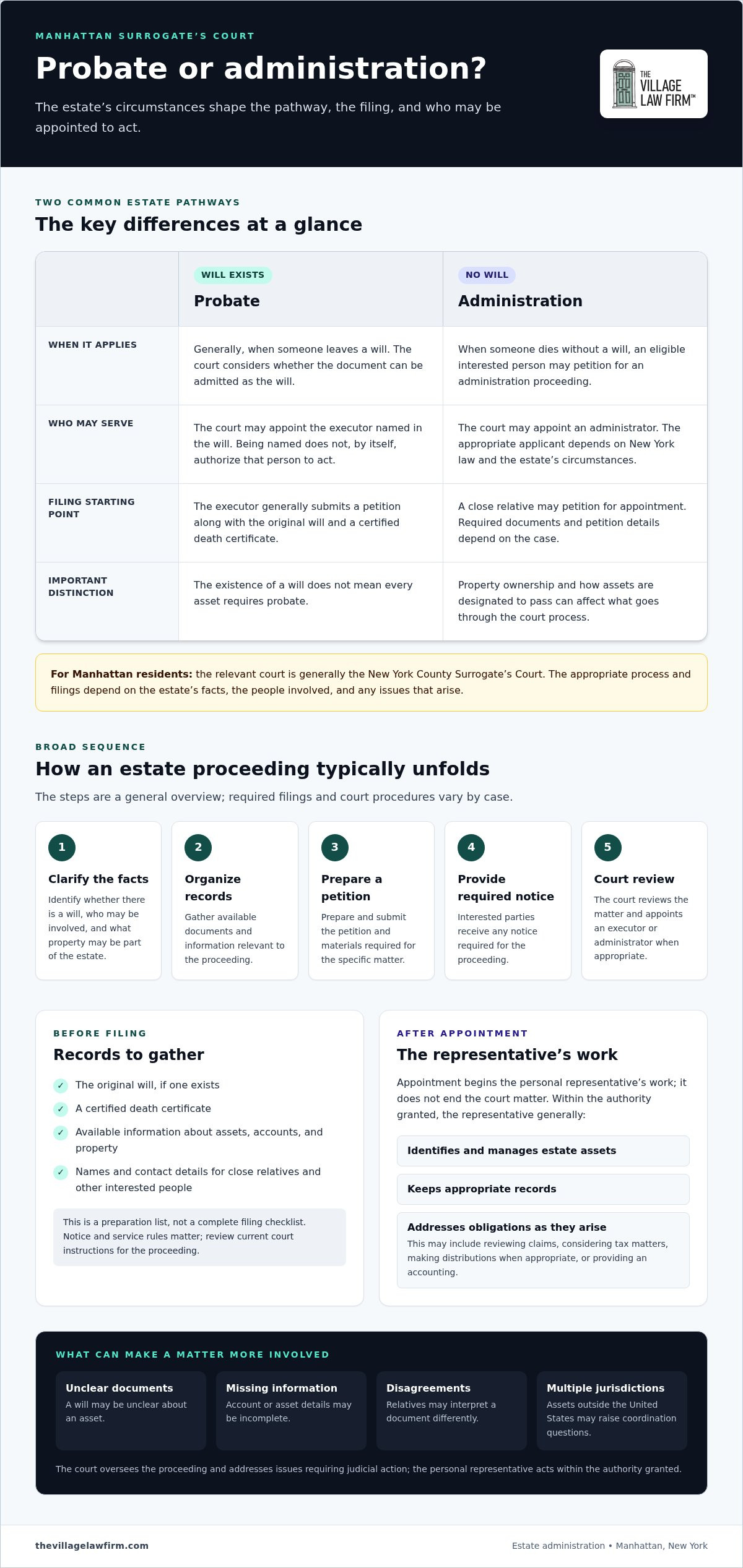
After a family loss, legal responsibilities can arrive when there is little room to think about forms, deadlines, or who is authorized to act. A useful first step is understanding the court’s role. New York’s Surrogate’s Courts handle probate and estate-administration proceedings, including matters involving a will and the appointment of someone to manage an estate when there is no will. For someone who lived in Manhattan, the relevant court is generally the New York County Surrogate’s Court.
The court is associated with the historic Surrogate’s Courthouse in Manhattan. The proceeding itself depends on the estate’s circumstances, including whether there is a will and how property is owned or designated to pass. Not every asset necessarily goes through the same court process.
When does a Manhattan estate matter involve Surrogate’s Court?
When someone leaves a will, probate is generally the process through which the court determines whether the document can be admitted as the will and appoints the executor named in it. If someone dies without a will, an eligible interested person may petition for an administration proceeding, in which the court appoints an administrator. The appropriate process and filings depend on the facts. The existence of a will alone does not mean every asset requires probate.
Who may be involved in a New York estate proceeding?
An executor is named in a will to manage the estate, but being named does not itself authorize that person to act. The court’s appointment, commonly shown through issued letters, gives the executor authority in the proceeding. When there is no will, the court may appoint an administrator instead. The appropriate applicant and process depend on New York law and the estate’s circumstances.
The personal representative handles estate responsibilities within the authority granted, while the court oversees the proceeding and addresses issues that require judicial action. The court does not simply take over the estate, and the representative does not decide every question independently. Disagreements about a will, uncertainty over assets, or questions about who should serve can bring the court’s role into sharper focus.
Good Manhattan Surrogate’s Court help begins with identifying these basic facts, rather than treating the matter as a paperwork exercise. Knowing whether there is a will, who is named to serve, and what property may be involved gives you a more orderly starting point.
How the Manhattan Surrogate’s Court process typically unfolds
Knowing the broad sequence can make an estate proceeding easier to approach, even though the required filings and court procedures depend on the case. Generally, the process begins by clarifying the estate’s circumstances and organizing relevant information. The appropriate petition is then prepared and submitted, interested parties receive any required notice, and the court reviews the matter before appointing an executor or administrator when appropriate.
Approach preparation as fact-gathering, not as an attempt to decide legal questions on your own. A will may point toward probate, while an estate without a will may involve an administration proceeding. The process and filing requirements can differ based on the estate, the people involved, and any issues that arise. Manhattan Surrogate’s Court help can organize that review and identify questions that need legal attention.
From identifying the estate pathway to preparing a petition
Start by assembling the records and information you have. Depending on the proceeding, useful items may include:
- The original will, if one exists
- A certified death certificate
- Available information about assets, accounts, and property
- Names and contact details for close relatives and other interested people
For probate, the executor generally submits a petition along with the original will and a certified death certificate. In an administration matter, a close relative may petition for appointment. These are general descriptions, not a complete filing checklist. Required documents and petition details depend on the case. Notice and service rules also matter, so review the requirements and current court instructions for the proceeding before filing.
What happens after an executor or administrator is appointed?
Appointment marks the beginning of the representative’s work, not the end of the court matter. Once authorized, the personal representative generally identifies and manages estate assets, keeps appropriate records, and addresses obligations as they arise. Depending on the estate, this may include reviewing claims, considering tax matters, making distributions when appropriate, or providing an accounting.
The work can become more involved when information is incomplete, beneficiaries disagree, or assets are held in more than one jurisdiction. Property or accounts outside the United States, for example, may raise coordination questions alongside the New York proceeding. The representative’s responsibilities depend on the estate’s facts and applicable requirements, so assumptions about what must happen or when can create avoidable uncertainty.
For families seeking a more organized approach to these responsibilities, estate-administration guidance can help clarify the issues and next steps, including in complex cross-border matters.
Common Surrogate’s Court challenges and when legal help matters
An estate can look straightforward at first and still raise questions that paperwork alone cannot resolve. A will may be unclear about an asset, account information may be missing, or relatives may interpret a document differently. Each uncertainty can affect what needs to be investigated and how the personal representative should proceed. Careful guidance helps organize the details and identify what needs assessment.
Disagreement can add another layer. Family members may differ over the meaning of a provision, the handling of property, or who should take responsibility. Keep relevant documents and communications together, and take care with statements or actions that could be misunderstood. Legal counsel can clarify the representative’s responsibilities, explain procedural options, and identify questions that need resolution before the estate moves forward. It can support informed decisions, but it cannot guarantee a particular result or timeline.
When an estate includes out-of-state or international assets
Property beyond New York may bring additional legal and administrative questions. Real estate in another state, for example, may require analysis under that state’s rules, while an account or other asset may pass under different arrangements. A separate ancillary probate proceeding can sometimes be relevant when someone owned property outside the state, but it is not automatically required for every out-of-state asset. Ownership, asset type, and applicable law matter.
International assets raise broader cross-border coordination questions, which may involve different legal systems and records. Ancillary probate is one specific concept; cross-border estate administration can involve a wider range of issues. Families considering whether ancillary probate applies can explore a focused guide to ancillary probate in New York alongside advice tailored to the estate’s facts.
When family dynamics or estate documents create uncertainty
Conflicting interpretations, incomplete records, or concerns about how an estate is being handled can complicate administration. Keep the will and related papers, account statements, correspondence, and a clear record of questions or decisions together. Communicate carefully and keep discussions factual. These steps will not resolve every disagreement, but they can help maintain a reliable record and clarify what remains uncertain.
Manhattan Surrogate’s Court help is especially valuable when the facts do not fit neatly into a simple filing. A lawyer can review documents and asset information, clarify the representative’s role, and explain relevant court procedures so the family can consider next steps with greater confidence. The Village Law Firm provides tailored estate-administration counsel in New York, including guidance for complex cross-border matters, without promising a particular court outcome.
How to prepare for Manhattan Surrogate’s Court help
You do not need to resolve legal questions before seeking guidance. Start by collecting what you know, noting what is missing, and keeping the two separate. A consistent set of records can make the initial assessment more focused, surface important details, and reduce the need to reconstruct the estate’s history from scattered papers.
Information to organize before discussing the estate
Gather available records without worrying about whether you have every document. A working folder or simple inventory can include:
- The will, trust papers, or other estate documents you’ve found, along with where any originals are kept
- A preliminary list of assets, debts, financial institutions, and property locations, including locations outside New York or the United States
- Names and contact details for close family members, possible representatives, and others who may have an interest in the estate
- Questions or known disagreements, with relevant correspondence or records kept together
Label estimates as estimates and unknowns as unknowns. For example, note that an account exists even if you do not yet have a current statement. Avoid deciding on your own whether an asset belongs in a particular court filing or how a legal document should be interpreted. Those conclusions depend on the facts and applicable rules.
Questions that help clarify the next step
Use your first discussion to identify what needs review, rather than arriving with a finished legal analysis. Consider asking:
- Which court pathway may fit the known facts, and what additional information could change that assessment?
- Which documents are needed for this particular proceeding, and how should originals be handled?
- Who may need notice, what service requirements apply, and are there deadlines or court instructions to address?
- How should uncertainty about an asset, family relationship, or estate document be handled before filing?
Requirements vary by proceeding and case details, so treat this list as a preparation aid, not a substitute for case-specific legal advice or a complete filing checklist. Review current court procedures before taking action. Manhattan Surrogate’s Court help can bring known facts and open questions into clearer order, so you can focus on the decisions that need attention.
If you’re also considering how to prepare for the future, explore New York estate-planning guidance. For an existing estate matter, The Village Law Firm provides tailored estate-administration counsel to help families understand responsibilities and organize next steps.
Get thoughtful legal guidance for a Manhattan estate matter
Once you’ve gathered available records and identified the questions that remain, individualized legal guidance can help turn preparation into a clear plan. The Village Law Firm provides estate-administration counsel in New York, helping families understand the issues in front of them and organize responsibilities during a difficult transition.
How an estate-administration attorney can bring clarity
An attorney can review the estate’s documents and known assets, then identify procedural questions that need attention. That may include assessing the appropriate court pathway, clarifying the personal representative’s role, or determining how uncertainty in the records could affect next steps. The goal is to help you make informed decisions based on the estate’s facts, not to promise a particular result.
Careful counsel can also support the preparation and management of estate-administration matters as they develop. Clear communication helps family members understand what is known, what still needs review, and who is responsible for addressing each issue. This steady approach can reduce avoidable confusion without minimizing the personal weight of the process.
A considered next step for New York families
Before discussing your matter, gather the documents you have and write down the questions you want answered. You do not need a complete file or every detail resolved. A preliminary list of assets, family relationships, and unresolved concerns gives the conversation a practical starting point.
If the estate includes property or accounts outside New York, or assets in another country, coordinated analysis may be needed to understand how those details relate to the New York proceeding. The Village Law Firm handles complex cross-border estate administration and provides tailored legal guidance for families working through these questions. Manhattan Surrogate’s Court help should clarify your responsibilities and the issues that deserve attention, not add pressure to have every answer immediately.
When you’re ready, discuss your estate-administration needs with The Village Law Firm.
Move Forward With Greater Clarity
Understanding the Manhattan Surrogate’s Court process can help you focus on the right first steps: clarify whether a proceeding may be needed, gather the estate’s records, and identify questions that depend on the specific facts. The court pathway and responsibilities vary, so organized information and careful legal guidance can help bring order to a demanding time.
Manhattan Surrogate’s Court help can also be important when family questions or assets outside New York add complexity. The Village Law Firm provides estate-administration counsel in New York, including guidance for complex cross-border matters. Counsel can help you understand responsibilities and consider next steps without promising a particular outcome or timeline.
If you’re ready to discuss your situation, discuss your estate-administration needs with The Village Law Firm. You do not have to resolve every question before beginning. A thoughtful first conversation can help you move forward with greater confidence.
Frequently Asked Questions
What does Manhattan Surrogate’s Court handle?
Manhattan’s New York County Surrogate’s Court handles probate and certain estate-administration proceedings for New York estates. Probate generally concerns admitting a will and appointing the executor. When someone dies without a will, an eligible person may petition for administration and appointment as administrator. The court also handles voluntary administration for qualifying small estates. Which process applies depends on the will, assets, and other facts, and not every asset necessarily requires the same court proceeding.
Do I need a lawyer for probate in Manhattan?
New York does not require every person involved in probate to hire a lawyer, and the New York County Surrogate’s Court has a Help Center for people representing themselves. Legal guidance can be valuable if the will is unclear, relatives disagree, asset information is incomplete, or property involves more than one jurisdiction. Manhattan Surrogate’s Court help can include reviewing the estate’s facts and clarifying procedural questions, without guaranteeing a particular result or timeline.
How do I start an estate matter in Manhattan Surrogate’s Court?
Begin by identifying whether the estate may involve probate, administration, or another proceeding, then organize relevant records before preparing a petition. For probate, the executor generally files the original will, a certified death certificate, and a petition with the Surrogate’s Court in the county where the deceased lived. An administration proceeding generally begins with a petition from an eligible relative. Filing details, notice requirements, and supporting documents depend on the case.
What happens if someone dies without a will in New York?
If someone dies without a will, the estate may proceed through administration in Surrogate’s Court. An eligible interested person, often a close relative, can petition for appointment as administrator. The court considers the petition and applicable circumstances before appointing someone to manage the estate. An administrator’s authority and responsibilities differ from an executor’s, who is named in a will. The estate’s assets, family relationships, and other facts affect the appropriate steps.
How long does a Surrogate’s Court proceeding take in Manhattan?
There is no fixed timeline for every Manhattan estate matter. New York probate proceedings commonly take about 9 to 18 months, while simple, uncontested estates may be completed in about 7 to 9 months. These are general estimates, not a promise for a particular case. Disputes, incomplete records, court review, asset complications, and other case-specific issues can affect how long administration takes. Counsel can assess the factors relevant to the estate.
Can Manhattan Surrogate’s Court help with assets outside New York?
A Manhattan proceeding can address a New York estate matter, but assets located elsewhere may raise additional legal and administrative questions. Out-of-state real estate, for example, may require analysis of the other state’s rules, and a separate ancillary probate proceeding may sometimes be relevant. International assets can involve broader cross-border coordination. Whether another process is needed depends on the asset, ownership, and applicable law, so review the full estate picture before drawing conclusions.
What documents should I gather before seeking Surrogate’s Court help?
Gather the will and other estate documents you can locate, and note where originals are held. Also collect a certified death certificate if available, preliminary information about assets and debts, account or institution details, property locations, and names of close relatives or potential representatives. Keep relevant correspondence together and note unanswered questions or disagreements. You do not need to interpret the documents yourself. A clear record of what is known and missing helps guide a case-specific review.