
A New York nursing home doesn’t automatically take your home, but Medicaid eligibility rules and estate recovery after death may affect it. If you’re considering how to protect assets from nursing home costs in NY, an irrevocable trust may help protect a home for Medicaid purposes when it is planned and funded more than five years before applying for nursing home benefits.
It’s understandable to think that giving a home to a child or placing it in any trust will keep it safe. Those shortcuts can create problems, and the five-year look-back makes timing important. This article explains when a home may be exempt, how a retained life estate differs from an irrevocable trust, and what each option can mean for your control of the property. It also addresses common myths, including the idea that all trusts offer the same protection. Understanding the rules and trade-offs can help you evaluate your options and identify questions to address before making a change.
Key Takeaways
- Separate the question of whether a home is exempt while you’re alive from whether Medicaid may seek recovery after death.
- Understand how a retained life estate can preserve a right to live in your home while affecting decisions about a future sale.
- Compare irrevocable trusts with revocable trusts, paying close attention to control of assets and the consequences of transferring them.
- Question common shortcuts, such as assuming that giving a home to a child or placing it in any trust automatically protects it.
1. Can a nursing home take my home in New York?
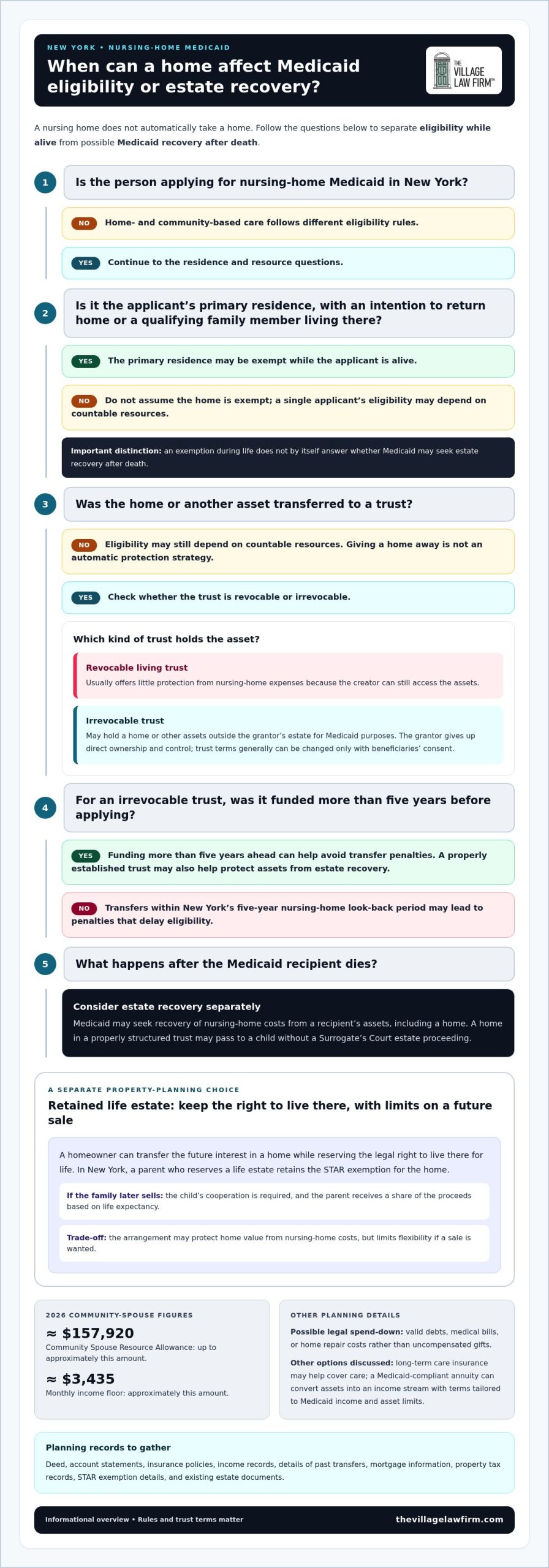
A nursing home doesn’t automatically take your home. But Medicaid eligibility and estate recovery can affect it. A single applicant’s eligibility for nursing home Medicaid may depend on countable resources. A primary residence may be exempt while the applicant intends to return home or a qualifying family member lives there.
A Medicaid Asset Protection Trust is an irrevocable trust that can remove assets from the applicant’s estate for Medicaid purposes. New York’s nursing-home Medicaid look-back period is five years. Transfers during that period may result in penalties that delay eligibility. Funding the trust more than five years before applying can help avoid transfer penalties, and a properly established trust may also help protect assets from estate recovery after death.
After a recipient’s death, Medicaid may seek recovery of nursing home costs from their assets, including a home. A home held in a properly structured trust may pass to a child without a Surrogate’s Court estate proceeding. A Medicaid-compliant annuity can also convert assets into an income stream, with terms tailored to Medicaid income and asset limits.
Long-term care insurance can help cover nursing home care and reduce the strain on savings. For former service members exploring programs to help offset care expenses, advocacy firms like Military Veteran Solutions, LLC assist veterans in obtaining the benefits they are entitled to.
New York applies different rules to home care and nursing home care. Nursing home transfers are subject to a five-year look-back, while home- and community-based care follows different eligibility rules.
In 2026, a community spouse may retain up to approximately $157,920 under the Community Spouse Resource Allowance, with a monthly income floor of approximately $3,435.
Legal spend-down steps may include paying valid debts, medical bills, or home repair costs rather than making uncompensated gifts. For a Medicaid planning meeting, gather deeds, account statements, insurance policies, income records, and details of past transfers.
2. What is a retained life estate?
A retained life estate lets a homeowner transfer the future interest in a home while keeping the legal right to live there for life. For example, a parent may deed the remainder interest to a child while reserving the right to occupy the home. In New York, a parent who reserves a life estate retains the STAR exemption for the home.
An outright transfer works differently: the parent gives up legal rights to the property. If the home is subject to a life estate, the child’s cooperation is required to sell it, and the parent receives a share of the proceeds based on life expectancy. This arrangement may protect the home’s value from nursing home costs, but it also limits flexibility if the family later wants to sell.
Include the arrangement in an estate plan before care needs become urgent. An elder-law attorney can assess the deed, family circumstances, Medicaid eligibility, and the parent’s need to retain control. A life estate is a legal transfer, not simply a promise between relatives, so its terms and effects should be set out in properly prepared documents.
Before a planning meeting, gather the current deed, mortgage information, property tax records, STAR exemption details, and existing estate documents. Explain who lives in the home, who may receive the remainder interest, and whether a future sale is likely. These details help clarify practical consequences alongside care costs.
New York residents can seek Medicaid planning help from an elder-law attorney familiar with eligibility rules, and contact their county Department of Social Services about application procedures. An attorney can review the proposed life estate alongside the rest of the estate plan. For a focused review of life-estate documents, bring the deed and your family’s plans together for discussion.
3. Irrevocable trusts
An irrevocable trust can hold a home or other assets outside the grantor’s estate for Medicaid eligibility purposes. In New York, the nursing-home Medicaid look-back period is five years. Transfers during that period may lead to penalties based on the transferred value and the area’s average long-term-care cost. For families asking how to protect assets from nursing home costs in NY, both timing and trust terms matter.
A revocable living trust usually offers little protection from nursing home expenses because its creator can still access the assets. With an irrevocable trust, the grantor gives up direct ownership and control. Trust terms generally can be changed only with beneficiaries’ consent, so children should understand the arrangement before assets are transferred.
Transferring a home requires careful consideration of future use and sale plans. A properly drafted irrevocable trust can keep sale proceeds in the trust rather than paying them directly to the grantor. It can also preserve the STAR exemption and provide a stepped-up tax basis for a child at the grantor’s death. Some trusts include a limited power of appointment, which allows the grantor to change beneficiaries later.
Gifts and property transfers during the look-back period can delay Medicaid eligibility. An outright gift may also give the recipient control, limiting the parent’s ability to use or sell the home. Deciding how to protect assets from nursing home costs in NY means weighing these consequences against the grantor’s income needs, home care plans, and intended beneficiaries. Discuss these factors with an estate planning attorney before transferring property.
Trust selection also has tax implications. Compare how the proposed trust handles sale proceeds, the STAR exemption, and the home’s basis at death. A coordinated estate plan can align those terms with Medicaid eligibility goals and the family’s inheritance priorities.
4. Common nursing home planning myths
Myth: A nursing home automatically takes the family home. Nursing home admission does not transfer ownership by itself. The key questions involve Medicaid eligibility and possible estate recovery after death. New York’s primary-residence rules may treat a home differently depending on plans to return and whether a qualifying family member lives there. Understanding these distinctions helps frame how to protect assets from nursing home costs in NY.
Myth: Any trust protects assets. A revocable living trust generally offers little protection because its creator retains access. An irrevocable trust changes ownership, but transfer timing matters. Funding a trust during the nursing-home Medicaid look-back period can trigger penalties. The trust’s title alone does not show whether its terms support the family’s goals.
Myth: Giving property to children is a simple shortcut. A gift can surrender the parent’s control and leave the child responsible for property decisions. A transfer may also affect Medicaid eligibility if it falls within the look-back period. Before gifting a home, consider residence rights, future sale plans, tax treatment, and the family’s inheritance priorities.
Myth: Spending down means giving assets away. Lawful spend-down strategies use funds for legitimate expenses rather than uncompensated transfers. Keep records of payments, such as medical bills or necessary home repairs. A rushed gift intended to qualify for Medicaid can create a penalty period instead of immediate eligibility.
Myth: Home care and nursing home care follow identical rules. New York applies different Medicaid rules to institutional care and home- or community-based care. A strategy designed for nursing home care may not suit someone receiving care at home. Identify the likely care setting before choosing trusts or transfer strategies, since that distinction shapes how to protect assets from nursing home costs in NY.
Test each assumption against the actual plan: who owns the home, who can use it, and what care setting is anticipated. Consult an attorney before signing deeds or moving assets. Review your Medicaid planning options before making a transfer that could affect eligibility.
The Village Law Firm: Estate Planning
The Village Law Firm helps New York families consider how estate documents, home ownership, and Medicaid planning fit together. If you’re weighing a retained life estate, an irrevocable trust, or a transfer to children, consult the firm before signing deeds or changing ownership. The timing and terms can affect your control of the home, Medicaid eligibility, and how property passes to loved ones.
Through Estate Planning and Medicaid Planning, The Village Law Firm can help you assess your goals, review existing documents, and shape a plan around your family’s circumstances. Bring the home’s deed, relevant trust papers, and a clear outline of your care and inheritance priorities. A thoughtful discussion can help clarify what to address before you act.
Contact The Village Law Firm to discuss your planning needs.
Shape a plan that can evolve with your family
Planning how to protect assets from nursing home costs in NY is also about deciding who should make choices, how your wishes are recorded, and what happens to your estate over time. Use the planning conversation to align those priorities, not simply to prepare documents. A deed or trust should support the life you want to maintain as well as the legacy you hope to leave.
The Village Law Firm offers Estate Planning, Medicaid Planning, and Estate Administration. These services can connect decisions made today with the administration of your estate later. Bring your questions and the documents that reflect your current plans, then discuss what to address first.
Contact The Village Law Firm today to start a thoughtful conversation about your next steps. A clear plan can help you move forward with greater confidence and care for the people who matter most.
Frequently Asked Questions
Can a nursing home take my home in New York?
A nursing home does not take ownership simply because someone enters care, but Medicaid rules and estate recovery can affect the home. For example, a primary residence may be exempt during eligibility review if the applicant intends to return or a qualifying family member lives there. After death, Medicaid may seek recovery from the recipient’s assets, including the home. Ownership, occupancy, and estate arrangements all matter.
How Long Is a Penalty Period for Breaking a Look-Back Rule?
The penalty period depends on the transfer’s value and New York’s average monthly nursing home cost used in the calculation. For example, a $140,000 gift made within the look-back period could result in a ten-month penalty. The period delays Medicaid eligibility; it doesn’t simply erase the transfer or its consequences.
What Are the Income and Asset Limits for Medicaid Eligibility?
Countable resources may affect eligibility for nursing home Medicaid in New York. A general income benchmark is about $31,300 annually, twice the 2025 federal poverty level for one person. Medicaid treats income differently according to care setting and household circumstances, so distinguish nursing home eligibility from home- and community-based care rules.
What Is the Medicaid Five-Year Look-Back?
New York’s nursing-home Medicaid look-back examines asset transfers made during the five years before an application. The review considers whether assets were transferred for less than fair value, such as when a home is gifted to a relative. A transfer during that period can lead to a penalty based on its value and local nursing home costs, delaying eligibility for benefits.
What if your parent needs long-term care soon and hasn’t done legal planning?
Start by gathering your parent’s deeds, account records, income documents, insurance information, and details of past gifts or transfers. Avoid making new gifts before understanding the Medicaid consequences, since a transfer during the look-back period can result in a penalty. Then consider the anticipated care setting, available income, and legitimate expenses. Planning options depend on those facts and your parent’s immediate needs.
What is an irrevocable trust?
An irrevocable trust is a legal arrangement that holds property under written terms, with the grantor giving up direct ownership and access. For Medicaid planning, assets transferred into a properly established trust may be excluded from resource assessments after the applicable look-back period. Trust terms generally cannot be changed without beneficiaries’ consent, so consider control, intended beneficiaries, and future property needs before transferring assets.