
A Medicaid planning attorney helps families assess a parent’s eligibility, identify countable and exempt assets, and plan a spend-down strategy before applying. For Medicaid planning for parents in NYC, timing matters: New York applies a 60-month look-back period to institutional nursing home Medicaid applications, while home care Medicaid eligibility has no look-back period.
It’s understandable to worry that arranging care could put a parent’s savings or home at risk. Careful planning can clarify which assets may be protected and what options may address financial eligibility, but the right approach depends on the care setting and your family’s circumstances. This guide explains how an attorney can help, which assets may be exempt, and how spend-down planning works so you can make informed decisions.
Key Takeaways
- Start by clarifying the type of care your parent may need, since eligibility rules can differ between home care and nursing home care.
- Sort assets into countable and potentially exempt categories before making financial decisions or transferring property.
- If income or assets exceed eligibility limits, learn which Medicaid pathways and planning strategies may address the gap.
- Build a spend-down plan around your parent’s care needs and financial circumstances, rather than making rushed transfers.
What Does A Medicaid Planning Attorney Do?
A Medicaid planning attorney reviews a parent’s care needs, finances, and eligibility concerns. The attorney can help organize an application strategy and consider asset protection before decisions become urgent. For Medicaid planning for parents in NYC, begin by identifying the care setting.
New York Medicaid Eligibility Planning
New York Medicaid eligibility for long-term care depends on financial eligibility and the level of care needed. Long-term care eligibility may depend on an applicant’s circumstances, including their age, disability status, and care needs. An attorney can review records and identify planning steps before an application. Advance planning also allows families to consider incapacity documents and how care decisions fit broader estate planning.
List income, accounts, property, transfers, and current care needs. This overview can help clarify which Medicaid program and application route may fit. Medicaid planning for parents in NYC should consider both care eligibility and your family’s longer-term priorities.
Home Care and Nursing Home Eligibility
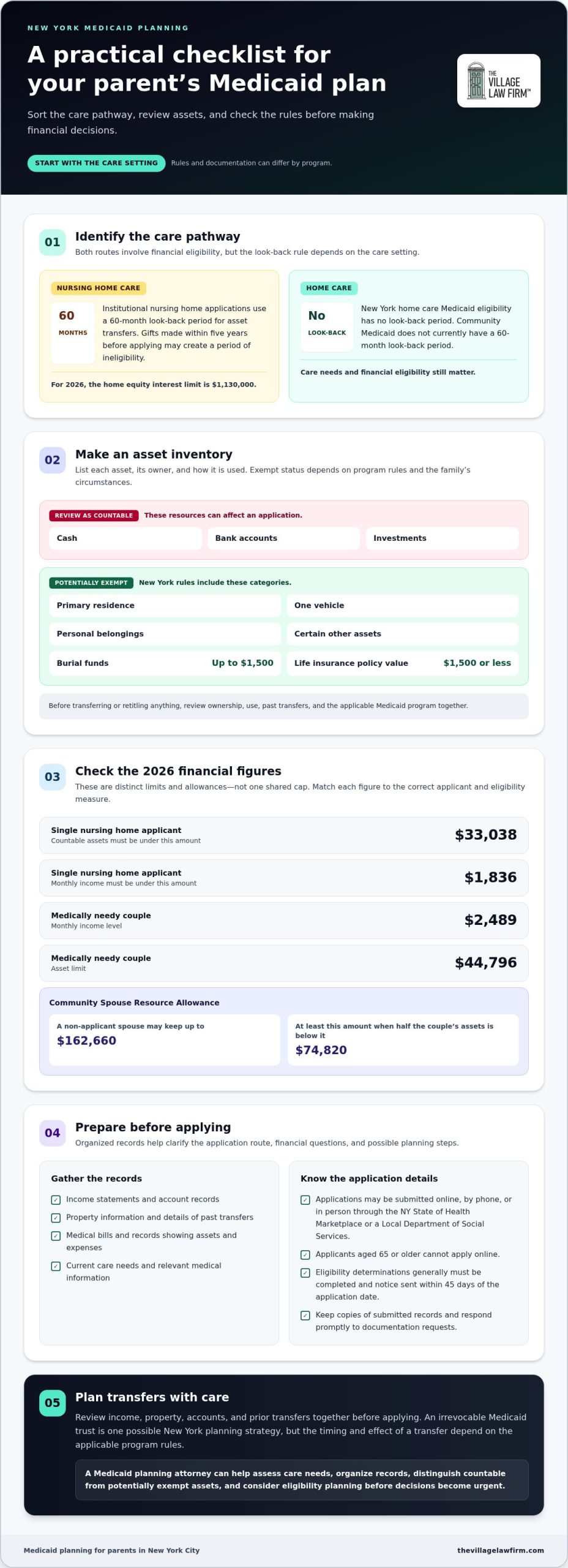
How do Medicaid rules differ for parents seeking nursing home care versus home care in NYC? Nursing home applications have a 60-month look-back period for asset transfers; New York home care Medicaid eligibility has no look-back period. Both routes involve financial eligibility, and the parent’s care needs matter. For nursing home Medicaid in 2026, the home equity interest limit is $1,130,000.
What Medicaid programs in NYC help parents pay for health care and long-term care? Medicaid provides health coverage, including options for community-based home care and nursing home care. Distinguish these pathways early, since the applicable rules and documentation can differ.
Income and Asset Eligibility
Medicaid eligibility considers income and assets, with rules that vary by program and household circumstances. An attorney can help organize financial records and identify resources that count toward eligibility and assets that may be exempt. Reviewing past transfers can also flag potential eligibility consequences before you submit an application.
Bring income statements, account records, property information, and details of past transfers to a consultation. Reviewing them can surface financial questions, assess planning strategies, and clarify next steps for your parent’s care planning.
Countable and exempt assets
New York Medicaid considers an applicant’s countable assets when determining financial eligibility. Cash, bank accounts, and investments can affect an application, while certain property is excluded under program rules. Before transferring or retitling anything, list each asset, its owner, and how it is used.
New York exempts a primary residence, one vehicle, personal belongings, and certain other assets from countable resources. Burial funds up to $1,500 are exempt, as are life insurance policies valued at $1,500 or less. These categories help individuals understand what may be considered, but ownership and eligibility circumstances still matter.
For 2026, a single New York nursing home Medicaid applicant must have countable assets under $33,038. The 2026 medically needy asset limit is $44,796 for a couple. A non-applicant spouse may keep up to $162,660 under the Community Spouse Resource Allowance; the allowance permits the spouse to keep at least $74,820 when half the couple’s assets falls below that amount. These are distinct limits and allowances, not one shared cap.
Institutional nursing home Medicaid applications use a 60-month look-back period. Medicaid reviews asset transfers during that period, and gifts made within five years before applying may create a period of ineligibility. New York community Medicaid does not currently have a 60-month look-back period. The care setting therefore matters before a family makes a transfer.
Asset protection planning should account for both eligibility and the parent’s estate. New York strategies can include transferring assets to an irrevocable Medicaid trust, but the timing and effect of a transfer depend on the applicable program rules. Review income, property, accounts, and prior transfers together, then determine which resources are exempt and which need planning. A focused Medicaid and estate planning review can help families organize those decisions before applying.
Can I Still Access Medicaid Benefits If I Have Assets Or Income Above The Eligibility Limits?
Possibly. New York has eligibility pathways that take income and household circumstances into account, while excess assets may call for planning before you apply.
Income and Asset Limits
For 2026, a single nursing home Medicaid applicant must have countable assets under $33,038 and monthly income under $1,836. New York’s medically needy income level is $2,489 per month for a couple, with a $44,796 medically needy asset limit. These figures apply to different eligibility measures, so identify the care program before comparing finances.
Income above a limit does not always end the inquiry. New York offers a Pooled Income Trust option for people with disabilities whose income exceeds the Medicaid limit. Eligibility also depends on countable assets, care needs, and the program involved.
Application Options and Assistance
New York Medicaid applications can be submitted online, by phone, or in person through the NY State of Health Marketplace or a Local Department of Social Services. Applicants aged 65 or older cannot apply online. Assemble financial statements, medical bills, income records, and other documents showing assets and expenses before completing the Medicaid application.
New York State Department of Health says eligibility determinations generally must be completed and notice sent within 45 days of the application date. Medicaid benefits may cover eligible expenses incurred while an application is pending. Keep copies of submitted records and respond promptly to requests for additional documentation.
Protecting a Spouse’s Income and Assets
How can married couples protect a spouse’s income and assets when one parent applies for Medicaid in New York? In 2026, the Community Spouse Resource Allowance lets a non-applicant spouse keep up to $162,660. If half the couple’s assets is below $74,820, the spouse may keep at least $74,820.
The 2026 Community Spouse Monthly Income Allowance is $4,066.50 per month. Document each spouse’s income, expenses, and jointly held assets to show the household’s financial picture. An attorney can help organize these records and assess which allowances apply to the parent’s Medicaid program and care setting.
Medicaid spend-down planning
A spend-down plan addresses countable resources above Medicaid’s financial limits. It does not simply mean giving assets away. The goal is to use or restructure resources through permitted planning, taking the parent’s care needs, income, household, and application timing into account.
Start with a current balance sheet listing bank accounts, investments, property, monthly income, debts, and expected care services. Then distinguish assets that may be exempt from those that could affect eligibility. New York Medicaid may allow planning through an irrevocable Medicaid trust. People with disabilities whose income exceeds the Medicaid limit may have a pooled income trust option.
Consider practical needs before moving money. Paying existing debts, medical bills, or necessary care expenses can reduce available funds while meeting real obligations. Essential home modifications may also affect how a home is treated during the application process. Keep invoices, account statements, and proof of payment together to document each transaction’s purpose and timing.
Care costs can shape the pace of planning. Compare projected expenses with available income and savings, then map out which resources can fund care while meeting the parent’s day-to-day needs. Avoid rushed gifts: transfers can affect eligibility, and any strategy must account for the applicable Medicaid rules.
Use a written sequence: identify the care setting, calculate countable resources, assess trust or pooled-trust options, document planned expenses, and coordinate the application. Review the plan as care services or finances change. For tailored Medicaid spend-down planning, discuss your parent’s assets, care needs, and timing with an attorney before making transfers.
The Village Law Firm: Estate Planning
The Village Law Firm helps families address Medicaid eligibility and asset protection through Medicaid Planning and Estate Planning. Turn to the firm when a parent’s care needs are changing, an application is approaching, or you need to coordinate long-term care decisions with your family’s estate plan.
A thoughtful review can bring together financial information, care goals, and existing estate documents. It can also identify where planning for a parent’s needs intersects with Planning For Families with Children. If your family is managing an estate after a loss, Estate Administration can help with the next stage.
Share your parent’s care concerns and planning priorities with The Village Law Firm. Contact the firm to discuss your family’s next step.
Make the Next Decision With Clarity
Start a focused conversation with your parent about their priorities: the care they want, the people they trust to help, and the decisions they want documented. Discussing this now can make future choices easier to organize, even if care needs are still evolving.
Medicaid planning for parents in NYC can connect immediate care considerations with broader family and legacy decisions. The Village Law Firm offers Medicaid Planning, Estate Planning, and Estate Administration to help families address planning needs as circumstances change. Bring your questions and the information you have; a thoughtful discussion can help clarify what to focus on first.
Contact The Village Law Firm to discuss your family’s planning needs. A considered next step can help you move forward with greater confidence.
Frequently Asked Questions
Can I Transfer Assets To My Family Members To Meet Medicaid Eligibility Requirements?
Transferring assets to relatives can affect eligibility, especially for nursing home Medicaid. New York reviews transfers made within its 60-month look-back period for institutional applications. A penalty period isn’t applied when a home is transferred to a spouse or a child under age 21. Before changing ownership or giving property away, document the proposed transfer and consider how it relates to the parent’s care needs.
If my parent moves from another state to New York, can they still keep their Medicaid?
No. Medicaid benefits do not automatically transfer between states, and a person cannot be enrolled in two states at once. Your parent should confirm the steps for applying in New York before submitting an application. The timing of disenrollment can depend on the state’s process, so confirm when coverage will end. Once New York residency is established, the state cannot impose a waiting period for coverage.
Will My Assets Prevent Me From Qualifying For Medicaid?
Not necessarily. New York Medicaid excludes certain property from countable assets, but eligibility also depends on income, care setting, and the applicable program. A parent’s home, for example, may be treated differently from cash in an account. List each asset’s owner, title, and use to help distinguish available resources from property that may be excluded under the relevant rules.
Are There Pitfalls You Need to Avoid?
Yes. Avoid undocumented gifts, rushed changes to property ownership, and assuming home care and nursing home applications follow identical transfer rules. Keep statements, receipts, and transfer records together so financial transactions can be explained during the application process. Also account for estate recovery: New York may seek repayment for covered services received on or after a recipient’s 55th birthday, or during permanent residence in a medical institution.
How Can I Avoid Medicaid Penalties?
Reduce penalty risk by reviewing proposed gifts and transfers before making them, particularly if nursing home care is possible. New York examines institutional applicants’ transfers during the five years before application. Keep the parent’s care needs and financial records central to each decision. A home transfer to a spouse or child under age 21 isn’t subject to a penalty period under the stated New York rule.
How do I apply for Medicaid?
Choose the application route based on your parent’s circumstances: New York Medicaid applications may be submitted online, by phone, or in person through the NY State of Health Marketplace or a Local Department of Social Services. Applicants aged 65 or older can’t apply online. Gather identity, income, asset, and medical records first. New York City residents can contact HRA about applying at 718-557-1399.