
A life estate deed can keep a home outside probate, but it may affect Medicaid eligibility in New York. The deed transfers a remainder interest to heirs, and that transfer is reviewed under the five-year look-back for nursing home Medicaid. The deed may also affect estate recovery, while a later sale can change how the proceeds are treated when eligibility is assessed.
A life estate deed may seem like a way to pass a home to family while keeping the right to live there. But life estate deed and Medicaid planning in New York involve important trade-offs around control, sale proceeds, and timing.
This article explains how a life estate deed and Medicaid planning in New York intersect, including the five-year look-back, home-sale proceeds, and estate recovery. It also covers trust planning as an alternative, so you can understand the trade-offs before deciding how to plan for your home.
Key Takeaways
- A life estate deed transfers a remainder interest, which may count as a gift for New York’s nursing home Medicaid look-back rules.
- Selling the home generally requires both the life tenant’s and remaindermen’s consent, and proceeds may be divided between them according to their interests.
- Proceeds from a home sale can affect Medicaid eligibility, so consider how the sale and resulting funds fit into the broader plan.
- A Medicaid Asset Protection Trust is an alternative to explore; the home generally needs to be transferred to it at least five years before applying for Medicaid.
Will a Life Estate Deed Protect My Home From Medicaid?
A New York life estate deed divides property interests: the life tenant retains the right to live in the home, while remaindermen receive a future interest. The deed can help the home pass outside probate, but it does not automatically prevent Medicaid penalties or estate recovery. For Medicaid planning in New York, both the transfer date and the value of the remainder interest matter.
Probate Avoidance and Estate Recovery
A life estate can allow the property to pass automatically to remaindermen when the life tenant dies, avoiding probate for that home. This distinction matters because New York Medicaid estate recovery may reach assets in a recipient’s probate estate, including a house. A life estate deed for Medicaid planning in New York may place the home outside that estate, but it doesn’t erase every recovery concern.
If the recipient held an interest in real property at death, Medicaid may place a lien on it. Recovery is limited to the lien amount or available estate assets, whichever is less, and follows funeral expenses, estate administration costs, and federal liens. The claim applies to estate assets, not beneficiaries’ personal funds.
Creation Costs and Risks
Creating a deed means identifying the life tenant and remaindermen, preparing the transfer document, and recording it. New York’s recording-related statute is N.Y.S. (RPP) Chapter 50, Article 8 § 243. The deed should be recorded more than five years before applying for nursing home Medicaid to avoid a transfer penalty. The remainder’s value counts in the look-back calculation.
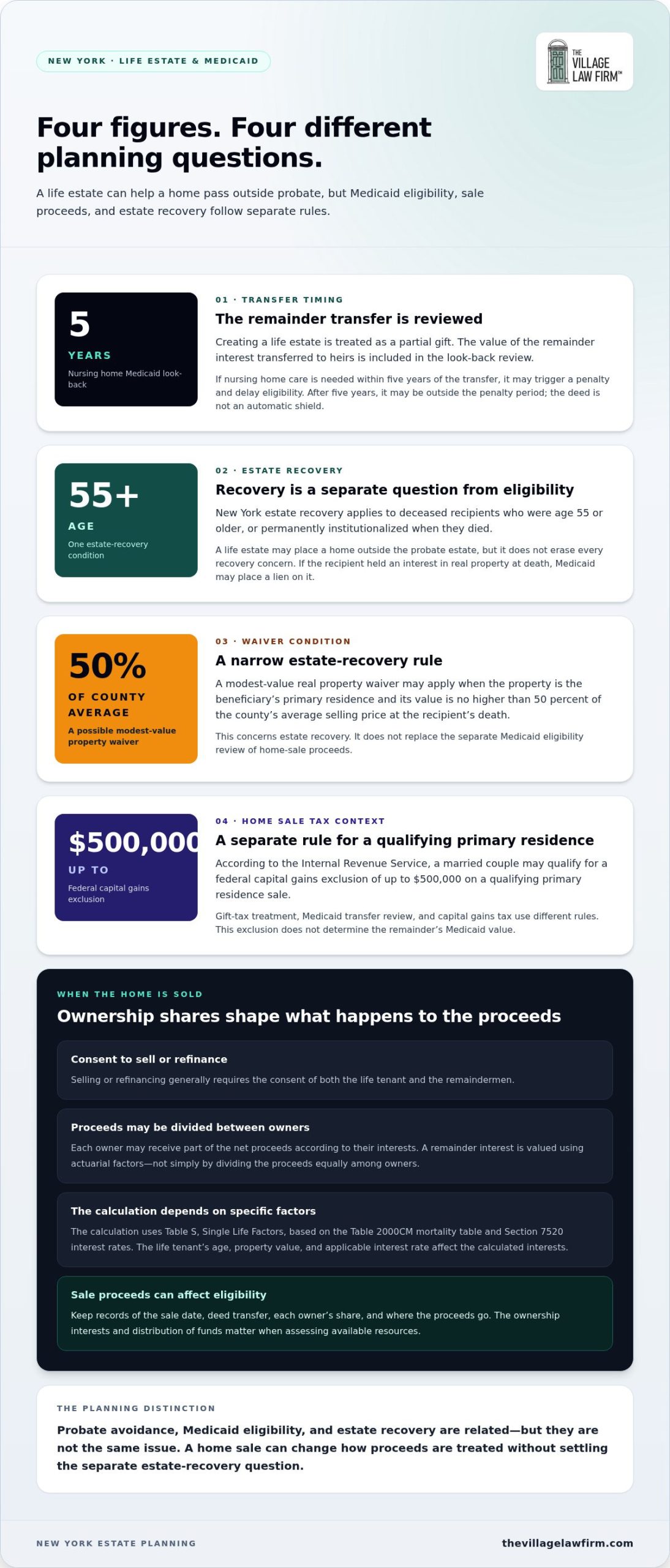
According to the Internal Revenue Service, a married couple may qualify for a federal capital gains exclusion of up to $500,000 on a qualifying primary residence sale.
The life tenant remains responsible for property expenses, including taxes, for life. Selling or refinancing generally requires the consent of both the life tenant and the remaindermen. The remaindermen’s interest may be exposed to their creditors or a divorcing spouse, and transferring the deed back can be difficult if they refuse.
Medicaid eligibility after a life estate home sale
Selling a New York home can change both Medicaid eligibility and how sale proceeds are treated. The five-year look-back, transfer history, ownership interests, and distribution of proceeds all matter.
The rules discussed here are statewide New York Medicaid rules. A county’s average home-sale price may matter separately when considering a modest-value property waiver for estate recovery.
Eligibility After a Home Sale
When a life-estate property sells, the proceeds may become an available resource for Medicaid eligibility and estate recovery. The planning question then shifts from who owns the home to who receives the money and how those funds affect eligibility.
For nursing home coverage, New York applies a five-year look-back to asset transfers. Keep records of the sale date, deed transfer, each owner’s share, and where the proceeds go. These details help distinguish sale proceeds from an earlier transfer and identify the assets still available to the applicant.
New York Medicaid estate recovery applies to deceased recipients who were age 55 or older, or permanently institutionalized when they died. Eligibility for coverage and later estate recovery are separate issues, so a sale that affects one does not by itself settle the other.
Gift Penalties and Eligibility
A gift penalty may apply when an applicant transferred assets for less than fair market value within the five-year look-back period. Creating a life estate is treated as a partial gift, and the remainder interest transferred to heirs is included in the transfer review.
If nursing home care is needed within five years of creating the life estate, the transfer may trigger a penalty and delay eligibility. After five years, it may be outside the penalty period. Medicaid planning should account for both the original transfer and any later sale, rather than treating the deed as an automatic shield.
For estate recovery, New York may waive recovery in whole or in part when it would cause undue hardship to an heir, survivor, or beneficiary. A modest-value real property waiver may also apply when the property is the beneficiary’s primary residence and its value is no higher than 50 percent of the county’s average selling price as of the recipient’s death. These recovery rules do not replace the separate eligibility review of sale proceeds.
Life estate and remainder interests in home-sale proceeds
When a life-estate home sells, the life tenant and remaindermen may each receive part of the net proceeds. Their shares reflect separate ownership interests, so the sale agreement alone does not establish how the funds should be allocated.
For Medicaid purposes, the remainder interest is valued using actuarial factors, not simply divided by the number of owners. The calculation uses Table S, Single Life Factors, based on the Table 2000CM mortality table and Section 7520 interest rates. The life tenant’s age, the property’s value, and the applicable interest rate affect the calculated interests.
Those figures illustrate how the allocation can differ from an equal split; they are not a universal formula.
Gift-tax treatment and Medicaid treatment are separate questions. The remainder transferred to heirs is a gift for Medicaid transfer review, while federal gift-tax rules use their own framework. Federal gift-tax rules include an annual exclusion for gifts to each recipient. That figure does not determine the remainder’s Medicaid value, which follows the actuarial calculation.
Inheritance and capital gains tax also require attention. After the life tenant dies, the property passes automatically to the remaindermen without probate. Under current tax law, heirs receiving property gifted with a retained life estate get a stepped-up basis to its value on the owner’s date of death. Sections 1014 and 2036 of the Internal Revenue Code relate to these tax considerations.
Before a sale, keep the deed, valuation, closing statement, and distribution records together. These documents show each person’s ownership share and how the proceeds were handled. They can clarify the transaction during later tax reporting, inheritance administration, or Medicaid review.
Trust planning as an alternative to life estate deeds
A Medicaid Asset Protection Trust offers another way to plan for a New York home without directly transferring a remainder interest to named heirs. The trust may protect the home if established at least five years before applying for Medicaid. That timing matters because an earlier transfer can affect nursing home eligibility.
Compare how each approach handles ownership and future decisions. A life estate deed gives the life tenant lifetime rights and names remaindermen, while a trust holds the home under its terms. The effect of a life estate deed on Medicaid planning in New York depends on timing, ownership, and family goals. Neither structure automatically resolves every Medicaid concern.
Include your family’s likely needs in estate planning. If your children are intended to inherit, weigh their interests alongside your right to remain in the home. Consider what could happen if you want to sell, refinance, or take out a mortgage. A life estate deed and Medicaid eligibility in New York may raise different practical questions from trust ownership when circumstances change.
Timing deserves close attention. If a Medicaid application may be needed before five years have passed, a trust transfer can fall within the look-back period. A later sale can also raise questions about ownership and proceeds. Compare the anticipated care timeline with the transfer date and any plans to sell the home.
Tax planning belongs in the same discussion. A qualifying primary residence sale may have federal capital gains consequences, while Medicaid transfer rules separately review asset transfers. Tax treatment does not determine Medicaid eligibility, and a Medicaid strategy does not settle capital gains tax.
Write down who should benefit, how a future sale would work, and what decisions you want to retain. Start mapping your home-protection plan around those priorities.
The Village Law Firm: Estate Planning
The Village Law Firm helps New Yorkers consider how a home transfer fits into their estate and Medicaid planning. If you are weighing a life estate deed against a trust, the firm can help you assess how each approach relates to your home, potential care needs, and plans for your family.
Estate Planning and Medicaid Planning bring ownership, timing, and inheritance questions into one discussion. Estate Administration may also be relevant when a family is handling a loved one’s estate. For families with children, planning can account for their interests alongside the homeowner’s needs.
Contact The Village Law Firm to discuss your estate planning options.
Plan for the choices ahead
Choosing a life estate deed for Medicaid planning in New York is more than a property decision. It is also a decision about what should guide your family if circumstances change. Before settling on a structure, rank your priorities: control of the home, flexibility to respond to future needs, and how value should pass to loved ones.
Turn those priorities into clear questions. Which decisions must remain yours? What changes would make you reconsider the arrangement? How should your plan respond if family needs or care plans shift? These questions can make a complex legal choice more deliberate and help everyone understand the purpose of the plan.
The Village Law Firm can help bring those questions into a plan shaped around your goals and family circumstances. Whether you’re considering a deed, a trust, or revisiting an existing plan, arrange a planning conversation to consider your next steps. Thoughtful planning can give your family a clearer path forward.
Frequently Asked Questions
What is Estate Recovery?
Estate recovery is New York Medicaid’s effort to recoup certain benefits from a deceased recipient’s estate. It may matter when someone dies after receiving covered care, because estate assets can be subject to a claim. For example, an estate representative may need to account for a house or other probate property. A surviving spouse or qualifying child can affect when recovery proceeds.
How does a life estate deed affect Medicaid eligibility in New York?
A life estate deed can affect eligibility because transferring the remainder interest to heirs is treated as a partial gift. If a homeowner signs a deed before applying for nursing home Medicaid, for example, the transfer’s value and date become relevant to the eligibility review. Keep the recorded deed and property valuation with other asset records to document the transaction and its timing.
Does transferring a home with a life estate deed trigger New York Medicaid’s five-year look-back period?
Yes. New York reviews asset transfers made within the five-year look-back when someone applies for nursing home Medicaid. The remainder interest transferred through the deed is included in that review. A deed transfer within that period may lead to a penalty if the home interest was transferred for less than fair market value. The deed date is therefore essential.
How does New York Medicaid calculate the penalty period for a life estate deed transfer?
New York bases the penalty review on the uncompensated value of the transferred interest and applicable Medicaid rules. The remainder’s value, rather than automatically the home’s full value, is relevant to a life estate transfer. Medicaid regulations address uncompensated transfers in 18 N.Y.C.R.R. § 360-4.4(c)(2)(i) (f). The transfer amount and governing calculation determine the resulting penalty period.
Can a life estate deed protect a New York home from Medicaid estate recovery?
A life estate deed can keep the home outside the recipient’s probate estate when the life tenant dies, but that does not remove every estate recovery concern. If the recipient still held an interest in real property at death, New York Medicaid may place a lien on it. Distinguish the probate-avoidance result from the separate question of whether a lien or recovery claim applies.
How does a life estate deed compare with a Medicaid asset protection trust in New York?
A life estate deed transfers a remainder interest directly to named heirs, while a Medicaid Asset Protection Trust holds the home in a trust. Either approach involves a transfer that must be considered under the five-year look-back. Before choosing an estate-planning structure, compare who will hold title, how a future sale would be handled, and how the plan fits your care timeline.