
Imagine the peace of mind that comes from knowing your family is secure, only to realize a villa in Italy or a business in London could be frozen for years due to a conflict between New York probate and foreign inheritance laws. For global citizens, assets across borders are often governed by contradictory rules that don’t care about your intentions. You likely feel that managing a legacy across different jurisdictions should be more seamless than it currently feels. We understand the anxiety of facing double taxation or the fear that your children might lose their inheritance to legal chaos. This 2026 guide to international estate planning offers a sophisticated, unified strategy to replace that uncertainty with a sanctuary of legal order.
You deserve a plan that honors your hard work without leaving your heirs to untangle global red tape. We’ll show you how to leverage the 2026 federal exemption of $15 million and navigate the New York estate tax cliff, which sits at $7,350,000 this year. This preview of cross-border strategy will help you minimize tax liabilities and protect your heirs regardless of geography. Let’s transform your complex holdings into a clear, protected legacy that stands firm against future uncertainty.
Key Takeaways
- Discover why 2026 is a critical year for tax transparency and how to coordinate conflicting legal systems to protect your global legacy.
- Learn the vital difference between “situs” and “domicile” to ensure your New York residency doesn’t lead to unexpected tax or probate traps.
- Protect your family from forced heirship rules in civil law countries by implementing a sophisticated, unified legal strategy.
- Explore the “two-will” strategy and the role of Qualified Domestic Trusts in a comprehensive approach to international estate planning.
- Gain the peace of mind that comes from replacing cross-border complexity with a meticulous, white-glove plan designed for your family’s security.
What is International Estate Planning and Why Does it Matter in 2026?
International estate planning is far more than just drafting a document. It’s the meticulous coordination of legal systems to protect assets that span multiple borders. While a local plan might address your Manhattan condo or your Brooklyn brownstone, a global strategy accounts for the complex interplay between U.S. law and the regulations of your home country or investment sites. Think of it as a bridge over jurisdictional chaos. We focus on building that bridge with you, ensuring your legacy remains intact regardless of where your assets are physically located.
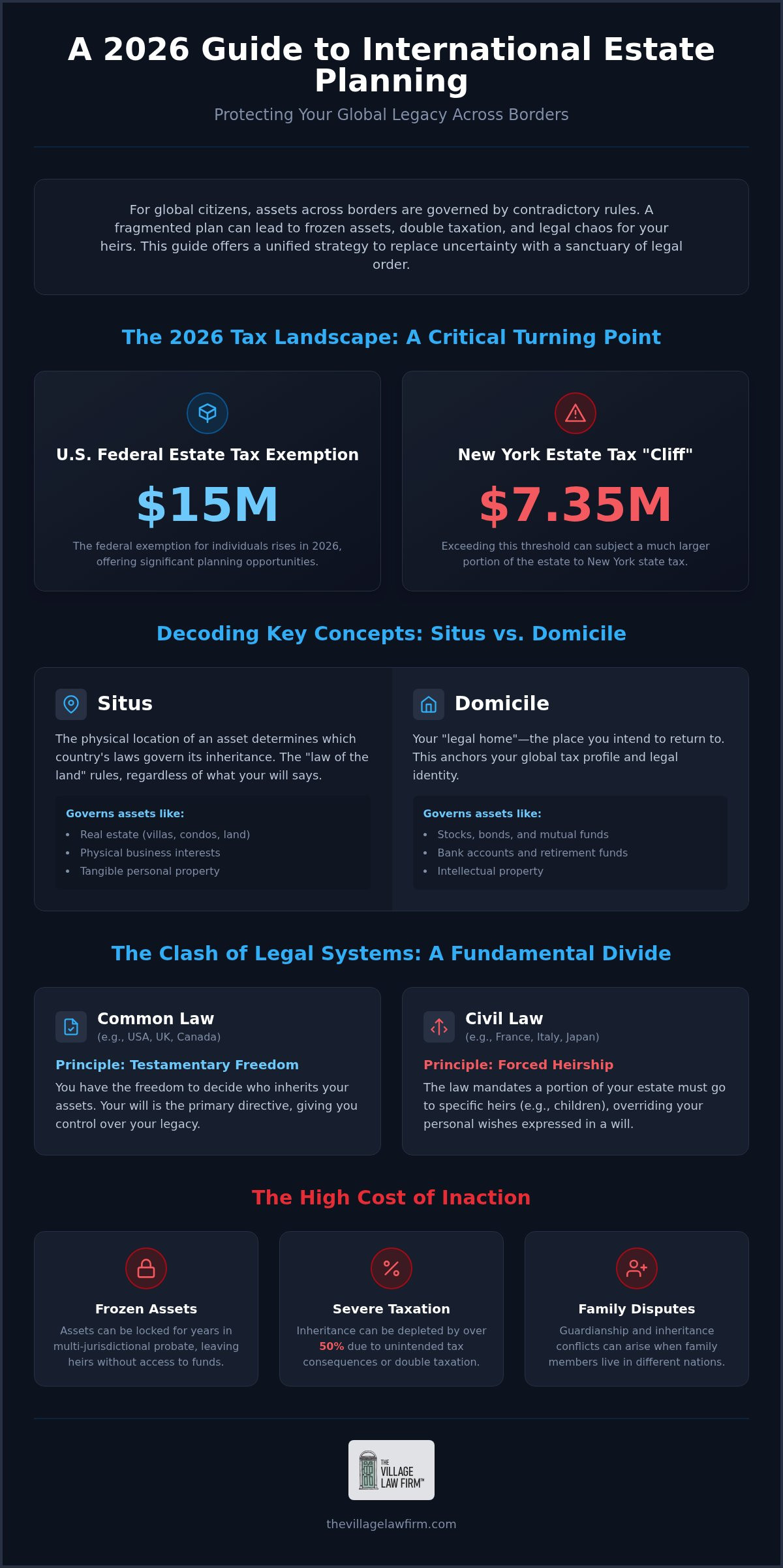
The year 2026 marks a turning point for global citizens. As tax transparency standards shift worldwide, the margin for error has disappeared. In the United States, the federal estate tax exemption has risen to $15 million for individuals, but the New York estate tax cliff remains a sharp trap for the unwary at $7,350,000. For those with assets in Europe, Asia, or South America, these numbers are only half the story. You need a shield that accounts for how these jurisdictions talk to each other. This isn’t just about wealth; it’s about the security of the people you love.
The Global Footprint: Who Needs an International Plan?
You might assume this level of planning is only for the ultra-wealthy, but the modern world has made global citizens of us all. If you are an expat living in New York with property or bank accounts back home, your estate is international. New York residents who expect to inherit from foreign relatives or who have children living abroad also fall into this category. Even something as simple as a vacation home in France or a retirement account in London requires a strategy that spans the Atlantic. We help you identify these touchpoints before they become complications.
The High Cost of Inaction
The consequences of a fragmented plan are both financial and emotional. Without a unified approach, assets can be frozen for years during a multi-jurisdictional probate process, leaving your heirs with limited access to necessary funds. In some cases, unintended tax consequences or double taxation can deplete an inheritance by over 50 percent. Perhaps most importantly, families with children face the risk of legal guardianship disputes if guardians and children reside in different nations. Utilizing specific legal instruments, such as International Wills, can help mitigate these risks by providing a document recognized across various treaty nations. We work to replace this potential chaos with a sanctuary of order, protecting your family’s future with precision and care.
Navigating the Conflict of Laws: Situs, Domicile, and Residency
The collision of different legal jurisdictions creates a friction that can feel overwhelming for global families. When your life spans continents, your legal identity must be clearly defined to prevent cross-border confusion. This begins with understanding “situs,” the rule that the physical location of real property determines which laws govern its inheritance. If you own a villa in Spain or a pied-à-terre in Paris, the laws of those specific countries will likely dictate the property’s future, regardless of what your New York will says. Real estate is always tethered to the dirt it sits on.
Domicile is the place you intend to return to, which anchors your legal identity. This single concept is the heartbeat of your global tax profile. While you might reside in several cities throughout the year, New York law looks for your permanent home to determine its jurisdiction over your global intangible assets. Stocks, bonds, and bank accounts are generally taxed and governed by the laws of your domicile. This makes the subtle distinction between residency and domicile a high-stakes calculation for any global citizen, as it determines which government has the final say over your wealth.
The New York Perspective on Global Assets
New York courts are accustomed to international residents, but the probate process remains rigorous and exacting. When a non-citizen or out-of-state resident passes away with assets in the Empire State, the family often must navigate ancillary probate in New York. This secondary court process is necessary to unlock local assets like Manhattan real estate or local business interests. It requires a high level of coordination between your New York attorney and local counsel in the “situs” country. We act as your steady urban guide in these matters, ensuring that foreign wills are properly authenticated and that your New York documents carry the weight they need abroad.
Tax Treaties: Your Shield Against Double Taxation
Double taxation shouldn’t be the price you pay for a global life. The U.S. maintains a robust network of estate tax treaties designed to prevent two nations from taxing the same dollar. These treaties are essential tools in modern international estate planning, providing clarity on which nation has the primary taxing right. As highlighted by Forbes on International Estate Planning, maintaining control and financial security requires a proactive approach to these shifting international rules.
In 2026, we also focus on the evolving “situs” rules for digital assets and complex securities. Ensuring your cryptocurrency and global portfolios are protected requires meticulous attention to detail. A significant part of this strategy involves managing your exposure to the New York estate tax exemption 2025. With the 2026 exemption set at $7,350,000, falling over the “cliff” can trigger a tax on the entire estate. Effective international estate planning serves as a shield against such outcomes, replacing jurisdictional chaos with a sanctuary of legal order.
Common Law vs. Civil Law: Avoiding the Trap of Forced Heirship
One of the most significant challenges in international estate planning is the fundamental divide between Common Law and Civil Law systems. In New York, we operate under a Common Law tradition that prizes testamentary freedom. You generally have the right to decide exactly who receives your assets. However, much of Europe, Latin America, and parts of Asia follow Civil Law traditions that prioritize the family unit over individual preference. This isn’t just a technical difference; it’s a completely different philosophy of legacy that can catch global citizens off guard.
This divide often leads to a legal mechanism known as forced heirship. Under these rules, a foreign government mandates that a specific portion of your estate must pass to “protected heirs,” such as children or a spouse, regardless of what your will says. For a New York resident with a villa in Italy or a business in France, this can feel like a violation of your personal wishes. The emotional weight of this conflict is heavy. You might intend to provide more for a child with special needs or protect a partner, only to find a foreign statute overrides those intentions. We help you navigate these tensions by using specific trust structures and “situs” wills to reclaim control over your global assets through comprehensive international estate planning.
The Hague Convention on Wills
You might wonder if your New York will even “counts” in a civil law country. The answer often depends on the Hague Convention on the Form of Testamentary Dispositions. This international treaty ensures that a will is recognized as valid if it complies with the laws of the place where it was signed. To provide even greater security, we often utilize “International Wills.” These are specific legal instruments created under a 1973 convention that follow a strict, universally recognized format. Using these tools ensures your documents aren’t dismissed by foreign courts on a technicality, providing a sanctuary of order for your heirs.
Dual Citizenship and Conflicting Mandates
For those holding multiple passports, the complexity doubles. Effective dual citizen estate planning New York requires a deep understanding of how your second country views your global wealth. Some nations employ “clawback” provisions, which allow them to reach back and pull previously gifted assets into the estate for tax or heirship calculations. To counter this, we meticulously draft choice-of-law clauses. These clauses tell foreign courts that you want New York law to govern your assets whenever possible. It’s a proactive way to shield your legacy from conflicting mandates and ensure your family remains protected according to your specific values.
The Global Toolkit: International Wills, Trusts, and Treaties
Building a global legacy requires a specialized toolkit that moves beyond standard documents. We often recommend a “Two-Will” strategy for our clients with significant cross-border holdings. By maintaining a New York will for domestic assets and a separate “situs” will for foreign property, you can streamline the probate process in both jurisdictions. This prevents a legal bottleneck in one country from freezing your entire estate. It’s a method that provides immediate clarity to executors and heirs alike, ensuring your wishes are carried out without years of delay.
For families with non-citizen spouses, the Qualified Domestic Trust (QDOT) is an essential instrument. Without it, you may lose the unlimited marital deduction, leading to a significant tax burden upon the first spouse’s death. We also use life insurance as a strategic tool to equalize inheritances across borders. If a foreign property is subject to heavy taxes or the forced heirship rules we discussed previously, an insurance payout can provide the necessary liquidity to ensure every child receives their fair share. Whether you choose offshore or domestic trusts, the goal remains the same: protecting your family from unnecessary complexity.
Structuring for Foreign Assets
Managing a global portfolio requires a proactive approach to estate planning for foreign assets. In some cases, we use holding companies to “domesticate” foreign real estate. This effectively turns a physical villa or commercial property into a corporate interest, which is often easier to transfer under New York law. This strategy is particularly effective for high-net-worth individuals who value privacy and simplified administration. As we move through 2026, we also incorporate specific protocols for digital assets and cryptocurrency. These assets exist everywhere and nowhere at once, making clear access instructions and jurisdictional designations vital for your heirs.
Guardianship for the Global Family
Family security is the heartbeat of a successful plan. If you have children, appointing guardians across different legal jurisdictions requires meticulous care. A guardian who is a perfect fit in New York might face legal hurdles if the children are citizens of another nation. We help you draft both temporary and permanent guardianship documents to ensure there is never a gap in care. For a deeper look at how to protect your children within the New York legal framework, our guide on estate planning for families with children NYC provides essential strategies for appointing guardians with precision and shielding your assets from the New York Tax Cliff. This provides a sanctuary of order during the most difficult transitions, ensuring your children are protected regardless of where they are in the world. If you’re ready to secure your family’s future, our team is here to provide the international estate planning expertise you need.
Securing Your Global Legacy with The Village Law Firm
Complexity shouldn’t be a barrier to your peace of mind. We’ve explored the intricate webs of tax treaties, forced heirship, and conflicting legal systems that define modern international estate planning. While these challenges are significant, they aren’t insurmountable when you have a steady urban guide by your side. Our role is to act as the bridge between the chaos of global regulations and the sanctuary of legal order you deserve. We take the weight of these cross-border complexities off your shoulders, allowing you to focus on the life you’re building today.
Our process begins with a comprehensive global asset audit. We meticulously examine every piece of your legacy, from New York real estate to foreign business interests and digital holdings. This methodical approach is the hallmark of our international estate planning strategy, ensuring that no detail is overlooked and no jurisdiction is left uncoordinated. By partnering with trusted foreign counsel in the “situs” countries where your assets reside, we ensure a seamless execution of your wishes. You gain a unified strategy that works across borders, replacing anxiety with a sense of profound security.
White-Glove Service for Busy Global Professionals
We understand that your time is your most valuable asset. Our white-glove service is designed for busy professionals who require efficiency without sacrificing meticulous attention to detail. We provide direct access to sophisticated legal counsel in the heart of New York, offering a level of transparency and responsiveness that high-stakes planning demands. Every decision is framed through the lens of its practical and emotional benefits, ensuring you feel seen and understood throughout the process. We pride ourselves on removing the friction from legal mechanics, delivering a premium experience that honors your achievements.
A Partnership for the Future
A true legacy isn’t built on a stack of documents; it’s built on a foundation of unwavering protection. We view our relationship with you as a long-term partnership rather than a one-time transaction. This commitment extends to the next generation, providing support for administering US estate for foreign beneficiary needs when the time comes. We build a protective shield around your family, combining technical precision with a deeply human touch. Your global journey is unique, and your estate plan should be a reflection of that path. Schedule a consultation with The Village Law Firm to secure your international legacy.
Protecting Your Legacy Across Every Border
Your global life is a testament to your ambition. It shouldn’t be overshadowed by the stress of foreign probate or the complexity of conflicting tax codes. By coordinating your New York domicile with the specific rules governing your foreign assets, you create a clear path for your heirs. Whether you’re navigating the 2026 tax landscape or shielding your family from forced heirship, a unified strategy is your strongest asset. This is the core of effective international estate planning; replacing cross-border chaos with a sanctuary of order.
We’re here to serve as your steady urban guide through these high-stakes decisions. Our firm provides specialized expertise in cross-border probate and a premium white-glove service tailored for New York’s busy professionals. We believe in an empathetic, partnership-based approach that turns global anxiety into methodical security. You’ve worked hard to build a life without borders. Let’s make sure your legacy is just as limitless.
Secure Your Global Legacy with a Sophisticated International Estate Plan
Frequently Asked Questions
Do I need a separate will for every country where I own property?
You often benefit from having separate wills for different jurisdictions. This “two-will” or “multi-will” strategy ensures that each document complies with local formalities and is recognized immediately by foreign courts. It prevents a legal bottleneck in New York from freezing your assets in Paris or Tokyo, providing your heirs with faster access to their inheritance without the need for extensive international authentication processes.
Will my New York trust protect my real estate located in Europe?
A New York trust may not provide the protection you expect for European real estate. Many civil law jurisdictions do not recognize the trust as a legal owner of land, which can lead to significant administrative hurdles or even the trust being ignored by local courts. In these cases, we often use holding companies or specific local instruments to achieve your asset protection goals while maintaining a unified strategy.
How does U.S. estate tax apply to non-citizens living in New York?
U.S. estate tax applies to your global assets if you are considered a “resident alien” domiciled in New York. For 2026, the federal exemption is $15 million per individual, but if you are not domiciled in the U.S., that exemption drops significantly for your U.S.-situs assets. We carefully review your domicile status to ensure you don’t face unexpected tax liabilities on your international holdings due to your residency status.
What is forced heirship and can a New York will override it?
Forced heirship is a legal requirement in many countries that mandates a portion of your estate go to specific relatives, such as children or a spouse. While a New York will is powerful, it generally cannot override these rules for real estate located in a country that enforces them. We use sophisticated international estate planning techniques, such as specific choice-of-law clauses and trust structures, to maximize your control over your legacy.
Can I appoint a guardian for my children who lives in another country?
You can absolutely appoint a guardian living abroad, but it requires a coordinated legal approach to be effective. New York courts generally respect your choice, but the guardian’s home country must also recognize the appointment for it to be valid there. To better understand the immigration and family law aspects of these arrangements, you can find out more about specialized legal representation. We help you draft temporary and permanent guardianship documents to ensure your children are protected and that their financial support remains accessible regardless of which border they cross.
What happens if I have assets in a country that does not recognize trusts?
If a country doesn’t recognize trusts, your assets there might be treated as if the trust doesn’t exist, potentially triggering local intestacy laws. This often results in the property passing according to local inheritance rules rather than your specific instructions. To solve this, we often place the asset within a corporate entity that the foreign jurisdiction recognizes, effectively “domesticating” the asset to ensure it follows your intended plan.
How do tax treaties affect my international estate plan in 2026?
Tax treaties act as a vital shield, ensuring you aren’t taxed twice on the same dollar by different nations. In 2026, these treaties are more important than ever as global transparency standards increase and reporting requirements become more stringent. They provide clarity on which country has the primary right to tax specific assets, allowing us to structure your international estate planning to minimize your overall tax exposure and protect your wealth.
How often should I update my international estate plan?
You should review your plan at least every three to five years or whenever there is a significant change in your family or the laws of the countries where you hold assets. With the major shifts occurring in 2026 regarding tax exemptions and global reporting standards, now is a critical time for a comprehensive audit. Regular updates ensure your legacy remains resilient against shifting global regulations and that your sanctuary of order stays intact.