

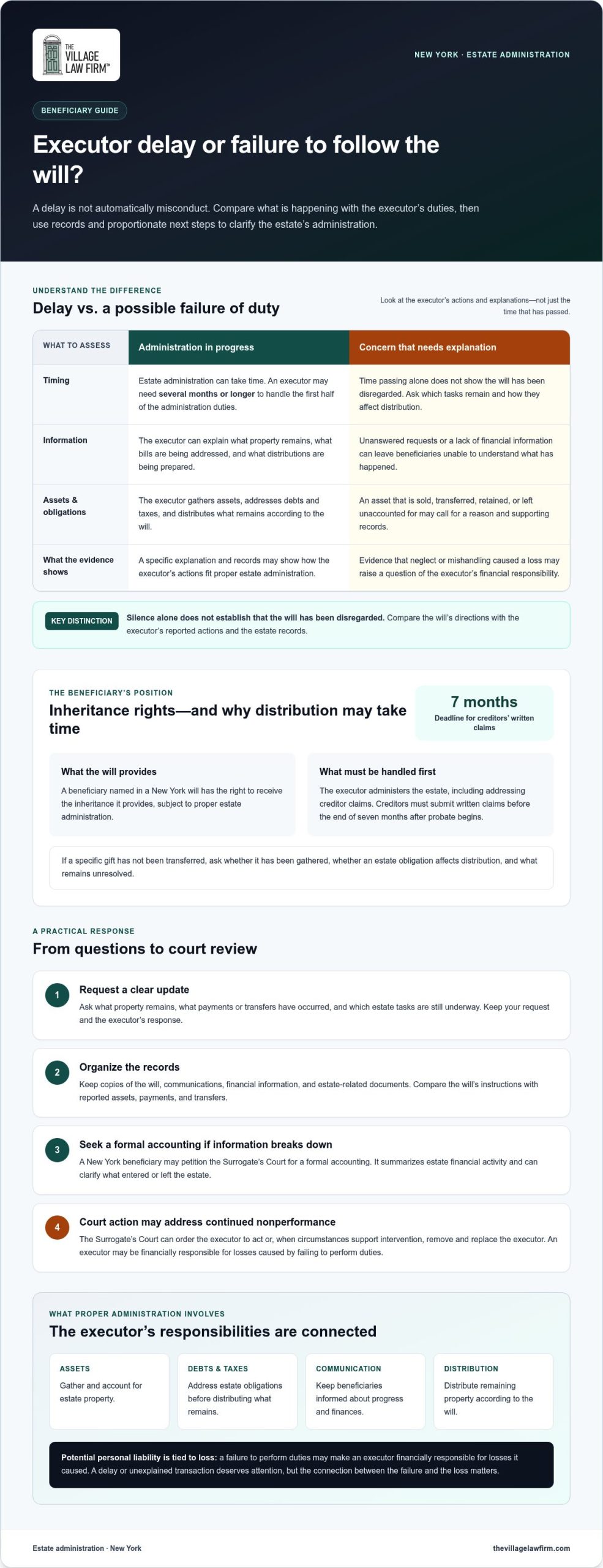
If you’re asking what happens if an executor does not follow a will in NY, the Surrogate’s Court can order the executor to act or remove and replace them. An executor may also be financially responsible for losses caused by failing to perform their duties. Beneficiaries named in the will are entitled to the inheritance it provides, subject to proper estate administration.
It’s understandable to feel unsettled when an estate isn’t being handled as the will directs. You’ll learn what an executor is responsible for, what beneficiaries can do when assets aren’t distributed, and how court action may lead to an accounting, compliance, or a replacement executor. The key is to distinguish an ordinary delay in estate administration from conduct that may put the estate or its beneficiaries at risk.
Key Takeaways
- Beneficiaries can request progress updates and financial information, and may petition the Surrogate’s Court for a formal accounting if communication breaks down.
- An executor must administer the estate according to the will; failing to meet those duties can expose the executor to financial responsibility for resulting losses.
- Keep relevant records, including communications and estate-related financial documents, to help show what has happened and where concerns remain.
- Beneficiaries can ask the Surrogate’s Court to compel action or seek the executor’s removal and replacement when the circumstances support court intervention.
- Understanding the difference between a delay and a failure to perform duties can help you choose a proportionate next step.
What if an Executor Won’t Distribute Assets?
If you’re asking what happens if an executor does not follow a will in NY, start by requesting an update and information about the estate’s finances. If the executor does not keep beneficiaries informed, a New York beneficiary may petition the Surrogate’s Court for a formal accounting.
Access to Updates and Financial Records
Beneficiaries may request updates on the executor’s progress and ask for financial records and other estate information. These details can show whether assets are being gathered, bills addressed, and distributions prepared. Ask specific questions, such as what property remains in the estate and what payments or transfers have occurred. Keep your request and the executor’s response so you can track what has been explained.
Requests for Information and Accountings
An accounting summarizes the estate’s financial activity and helps beneficiaries understand how money and property have been handled. You can first ask the executor for an update and relevant financial information. If the executor does not keep beneficiaries informed, a New York beneficiary may petition the Surrogate’s Court for a formal accounting. It can clarify what entered or left the estate and identify transactions that need an explanation.
Rights to Inheritance
A beneficiary named in a New York will has the right to receive the inheritance it provides. That does not mean every asset must be distributed immediately. The executor must administer the estate, including addressing creditor claims. According to the New York State Legislature, creditors must submit written claims to the executor before the end of seven months after the probate process begins.
For example, a will may leave a specific asset to one beneficiary and the remainder to others. If that asset has not been transferred, ask whether it has been gathered, whether an estate obligation affects distribution, and what remains unresolved. A written request creates a record and gives the executor an opportunity to explain. Silence alone does not establish that the will has been disregarded.
Administration can take time. An executor may need several months or longer to handle the first half of estate-administration duties. Ask which tasks remain and how they affect the inheritance. Understanding what happens if an executor does not follow a will in NY also means distinguishing routine administration from an unexplained failure to act.
Keep copies of the will, your requests, replies, and any financial information received. These records can help distinguish a delay from a failure to administer the estate as directed. If the executor will not provide updates or explain a distribution, a petition for a formal accounting can bring the estate’s financial activity before the Surrogate’s Court for review.
Executor duties and potential personal liability
In New York, an executor must administer the estate for its beneficiaries and follow the will. How the executor handles assets, debts, and distributions can affect whether the estate preserves its value.
Fiduciary Duties in New York
An executor’s fiduciary duty requires them to act in the estate’s and beneficiaries’ best interests. In New York, that includes gathering estate assets, paying debts and taxes, and distributing what remains according to the will. Each decision should serve proper estate administration, not the executor’s personal interests. For example, an executor should account for estate property before distributing it.
An executor’s responsibilities are connected: they gather estate assets, keep beneficiaries informed, address debts and taxes, and distribute the remaining property under the will. Distributing an asset before addressing an estate obligation, for example, may leave the estate unable to meet that obligation. Beneficiaries can assess the administration by comparing the will’s directions with the executor’s reported actions.
Consider a will that leaves a particular asset to a named beneficiary. The executor must account for that asset and administer it under the will, rather than treat it as personal property. If the asset is sold, transferred, or retained, the reason and related records can help explain how the executor handled it. Specific questions from a beneficiary may clarify whether the decision fits the executor’s duties.
Potential Personal Liability
An executor may be financially responsible for losses caused by failing to perform their duties. This matters when an omission or mishandling harms the estate, not merely when it upsets a beneficiary. For example, evidence that estate property lost value because the executor neglected it may raise a question about financial responsibility. The connection between the failure and the loss is central.
For beneficiaries asking about fees and reimbursement, distinguish compensation claimed for executor work from reimbursement claimed for estate-related expenses. Review both alongside the work performed, expense records, and any losses attributed to the executor’s actions. A failure to follow the will raises a performance issue; it does not, by itself, explain every compensation or reimbursement entry.
Keep the relevant documents together. The will shows the distribution instructions; estate records show assets, payments, and transfers; communications may show what the executor said about decisions. Compare those records with the duties to gather property, pay debts and taxes, communicate with beneficiaries, and distribute what remains. This creates a clearer account of what happened and what financial effect, if any, followed.
Personal liability is tied to losses caused by a failure to perform duties. A delayed answer or unexplained transaction deserves attention, but beneficiaries should distinguish the facts from assumptions about motive. Identify the executor’s action or omission, the duty involved, and the resulting effect on the estate. That focused comparison helps explain the concern without treating every disagreement as proof of financial harm.
Legal consequences for failing to distribute estate assets
An executor’s failure to distribute property can delay beneficiaries’ inheritances and expose the estate to practical and financial harm. The consequences depend on what the executor failed to do and how the delay affected estate assets.
There is no single deadline for every challenge to an executor’s actions. The applicable timing depends on the issue raised and the court relief sought, so identify the disputed act and act promptly. A delay in distribution alone does not establish whether the executor has breached a duty; the estate’s progress and the will’s terms matter.
Distribution follows the will, but it is part of estate administration. The executor must gather assets, address debts and taxes, and then distribute the remaining property according to the will. For example, a beneficiary named to receive a particular asset may not receive it while estate obligations remain unresolved. Ask which specific administration tasks explain the delay.
If beneficiaries cannot understand how the executor handled property, they may petition the Surrogate’s Court for a formal accounting. The accounting can show money and assets entering or leaving the estate. The court can also require the executor to act, enforce timelines, or appoint a replacement when necessary. These measures can clarify whether an unexplained delay reflects unfinished work or a failure to perform duties.
Creditors’ claims can affect when beneficiaries receive distributions. According to the New York State Legislature, creditors must submit written claims to the executor before the end of seven months after the probate process begins. The executor must account for estate obligations before distributing what remains. A beneficiary can ask which claims or payments are delaying a particular transfer.
Estate administration does not always move quickly. An executor may need several months or longer to handle the first half of administration duties. Gathering assets, reviewing obligations, and preparing distributions take time. But inaction can leave bills unpaid, allow property to deteriorate or lose value, cause belongings to go missing, or lead to tax penalties. Each consequence can reduce what remains for beneficiaries.
The difference lies in the facts. If a property transfer is delayed, ask whether the executor has identified estate obligations or another administration task. If the executor gives no meaningful explanation, beneficiaries can record the unanswered questions and seek an accounting. If estate property is deteriorating, document its condition and the communications about its upkeep.
A formal accounting can bring the estate’s financial activity before the court. Court action may compel the executor to perform their duties or result in replacement when they fail to do so. Beneficiaries can focus their concern by connecting the will’s distribution instructions, the executor’s actions, and any resulting harm to estate assets.
Evidence used in executor-removal proceedings
In New York, a failure to carry out executor duties can support a request for removal. Evidence should connect the executor’s actions or inaction to specific responsibilities, estate property, or the will’s instructions.
A concern alone may not show that removal is warranted. Build a clear record of what the will required, what the executor did, and what remains undone. For example, if the will directs a particular asset to a beneficiary, keep the relevant will provision and records showing that the asset remains undistributed.
Written communications can establish whether the executor received and responded to requests. Preserve emails, letters, and messages asking about estate progress, assets, or a delayed distribution. A dated request followed by no response, or an answer that conflicts with estate records, may help explain the beneficiaries’ concerns. Keep complete conversations, not isolated excerpts.
Financial documents can help reveal how estate property was handled. Relevant records may include account statements, transaction histories, invoices, and an accounting. Compare entries with the executor’s explanations and the will’s directions. For instance, a transfer that appears inconsistent with a beneficiary’s bequest calls for a documented explanation, not an assumption about the executor’s motive.
- The will: Mark the clauses that identify beneficiaries and describe their gifts.
- Communications: Keep dated requests, responses, and unanswered follow-ups.
- Estate records: Organize account statements, transaction records, and the accounting.
- Property records: Save documents or photographs showing an asset’s condition or location.
Evidence of inaction can also matter. If a home appears neglected, dated photographs and maintenance communications may show its condition over time. If an executor says a distribution is delayed by an estate obligation, retain that explanation and any records describing the obligation. These details help distinguish an administrative delay from a failure to address the estate’s needs.
Organize the material by event. A concise timeline can list the relevant instruction in the will, when you asked about it, the executor’s response, and any change in the asset’s status. Attach the supporting document to each entry. This format helps the Surrogate’s Court see the connection between the executor’s conduct and the relief requested.
A formal accounting may clarify disputed transactions or missing information. If it identifies unexplained payments, compare them with invoices and account statements. If it omits an asset named in the will, note the omission and any records showing that the asset belonged to the estate. Specific discrepancies give beneficiaries a firmer basis for explaining their concern than broad accusations.
Keep original records and avoid editing messages or photographs. Separate firsthand observations, such as seeing an estate property deteriorate, from information reported by another person. That distinction makes the evidence easier to assess. Present the will, communications, and financial records together so the court can evaluate the executor’s duties against the documented administration.
Can beneficiaries sue or remove an executor in New York Surrogate’s Court?
Yes. A beneficiary may petition a New York Surrogate’s Court to compel an executor to act or seek their removal. The court can appoint a replacement when necessary. The appropriate request depends on the executor’s conduct and the relief the beneficiary seeks.
Start by identifying the specific action or omission at issue. For example, an executor may fail to make a distribution required by the will, avoid requests for an accounting, or leave estate property unattended. Connect each concern to the executor’s duty and its practical effect on the estate. A general family disagreement, without evidence of a failure to perform duties, does not explain why court intervention is needed.
Beneficiaries can ask the Surrogate’s Court to:
- Require the executor to provide updates or an accounting.
- Compel the executor to carry out required estate duties.
- Remove the executor and appoint a replacement when warranted.
These requests address different problems. An accounting may clarify estate activity, while a request to compel action focuses on an unfinished responsibility. Removal seeks a change in who administers the estate. If an executor has not distributed a beneficiary’s gift, for instance, the beneficiary may ask the court to require action. If the executor’s conduct shows a broader failure to administer the estate, removal may also be sought.
Organize the supporting records before bringing the concern forward. The will identifies the relevant instructions; communications show what the beneficiary asked and how the executor responded. Estate records may help explain whether property was gathered, transferred, or left unaccounted for. A focused record helps show the court what happened, which duty is involved, and what outcome the beneficiary seeks.
A beneficiary may sue an executor who does not follow the will. The claim should identify the executor’s conduct and how it relates to estate duties or harm. Financial responsibility may be relevant if the failure caused losses to the estate. The requested relief should match the problem, whether that means compelling a specific action or seeking removal.
Court action can be expensive, so beneficiaries should weigh the unresolved issue against the records supporting it. A request for an accounting may address uncertainty about estate finances; a removal petition asks the court to replace the person responsible for administration. The Surrogate’s Court can also enforce timelines and appoint a replacement when necessary. Clear evidence and a precise request help keep the dispute focused on the estate and the will.
The Village Law Firm: Estate Planning
The Village Law Firm helps New Yorkers address estate concerns through Estate Administration and Estate Planning. If an executor’s actions leave you uncertain about estate records, distributions, or the will’s instructions, legal guidance can help you understand the administration issues and options available to beneficiaries.
Estate Administration addresses an estate after a death, while Estate Planning helps people prepare clear instructions for the future. The right next step depends on whether you’re dealing with an active estate or planning to reduce confusion for your family later. Bring together the will, relevant communications, and estate documents so you can discuss your questions clearly.
For guidance on estate administration or future planning, contact The Village Law Firm.
Choose a Clear Next Step for Your Estate
If you’re still weighing what happens if an executor does not follow a will in NY, focus on the decision in front of you: what information or action would clarify the estate’s next step? A considered response can help protect your interests while keeping attention on the will and its administration, rather than allowing uncertainty to drive the process.
The Village Law Firm offers Estate Administration for estate matters, as well as Estate Planning and Medicaid Planning for broader planning needs. Whether you’re a beneficiary seeking clarity or preparing your own affairs, a conversation can help identify the questions that deserve attention and a thoughtful way forward.
Bring the will and relevant estate communications to make your concerns concrete. Contact The Village Law Firm to discuss your situation and take a measured next step. A clear plan can make a difficult moment feel more manageable.
Frequently Asked Questions
What Happens If an Executor Doesn’t Do Their Job?
A New York beneficiary can ask the Surrogate’s Court to require an executor to perform estate duties or seek removal. The right response depends on the problem. If the executor has not transferred a specific gift, for example, a focused request may address that issue. If estate records or property are also in question, organize the relevant documents and explain how the concerns affect administration.
What Constitutes Ignoring the Will?
Ignoring the will means failing to carry out its instructions, not simply disagreeing with a beneficiary. For example, an executor may appear to disregard the will by withholding a named gift without explanation or distributing property differently. A delay alone does not establish that the will is being ignored. Compare the relevant clause with the executor’s actions and any reason they have given.
What are the duties of an executor?
An executor handles the estate’s practical affairs in line with the will. That includes identifying and gathering estate property, addressing debts and taxes, communicating with beneficiaries, and distributing what remains as directed. Before transferring a specific item to a beneficiary, for example, the executor needs to establish that it belongs to the estate. Decisions about property and obligations shape what can ultimately be distributed.
What are an executor’s duties under New York law?
In New York, an executor has a fiduciary duty to act in the estate’s and beneficiaries’ best interests. The role includes gathering estate assets, paying debts and taxes, and distributing remaining property according to the will. This duty guides decisions throughout administration. For instance, an executor should use an estate account for estate purposes, not treat its funds as personal money.
What happens if an executor violates the terms of a will in New York?
A beneficiary can ask the New York Surrogate’s Court to compel the executor to act, seek an accounting, or request removal. An executor may also be financially responsible for losses caused by failing to perform their duties. If a beneficiary’s gift is withheld, for example, identify the will’s instruction and the executor’s explanation. The court can assess the conduct and requested remedy in light of the estate’s circumstances.
How can a beneficiary compel an executor to provide an accounting in New York?
A beneficiary may petition the New York Surrogate’s Court for a formal estate accounting if the executor has not kept beneficiaries informed. Before filing, organize written requests, replies, and any estate records already received. Identify the information you need, such as transactions involving a particular account or property. A clear request helps show what remains unexplained and why a court-ordered accounting could clarify the administration.
Can an executor be held personally liable for mismanaging an estate in New York?
Yes. In New York, an executor may be financially responsible for losses caused by failing to perform their duties. The important connection is between the conduct and the loss. For example, evidence that neglected estate property deteriorated may help explain the financial effect of inaction. Keep records showing the property’s condition, communications about its care, and any related estate documents.
What penalties or damages can a New York executor face for breaching fiduciary duties?
A New York executor may face personal financial responsibility for losses caused by failing to meet their duties. Beneficiaries may also ask the Surrogate’s Court to compel performance or remove the executor and appoint a replacement. These are distinct forms of relief: one addresses losses, while another directs or changes estate administration. Relevant evidence includes the will, records of the executor’s actions, and documents showing the effect on estate property.