
When a loved one passes, you are left to navigate not only your grief but also a complex web of legal and financial responsibilities. For those tasked with settling an estate in New York, the process can feel overwhelming, filled with unfamiliar terms, court procedures, and the weight of personal liability. This is a moment where clarity is essential, yet it is often the hardest to find.
This guide is designed to provide that clarity. It offers a reassuring, step-by-step framework for the New York estate settlement process in 2026, transforming what feels like chaos into a manageable, orderly path forward. Estate settlement is more than a bureaucratic task; it is the final act of care for a loved one’s legacy, ensuring their wishes are honored and their family is protected.
Table of Contents
-
What is Estate Settlement in New York? From Chaos to Clarity
-
The Legal Architecture of NY Settlement: Steps in the Surrogate’s Court
-
Managing Complexity: Tax Obligations and Cross-Border Assets
-
Protecting the Legacy: Why Partnership in Settlement Matters
What is Estate Settlement in New York? From Chaos to Clarity
Estate settlement is the formal process of winding up a person’s financial affairs after their death. In New York, this is a structured legal and fiduciary responsibility that involves identifying and gathering the decedent’s assets, paying their outstanding debts and taxes, and distributing the remaining property to the rightful heirs or beneficiaries. It is the bridge between a loved one’s final wishes and the family’s future security.
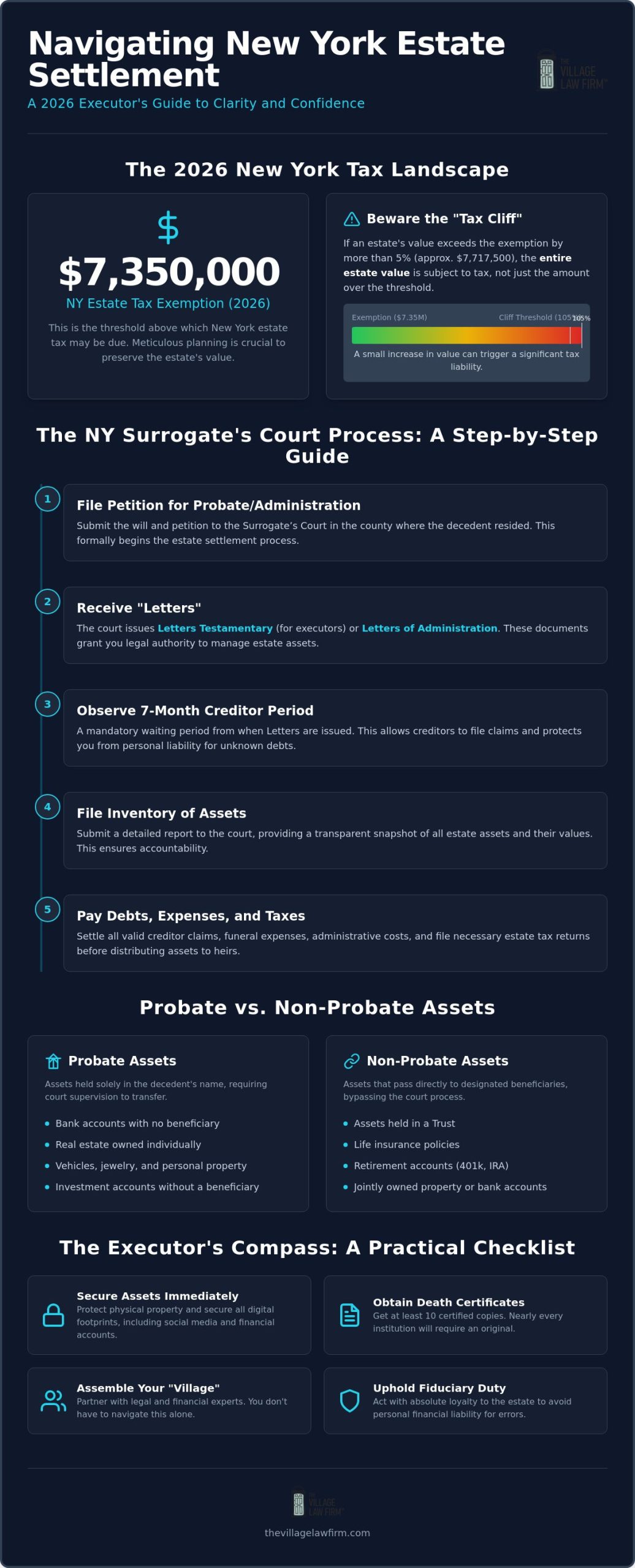
New York’s process is distinct from many other states due to the direct and formal oversight of the Surrogate’s Court. This court system is specifically designed to handle matters related to wills, estates, and trusts, ensuring that the executor or administrator acts in the best interest of the estate and its beneficiaries. A critical first step is distinguishing between probate and non-probate assets. Non-probate assets, such as jointly owned property, life insurance policies with named beneficiaries, or assets held in a trust, can pass directly to their new owners without court intervention. Probate assets are those owned solely by the decedent, which must go through the Surrogate’s Court to be legally transferred.
The Role of the Executor or Administrator
If you are named as the executor in a will or appointed as an administrator by the court, you are assuming a significant fiduciary duty. This is the highest standard of care under New York law, legally obligating you to act with complete honesty, prudence, and loyalty to the estate. This role is not ceremonial; it carries substantial personal liability. Mismanaging assets, failing to pay taxes correctly, or improperly distributing funds can expose you to legal action from beneficiaries and financial penalties. Your lawyer’s role is to act as your steady guide, providing the legal expertise and procedural knowledge to ensure every decision you make is sound, compliant, and protective of the legacy you are entrusted to manage.
Probate vs. Non-Probate: What Actually Settles?
Understanding which assets are subject to court oversight is fundamental to an efficient settlement. Assets that bypass the court system entirely provide immediate access to funds and resources for the family.
-
Non-Probate Assets: These include retirement accounts (like 401(k)s and IRAs) with designated beneficiaries, life insurance proceeds, bank accounts designated as "payable-on-death" (POD) or "in-trust-for" (ITF), and property held in joint tenancy with rights of survivorship.
-
Probate Assets: These typically include real estate owned solely by the decedent, individual bank or brokerage accounts, vehicles, and personal property without a designated beneficiary.
Properly established trusts, particularly revocable living trusts, are a powerful tool for streamlining the settlement process in New York. Assets held within a trust are considered non-probate and can be managed and distributed by a successor trustee according to the trust’s terms, avoiding the time and expense of Surrogate’s Court. This is especially vital for managing the immediate liquidity needs of the family, providing access to funds for living expenses while the formal probate process unfolds. For more on this, see our guide: Revocable Trust Attorney New York: A Guide to Protecting Your Legacy in 2026.
The Legal Architecture of NY Settlement: Steps in the Surrogate’s Court
For assets that must pass through probate, the New York Surrogate’s Court provides a formal structure for the process. While each estate is unique, the core legal steps are consistent. Navigating this architecture requires precision and an understanding of local procedures.
-
File the Petition: The process begins when the nominated executor files a petition for probate along with the original will in the Surrogate’s Court of the county where the decedent resided. If there is no will, a close relative petitions to be appointed as the administrator.
-
Obtain "Letters": Once the court validates the will and approves the petition, it issues "Letters Testamentary" to the executor (or "Letters of Administration" if there is no will). This legal document is the official grant of authority, empowering the individual to act on behalf of the estate—to open an estate bank account, sell property, and access financial information.
-
Notify Creditors: The executor must make a diligent effort to identify and notify all known creditors of the decedent’s passing. New York law establishes a mandatory seven-month waiting period from the issuance of Letters, during which creditors can file claims against the estate. This period protects the executor from being held personally liable for debts that surface after the estate has been distributed.
-
Inventory and Appraise Assets: A meticulous inventory of all probate assets must be compiled and, if necessary, formally appraised. This includes real estate, bank accounts, investments, art, and other valuable personal property. This inventory is a critical document for both the court and for calculating any potential estate taxes.
Navigating the New York Surrogate’s Court
Each New York county’s Surrogate’s Court has its own local rules and culture. The procedures and expectations in Manhattan can differ from those in Brooklyn, Queens, or Westchester. Working with a law firm that has deep experience in these specific courts is invaluable. One of the first and most important practical steps is to obtain multiple certified copies of the death certificate; you will need them for nearly every administrative task, from closing bank accounts to claiming life insurance benefits. The court process also has established procedures for complex situations, such as locating "missing" heirs or resolving disputes when a will is contested, ensuring a legal framework exists to handle family disagreements.
The Timeline of a Typical NY Estate
It is crucial to set realistic expectations. While a straightforward estate might settle in under a year, it is common for probate in New York City to take 9 to 12 months, and sometimes longer if complications arise. Factors that can delay the distribution of assets include will contests, difficulties in selling real estate, creditor claims, or complex tax situations. Conversely, a well-organized estate with clear documentation and proactive legal counsel can move more efficiently. Consistent and proactive communication from your legal partner helps reduce uncertainty for beneficiaries, providing regular updates and a clear understanding of the timeline and what to expect next.
Managing Complexity: Tax Obligations and Cross-Border Assets
Beyond the court process, an executor is responsible for satisfying all of the decedent’s and the estate’s tax obligations. This is one of the most complex areas of estate settlement, where mistakes can be costly. The responsibility includes filing several different types of tax returns.
-
Final Personal Income Tax Return: The executor must file a final federal (Form 1040) and state income tax return for the decedent, covering the period from the beginning of the year until the date of death.
-
Estate Income Tax Return: If the estate generates more than $600 in income during the administration period (e.g., from investments or rental property), an income tax return (Form 1041) must be filed for the estate itself.
-
Federal Estate Tax Return: For 2026, the federal estate tax exemption is quite high. A federal return (Form 706) is only required for very large estates that exceed this threshold.
-
New York State Estate Tax Return: New York has its own estate tax with a significantly lower exemption threshold than the federal government. This is a critical area of focus for many New York estates.
For global citizens and families with assets overseas, managing cross-border inheritance adds another layer of complexity. This involves navigating foreign probate laws, understanding international tax treaties to avoid double taxation, and coordinating with legal and financial professionals in other countries.
The New York Estate Tax in 2026
As of 2026, executors must be aware of the New York estate tax exemption threshold. What makes New York’s tax particularly challenging is the "cliff" effect. If the value of the taxable estate is more than 105% of the exemption amount, the entire estate becomes subject to tax, not just the amount over the exemption. Proper planning and valuation are essential to minimize the tax burden on beneficiaries. This can involve strategies like making certain deductions on the estate tax return versus the estate income tax return. In some cases, issues related to long-term care can also impact an estate, particularly if Medicaid was involved. For more information, read our guide on Medicaid Planning Attorney New York: Protecting Your Assets & Legacy in 2026.
Cross-Border Settlement: Assets Beyond US Borders
When an estate includes assets in another country—a vacation home in Europe, a bank account in Asia, or shares in a foreign company—the settlement process becomes a global affair. The executor, guided by an international estate planning attorney, must coordinate a multi-jurisdictional administration. This requires a deep understanding of foreign inheritance laws, which can differ dramatically from those in the U.S. (e.g., forced heirship rules). An experienced attorney is essential to navigate international tax treaties, ensure compliance with reporting requirements like FBAR, and efficiently consolidate and distribute global assets to the intended beneficiaries.
The Executor’s Compass: A Practical Checklist for 2026
Serving as an executor requires a methodical approach. This checklist provides a high-level overview of the key actions required, moving from immediate needs to long-term administrative duties. For high-net-worth estates in New York, a "white-glove" level of detail is necessary to protect every aspect of the legacy.
-
Secure the Assets: Immediately secure all physical property, including real estate (change locks), vehicles, and valuable personal items. At the same time, begin protecting digital footprints by identifying online accounts and subscriptions.
-
Gather Your Team: No executor should work in isolation. Assemble your "village" of professional advisors, including an experienced estate administration attorney, a tax professional (CPA), and a financial advisor.
-
Open an Estate Bank Account: As soon as you receive Letters Testamentary, open a dedicated bank account in the name of the estate. All estate funds must be kept separate from your personal assets to maintain a clear financial record and uphold your fiduciary duty.
-
Value and Appraise: Obtain formal appraisals for significant assets like real estate, art, jewelry, or business interests from NY-certified appraisers. Accurate valuation is required for tax filings and equitable distribution.
-
Prepare for Final Distribution: Before distributing any assets to beneficiaries, it is wise to have them sign a release and indemnification form. This document confirms they have received their inheritance and releases you from future liability related to your administration of the estate.
Immediate Actions (Days 1-30)
The first month is about securing the estate and gathering information. Your priorities should be locating the original Will and any amendments (codicils), notifying the Social Security Administration and any pension or annuity providers of the death, and beginning the process of organizing the "chaos" of paperwork, from financial statements to digital passwords.
Administrative Actions (Months 2-9)
This period is focused on the core work of administration. You will work with your professional team to liquidate assets as needed to pay debts, expenses, and taxes. Throughout this entire phase, it is absolutely critical to maintain meticulous records of every dollar that comes into and goes out of the estate. These records are the foundation for the final accounting you may need to submit to the court and beneficiaries.
Protecting the Legacy: Why Partnership in Settlement Matters
Serving as an executor is a profound responsibility that often forces you to balance your personal grief with a mountain of administrative work. The emotional toll can be significant, and when family dynamics are complex, the risk of disputes and litigation increases. Professional administration is not just about legal compliance; it is about preserving family harmony.
A partnership with an experienced law firm transforms the experience. The Village Law Firm approach is to replace the anxiety and uncertainty of the process with a structured, orderly plan. We manage the court filings, creditor notices, tax complexities, and beneficiary communications, allowing you to focus on your family. We help transition the estate from the settlement phase to a place of future security for the next generation.
Avoiding the Chaos of Self-Administration
In a complex jurisdiction like New York, the "do-it-yourself" approach to probate can have significant hidden costs. A missed deadline, an incorrect tax filing, or a failure to properly notify an heir can lead to personal liability, court delays, and unnecessary expenses that diminish the value of the estate. A steady, experienced guide ensures every technical detail is addressed correctly, preventing small oversights from becoming major problems. The difference between a streamlined settlement and a contested one often comes down to the quality of the professional guidance the executor receives from the start.
Your Next Steps Toward Resolution
If you are facing the responsibility of settling an estate, your first step is to understand the scope of the task ahead. A preliminary consultation with an estate administration attorney can help you assess the estate’s complexity, identify immediate priorities, and chart a clear path forward. To prepare for your first meeting, gather all the documents you can find, including the will, death certificate, and any recent financial statements. For those who require legal support in other regions, such as in Australia, you can learn more about the services offered by Mohan Yildiz & Associates.
This process does not have to be a source of stress and confusion. With the right partner, it can be a final, dignified act of service to your loved one. For more guidance, our Estate Planning Attorney New York: Protecting Your Legacy in 2026 article can provide a broader perspective on securing a family’s future.
Frequently Asked Questions (FAQs)
How long does the estate settlement process typically take in New York?
For a relatively straightforward estate, the process in New York often takes 9 to 12 months. (If there is just one heir and that heir is also the executor, it can be much shorter.) However, it can take significantly longer if the estate is complex, involves a will contest, has hard-to-value assets, or faces tax complications.
Can an executor be held personally liable for mistakes during estate settlement?
Yes. An executor has a fiduciary duty to the estate and its beneficiaries. If an executor is negligent, mismanages funds, or fails to follow New York law, they can be held personally liable for any financial losses incurred by the estate.
What is the difference between probate and estate settlement?
Estate settlement is the entire process of winding up a person’s affairs after death. Probate is a specific legal component of estate settlement that involves the Surrogate’s Court validating the will and supervising the administration of assets that do not pass directly to beneficiaries by other means (like trusts or joint ownership).
Does every estate in New York have to go through Surrogate’s Court?
No. If all of the decedent’s assets are non-probate (e.g., held in a trust, jointly owned, or with designated beneficiaries), formal court proceedings may not be necessary. Additionally, New York has a simplified process for "small estates" with personal property valued under a certain threshold.
How much does an executor get paid in New York (Executor Commissions)?
New York law sets executor commissions by statute, calculated as a percentage of the value of the estate subject to commissions. The rates are tiered: 5% on the first $100,000, 4% on the next $200,000, 3% on the next $700,000, and so on. The will can also specify a different compensation amount.
What happens if a loved one dies in New York without a will?
This is known as dying "intestate." The Surrogate’s Court will appoint an administrator (usually a close relative) to manage the estate. The decedent’s assets will be distributed according to New York’s intestacy laws, which dictate a specific order of inheritance based on family relationships (spouse, children, parents, etc.).
How are international assets handled during a NY estate settlement?
International assets require a parallel administration process known as ancillary probate or its equivalent in the foreign country where the assets are located. This process is coordinated by an attorney with cross-border expertise to navigate foreign laws, tax treaties, and currency issues to consolidate the assets for the New York estate.
Who pays for the legal fees during the estate settlement process?
The legal fees, as well as other administrative costs (like court filing fees, appraiser fees, and executor commissions), are considered expenses of the estate. They are paid directly from the estate’s assets before any final distributions are made to the beneficiaries.