
What if the legal protections you’ve established in Manhattan mean nothing to a probate judge in London, Paris, or Tokyo? For high-net-worth families, dual citizen estate planning New York is often the only shield against the sudden freezing of international accounts or the complexities of foreign forced heirship laws. It’s natural to feel anxious when your legacy is spread across jurisdictions, especially with the 2026 New York estate tax cliff threatening to tax your entire estate if it exceeds $7,717,500 by even a single dollar.
You deserve a sense of order and security that transcends borders. We’re here to replace that uncertainty with a sophisticated, unified plan that protects your assets and provides your heirs with immediate clarity. This resource guide details how to navigate the $15 million federal exemption, manage the $194,000 annual limit for non-citizen spousal gifts, and ensure your global strategy is both tax-efficient and legally sound in every country you call home.
Key Takeaways
- Master the nuances of dual citizen estate planning New York to ensure your local intent isn’t overridden by foreign civil codes or forced heirship laws.
- Identify the critical legal distinction between residency and domicile to protect your worldwide assets from conflicting international inheritance requirements.
- Prepare for the 2026 federal tax shift by structuring your global wealth to avoid double taxation and the complexities of IRS global reporting.
- Learn how specialized tools like Situs Wills and International Wills create a seamless transition of assets across different legal systems.
- Establish a methodical path for your heirs to access international funds quickly, replacing the typical chaos of cross-border probate with a sanctuary of order.
The Unique Challenges of Dual Citizen Estate Planning in New York
Living a life that spans two nations is a remarkable achievement, yet it introduces a layer of legal friction that a standard New York estate plan simply cannot resolve. For many, the transition from a single-jurisdiction mindset to a global one is born out of necessity. You might own a brownstone in Brooklyn while maintaining a family villa in Italy or a business interest in London. These assets don’t exist in a vacuum. When you hold dual citizenship, your estate exists in a state of legal tension where the laws of New York and your second home may pull in opposite directions. This often leads to assets being frozen by foreign banks or unexpected delays in the New York Surrogate’s Court as judges grapple with foreign documentation. Dual citizen estate planning New York requires more than just a Will; it requires a shield against the chaos of competing legal systems.
The emotional weight of this complexity shouldn’t be underestimated. You’ve worked hard to build a legacy that honors both your roots and your current life in the city. The fear that your heirs might face years of international probate or lose a significant portion of their inheritance to avoidable taxes is a heavy burden. We focus on removing that weight by navigating the complex conflict of law principles that arise when your life spans multiple borders. Our goal is to provide a sanctuary of order, ensuring your global assets remain protected and accessible.
Domicile vs. Residence: Why Your ‘Home’ Matters
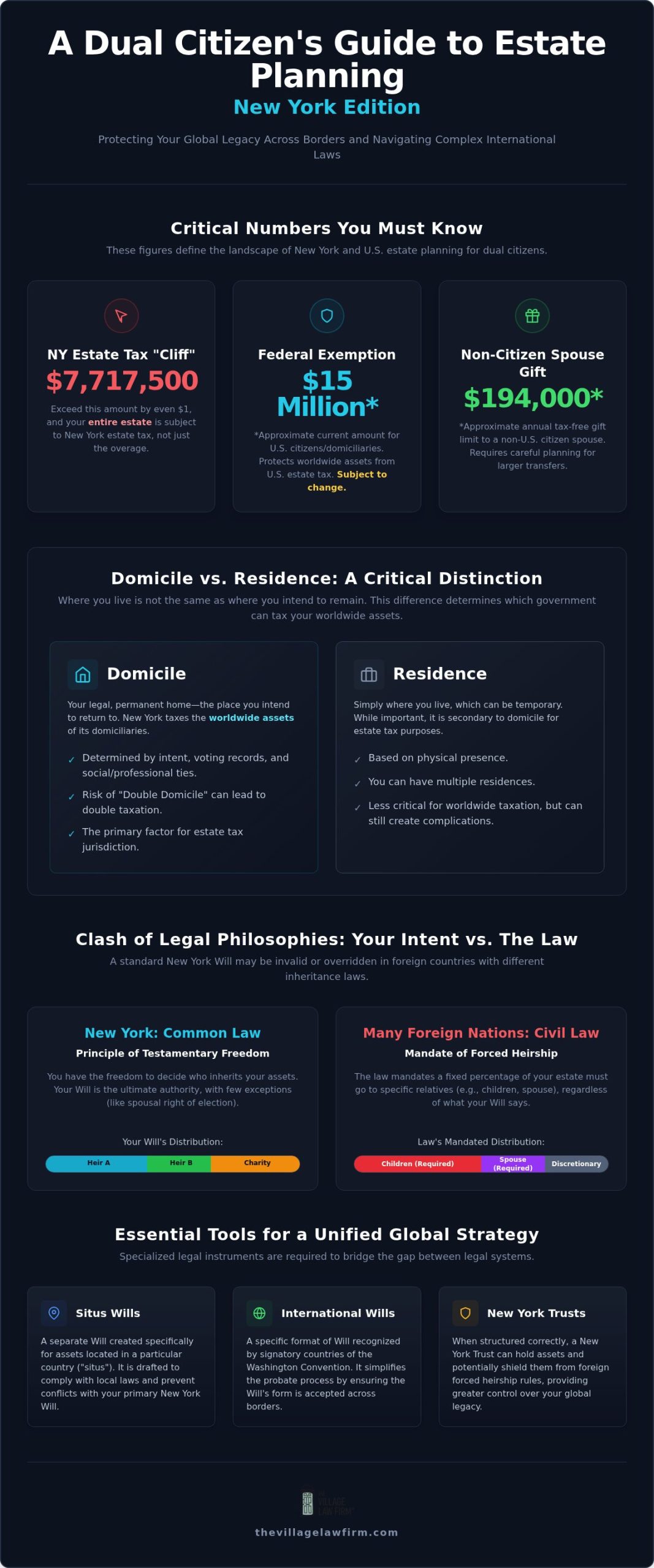
Under New York law, your residence is simply where you live, but your domicile is the place you intend to be your permanent home. This distinction is critical because New York taxes the worldwide assets of its domiciliaries. If another country also claims you as a domiciliary, you risk being “double domiciled.” This can lead to double taxation and conflicting inheritance rules. New York courts determine domicile by examining where you vote, where you keep your most cherished possessions, and where your primary professional ties lie. We help you document these connections clearly to avoid costly disputes.
Why a Standard Will Often Fails Dual Citizens
A standard local Will often lacks the specific language required to be recognized in foreign civil law jurisdictions. Without a coordinated strategy, you may end up with a “split estate” where New York law governs your local condo, but foreign “forced heirship” rules dictate who inherits your overseas property regardless of your wishes. International Estate Planning is the strategic alignment of two or more legal jurisdictions. By integrating dual citizen estate planning New York into your broader financial life, you ensure that your intent is honored in every corner of the world where you hold assets.
New York Common Law vs. Foreign Civil Law: Avoiding the Conflict
New York law celebrates your freedom to choose. Under our common law system, you generally have the right to decide exactly how your assets are distributed. Civil law jurisdictions often do not share this philosophy. In many countries across Europe, Latin America, and Asia, “forced heirship” rules mandate that a specific percentage of your estate must pass to your children or spouse. This creates a direct collision for dual citizen estate planning New York. If your New York Will attempts to disinherit a relative who is protected by foreign law, your heirs could face years of litigation in a foreign court. We work to resolve these tensions before they become a crisis for your family.
The conflict isn’t just about who gets what; it’s about which legal system has the final word. When your life spans borders, you aren’t just managing money. You’re managing two distinct legal heritages. We act as your bridge between these worlds, replacing the anxiety of conflicting laws with a clear, methodical strategy. By understanding the nuances of how foreign jurisdictions view New York documents, we can help you maintain control over your global legacy.
The Reality of Forced Heirship and Succession
In countries like France, Italy, or Brazil, the law views inheritance as a social obligation rather than a personal choice. These mandatory rules can apply to any real estate you own in those countries, regardless of your New York residency. To protect your intent, we often utilize New York trusts. When structured correctly, these trusts can sometimes shield your assets from foreign succession claims. It’s also vital to consider how the U.S. estate tax for nonresidents and citizens impacts these foreign holdings, as tax treaties often play a quiet but decisive role in how property is transferred.
Choosing the Applicable Law for Your Estate
A significant breakthrough for dual citizens is EU Regulation No. 650/2012, commonly known as Brussels IV. This regulation allows you to choose the law of your nationality to govern the succession of your assets across most of the European Union. By including a specific “Choice of Law” clause in your international documents, you can often bypass foreign forced heirship in favor of New York’s flexibility. However, your New York fiduciaries must be granted explicit authority to act abroad. Without this precision, your executors may find themselves powerless to manage your international accounts. Our firm provides the white-glove expertise needed for cross-border estate administration, ensuring your plan remains a sanctuary of order in a complex world.
The 2026 Tax Landscape: Protecting Your Global Wealth
The IRS casts a wide net. As a U.S. citizen, your global assets are subject to federal estate tax regardless of where those assets are located or where you’re living at the time of your passing. For those engaged in dual citizen estate planning New York, this reality often creates a sense of financial vulnerability. The 2026 tax landscape is particularly complex. While the federal exemption has reached $15 million per individual, the New York state exemption remains much lower at $7,350,000. This gap creates a significant trap. If your estate exceeds the New York “cliff” of $7,717,500, the state taxes the entire amount, not just the overage. We focus on bridging this gap, ensuring your global wealth isn’t eroded by avoidable tax liabilities.
One often overlooked hurdle in international administration is IRS Form 5173, the Transfer Certificate. Without this document, foreign banks and transfer agents may refuse to release U.S. assets to your heirs. It’s a procedural bottleneck that can freeze an estate for months. We act as your guide through these technicalities, ensuring that the necessary paperwork is in place to keep your legacy moving forward. By coordinating with foreign jurisdictions early, we help you avoid the stress of frozen accounts and administrative gridlock.
Navigating the 2026 Exemption Sunset
The current $15 million federal exemption represents a unique window of opportunity. For dual citizens with high-value global portfolios, this is the time to consider proactive gifting strategies. You can utilize the $19,000 annual gift exclusion or the $194,000 annual limit for non-citizen spouses to transfer wealth tax-free. It’s about creating a sanctuary of order for your wealth. Working with an Estate Planning Attorney New York: Protecting Your Legacy in 2026 allows you to align your international holdings with these shifting federal and state thresholds before the legal landscape changes again.
Avoiding the Double Taxation Trap
Double taxation is a primary concern for those with assets in two countries. You don’t want your legacy eroded by “foreign death taxes” simply because your assets are located in a jurisdiction with aggressive tax laws. Fortunately, the U.S. has entered into estate tax treaties with several nations to mitigate this risk. These treaties, combined with the Foreign Tax Credit, provide a methodical way to offset taxes paid to a foreign government against your U.S. liability. Meticulous record-keeping is your best defense. Accurate, up-to-date valuations of your foreign property are essential to ensuring you don’t pay more than your fair share to any government. A comprehensive approach to estate planning for foreign assets ensures that every overseas holding is accounted for and protected against double taxation before the 2026 thresholds shift.
Essential Tools for Dual Citizen Estate Planning
A single legal document is often insufficient for a life that spans two countries. For your legacy to remain a sanctuary of order, your planning must account for the specific formalities of each jurisdiction. Effective dual citizen estate planning New York requires a coordinated ensemble of tools designed to speak the legal language of both your home in the city and your assets abroad. This isn’t just about translating words; it’s about translating intent. Without the right instruments, your family could face a vacuum of authority, leaving them unable to manage bank accounts or make critical healthcare decisions during a crisis.
The International Will, established by the Washington Convention, is one of the most powerful tools at your disposal. It provides a standardized format that signatory countries are required to recognize, significantly reducing the friction of cross-border probate. However, even an International Will has its limits. You also need local Powers of Attorney and Healthcare Directives that meet the specific statutory requirements of each country. A New York Power of Attorney is a robust document, but a bank in Madrid or Zurich may reject it if it doesn’t mirror their local legal customs. We ensure your authority is recognized wherever your footprint lands.
The ‘Situs Will’ Strategy
In many cases, the most methodical approach involves creating “Situs Wills.” This strategy uses a New York Will to govern your U.S. assets and a separate foreign Will to manage your overseas property. This separation prevents a bottleneck in the New York Surrogate’s Court and allows for faster asset distribution. It’s vital that these documents are drafted in tandem to ensure they don’t accidentally revoke each other. This proactive coordination is a key part of Ancillary Probate in New York: A 2026 Guide to Managing Out-of-State Assets, helping you avoid the administrative gridlock that often haunts international estates.
Trusts in an International Context
While a Revocable Living Trust is a cornerstone of New York planning, it can be a liability in certain civil law jurisdictions. Many countries don’t recognize the concept of a trust, which can lead to your assets being taxed as a direct gift or even being subjected to forced heirship rules. We take a white-glove approach to structuring your trusts, often coordinating with foreign counsel to ensure your New York planning doesn’t trigger unexpected “gift taxes” abroad. It’s about building a bridge between two systems that often speak in contradictions. If you’re ready to replace this complexity with a clear, protective strategy, our team is here to provide the international estate planning expertise your global legacy requires.
Securing Your Legacy with The Village Law Firm
Legacy planning is about more than just legal documents; it’s about the profound peace of mind that comes from knowing your life’s work is safe. For the busy professional, dual citizen estate planning New York requires a partner who possesses both the technical precision of international law and the emotional intelligence to understand a global family. We don’t just draft Wills. We build a protective shield around your worldwide assets, ensuring that your achievements aren’t dismantled by bureaucratic friction or international tax traps. Our approach is fundamentally different. We act as your steady urban guide, replacing the noise of conflicting jurisdictions with a methodical, white-glove service that values your time and your family’s security.
Transparency and directness are the cornerstones of our practice. We believe that complexity should be managed by your counsel, not felt by your family. By providing a sanctuary of order in a fast-paced world, we help you transition from the anxiety of global uncertainty to a state of absolute clarity. Our firm combines the meticulousness of a high-end boutique with the authoritative expertise required to navigate the most intricate cross-border challenges. We’re here to walk alongside you, ensuring that every detail of your international footprint is accounted for and protected.
A Calming Path Through Complex Law
The complexity of international law can feel like a constant storm, but we provide the sanctuary. Our process begins with a comprehensive audit of your global footprint. We identify where your assets are located, how they’re titled, and where they might trigger conflict of law issues. This meticulous attention to detail ensures that no account is left vulnerable to foreign freezing or unexpected probate delays. If your situation involves helping others across borders, you can learn more about How to Administer a US Estate for a Foreign Beneficiary: A 2026 Guide. We aim to remove the stress of forced heirship and replace it with a sense of security that spans continents.
Your Partner in Global Asset Protection
High-net-worth dual citizens trust us because we prioritize the partnership over the transaction. We understand that your legacy is a living thing, evolving as you acquire new assets or as your family grows across borders. This partnership-based mindset means we’re with you for the long term, adapting your strategy as the 2026 tax thresholds shift or foreign regulations change. During your initial global strategy consultation, we’ll map out a clear, transparent path forward. You’ll leave with a defined plan and the confidence that your interests are protected by a firm that combines legal excellence with deep human compassion. Schedule a consultation today to secure your family’s future across every border you call home.
A Sanctuary of Order for Your Global Footprint
Your legacy is a bridge between two worlds. It shouldn’t be a source of stress for your heirs. By aligning your New York intent with international legal requirements, you prevent the chaos of frozen assets and conflicting inheritance laws. We’ve seen how specialized tools and a deep understanding of the 2026 tax landscape can shield your wealth from double taxation and the New York estate tax cliff. Replacing complexity with clarity is the most valuable gift you can leave behind. It’s about ensuring that your life’s work remains a source of stability rather than a legal burden.
Masterful dual citizen estate planning New York is about more than just numbers; it’s about the security of a well-defined journey. The Village Law Firm provides specialized international planning for New York families and sophisticated asset protection for high-net-worth individuals. We bring expertise in complex cross-border probate to ensure your transition is seamless. Schedule a calming, white-glove consultation for your international estate plan today. You’ve worked hard to build a life across borders. Let’s ensure it remains a lasting, protected sanctuary for the ones you love.
Frequently Asked Questions
Do I need a separate Will for every country where I own assets?
Not necessarily, but it’s often the most methodical approach for real estate in civil law countries. For dual citizen estate planning New York, coordinating separate Situs Wills ensures each document complies with local formalities without accidentally revoking the other. This prevents administrative gridlock and speeds up the distribution of your global legacy.
Can a foreign executor manage my New York probate process?
Yes, but the New York Surrogate’s Court imposes specific restrictions. A non-resident alien can generally only serve as an executor if they serve alongside a New York resident co-executor. Courts may also require the foreign executor to post a bond, which can be an expensive and time-consuming hurdle. We often recommend appointing a local fiduciary to maintain a sense of order and efficiency.
How does New York law handle inheritance for children living in another country?
New York law allows you to leave assets to beneficiaries regardless of where they live. However, the logistics of transferring those funds can be complex due to international banking regulations and tax reporting. We help you navigate these procedural bottlenecks, such as the 2026 wait times for IRS transfer certificates, to ensure your children receive their inheritance without unnecessary stress or delays.
What is the difference between an International Will and a Situs Will?
An International Will follows a standardized format recognized by countries that signed the Washington Convention. A Situs Will is a localized document designed specifically for assets in one particular jurisdiction, such as a villa in Italy. While an International Will offers broad recognition, a Situs Will provides the technical precision needed to navigate unique local inheritance laws and tax requirements.
Will my foreign assets be subject to New York estate tax?
Yes, if you are a New York domiciliary, the state taxes your worldwide assets. This includes everything from foreign bank accounts to overseas real estate. In 2026, the New York exemption is $7,350,000. If your global estate exceeds the $7,717,500 “cliff,” the entire amount becomes taxable, making meticulous dual citizen estate planning New York essential to protecting your wealth.
What happens if my foreign country doesn’t recognize my New York trust?
If a foreign jurisdiction doesn’t recognize your trust, it may treat the transfer of assets as a direct gift or subject them to “forced heirship” rules. Many civil law countries don’t have a legal equivalent to the U.S. trust. We coordinate with foreign counsel to structure your plan so it respects both New York’s flexibility and the mandatory legal requirements of your other home country.
How can I avoid my family’s US bank accounts being frozen after I pass away?
The most effective way to prevent frozen accounts is to hold them in a Revocable Living Trust or use “Transfer on Death” (TOD) designations. These strategies allow assets to pass directly to your beneficiaries without waiting for the Surrogate’s Court to grant probate authority. This provides your family with immediate access to funds, replacing potential chaos with a sanctuary of financial stability.
Does EU Regulation 650/2012 apply to me if I live in New York?
Yes, this regulation allows you to choose the law of your nationality to govern the succession of your assets located within participating EU countries. Even as a New York resident, you can include a “Choice of Law” clause in your Will to bypass foreign forced heirship rules. This ensures that your New York intent remains the final word on your European property.